Somebody had something wrong and it made it look as if the water at Chadds Ford Elementary School was bad. It’s not, though. The bogus information was the fault of a typo — a misplaced decimal point.
According to Superintendent of Schools John Sanville, the water is fine.
In an email to parents, Sanville said:
“You may have seen a story stating that the water at Chadds Ford Elementary School has unsafe levels of lead — this simply is not true – our water is safe. The Environmental Protection Agency requires us to test our water every three months — the official results of this testing have given Chadds Ford Elementary School water a clean bill of health. It appears that a typographical error got Chadds Ford ES mistakenly placed on an EPA violation list.
“The test results cited in recent media articles are from September of 2013 — I have included the analytical report from that testing. The report indicates a reading of .012 mg/L (12 parts per billion) — well within healthy guidelines as determined by the EPA. However, the EPA report incorrectly indicates a reading of .12 mg/L (120 parts per billion) — this is simply an error that became a story for some media outlets.
“Despite the misplaced decimal point and shoddy investigative reporting – Chadds Ford ES water is completely safe. We will continue to regularly test our water to ensure that it is clean and healthy for all.
“If you have any questions please do not hesitate to contact me directly,” he writes.
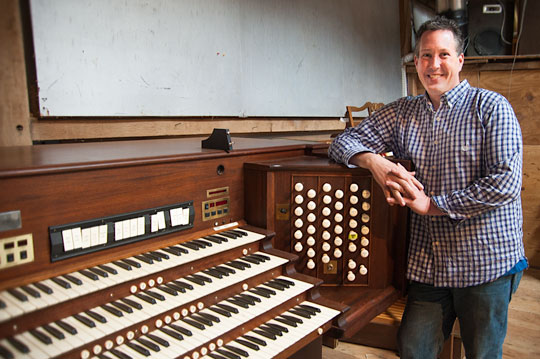
Randell Spackman, with one of the organ consoles, wants to start holding pipe organ concerts in his barn at Thornbury Farm. How long it will take to get the entire organ working is uncertain.
The sound of pipe organ music might begin wafting through the air along the Brandywine Battlefield sometime this year.
Randell Spackman, owner of Thornbury Farms, has four sets of pipes, two controllers, and a pair of air blowers in his barn and is eager to put them all together and have some organ music concerts. He said he’s already been talking with people at the Sanderson Museum in the hopes of having a square dance at his barn this summer.
Chris Sanderson used to have square dances there, and Sparkman sees this as a way to bring back more of the farm’s history. The farm was also a part of the battlefield during the 1777 Battle of Brandywine.
Getting the organ up and running is not a sudden passing fancy for Spackman. Coming into possession of the individual pieces has happened over time and is based on his love of the sound.
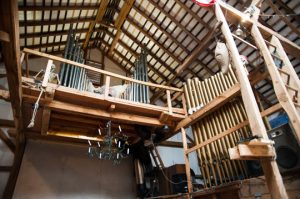
Two sets of pipes are in the rafters. Another two still need to be installed.
“I always had a love for pipe organs, the complexity of them. The music [tonal range] was always so full. It has a depth that speakers can’t bring out,” he said.
Spackman, like his late father, Tom, before him, has an abiding interest in preserving the history of the farm and the region, and his interest in the organ falls into that category.
“As I learned about them, I became more inquisitive, and I learned about some organ parts that were going to be cut up and made into tables. I bought them to save them,” Spackman said.
With a little help from friends and others who share his enthusiasm, Spackman formed Thornbury Pipe Organ, a nonprofit organization of volunteers who will refurbish and reassemble all the equipment to bring the full rich sound back to life in a place that’s not a normal concert hall.
“My idea is to have concerts, events, and just have people be able to play the organ here in a different atmosphere…The people who learned about me wanting to have my own pipe organ really identified with that.”
As word spread through a variety of organizations, Spackman learned of other pieces’ becoming available, how they work and what work would be needed to get those various elements working together.
One of the consoles — the part that contains the keyboard and other controls — came from a church in Georgia. That one piece alone weighs a half a ton, he said, and will help control the entire organ, which, he added, will actually be four organs in one.
A second console was designed to play music during the old silent movie days, something Spackman said he wants to be able to do at the barn: show old silent movies and have someone play the organ during the showing.
The four organs are the four sets of pipes, Spackman explained, and they are the valuable part of the organ.
“The consoles are how you work the pipes. They’re the interface. But the soul of the organ is the pipes.”
He has more than 5,000 pipes, some as small as a pencil, others 16 to 18 feet tall, he said.
“Each organ has a story, like a baby book, and I think I’m only the steward,” Spackman said. “A couple of people wanted to buy parts of them, but I don’t want to do that because I want the organs’ integrity to be whole. Once they’re split up, they’re gone forever.”
And what he has, he said, is unique.
“There are only about seven organs like this in the country. It’s very rare to have this eclectic type of combination,” he said.
One of the four organs dates back to the 1880s. That will be incorporated with the other pipes, one dating back to the 1920s, and another that was made in 1918. One set of pipes came from the old Prince Theater in Philadelphia, he said.
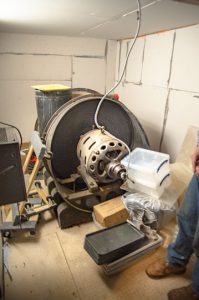
A five horsepower blower needs to be wired and connected to provide a steady stream of air to the organ’s pipes.
Spackman bought pieces as they became available, a process he likened to buying a car one piece at a time, a tire today, a fender tomorrow.
In getting everything ready for the types of concert experience that Spackman envisions, the volunteers of Thornbury Pipe Organ would have a lot to do. He said there’s a lot of wires that need to be soldered to valves, thousands of pipes to be cleaned and other pieces sorted, among other things. They also need to get a five-horsepower air blower to work properly so it can deliver the right amount of air through the pipes.
When asked how long that might take, Spackman laughed and referenced an old TV commercial, “That would be like asking how many licks you need to get to the center of a Tootsie Pop.”
After the joke, he said getting everything up and running together would take several years.
One point that can’t be avoided is economics. It takes money to get it all done. Spackman said the word is getting out and that had resulted in some donations. He speculated that it would take about $100,000 to get the organ operational. Replacing it, though, would cost about $2 million, he said.
Donations are coming in, he said, and more people are offering to help with the work. That could shorten the time frame, but Spackman can’t yet say how much time can be saved.
The next step for Thornbury Pipe Organ, he said, is to become “a consistent volunteer organization with people who are passionate about preserving our musical heritage and mechanical music.”
Anyone interested in helping out or learning more by taking a tour should contact Spackman at www.thornburyfarmcsa.com or by phoning 610-793-2933.
Active threat and reunification on a school campus will be addressed at the bi-annual Safe Schools Summit on Thursday, April 7.
From 5 to 8:30 p.m., school administrators, school board directors, law enforcement, teachers and parents are invited to learn more about responding to and recovering from an active shooter scenario. The Safe Schools Summit will be held in the auditorium of Phoenixville High School, 386 City Line Avenue, Phoenixville, 19460. The event will also be available for live streaming on CCiTV (ccitv.cciu.org), said a press release from the Chester County Intermediate Unit.
The evening will feature keynote speakers from a variety of law enforcement agencies and school officials. The speakers will be followed by a moderated panel discussion with audience participation.
The summit will focus on several key areas of active threat scenarios, including: how police respond to an active shooter situation; the importance of school communications plans; and the necessity of creating follow up procedures to assist with parent/guardian and child reunification, the release said.
Adrienne Phillips Wickersham, 95, of Kennett Square, died of natural causes on Sunday, March 27, at her home in Kendal at Crosslands. The older of two children, Adrienne was born to Adrienne (McMahon) and Edmund Phillipson April 27, 1920 in New York, New York. She attended Houghton College in Houghton, New York, where she earned a Bachelor of Science degree in communications engineering. Upon graduation, she was employed by the United States Army Signal Corps as a transmission engineer before taking a similar position with ITT, where she also held positions in systems engineering and publications administration for various ITT companies and later Computer Science Corporation.
In 1946, she married Wilfred H. Wickersham, and together they raised two sons, William and Edmund, in Nutley and Upper Saddle River, New Jersey. Upon retiring from ITT, Adrienne enjoyed a variety of jobs in and around her community. She was administrator of the 1970 Census of Bergen County, New Jersey, and was manager of the Upper Saddle River Swim and Tennis Club, of which she was a founding member. As one who enjoyed singing, Adrienne was a long-standing member of Sweet Adelines International, one of the world’s largest a cappella singing organizations for women.
In 1977, Adrienne and Wilfred moved to Kendal Crosslands, a continuing care retirement community (CCRC) located in Kennett Square, Pennsylvania. As founding residents, they embraced the CCRC concept and helped shape the growth and feel of their new community. She and her husband traveled extensively during their retirement and introduced an entertaining photography slide series at Crosslands called “The World Around Us,” which was always well attended. Over the years, Adrienne held several volunteer roles at Crosslands, such as manager of the Sunflower Shop, manager of the swimming pool, and member of the Residents’ Association, food committee, and Crosslands Chorus. Much later in life, she was thrilled to become a grandmother and thoroughly enjoyed her time spent with Ed and his family. For the last several years, Adrienne had the distinction of being the last living founder of Crosslands.
Adrienne is predeceased by her husband and sons. She is survived by her granddaughters, Kate and Elena; her daughter-in-law, Lisa; and her late brother Jack’s children, Larry, Beckie, and Jeff Phillips.
A memorial service to celebrate Adrienne’s life and generous spirit will be held at Crosslands, 1660 East Street Road in Kennett Square, at 2 p.m. on Saturday, April 23.
In lieu of flowers, donations may be made to the World Wildlife Fund (worldwildlife.org/donate) or an environmental charity of one’s own choice
Joanne Parsons Barker, 85, of Kennett Square, died Friday, April 1, at Neighborhood Hospice in West Chester. She was the wife of Wade H. Barker, with whom she shared 64 years of marriage.
Born in Kennett Square, she was the daughter of the late Newton and Ruth Loller Parsons..
Mrs. Barker was a tour coordinator at Longwood Gardens, Kennett Square, retiring in 1985 after 21 years of service.
She was a member of the Hamorton United Methodist Church.
Mrs. Barker enjoyed music, watching sports on TV, going on vacation to the beach with her family, and especially being with her family and friends.
In addition to her husband, she is survived by one son, David S. Barker of Kennett Square; one daughter, Dianne B. Bramble of West Grove; one sister, Ramona Waltz of Kennett Square, two grandchildren and one great granddaughter.
She was predeceased by one sister, Nan Parsons.
You are invited to visit with her family from 1 to 2 p.m. on Saturday, April 9, at the Hamorton United Methodist Church, 1052B East Baltimore Pike (Route 1), Hamorton, PA 19348. Her memorial service will follow at 2. Burial will be private.
In memory of Joanne, a contribution may be made to the Hamorton United Methodist Church at the above address.
Marie Ethel Mutter Janton, 79, of Kennett Square, died peacefully on Thursday, March 31, at her home with her husband. She was the wife of Frank Janton with whom she shared 60 years of marriage.
Born in Philadelphia, she was a daughter of the late Frank and the late Anna (Vitale) Mutter and predeceased by her brother Frank Mutter.
Marie was an accomplished pianist and cellist. She enjoyed 25 years as a Cellist with the Delaware County Symphony. She had also performed at the Academy of Music in Philadelphia. She was a recent recipient of the Presidential Humanitarian Award from Neumann University. She will be awarded an honorary Doctorate Degree with her husband conferred by Neumann University at a future commencement.
She was a member of West Catholic Girls Alumnae and a member of the Neumann University Scholarship Gala Committee for the past decade. She shared life membership with her husband at the Union League of Philadelphia. She enjoyed traveling and visiting her four children in various locations throughout the US.
Survivors include, in addition to her husband, three sons, Dr. Francis J. Janton (Susan) of Harrisburg, Stephen R. Janton (Robert Jackson) of Ashville, N.C. and Thomas M. Janton (Clare) of Kennett Square, a daughter, Marie J. DiPrinzio (Eugene) of Chadds Ford, and seven grandchildren, Stephen, Matthew, Thomas, Sandra, Christine, Laura and Marco.
You are invited to visit with Marie’s family and friends from 6-8 p.m. Tuesday, April 5, at the Kuzo & Grieco Funeral Home, Inc. (610-444-4116) 250 W. State St. Kennett Square, PA 19348 and from 10-11 a.m. Wednesday, April 6 at St. Gabriel of the Sorrowful Mother, 8910 Gap Newport Pike, Avondale PA, 19311. Her Mass of Christian Burial will follow at 11 a.m. Wednesday, at the church. Interment will be in St. Patrick Cemetery, Kennett Square.
Contributions in her memory may be made to Neumann University, One Neumann Drive Aston, PA 19014. To view her online tribute and to share a memory with her family, please visit www.griecocares.com.
Kennett Square is the smallest town in the U.S. that supports a professional symphony orchestra, according to Kennett Symphony Board President Paul Merluzzi.
He told a sold-out crowd at Longwood Gardens of the organization’s debt to supporters to keep the orchestra going and growing. The occasion was the spring concert Sunday, April 3, which included a salute to a longtime supporter, the late F.M. Mooberry.
Kennett Square Mayor Matthew Fetick told the audience that the ticket sales for Kennett Symphony are up this year for its 75th anniversary celebration. He told of plans to reach a broader audience. This anniversary year marked the first time there was a free concert – at the Mushroom Festival in September. According to Fetick, 50 percent of the listeners had never heard a live symphony orchestra before.
Another orchestra outreach is the personal interaction offered by conductor Michael Hall. For the concert, Hall offered a pre-concert discussion of the works to be played. More than half of the audience showed up an hour early to hear the pre-concert presentation.
Hall believes knowing about the work can enhance your appreciation. He likened learning about the musical pieces to when you have earphones to tell you about a piece of art you are looking at. Of course you can enjoy looking at the picture, but learning more about it can enhance the experience. After the performance, one of the members of the audience said that she had heard Beethoven’s Symphony No. 5 many times, but having heard Halls description of the different movements gave her new appreciation.
Hall described Beethoven’s symphony as expressing the struggle between darkness and light, minor keys finally resolving to C major. Hall played recorded excerpts and jumped to the keyboard to illustrate different passages. He feels that the trauma of Beethoven’s encroaching deafness made the composer dig deeply, resulting in one of the most appreciated symphonies of all time.
The concert opened with “Clair de Lune” played by Janet Witman on the harp in honor of FM Mooberry. A guest violin soloist, Margaret Dziekonski, played Mendelssohn’s “Violin Concerto in E Minor, Op. 64.” After intermission, Beethoven’s “Symphony No. 5” was played.
The concert was the first time the Kennett Symphony had performed in the Conservatory at Longwood Gardens. The symphony’s outdoor concerts at Longwood Gardens have been a regular event in August for many years, but the conservatory presented new performance challenges. According to Hall, “Every venue has its own challenges.” Hall likes the acoustics of the conservatory, although rehearsals during the day can be a problem with the sun shining through the glass ceiling. One of the musicians had to wear sunglasses for the rehearsal.
The venue provided guests with a treat for another sense not usually found at a musical performance. The lilies were in full bloom and fragrance in the conservatory.
The Violin Concerto was appreciated with a standing ovation, as was the Beethoven symphony. Descendants of one of the Kennett Symphony founders, Ray Ott, were in the audience.
Artists converse with the audience after the concert. From left to right: Concertmaster Eliezer Gutman, Conductor Michael Hall, Soloist Margaret Dziekonski, and Principal Oboe Terence Belzer
The second part Hall’s outreach came after the concert. The audience was invited to stay and talk to the conductors and a few performers. About one third of the audience stayed. They were intrigued by the guest soloist. Still a graduate student at The Royal Academy of Music, London, Dziekonski seemed young to demonstrate technical skill and perform with such poise. Hall said he came to know about Dziekonski from Timothy Blair, Dean of West Chester Music.
In the post-concert interview, Dziekonski was asked how long it took for her to learn the Mendelssohn concerto she had played. She said she first played the piece two years ago, but preparation for this concert took three months. West Chester resident, Pam Hesler, said that she knows Dziekonski’s future in-laws and that when Dziekonski is in town she practices five hours a day. Hesler said the concert was “fantastic.”
Dziekonski plays a J.B. Vuillaume, which was made in 1860. The instrument is on loan from the Royal Academy of Music.
The symphony’s 75th anniversary celebration will be Saturday, June 11, at the Stone Barn in Kennett Square. Tickets will go on sale mid-April. http://www.kennettsymphony.org/
The next concert is “Postcards From Abroad” which will be held in the outdoor amphitheater at Longwood Gardens on Aug. 13. Ticket price includes the concert, free parking, all day admission to Longwood Gardens on the day of the concert, and access to Nightscape: A Light and Sound Experience at Longwood after the concert.
Emily Myers has lived and worked in Chadds Ford for over thirty five years. She founded the parent company of Chadds Ford Live, Decision Design Research, Inc., in 1982. ChaddsFordLive.com represents the confluence of Myers' long time, deep involvement in technology and community.
Myers was a founding member of the Chadds Ford Business Association and currently serves on its board of directors. Her hobbies include bridge, golf, photography and Tai Chi.
She lives with her husband, Jim Lebedda, in Chadds Ford Township.
June A. Milam, 74, of Landenberg, died Friday, April 1, at the Chester County Hospital. She was the wife of Pedro Lopez, who died in 2015, and with whom she shared 42 years of marriage.
Born in Elkton, Md,, she was the daughter of the late Raymond and Martha Bullock Holmes.
June was a custodian at the Kennett School District for 18 years, retiring in 2003. After her retirement, she worked for six years as an aide at the Pocopson Home.
She enjoyed shopping, flower gardening, taking care of others and being with her family and friends, especially her grandchildren.
June is survived by three sons, Eddie Benson Milam of Avondale, Bryan Ronald Milam of Maryland and Pedro Lopez, Jr. of Avondale; four daughters, Terry Velazquez and her husband Isabelino of Kennett Square, Dannette Rentas of Nottingham, Donna S. Milam of Landenberg, and Carmen Lopez Colon of Oxford; one sister, Celia Holmes of Elkton, Md.; 17 grandchildren and 20 great-grandchildren.
She was predeceased by one son, John Benson Milam; one sister, Ruth Ann Holmes, and one brother, Clyde Conard.
You are invited to visit with her family and friends from 11a.m. to 1 p.m. Wednesday, April 6, at the Kuzo & Grieco Funeral Home, 250 West State Street in Kennett Square. Her funeral service will follow at 1. Burial will be private.
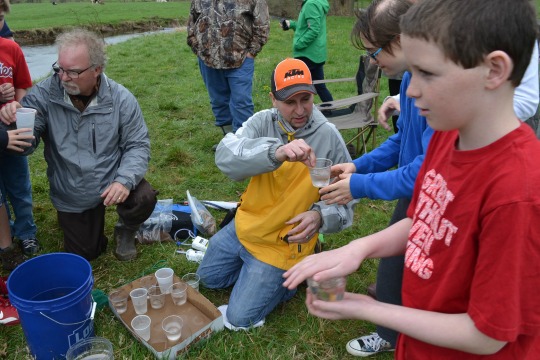
Pocopson teachers Andy Lefko (from left) and Ryan Stephens distribute brook trout fingerlings to students in Dave Lichter's fifth-grade class so they can release them into Pocopson Creek.
For five months, the relationships intensified, spawning affection as well as insight.
After releasing the young trout, a group of fifth-graders from Dave Lichter’s class dig up some worms to feed the bigger fish in Pocopson Creek.
But for fifth-graders at Pocopson Elementary School, breaking up wasn’t so hard to do on Friday, April 1 – even when the results turned from fun to fatal.
“He’s swimming away to a better life,” one girl exclaimed as her fingerling brook trout darted away in the Pocopson Creek.
“Mine died,” one boy lamented. “A bigger fish ate him right after I let him go.”
But the day’s packed schedule allowed no time for mourning. Besides, the earlier rains had unleashed a plethora of worms, and the excited students from Dave Lichter’s class quickly scooped them up and dropped them into the water. Periodically, a splash marked the spot where a larger fish enjoyed the feast.
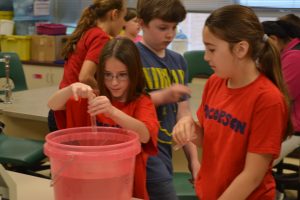
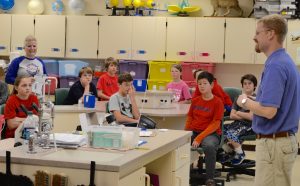
Students in Laurie Swisher’s fifth-grade class carefully prepare water samples from the Pocopson Creek for testing.
The exercise was but one facet of Trout in the Classroom, an interdisciplinary national program in which students learn about cold-water conservation while raising brook trout from eggs to fingerlings in a classroom aquarium. Pennsylvania’s TIC program exists through a partnership between Pennsylvania Council of Trout Unlimited and the Pennsylvania Fish and Boat Commission.
At Pocopson, the fifth-graders enjoyed a full morning of fish-related activity, rotating through four stations. The half-hour sessions included a presentation by the Stroud Water Research Center, a demonstration of fly-tying, fish-related art projects, and the coveted release.
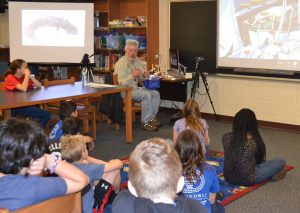
Students in Barbara Williamson’s fifth-grade class listen as Terry Peach from A Marblehead Flyfisher Inc. demonstrates fly-tying.
Laurie Swisher’s class began its day by exploring the science of healthy waterways. Steve Kerlin, Stroud’s director of education, involved the students in testing the water at the site where the fingerlings were being set free. He received assistance from Dave Dickens, who retired in 2005 as Unionville High’s principal and now enjoys working part-time with Stroud.
Kerlin told the students he was very impressed with their success in raising the fish. “Yours are bigger, and you have more than we do [at Stroud],” he said, acknowledging that Stroud’s collection experienced a setback during holiday vacations.
As teacher Terry Swisher (top, left) looks on, Steve Kerlin (right) from the Stroud Water Research Center explains water-testing procedures to her students.
At Pocopson, the custodial staff ensured that the baby fish were fed when school wasn’t in session, but that didn’t mean that the experience was trouble-free. “Our fish had a problem with the nitrate level,” one girl volunteered.
Kerlin explained why that’s not unusual and how to remedy it, describing the damage that fertilizer runoff can cause. He also led the students through a series of tests from pH to nitrites, watching as the young scientists assessed their results.
Nearby in the library, Terry Peach from A Marblehead Flyfisher Inc. in Centreville, Del., showed students how to create lures from natural materials that mimic nature, thereby fooling the fish – but not for long. “We always do catch and release,” he said. “We want them to live so they get to fight another day.”
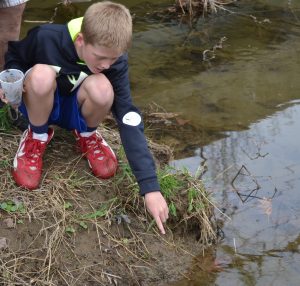
A student in Dave Lichter’s class points to a water spider darting along the creek.
As Peach worked his artistry, describing the process as he added rabbit fur to one lure, the students got the benefit of two screens. One displayed an image of the particular insect Peach was replicating, and one magnified his work space so that all the students could see exactly what he was doing. Once he finished a lure, he passed it around so students could view its intricacy up close.
Fifth-grade teacher Linda Bowman said she enjoyed Peach’s ability to connect with the students. “It’s so fun to watch,” she said. “He’s so engaging; the kids are mesmerized.”
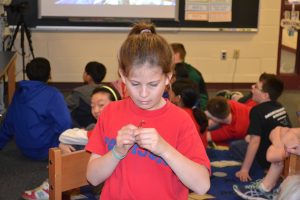
Students work diligently on their foil fish art, which will be displayed at the school.
At the school’s Cool Bean Café, groups of fifth-graders were equally fixated as they put finishing touches on their foil-punch fish drawings. They also snacked on goldfish crackers. “Wasn’t that a great idea?” asked Lichter, who credited his colleague, fifth-grade teacher Barbara Williamson, for providing the tasty, themed treat.
Eileen Day, one of the parents assisting with the art activities, said her daughter Maddie had been eagerly awaiting release day. “She’s been talking about this since the eggs came,” her mother said.
A student in Linda Bowman’s class examines one of Terry Peach’s intricate creations.
Lichter said the students managed to raise about 200 fingerlings from the 317 eggs that arrived in November, an exciting achievement. During that time, the students monitored the temperature, acidity, ammonia, nitrate and nitrite levels of the water.
Dave Macaleer, a member of the Valley Forge chapter of Trout Unlimited, said he valued the program’s positive impact. “It’s never too early to teach kids about the importance of conservation and the importance of our environment,” he said.
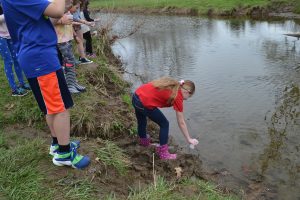
After releasing their fingerlings into the Pocopson Creek, students have no trouble finding other areas of interest along the water.
Plus, it was gratifying to see the results as the students gently coaxed their fish into the creek. “Basically we’re here for the kids,” Macaleer said. “Release day is a lot of fun.”
A few minutes earlier, he had watched as students eagerly swarmed the fish distributors: Ryan Stephens, a fourth-grade teacher, and Andy Lefko, the fifth-grade learning support teacher.
“Be careful: We’ve had some jumpers,” warned Stephens as he handed each student a small plastic cup containing a couple of the approximately two-inch fingerlings. Some students even gave them names, covering the top of the container, just in case a fish got feisty.
Students take turns easing their fingerlings into the Pocopson Creek.
“Get as close to the water as you can without going in,” said Stephens. “And remember that they went from a 55-gallon tank to a five-gallon bucket to an eight-ounce cup. They’re going to be a little shocked.”
But the bigger shock likely belonged to the adults. Despite some knee-deep mud, which behaved like quicksand in a couple of spots, the group of fifth-graders managed to keep their footing.
Students in Linda Bowman’s class enjoy watching some wriggling mealworms supplied by Dave Dickens, a retired UHS principal who now works at the Stroud center.
For those who would like to duplicate the experience, the Stroud Water Research Center is hosting the “Trout Grow on Trees Family Outing” on Saturday, April 23, starting at 10 a.m. at the White Clay Creek Preserve. And for the uninitiated, Kerlin can explain the symbiotic significance of the event’s title: Insects eat the leaves from the trees, and the fish dine on the insects.
For more information about “Trout Grow on Trees,” contact Tara Muenz at 610-268-2153, ext. 301, or tmuenz@stroudcenter.org or visit www.stroudcenter.org. More information on Trout in the Classroom can be found here.