
April 9, 2016

Op/ed: Borough residents taxed by growth

I want to see the Kennett Square community move forward. I have been part of this forward movement for over 40 years. Unfortunately, what I see now is growth that is unsustainable for the community as a whole. As developers and well-intentioned people who don’t sleep here make decisions, they are leaving many of us longtime residents behind. On top of the ground, things look great. However, under the ground, our infrastructure is crumbling.

In my years in Kennett Square I have been involved in paying for at least two sewer plant expansions. Why am I expected to pay for further expansions as we move forward? The move-forward crowd is proud of being one of the coolest towns in America, but at what cost to the citizens who just want to sleep here? We were here first, and our rights need to be protected. I absolutely believe that everyone should pay their fair share and that we as a community should support businesses that wish to call Kennett Square home. However, this support should not come from taxpayer dollars.

For whatever reason, our taxes have increased 170 percent in an eight-year period. There is either a hole in the dike or nothing coming in. As we strive to be a festival town, some folks are doing great. People who own businesses all around the country come to Kennett Square to sell their wares, and they do quite well. Some of the profits from these events go to charitable organizations, many not in Kennett Square.

Kennett Square is a walkable community; that’s part of its charm. Being one square mile makes it easy to see, and if we were good businesspeople, we would call this little borough a venue. When people want to have an event, they need a venue, and you can bet that Kennett Square is at the top of the list of available venues. Things usually go well for the event sponsor, event participants, some business owners, borough employees and police, who can make a little extra in their paycheck. Unfortunately, nothing is set aside for the residents who sleep here.

As much as you try and dress it up to a lot of sleepers, festivals are just an inconvenience and intrusion of their weekend. On the advertising for these events, some of the “funders” have been publicly thanked, but the biggest funder has been left off and taken for granted: those who sleep here in Kennett Borough. We are left behind.

At one time we could walk through the beautiful grounds at Longwood Gardens for free, but now it’s $20 for most of you. If you sleep in a Genesis facility, it costs about $325 a day; if you work at the Chester County Planning Commission, you make a fair wage, and if you own a business in Kennett Township, you pay taxes. However, if you use the venue of Kennett Square Borough, you pay the owners of the venue nothing.

In every place in the modern world, owning a venue like Kennett Square means you hit a home run, but where is the fair share for those who sleep here? I voted for seven people to represent me and my tax dollars, and I firmly believe that we should be getting our cut for anything that happens in our community. As developers tie into our sewer plant, they should pay for upgrades. Festivals should be charged a fee that makes it worth our while to allow them use of the venue.

Living in one of the coolest towns in America should make my taxes go down, not up. The Borough of Kennett Square has allowed too many folks who don’t sleep here to determine our future. If Kennett Square is such a cool place to live, why don’t most of the board members from Historic Kennett Square live here? Who on that board represents those who have been left behind?

Tony Talamonti

Kennett Square

About CFLive Staff

See Contributors Page https://chaddsfordlive.com/writers/

Op/ed: Borough residents taxed by growth Read More »
Winterthur exhibit an elegant global showcase

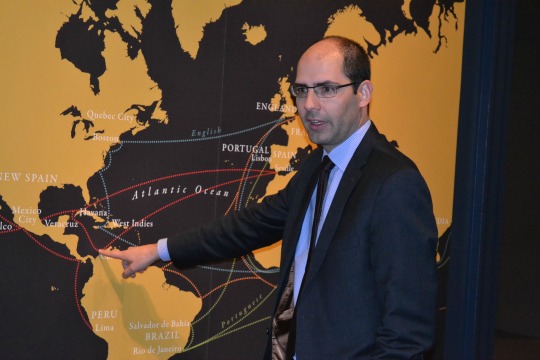
'Made in the Americas' curator Dennis Carr shows the path that luxury goods took in the 16th century that inspired their Asian influence and replication.

For a Winterthur intern who graduated in 1991 before heading to Yale for a doctorate, the journey back to Henry Francis du Pont’s esteemed estate constituted an odyssey replete with globetrotting, research discoveries – and even some colorful dead birds.

Linda Eaton, Winterthur's project curator, shows off some of the elegant textiles in 'Made in the Americas.'
Linda Eaton, Winterthur’s project curator, shows off some of the elegant textiles in ‘Made in the Americas.’

Dennis Carr returned to Winterthur Museum, Garden & Library as the curator of “Made in the Americas: The New World Discovers Asia,” an exhibit which opened on March 26 after debuting at the Museum of Fine Arts, Boston (MFA).

During a recent presentation, Carr, now the Carolyn and Peter Lynch Curator of American Decorative Arts and Sculpture at the Boston museum, said that not only was it an honor for him to come full circle, but Winterthur offered the perfect venue to continue the first large-scale, Pan-American exhibition to examine the profound influence of Asia on the arts of the colonial Americas.

Visitors who regard globalism as a modern phenomenon – fueled by economics or the Internet – will quickly find that the exhibit upends that view. It provides compelling, visual evidence that despite the thousands of miles and many-month voyages centuries ago that separated the Americas from Asia, its influence proved pervasive and lasting.

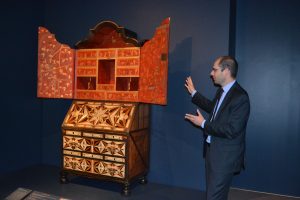
Curator Dennis Carr points out the intricacies of a mid-18th-century desk and bookcase that contains myriad global influences.

“We tend to think of globalism as a recent discovery, but globalism has its roots in the 16th century,” Carr explained. “The history of the colonial Americas has long been written as a series of encounters between Europe and the New World; however, the extraordinary objects in this exhibition encourage us to think more broadly about the Americas as being at the center of this global cultural and commercial exchange.”

About 80 works, including fine furniture, textiles, ceramics, silverwork, and paintings, which date from the 17th to the early 19th centuries, relay the complex story of how craftsmen throughout the hemisphere co-opted Asian styles in a range of objects. The exhibition features works from the MFA and Winterthur, and loans from public and private collections, many never previously seen publicly.

Carr said that beginning in 1573, Spanish ships set sail for Manila, laden with luxury goods from Asia, headed toward Acapulco, Mexico. The bounty for the English and French colonists in the Americas included silk and porcelain from China, painted screens and lacquer ware from Japan, and carved ivory from India and the Philippines.

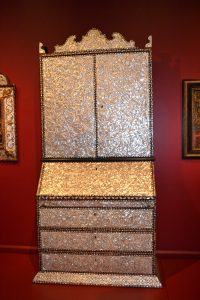
A desk and bookcase from 18th-century Peru features mother-of-pearl and tortoiseshell inlays, Spanish cedar, mahogany, gilding and oil painting.

Amassing the items for the exhibit also required years of travel for Carr, who described one acquisition of a Mexican feather-work painting – an intricate technique utilizing bird feathers in such a way that they appeared to have been painted – posed a challenge. The Boston museum purchased the late 16th-century work entitled “St. Michael Slaying the Devil” and had to consult with ornithology experts to assure customs officials that no endangered birds were included in the work.

Carr said his travels also introduced him to items such as a painstakingly detailed Peruvian tapestry created as a balcony hanging in 1661 for the arrival of a viceroy, “objects that fell through cracks of art history.” The embroidery received its bright red color from cochineal, a natural dye derived from cactus-craving insects.

Linda Eaton, Winterthur’s John L. & Marjorie P. McGraw Director of Collections and Senior Curator of Textiles, served as the project curator for the Winterthur installation, and said the opportunity to juxtapose the artifacts was exciting, such as a rare 18th century shawl purchased by Henry Francis du Pont and some early embroidery that is double-sided.

“The range of exquisite objects ‘Made in the Americas’ brings together is remarkable, but it is the riveting scholarship presented that is eye-opening,” she said. The exhibit should help explain why decorative art historians grimace when globalism is touted as a recent addition to the mainstream.

“This is not new,” she said. “We clearly lived in a global age long before the internet and smartphone.”

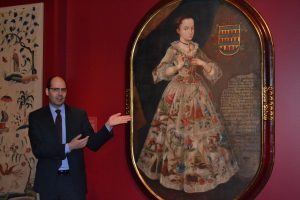
Dennis Carr points out that this circa 1773 painting from Mexico illustrates global imagery in the young noble's embroidered dress.
Dennis Carr points out that this circa 1773 painting from Mexico illustrates global imagery in the young noble’s embroidered dress.

“Made in the Americas: The New World Discovers Asia” is an exhibit that requires viewers to take their time and read the detailed descriptions about the work. Those who do will be rewarded with insight as well as education. The approximately 80 pieces in the exhibit range from examples of “chinoiserie,” which translates as “in the Chinese taste” and created a global sensation during the colonial period, to Peruvian furniture inlaid with mother-of-pearl and tortoiseshell.

Among the rarest pieces of furniture in the exhibition is a desk-and-bookcase from mid-18th-century Mexico. It boasts a dramatic interior displaying chinoiserie-style painting in gold on a red background. Reminiscent of early colonial maps drawn by indigenous artists, the inside of the doors reveals an extensive hacienda in Veracruz.

 The items on display include treasures from Mexico City, Lima, Quito, Quebec City, Boston, New York, and Philadelphia dating from the 17th to the early 19th centuries. Carr said only about 10 pieces differ from the Boston show. He said some of the textiles were too fragile to move from New England; however, they were quickly replaced with items from Winterthur’s collection.

He said the opening of the exhibition in Boston in 2015 was timed to mark the 450th anniversary of the Galleon trade between the Philippines and Mexico, inaugurated in 1565 and lasting for two and a half centuries, until 1815. He said that the exhibit proved popular and that he hopes audiences in the Philadelphia region will share that enthusiasm.

At Winterthur, the exhibition will be accompanied by a range of special programming, including concerts, dancers, cuisine, and wine tastings. For more information, visit winterthur.org/madeintheamericas.

 Carr said the exhibition has served as a catalyst for reevaluation of traditional history, art history, and other curricula relative to the period. He said that professors at Harvard taught a course in the fall that was inspired by the exhibit, and other institutions, such as the University of Delaware, have also expressed interest in adding this new scholarship into their curriculums.

 Backed by DuPont, Glenmede and John L. and Marjorie P. McGraw with additional support from M&T Bank and Potter Anderson & Corroon LLP, the exhibit will continue through Jan. 8, in the Winterthur Galleries.


About CFLive Staff

See Contributors Page https://chaddsfordlive.com/writers/

Winterthur exhibit an elegant global showcase Read More »

Amerikids to mark 30 years of service, song

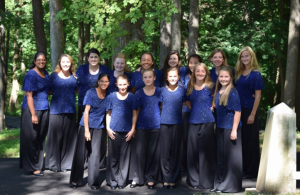
A chorus of youthful patriotism will fill Stetson Middle School on Friday, April 15, when Amerikids, a West Chester-based patriotic show choir, takes the stage.

The Amerikids are shown at a performance at Freedoms Foundation.
The Amerikids are shown at a performance at Freedoms Foundation in Valley Forge.

The 7 p.m. concert, which celebrates the 30th year of Amerikids’ “Service and Song” to the Chester County community, is free and open to the public, with a special invitation to veterans. The concert includes a color guard presentation and the singing of  “The Armed Forces Salute.”

Under the direction of Nicole O’Rourke, a former music teacher in the West Chester school district, Amerikids is a group of area students in grades five to 12. The students learn a show during a week of summer camp and then take the show on the road during the school year to nursing homes, community events and veteran centers.

Founded in 1986, Amerikids teaches middle and high school children about patriotism and volunteerism, helping them develop self-esteem through performing arts and by devoting their time and talents to community service.  The program is open to boys and girls in the Delaware Valley; however, nearly all of its members reside in Chester County and typically consist of all girls, according to its website.

In addition to annual performances ranging from the Veterans Administration hospital in Coatesville to Memorial Day ceremonies, the Amerikids complete many service projects.  They have ranged from collecting hundreds of personal hygiene products for Safe Harbor, a homeless shelter in West Chester, to creating and mailing holiday greeting letters to the men and women in the Armed Forces.

In the process, the Amerikids organization has received numerous citations for program excellence from numerous lawmakers to the American Legion.

In addition to the annual concert, a summer camp will be held from July 25 to July 29 at Stetson Middle School from 8:30 a.m. to 4 p.m.  All middle-school students who are interested in singing as a community service are welcome.

During the weeklong summer camp, students are mentored by Amerikids who have graduated from the program and return to share their experiences.  During the school year the Amerikids rehearse or perform once a week.

For more information, visit http://amerikidswc.org.

About CFLive Staff

See Contributors Page https://chaddsfordlive.com/writers/

Amerikids to mark 30 years of service, song Read More »

Mind Matters: Words matter

“Sticks and stones may break my bones, but words will never hurt me.” So goes the childhood ditty of defense against the bully. Actually, words do hurt and they do matter.

This column has addressed bullying previously. Hence, the foray into words here will take a different tack — not only how we use words towards and about others but towards ourselves as well.

No Pollyanna of positive psychology am I, yet I concur with cognitive behavioral therapists about how we can be negative with our words. We may “generalize” when something we don’t like happens and say, “it’s always like this,” or we may “awfulize” and perceive even a minor disturbance as a horrific one. Family therapists talk about rephrasing a situation or message — how to speak affirmatively instead of negatively.

Now with the birth of my first grandchild, I am even more cognizant of how words matter — what we say and how we say it is creating an imprint on that young, absorbent mind.

What does she hear us say, not only to her but to each other that will influence not only her speech development but also her outlook on life? Recently, I needed my own reframe when I developed a very painful neck, shoulder, and arm. What did I say? “My neck and arm are killing me.” A colleague and friend urged the rephrase. Okay, my arm and neck hurt, but they are not “killing me.” Why add that violent image to what already hurts? So I changed the message to self. Also note that there are also psychological components to our aches, as well as muscular issues. Who is the “pain in the neck”? Are they really “killing you”?

We bandy about all sorts of words that convey much violence and negativity.

We label ourselves and others cruelly, often internalizing the negative refrains of a verbally abusive authority figure from childhood. Some of us go beyond chastising ourselves with these inner voices that chide us with “you’re stupid” or “bad” (or whatever words demean us) and externalize the labels onto others. Who hasn’t cursed at a driver in “our way”?

Think, too, about the words we use to describe another derogatorily that are our and their body parts. Ever reflect on how there really is no part of the body that should be so defamed? From head to toe, mouth to —–, we are one whole body. We need all the parts to work in unison.

I am reflecting on my words about myself and others a lot these days. Might you do the same?

* Kayta Curzie Gajdos holds a doctorate in counseling psychology and is in private practice in Chadds Ford, Pennsylvania. She welcomes comments at MindMatters@DrGajdos.com or 610-388-2888. Past columns are posted to www.drgajdos.com. See book.quietwisdom-loudtimes.com for information about her book, “Quiet Wisdom in Loud Times: The Rise of the Wounded Feminine.”

** The opinions expressed are those of the author and do not necessarily reflect those of the ownership or management of Chadds Ford Live. We welcome opposing viewpoints. Readers may comment in the comments section or they may submit a Letter to the Editor to: editor@chaddsfordlive.com


About Kayta Gajdos

Dr. Kathleen Curzie Gajdos ("Kayta") is a licensed psychologist (Pennsylvania and Delaware) who has worked with individuals, couples, and families with a spectrum of problems. She has experience and training in the fields of alcohol and drug addictions, hypnosis, family therapy, Jungian theory, Gestalt therapy, EMDR, and bereavement. Dr. Gajdos developed a private practice in the Pittsburgh area, and was affiliated with the Family Therapy Institute of Western Psychiatric Institute and Clinic, having written numerous articles for the Family Therapy Newsletter there. She has published in the American Psychological Association Bulletin, the Family Psychologist, and in the Swedenborgian publications, Chrysalis and The Messenger. Dr. Gajdos has taught at the college level, most recently for West Chester University and Wilmington College, and has served as field faculty for Vermont College of Norwich University the Union Institute's Center for Distance Learning, Cincinnati, Ohio. She has also served as consulting psychologist to the Irene Stacy Community MH/MR Center in Western Pennsylvania where she supervised psychologists in training. Currently active in disaster relief, Dr. Gajdos serves with the American Red Cross and participated in Hurricane Katrina relief efforts as a member of teams from the Department of Health and Human Services' Substance Abuse and Mental Health Services Administration.Now living in Chadds Ford, in the Brandywine Valley of eastern Pennsylvania, Dr. Gajdos combines her private practice working with individuals, couples and families, with leading workshops on such topics as grief and healing, the impact of multigenerational grief and trauma shame, the shadow and self, Women Who Run with the Wolves, motherless daughters, and mediation and relaxation. Each year at Temenos Retreat Center in West Chester, PA she leads a griefs of birthing ritual for those who have suffered losses of procreation (abortions, miscarriages, infertility, etc.); she also holds yearly A Day of Re-Collection at Temenos.Dr. Gajdos holds Master's degrees in both philosophy and clinical psychology and received her Ph.D. in counseling at the University of Pittsburgh. Among her professional affiliations, she includes having been a founding member and board member of the C.G. Jung Educational Center of Pittsburgh, as well as being listed in Who's Who of American Women. Currently, she is a member of the American Psychological Association, The Pennsylvania Psychological Association, the Delaware Psychological Association, the American Family Therapy Academy, The Association for Death Education and Counseling, and the Delaware County Mental Health and Mental Retardation Board. Woven into her professional career are Dr. Gajdos' pursuits of dancing, singing, and writing poetry.

Mind Matters: Words matter Read More »

Scroll to Top