

April 23, 2016

Trying to stem flood of drugs in waterways

From cocaine and morphine to antibiotics and antihistamines, the nation’s waterways are awash in drugs.
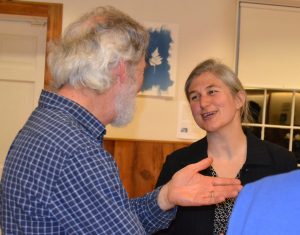
Emma Rosi-Marshall, a scientist from the Cary Institute, chats with attendees after her Stroud Water Research Center presentation entitled 'Our Rivers on Drugs.'
Emma Rosi-Marshall, a scientist from the Cary Institute, chats with attendees after her Stroud Water Research Center presentation entitled ‘Our Rivers on Drugs.’

Emma Rosi-Marshall, a scientist from the Cary Institute, discussed this disturbing discovery at the Stroud Water Research Center on Thursday, April 21. Her presentation, entitled “Our Rivers on Drugs,” was part of the center’s Science Seminar Series and attracted an appreciative audience of about 80.

David B. Arscott, Stroud’s assistant director and a research scientist, introduced Rosi-Marshall, a scientist from the Cary Institute who worked previously as an associate professor at Loyola University of Chicago. Rosi-Marshall is also heading the Baltimore Ecosystem Study, a long-term ecological research project.

Rosi-Marshall, who described herself as an aquatic ecologist, said she was thrilled to be visiting Stroud for the first time. She said he hoped the local audience realized how significant the Stroud Water Research Center is to freshwater ecology.

She used a 1962 quote from Rachel Carson, the author of “Silent Spring,” to set the stage for her lecture: “The chemicals to which life is asked to make its adjustments are no longer merely the calcium and silica and copper and all the rest of the minerals washed out of the rocks and carried in rivers to the sea; they are the synthetic creations of man’s inventive mind, brewed in his laboratories, and having no counterparts in nature.”

Rosi-Marshall suggested that Carson’s admonitions are truer today, and she acknowledged that the research she and her team have been conducting raises more questions than answers. What is known, she said, is that the 1,467 pharmaceuticals and an infinite number of chemical-laden, personal-care products, collectively known as PPCP, take many pathways into the water.

Some are discharged from drug manufacturing plants while others are released through human waste. “Wastewater treatment plants were not designed to remove pharmaceuticals,” she said, adding that the plants represent an ailing infrastructure in need of a $300 billion overhaul.

Another way that drugs infiltrate the freshwater system occurs through improper disposal, Rosi-Marshall said, explaining that when unused medications are flushed down the toilet or thrown in the trash, they eventually end up in streams and rivers.
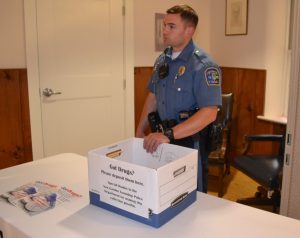
New Garden Township Police Officer Matthew Jones offers a safe way to dispose of unwanted medication.

Rosi-Marshall said that out of the many dozens of times that she’s spoken on this topic, the Stroud Water Research Center was the only venue to offer an opportunity for attendees to dispose of unwanted medications safely.

“That’s so awesome,” she said, referring to the presence of New Garden Township Officer Matthew Jones, who had a collection box at the back of the room.

Rosi-Marshall said she and her researchers have created artificial waterways with concentrations of PPCPs that mimic what’s occurring in nature. She said experiments to put algae on drugs and bugs on drugs have begged numerous questions that will require further investigation.

For example, Benadryl, a common antihistamine, affects algae more than other drugs do, but scientists do not yet know why. Changes have occurred in bug populations, but the effects on mortality and growth have yet to be determined, Rosi-Marshall said.

The Environmental Protection Agency regulates sewage, but not PPCPs, and the Food and Drug Administration monitors the safety of drugs, but not their effects on the environment, Rosi-Marshall said, adding that cosmetics are totally unregulated.

She said one good place for people to start fixing the problem is to reduce the use of chemicals and lobby lawmakers to maintain and upgrade the sewage infrastructure. After the 45-minute presentation, Rosi-Marshall took questions from the audience and then stayed to chat with attendees.

Joan Fenza of Landenberg said that the recent problems in Flint, Mi., have made water “a hot topic” and that she learned a lot from the lecture.

Tony Buck of Coatesville agreed. “It’s a huge problem,” he said. “Every drug is in the water.”

Buck suggested that the country desperately needs to focus on its aging sewage infrastructure. “I think water and soil and climate change will define the next 100 years,” he said.

Kelly Dillon traveled from Elverson to attend the presentation with her eighth-grade daughter, Eva. As a home-schooling mother who works as a program coordinator for Open Connections, a home-schooling resource, Dillon said she’s very familiar with the educational programs that Stroud offers.

Dillon said she appreciated Rosi-Marshall’s candor in stressing that many unknowns exist about the effects of drugs on waterways. And although she found that revelation depressing, Dillon said she felt inspired to do her part to minimize the impact.

“I had no idea this was happening,” her daughter added. “I learned a lot.”

The Stroud Water Research Center began in 1967, five years before the birth of the Environmental Protection Agency. It resulted from the foresight and vision of W.B. Dixon Stroud, his wife, Joan M. Stroud, and Ruth Patrick, a water scientist at the Academy of Natural Sciences. They joined forces to establish a location in Avondale along a branch of the White Clay Creek that could be studied by teams of scientists during a time when the nation’s waterways were severely imperiled.

Since then, the center has expanded, continuing its commitment to environmental advocacy. Its Moorhead Environmental Complex received LEED platinum certification in 2013, the highest honor for green buildings. For more information on the center and its many programs, visit http://www.stroudcenter.org.

About CFLive Staff

See Contributors Page https://chaddsfordlive.com/writers/

Trying to stem flood of drugs in waterways Read More »
Mind Matters: The path to healthy boundaries

Well, it happened again. A young man walking with, presumably his girl friend at Longwood, has his arm around her neck. She looks uncomfortable and is protesting. Finally, after some time, he gets the message and removes his arm from this “wrestling” hold. No, not the first time I’ve witnessed this kind of display of boundary crossing.

The boyfriend, in this scene, invaded the young woman’s personal space; she did not want to be touched in this way. Whether what he was doing was physically hurting her or not was not the crux of the matter. At root is the notion that a person’s body—infant, child, or adult—is their space, sacred if you will, not to be dominated or intruded upon by another.

Defining boundaries as a line that marks a limit, what about healthy boundaries in relationships? When do we intrude upon another’s space? Unhealthy boundaries and intrusiveness can occur between couples, parents and children, employer and employee, and friends. Anywhere people are!

Simplistically re-interpreting the eighteenth century philosopher Immanuel Kant, one person’s freedom ends where another person’s freedom begins. Hopefully, we readily see that physical abuse or sexual abuse are egregious boundary violations. However, other intrusive and unwanted behavior inflicted on another need to be included on the spectrum of such violations.

Fossum and Mason in their book “Facing Shame” discuss the development of healthy versus unhealthy physical boundaries in families. Healthy physical boundaries, they say, “require a clear sense of physical space. Those with defined boundaries can intuit distance comfort and discomfort and can move away or toward someone…They have grown up with people respectful of their physical space and have had appropriate recognition of their developmental needs regarding modesty and openness.”

While physical boundaries are necessary, so are emotional and intellectual boundaries. Most assuredly, in families, they intersect. According to Fossum and Mason, intellectual boundary violations include criticizing, blaming, mind reading, prying. These inappropriate behaviors can be acted out by parents to a child, or by an adult to an adult. There are also speech boundary violations: talking over the other, interrupting, raising voices, correcting, completing sentences.

In addition, emotional boundary blurring can occur in families where generational boundaries are lost: that is, where one parent fuses with a child for his or her emotional support. This is not to be confused with healthy loving relationships. The child, in this case, doesn’t know where his or her feelings begin or end, having become an emotional sponge for the needy parent, thus mirroring the parent’s roller coaster of emotions.

All this reflection on boundaries from one scene on a garden path. My guess is that if that couple is to have a flowery future, they will need to take heed of healthy boundaries — as do we all.

* Kayta Curzie Gajdos holds a doctorate in counseling psychology and is in private practice in Chadds Ford, Pennsylvania. She welcomes comments at MindMatters@DrGajdos.com or 610-388-2888. Past columns are posted to www.drgajdos.com. See book.quietwisdom-loudtimes.com for information about her book, “Quiet Wisdom in Loud Times: The Rise of the Wounded Feminine.”

** The opinions expressed are those of the author and do not necessarily reflect those of the ownership or management of Chadds Ford Live. We welcome opposing viewpoints. Readers may comment in the comments section or they may submit a Letter to the Editor to: editor@chaddsfordlive.com


About Kayta Gajdos

Dr. Kathleen Curzie Gajdos ("Kayta") is a licensed psychologist (Pennsylvania and Delaware) who has worked with individuals, couples, and families with a spectrum of problems. She has experience and training in the fields of alcohol and drug addictions, hypnosis, family therapy, Jungian theory, Gestalt therapy, EMDR, and bereavement. Dr. Gajdos developed a private practice in the Pittsburgh area, and was affiliated with the Family Therapy Institute of Western Psychiatric Institute and Clinic, having written numerous articles for the Family Therapy Newsletter there. She has published in the American Psychological Association Bulletin, the Family Psychologist, and in the Swedenborgian publications, Chrysalis and The Messenger. Dr. Gajdos has taught at the college level, most recently for West Chester University and Wilmington College, and has served as field faculty for Vermont College of Norwich University the Union Institute's Center for Distance Learning, Cincinnati, Ohio. She has also served as consulting psychologist to the Irene Stacy Community MH/MR Center in Western Pennsylvania where she supervised psychologists in training. Currently active in disaster relief, Dr. Gajdos serves with the American Red Cross and participated in Hurricane Katrina relief efforts as a member of teams from the Department of Health and Human Services' Substance Abuse and Mental Health Services Administration.Now living in Chadds Ford, in the Brandywine Valley of eastern Pennsylvania, Dr. Gajdos combines her private practice working with individuals, couples and families, with leading workshops on such topics as grief and healing, the impact of multigenerational grief and trauma shame, the shadow and self, Women Who Run with the Wolves, motherless daughters, and mediation and relaxation. Each year at Temenos Retreat Center in West Chester, PA she leads a griefs of birthing ritual for those who have suffered losses of procreation (abortions, miscarriages, infertility, etc.); she also holds yearly A Day of Re-Collection at Temenos.Dr. Gajdos holds Master's degrees in both philosophy and clinical psychology and received her Ph.D. in counseling at the University of Pittsburgh. Among her professional affiliations, she includes having been a founding member and board member of the C.G. Jung Educational Center of Pittsburgh, as well as being listed in Who's Who of American Women. Currently, she is a member of the American Psychological Association, The Pennsylvania Psychological Association, the Delaware Psychological Association, the American Family Therapy Academy, The Association for Death Education and Counseling, and the Delaware County Mental Health and Mental Retardation Board. Woven into her professional career are Dr. Gajdos' pursuits of dancing, singing, and writing poetry.

Mind Matters: The path to healthy boundaries Read More »

Scroll to Top