

April 4, 2020

Farmers sow seeds of optimism

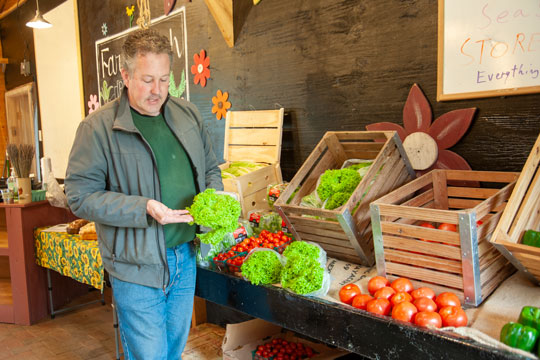
Randell Spackman gets his Thornbury Farm store ready for the season. Some crops, for now, aren't locally grown yet.

Businesses try to maintain a sense of normalcy even in tough times. They have to. It’s a common concern, but it becomes more so in times of uncertainty. Even for businesses that provide necessities, like farmers.

Consider Randell Spackman, of Thornbury Farm in Thornbury Township in Chester County, and H.G. Haskell, of Hill Girt Farm in Pennsbury. They grow and sell food and have their own little markets on their properties. How might they fare amid the 2020 COVID-19 pandemic?

Both men are hoping for the best, but neither can predict what will happen.

Haskell said he doesn’t know what the effect will be, but he’s hoping for the best.

“As far as food goes, we are planning on planting on schedule. We have stuff growing in the greenhouse, and I’ll be planting my first corn next week,” Haskell said. “None of that will be ready until the end of June, so I’m just crossing my fingers that people will be out by then. People still have to buy food, so I’m hopeful that, even if it’s still a bit iffy, people will come to buy fruits and vegetables.”

Customers at Thornbury Farm have a place to wash their hands.

Spackman, too, is trying to stay optimistic and opened his farm’s store for the season on Saturday, April 4. While it started as Thornbury CSA — or community sponsored agriculture — eight years ago, Spackman said that anyone could shop there. You don’t have to be a member. The only days when the store is for members only will be Thursdays.

Members pay either $700 for a full-share membership or $385 for getting food every other week. They also get a discount at other locations, such as The Gables, Brandywine Prime and Shoo Mamas, Spackman said.

The store is open to the general public on the weekends, from 9 a.m. to 3 p.m. on Saturdays and 11 a.m. to 3 p.m. on Sundays. Hours will be extended during the summer, Spackman said, adding that the store area is cleansed and bleached and has good airflow. There’s also a hand-washing station just outside the store area.

Other parts of their businesses have been hurt so far. Both Haskell and Spackman said they lost a lot of plant sales but have done what they could to offset those losses by finding other suppliers.

Somethings couldn’t be offset. According to Spackman, bread and brewing classes were canceled as were some weddings and other events. However, he knows some people will be looking for outdoor venues once the virus is under control, and life returns to normalcy.

“That doesn’t equal out,” he said, “but it helps.”
About Rich Schwartzman

Rich Schwartzman has been reporting on events in the greater Chadds Ford area since September 2001 when he became the founding editor of The Chadds Ford Post. In April 2009 he became managing editor of ChaddsFordLive. He is also an award-winning photographer.

Farmers sow seeds of optimism Read More »
Mind Matters: Crisis as opportunity

How quickly life can change. Got to admit, I never expected life to change all across the globe so abruptly. Not so abruptly perhaps if you are a scientist paying attention to the signals from China or a self-serving politician who figured the stock market would tank because he had been forewarned of an imminent pandemic.

Now that we are quarantined en masse, how will this change us? No matter how difficult the situation, how we respond to it is our choice. Will we as a nation be generous of spirit or hoard toilet paper and hide guns?

Many Americans experience only first world problems. Now, however, a pandemic is having us rethink our priorities. Personally, I am frivolous with my use of toilet paper which I have begun to self-ration. I look at food more carefully — not being as nonchalant about letting things land in the compost bin.

How do I know how the anonymous farm workers from Mexico who work in the fields of California will manage between the Scylla and Charybdis of sickness and closed borders?

How will delivery people manage to stay healthy? How will our postal service workers keep going? What of trash collectors? And workers up and down the food supply chain? And, of course, especially health care workers. We rely on so many anonymous lives to maintain our lives. It is laughable that anyone could believe they are independent and self-reliant.

We are all in this together. We see with this pandemic how incredibly connected we are. unlike natural disasters that can devastate large areas yet don’t go beyond a given geography, this pandemic has traveled the globe. Did it take a microscopic organism to stop us in our tracks, teaching us to see that what affects one of us affects all of us? I remember volunteering in various disasters, then leaving to go home — sometimes the disaster was only miles away — and I would see people walking around enjoying their day oblivious to the incident not that far away.

Few people cared about the Ebola outbreak in Africa until (white) Americans were infected and came back to the U.S. COVID-19 may not be as lethal as Ebola, but it is also far more able to be ubiquitous, knowing no socio-economic bounds or national boundaries. Of course, while the affluent can be affected by their medical support and infrastructure to sustain them will be more secure than for those with little or no means. Will this pandemic teach us anything about equality vs inequality?

The Chinese character for crisis is also the character for opportunity. Crisis indicates a crossroads, a time for choice, hence an opportunity to choose the good. What will people across the globe — Americans included — choose in this time of trial? Will we unite together (keeping our social distance!) and care for each other — notice each other? I discovered today that a young woman, a refugee from Afghanistan, who works at a Dunkin’ Donuts, was given a $40 tip from a customer who thanked her for her service. Indeed, where would we be without immigrants who continue to face adversity each day? Where would we be without all the people who care for us in hospitals, who stock the grocery shelves, who make deliveries? When this crisis is resolved, will we have used the opportunity to transform the world into a more equitable place for everyone? One can hope.

About Kayta Gajdos

Dr. Kathleen Curzie Gajdos ("Kayta") is a licensed psychologist (Pennsylvania and Delaware) who has worked with individuals, couples, and families with a spectrum of problems. She has experience and training in the fields of alcohol and drug addictions, hypnosis, family therapy, Jungian theory, Gestalt therapy, EMDR, and bereavement. Dr. Gajdos developed a private practice in the Pittsburgh area, and was affiliated with the Family Therapy Institute of Western Psychiatric Institute and Clinic, having written numerous articles for the Family Therapy Newsletter there. She has published in the American Psychological Association Bulletin, the Family Psychologist, and in the Swedenborgian publications, Chrysalis and The Messenger. Dr. Gajdos has taught at the college level, most recently for West Chester University and Wilmington College, and has served as field faculty for Vermont College of Norwich University the Union Institute's Center for Distance Learning, Cincinnati, Ohio. She has also served as consulting psychologist to the Irene Stacy Community MH/MR Center in Western Pennsylvania where she supervised psychologists in training. Currently active in disaster relief, Dr. Gajdos serves with the American Red Cross and participated in Hurricane Katrina relief efforts as a member of teams from the Department of Health and Human Services' Substance Abuse and Mental Health Services Administration.Now living in Chadds Ford, in the Brandywine Valley of eastern Pennsylvania, Dr. Gajdos combines her private practice working with individuals, couples and families, with leading workshops on such topics as grief and healing, the impact of multigenerational grief and trauma shame, the shadow and self, Women Who Run with the Wolves, motherless daughters, and mediation and relaxation. Each year at Temenos Retreat Center in West Chester, PA she leads a griefs of birthing ritual for those who have suffered losses of procreation (abortions, miscarriages, infertility, etc.); she also holds yearly A Day of Re-Collection at Temenos.Dr. Gajdos holds Master's degrees in both philosophy and clinical psychology and received her Ph.D. in counseling at the University of Pittsburgh. Among her professional affiliations, she includes having been a founding member and board member of the C.G. Jung Educational Center of Pittsburgh, as well as being listed in Who's Who of American Women. Currently, she is a member of the American Psychological Association, The Pennsylvania Psychological Association, the Delaware Psychological Association, the American Family Therapy Academy, The Association for Death Education and Counseling, and the Delaware County Mental Health and Mental Retardation Board. Woven into her professional career are Dr. Gajdos' pursuits of dancing, singing, and writing poetry.

Mind Matters: Crisis as opportunity Read More »

Scroll to Top