Eric Roe will make an outstanding state representative for us in the 158th Legislative District. He’s one of the hardest working men I know, and he’ll work tirelessly for the residents of the 158th in Harrisburg. He’s got the work ethic, the skill lsets, the private sector experience and the professional acumen to be an effective advocate for families and seniors. He values women and children, immigrants, victims of crime, and the vulnerable in our society. Eric sees the good in people and treats them as if that’s all he sees.
Eric serves on the board of directors of the Domestic Violence Center of Chester County. It serves thousands who seek refuge, and Eric helps steer the organization in the right direction. That’s not easy, considering how its state funding was heldhostage during the recent budget impasse.
He has taught ESL and a citizenship class for legal immigrants in Kennett Square and uses his Spanish language skills to help newcomers to our community. His own wife is an immigrant to the U.S.
Perhaps most of all, Eric values women. Not only does he serve on the board of the Domestic Violence Center of Chester County, but he and his wife, Alice, also support and volunteer for Chester County Women’s Services, a crisis pregnancy center with locations throughout the county. He often refers to his mother, QVC host Mary Beth Roe, as his hero for balancing professional success with a strong family life.
Lastly, he’s a class act who works hard. His age is an asset, not a liability. His energy and enthusiasm are unparalleled. Eric has already knocked on over 9,000 doors this year, and you should see him on the rare occasion that a voter tells him they’re supporting his opponent. He never says a negative thing about her, and he even takes the time to compliment her. I know this because I’ve gone door-knocking with him. In an otherwise heatedelection cycle in 2016, where political rhetoric has reached a fever pitch, Eric is a breath of fresh air.
I’m a values voter, and I’m voting for Eric Roe for state representative.
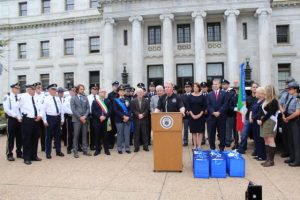
Delaware County District Attorney Jack Whelan and Delaware County Council Chairman Mario Civera, along with various police chiefs and departments from across Delaware County, welcomed 14 police and delegates from Ariano, Italy, to the county seat in Media on Saturday, Oct. 8.
Delaware County District Attorney Jack Whelan, joined by area government and law-enforcement officials, welcomes a delegation from Ariano, Italy.
Officials held the gathering to demonstrate the shared partnership and unity among law enforcement both locally and internationally.
The delegation received a warm welcome from officials and law enforcement and exchanged gifts with the District Attorney’s Office, along with a tour and demonstration of county emergency services equipment, including the District Attorney’s CID Bomb Unit.
The celebration continued at Ariano’s Restaurant on Olive Street in Media, and a block party, which is open to the public, will continue until 4 p.m.
“Rural Modern: American Art Beyond the City,” a major new exhibition opening at the Brandywine River Museum of Art, will provide an innovative view of avant-garde art from the 1920s through the 1940s, exploring the surprising contribution of artists working outside major urban centers in the expansion and acceptance of modernist styles in the U.S.
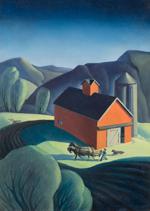
“Spring Turning,” a 1946 work by Dale Nichols.
Modernism spread outward from New York, Boston, and Chicago – the first points of contact – to coastal New England, small-town Pennsylvania, Midwestern farms, and other rural regions. On view from Oct. 29 through Jan. 22, 2017, the exhibition will feature more than 60 works by iconic artists such as Charles Demuth, Arthur Dove, Marsden Hartley, Georgia O’Keeffe, Charles Sheeler, and Grant Wood along with Ralston Crawford, Anna Mary Robertson “Grandma” Moses, N.C. Wyeth, and Andrew Wyeth, according to a museum press release.
These stunning paintings are drawn from renowned private and museum collections, such as the Albright-Knox Art Gallery, the Hirshhorn Museum and Sculpture Garden, and Whitney Museum of American Art.
“In selecting the works for this exhibition, I sought to connect the mainstream American modernists with both their well-known counterparts in American Regionalism and other artists of the period deserving of attention. Through the conceptual framework of ‘rural modernism,’ a new paradigm for investigating the modernization of American art is offered,” the exhibition’s curator Amanda C. Burdan said in the release.
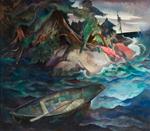
‘The Drowning’ was painted by N.C. Wyeth in 1936.
Included are artists such as Marsden Hartley and N.C. Wyeth working in Maine, and Horace Pippin and Charles Demuth working in Pennsylvania. Each developed distinct visual styles of painting and experienced such vastly different lives that comparisons of their work have rarely been undertaken. Through the lens of “rural modernism,” each can be seen as contributing to a shared expression of American modernity, the release said.
“Rural Modern provides a fascinating new examination of some of the 20th century’s best-known American artists who left the city behind and found subjects not usually associated with modernism,” Thomas Padon, director of the Brandywine River Museum of Art, said in the release. “This exhibition, one of the museum’s most ambitious, follows these artists throughout the country from Maine to New Mexico and examines their individual responses to new subjects-vast open landscapes, industrial buildings, and figures far from the urbane. As the migration of artistic talent continued, modern art was transmuted from a European-inflected approach practiced mainly by those living in the largest cities towards one that was national and distinctly American.”
The exhibition is divided into three sections. “Rural Modern Landscape” features sweeping vistas and the architecture of rural America. The artists of rural modernism continued the long-standing tradition of American pastoral landscape, giving great attention to scenes that emphasized the idealized landscape and humanity’s place within it. Barns of all shapes and sizes – in the sun and in the snow (by Georgia O’Keeffe), old and crumbling or shiny and new (by Dale Nichols), traditional red or stark, clean white (by Ralston Crawford) – provide a common reference in this regard.
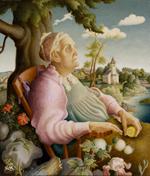
‘Godly Susan’ is a 1941 egg tempora painting by Roger Medlars.
Marvin Cone’s Stone City Landscape (1935) plays up the peaceful, charming, and orderly landscape of the American heartland and is matched by equally distinct regional scenes by other artists – from Marsden Hartley’s Hurricane Island, Vinalhaven, Maine, (1942, Philadelphia Museum of Art), to Georgia O’Keeffe’s Lake George, Autumn (1922, collection of Jan and Marica Vilcek), to Stuart Davis’s New Mexican Landscape(1923, Amon Carter Museum) – in a visual national anthem.
The “Rural Modern Life” section features the countless country types who appear in rural modern painting. The farmers, farm workers, and farm families are matched equally by fishermen, mine workers, lumberjacks, and all manner of people who work the land. Grandma Moses’s 1938 painting “Bringing in the Maple Sugar” (private collection) revels in the sense of community engendered in rural living. Her paintings, and others by self-taught artists, became increasingly popular in the New York art market in the period, reflecting the expanding nature of American modernism. In several works, life in rural areas is shown as inherently dependent on the land; however a number of works specifically depict an older generation with a suggestion of the passing of their way of life. Several still lifes and interior scenes, including two highly important examples by Charles Sheeler depicting his home in Bucks County, Pennsylvania, give further insight into life in rural American as glimpsed through an artist’s eye.
In “Rural Modern Gothic” both subject matter and style show the darker side of American life between the World Wars. In this section are artists who depicted the environmental and economic crises that impacted all parts of the country in the period using the visual imagery of the Dust Bowl, the encroachment of industrialization on previously pristine landscapes, and the Depression.
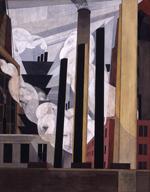
Paintings such as Charles Demuth’s “End of the Parade Coatesville, Pa.” (1920, collection of Deborah and Ed Shein), rendered in the boldly modern style of Precisionism, reflect on the industrialization of small town America. A major work by the Texas regionalist Alexandre Hogue entitled “The Crucified Land” (1939, Gilcrease Museum) keys on the devastation of American farmland during the 1930s, while works such as Ben Shahn’s “Farmers” (1943, University of Kentucky Museum of Art), concentrate on the psychological weight of the crises borne by the American people.
Charles Demuth painted ‘End of the Parade, Coatesville, Pa.,’ in 1920.
In addition to providing a full visual document of the works in the exhibition, the accompanying catalogue for Rural Modern, published by Skira Rizzoli, will explore in-depth topics related to the exhibition’s themes. Along with a major essay by Burdan, the catalogue includes insightful texts by Betsy Fahlman (Arizona State University), Christine B. Podmaniczky (Brandywine River Museum of Art), Jonathan Frederick Walz (The Columbus Museum), and Catherine Whitney (Philbrook Museum of Art). The essays provide a broad spectrum of approaches to the exhibition’s theme, including concentrations on individual artists, specialized styles of American modernism, regional identity, and important social issues affecting artists in rural America.
Rural Modern: American Art Beyond the City is organized by the Brandywine River Museum of Art in collaboration with the High Museum of Art, Atlanta. After opening in Chadds Ford, the exhibition will travel to Atlanta, where an expanded presentation, including murals and photography of the period, opens under the title “Cross Country: The Power of Place in American Art, 1915-1950,” and will be on view from Feb. 12 through May 7, 2017.
This exhibition is supported by The Davenport Family Foundation and Morris and Boo Stroud. Support for the catalogue has been provided by the Wyeth Foundation for American Art.
The Brandywine River Museum of Art features an outstanding collection of American art housed in a 19th-century mill building with a dramatic steel and glass addition overlooking the banks of the Brandywine. The museum is open daily (except Thanksgiving and Christmas Day) from 9:30 a.m. to 5 p.m. Admission is $15 for adults, $10 for seniors ages 65 and over, $6 for students and children ages 6 to 12; free for children 5 and younger and members. The museum is located on Route 1 in Chadds Ford. For more information, call 610-388-2700 or visit brandywinemuseum.org.
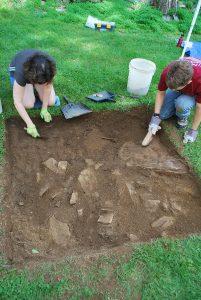
The Newlin Grist Mill is offering an appropriate way to dig into history on Saturday, Oct. 15, as it celebrates International Archaeology Day as well as the mill’s final 2016 public archeology excavation.
The public is invited to participate in the final public archaeology dig of the year at the Newlin Grist Mill on Oct. 15.
From 10 a.m. to 3 p.m., the public is invited to participate in this convergence of events by assisting professional archaeologists with excavations. Current excavations focus on the area of the property between the 1704 Grist Mill and the site’s archive building, originally a general store.
Previous archaeological digs this year have uncovered portions of the tunnels that enclose the grist mill’s tail races, which run 214 feet long and consist of stone walls with vaulted arch ceilings, and the attached sawmill. More fascinating finds are expected.
This event is free to the public and open to all ages. No reservations are required. Those who would like to help out with the dig should bring work gloves and wear clothes that can get dirty and close-toed footwear. For more information, call 610-459-2359 or visit http://www.newlingristmill.org. To learn more about International Archaeology Day, visit https://www.archaeological.org/archaeologyday.
Founded in 1960, the Nicholas Newlin Foundation aims to preserve land and historic buildings for the pleasure and education of the public. In an area of urban growth, the foundation maintains open land as a refuge for plants, animals, and birds, and for the people who come to enjoy them and offers visitors insights into the vanished life of the rural 18th century.
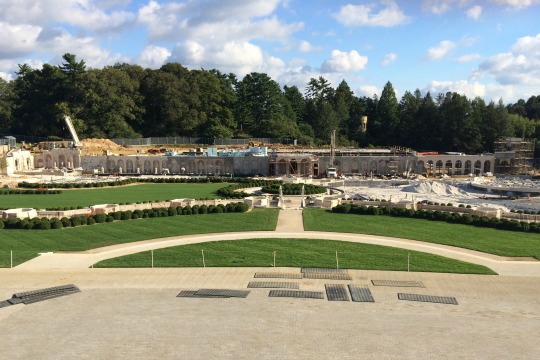
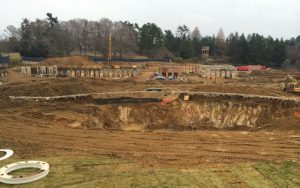
Longwood Gardens' $90 million reconstruction of the Main Fountain Garden is nearing completion.
With a 75 percent increase in attendance during the past decade, Longwood Gardens is now “the most visited public garden in North America right now,” said its executive director, who fervently wants to keep it that way.
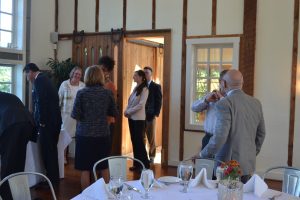
Members of the Chadds Ford Business Association socialize before hearing a presentation from Paul B. Redman, executive director of Longwood Gardens.
Addressing the Chadds Ford Business Association, Paul B. Redman said that attendance figures for the year ending Sept. 30 came in at 1.34 million visitors. Redman was the keynote speaker at the CFBA’s monthly luncheon on Thursday, Oct. 6, which was held at Gables Restaurant.
Redman was introduced by Esmé Frangiosa, the group’s incoming president, who detailed Redman’s award-winning, 25-year history in horticulture. It began with Redman’s bachelor’s and master’s degrees in horticulture from Oklahoma State University and took him to the Franklin Park Conservatory and Botanical Gardens in Columbus, Ohio, before landing him at Longwood in 2006 .
Mindful that many in the audience were familiar with Longwood Gardens, Redman focused his presentation on work that occurs primarily behind the scenes, projects joined by a commitment to sustain the horticultural, cultural, and educational vision of the gardens’ founder, Pierre S. du Pont.
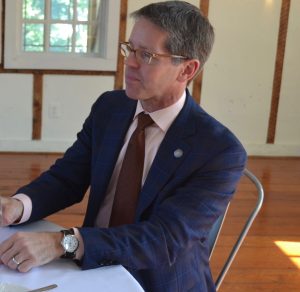
Paul B. Redman, executive director of Longwood Gardens, interacts with members of the Chadds Ford Business Association.
One example involved the Main Fountain Garden, also known as “the Versailles of North America.” Redman explained that it represented a state-of-the-art marvel when installed more than 80 years ago. But after decades of inclement weather took a toll, Longwood initiated a massive reconstruction project that began in October 2014.
When the fountain reopens in May, it will feature “a knockout performance that has never been seen before,” said Redman. For example, some of the water jets will be equipped with propane lines to create an actual fire and water experience.
And while much of the construction has been visible, a significant portion has not. Redman said more than 4,000 pieces of limestone that originated in Italy went to Dan Lepore & Sons, a third-generation masonry company in Conshohocken for painstaking repairs. In addition, a quarter-mile of underground tunnels took shape so that Longwood employees would have easier access to the new equipment; previously, repairs involved digging.
Longwood Gardens’ many mission-based programs represent other components of the gardens that often escape public notice. He said staffers are constantly working on projects that involve butterfly and bird monitoring, water research, and plant development.
The Main Fountain Garden is shown in April 2015 during the early stages of the renovation project.
During the past six decades, Longwood has developed more than 130 plants in partnership with the U.S. Department of Agriculture, including the popular New Guinea impatiens and a host of chrysanthemums.
“More of us are wearing white lab coats than not,” Redman said.
Redman said continuing that tradition has spawned another offshoot of Longwood’s outreach: education. Redman, the co-chair of Seed Your Future, described the initiative as a national campaign in partnership with the American Society for Horticultural Science (ASHS) to promote awareness and careers in horticulture.
He said Seed Your Future aims to reverse an alarming decline in awareness of horticulture among young people, especially as a career path. He said many schools have discontinued their horticulture programs.
Without university programs, the nation’s gardens will soon have recruiting problems, Redman added, explaining that Longwood is trying to fill that void by instituting numerous free, online education programs.
“We’ve been taking Longwood Gardens to the world,” Redman said. “This is doubling our outreach to schoolchildren.”
Redman ended his presentation fittingly with a quote from renowned architect Frank Lloyd Wright: “The longer I live, the more beautiful life becomes. If you foolishly ignore beauty, you will soon find yourself without it. Your life will be impoverished. But if you invest in beauty, it will remain with you all the days of your life.”
He said Longwood is committed to that investment, and he reminded the audience that Longwood Gardens wants area businesses to benefit from the gardens’ visitors. “We promote local businesses on our website,” he said.