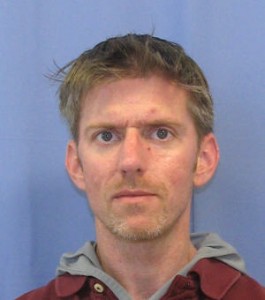
Tinicum Township Police and the District Attorney’s Criminal Investigation Division have identified the body of a white male found yesterday afternoon in a suitcase as 40-year-old Scott Stephen Bernheisel, 140 pounds, 5 feet 8 inches with a last known address in Philadelphia.
Scott Stephen Bernheisel
Authorities discovered the body on Thursday, May 28, at approximately 1:50 p.m., after a man walking his dog on 2nd Street noticed a strong odor emanating from a suitcase located in the weeds off the road. The man contacted police. The suitcase was located approximately 20 feet off the roadway at the 1000 Block of 2nd Street in Lester, Tinicum Township.
The investigation is ongoing by the Tinicum Township Police Department, the District Attorney’s Criminal Investigation Division and the Medical Examiner’s office.
Anyone with information pertaining to the death of Scott Stephen Bernheisel or anyone who was recently in contact with him, are asked to contact County Det. Sgt. William Gordon at 610-891-4703 or Sgt. James Y. Simpkins, of Tinicum Township Police at 610-521-3830.
PennDOT has announced the following road projects, which are weather-dependent and could affect residents in the greater Chadds Ford area during the week of May 31 through June 7. The department recommends that motorists allow extra time if they are traveling through one of the construction zones.
Drivers on Route 1 in both directions will experience lane restrictions between Newark Road and East Baltimore Pike in Kennett and New Garden townships for guide rail installation. Crews are scheduled to work from Monday, June 1, through Friday, June 5.
On Route 202 in Concord and Chadds Ford townships, lane closures will continue to be needed for roadwork in connection with the Wegmans shopping center between Applied Card Way and Route 1 from 9 a.m. to 3 p.m. and 7 p.m. to 6 a.m. through Oct. 1
On Route 1 in Concord Township, lane closures will be needed in both directions between Brinton Lake Road and Route 202 from 9 a.m. to 3 p.m. and 7 p.m. to 6 a.m. through Oct. 1. On southbound Route 1, 24-hour lane closures will be needed between Thornton and Conchester roads for work scheduled through July 7.
Motorists on Boot Road in West Goshen Township will experience lane restrictions between Clover Mill Road and National Road through July 31. Crews will be working on road-widening from 9 a.m. to 3 p.m.
Traffic signal installation in Kennett Square Borough will continue to require lane closures on Cypress Street at Mill Road, Meredith Street and South Broad Street; Union Street at South Street; and State Street at Broad Street, Union Street and Mill Road. Crews are scheduled to work from 7 a.m. to 3:30 p.m. on Monday, June 1, through Friday, June 5.
Burnt Mill Road in Kennett Township is closed and detoured between Norway and Spring Mill roads indefinitely while crews prepare for repairs to a bridge that collapsed on April 24.
Crack sealing will necessitate intermittent lane closures on Route 3 in both directions in Willistown, Westtown, East Goshen and West Goshen townships. The work is scheduled between Matlack Street and Delchester Road from 8 a.m. to 2 p.m. on Monday, June 1, through Friday, June 5.
Intermittent lane closures are scheduled on Route 30 (the Exton Bypass) in both directions between Route 202 and the Lancaster County line from Monday, June 1, through Thursday, June 4, in West Whiteland, West Sadsbury, Valley, Caln and East Caln townships. The street-sweeping work will be done from 9 a.m. to 2:30 p.m.
Route 100 will continue to be restricted to one lane in both directions between Sunrise Drive and Route 113 in Uwchlan and West Whiteland townships, from Monday, June 1, through Friday, June 5, from 9 a.m. to 3 p.m. for road widening.
The right lane will be closed on northbound Interstate 95 between the Walt Whitman Bridge and Washington Avenue in Philadelphia on Monday, June 1, through Wednesday, June 3, from 8 p.m. to 5 a.m. for bridge deck sealing. In addition, the right lane will be closed on southbound I-95 between Washington Avenue and the Walt Whitman Bridge on Thursday, June 4, from 8 p.m. to 5 a.m.
One lane will remain closed on Interstate 95 North at the Commodore Barry Bridge for construction through July 14.
If you want to report potholes and other roadway maintenance concerns on state roads, call 610-566-0972 in Delaware County or 484-340-3200 in Chester County, or visit www.dot.state.pa.us and click on “submit feedback.”.
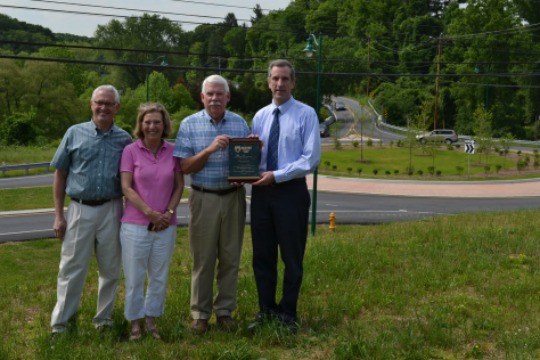
With the roundabout in the background, Pocopson Township Supervisors' Chairman Barney Leonard (from left), Supervisor Georgia Brutscher, former Supervisor Steve Conary, and Paul Linahan, the project manager, display the plaque from the Delaware Valley section of the American Society of Highway Engineers.
If sitting and watching traffic doesn’t sound like fun, then you probably weren’t involved in the construction of the roundabout in Pocopson Township – a process fraught with angst, delays, and complaints.
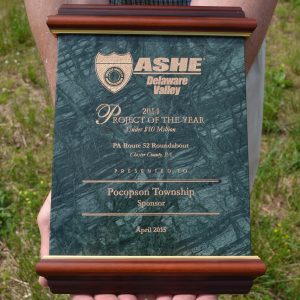
The plaque from the Delaware Valley section of the American Society of Highway Engineers recognizes the Pocopson roundabout as the 2014 Project of the Year.
Admittedly, the officials who gathered on Friday, May 29, on a hillside overlooking the intersection of Route 52 (Lenape Road), Wawaset Road, and Lenape Unionville Road, did not expect to be entertained. But the vantage point afforded an opportunity to witness first-hand how motorists are forced to slow down, producing a welcome traffic-calming effect that has generated positive reviews from residents as well as outsiders.
In fact, it was the latter that prompted Friday’s celebratory roundabout rendezvous. Paul Linahan, the project manager from Gennett Fleming, Inc., presented two current and one former township supervisor with a plaque from the Delaware Valley section of the American Society of Highway Engineers (ASHE), which deemed the roundabout the best project under $10 million in the five-county Philadelphia area.
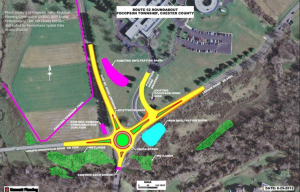
Linahan explained that the $2.2 million initiative represented the first roundabout constructed in southeast Pennsylvania by PennDOT, primarily with federal funds. The handful of other regional roundabouts resulted from private development.
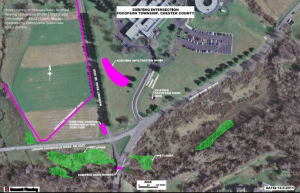
A drawing shows the configuration of the roads before the roundabout.
He said research has shown that roundabouts improve safety by reducing speeds. “We will see more of them” in the future, he predicted.
Supervisor Georgia Brutscher said she was disappointed that Supervisor Ricki Stumpo was unable to attend the award ceremony because she was one of the people who fielded the bulk of the complaints, mainly over the detours that the project created for nearly a year. The construction began in January 2014 and concluded in December.
Supervisors’ Chairman Barney Leonard said the plaque would be hung in the township building. As he and the others observed drivers’ negotiating the roundabout, they expressed surprise that it was fascinating to watch.
Would the minivan yield to the subcompact? Would the tractor-trailer slow down sufficiently so that it didn’t need to utilize the “truck apron,” the colored concrete surrounding the island?
“This could become the new entertainment in Pocopson,” Leonard joked as the truck driver skillfully turned onto Wawaset Road.
But the conditions that necessitated the new intersection were no laughing matter. Steve Conary, a former supervisor, said the monitoring that preceded construction showed that some drivers traveled through the complex intersection at speeds up to 70 mph. Brutscher added that at least two fatalities had occurred there.
Conary said that when the county expanded the nearby prison and added the juvenile detention center, the increased traffic made the improvements to the intersection critical.
The Pocopson Township supervisors say that complaints during construction have been replaced by praise since the roundabout’s completion.
The township, in cooperation with PennDOT, the Chester County Planning Commission, the Delaware Valley Regional Planning Commission, and the Federal Highway Administration (FHWA), opted for a roundabout. According to federal statistics, roundabouts have produced a 35 percent reduction in overall crashes.
Brutscher said that another benefit occurred when PennDOT took advantage of the Route 52 closure to make improvements to the existing arch bridge over Pocopson Creek.
In recognizing the project, ASHE cited improved safety and noted that the “project set the bar for signing, safety, and maintenance responsibilities for future roundabout projects …”
Brutscher, who noted that the intersection was the only one in the township that ever received a failing grade in a traffic study, said it’s been gratifying to see the results of its reconstruction.
“We’ve had nothing but rave reviews; it moves traffic efficiently, and it’s a traffic-calmer,” she said, adding that it even looks better than it did before.
The island features native, low-maintenance plants and lantern-style lights that are not the standard PennDOT “cobra-head” style.
“That was a special request” to PennDOT, said Brutscher, urging everyone to drive through the roundabout at night. “It’s lovely. The light is very soft but very effective.”
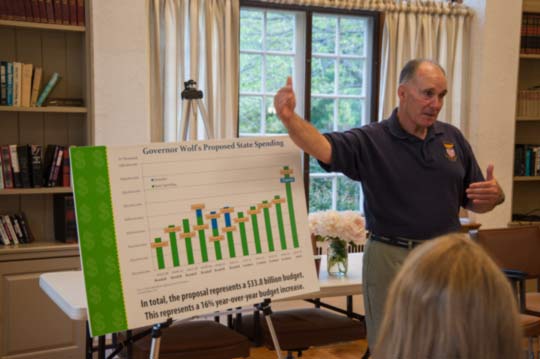
Gov. Tom Wolf’s proposed budget calls for a $4.5 billion spending increase, raising the sales tax to 6.6 percent and income taxes to 3.7 percent, according to a presentation by state Rep. Stephen Barrar.
“That’s a pretty dramatic tax increase,” said the 160th Legislative District’s Republican representative, now in his 10th term in office.
He thinks the governor will not get what he wants.
“My opinion is the only tax the governor is going to get is the Marcellus Shale tax…I’ll vote for a 3.5 percent Marcellus Shale tax increase, but I’m certainly not voting for a 7.4 percent, which would make us the second highest natural gas tax in the nation.”
Barrar, whose comments came during a town hall meeting in Pennsbury Township on May 27, said a 7.4 percent increase would be harmful to the industry, which he referred to as “the only economic bright spot in Pennsylvania in the last five years.”
“If there’s something that’s fueling the state’s economy, why would you go shoot it in the head and kill it with the second highest tax rate in the nation?”
Barrar added that there’s already a 2 percent impact fee on Marcellus Shale, resulting in $700 million per year collected by the state. A 3.5 percent increase would add another $700 million, he said.
He said he’d like to see the increased revenue used to eliminate some already existing taxes rather than on additional spending.
Among the taxes he’d like to see eliminated is the 4.5 percent inheritance tax, which taxes money left to a deceased person’s children.
“Our inheritance tax, in my opinion, is the most immoral tax we have because we tax you at a higher rate when you’re dead. You’re not here to complain about it,” he said.
Whenever there’s talk about the state budget, the topic usually turns toward education funding and the conversation during this meeting was no exception.
The governor’s proposed budget, Barrar said, calls for spending an additional $1 billion for education. He also said those who claim former Gov. Tom Corbett cut $1 billion from education are lying. That lost money, according to Barrar, was a result of lost federal stimulus money.
“We’re at the highest point in our history when it comes to the amount of money the state puts into education,” Barrar said. “Do we need more money in education? Absolutely. Especially for special education, which is seriously underfunded.”
As he has said before, Barrar wants to change the way schools are funded.
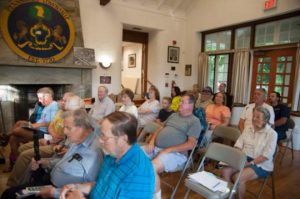
Residents from several township gather in Pennsbury Township to listen to state Rep.Stephen Barrar.
“If your children go to Unionville-Chadds Ford or to Garnet Valley schools, your kids are shortchanged,” he said.
Barrar explained the point, saying schools in those districts get $350 per student from the state, while the state spends more than $10,000 per student in Philadelphia and Chester schools. State and local taxes for public education total $17,000 per student while the national average is $11,000 per student.
He said some districts are spending less than $17,000 and have great results, while others, such as Chester, spend more without good results.
Barrar said 38 percent of school kids in Philadelphia and 42 percent in Chester opt out of regular public schools in favor of charter schools. He likened that to a business losing 38 or 42 percent of its customers.
He proposed a change in the funding formula to offer a baseline for all students, suggesting the state pay $4,000 per student across the commonwealth.
Specifically, he wants to see a shift away from property taxes used to pay for state schools. Instead, the idea is to use sales tax, an income tax, or a combination of both. That, however, is still debated in the legislature.
Barrar told a personal anecdote about buying his first house in 1978, and telling his father he thought taxes were too high. He said his father told him not to worry because the legislature was going to fix the problem in a year. Most of the audience laughed.
He said everyone does want to fix the issue. But “the problem is, everyone has a different idea of what would work,” he said.
Some people want to see an increase in sales taxes, while others want to see an increase in income taxes to pay for public schools.
One proposed bill, HB 76, would shift school funding completely away from property taxes and shift to the others. Barrar said he’s sponsored the bill in two different House sessions, but it’s never received more than 60 votes.
Part of the problem with increasing the sales tax to pay for education, especially in this area, is that consumers will go shop in Delaware. Additionally, the added income tax burden would be “enormous” in areas with already high school taxes, he said.
Barrar added that only about 100 of the state’s 500 school districts would see any serious property tax relief under the governor’s plan, and none of those are in the greater Chadds Ford area school districts: Unionville-Chadds Ford, Garnet Valley and Kennett Consolidated.
“The school districts that get the highest amount of support from the state will get the highest amount of property tax relief because of the way the formula works,” Barrar told members of his constituency. “People in this area will be cheated enormously. You’ll pay a lot more income taxes.”
(Top photo: State Rep. Stephen Barrar makes a point during the town hall meeting.)