

Interim vampires revel in Longwood darkness
A self-acknowledged vampire – at least temporarily – captivated a capacity crowd at Longwood Gardens on Friday, Aug. 12.

Ricardo Rivera, the creator of “Nightscape: A Light and Sound Experience,” debuted this year’s “Artist & Friends” series, a panel discussion designed to complement the innovative light and sound exhibit. He appeared with Thom Roland, a colleague at Klip Collective, a Philadelphia-based experiential art shop that specializes in integrating projection lighting and technology with storytelling.
The pair discussed projection mapping, a process that turns objects, such as buildings – or in Longwood’s case, plants – into display surfaces for video projection. Using specialized software, creators can map a two- or three-dimensional object on a virtual program that mimics the real environment where the projection will occur.
“You name it; I project on it,” said Rivera, a co-founder of Klip Collective.
But the process won’t appeal to everyone, he said, explaining that getting the details right can be downright tedious. Plus, “when you look at it, it’s super mundane on the screen,” he added. To achieve the final product, he said he and his crew spent many hours over the course of a year at Longwood Gardens during “vampire hours” in the middle of the night.
Rivera said two of his muses are the late Edmund Bacon, a renowned Philadelphia planner and architect, and Hayao Miyazaki, an acclaimed Japanese filmmaker. As Rivera spent more time at Longwood, he said his interactions with staff horticulturists also proved inspiring, prompting him to rely on the beauty and expanse of the gardens to create his canvas.
“I remember going into the Silver Garden and losing my mind,” Rivera said. “Wow, everything’s grey; everything’s textured. This is going to be awesome.”
Rivera said the cacti and other succulents conjured up images of Aztecs in the desert, setting up the collaborative process. Rivera said he would share that vision with Roland, who designed the patterns, often making requests such as “I need more lines” or “I need more wavy, circling lines that change colors.”
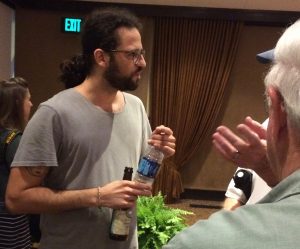
Asked about his favorite Nightscape installation, Rivera paused, ultimately likening the question to naming one’s favorite child. “I love them all for different reasons,” he said.
For Roland, the choice was clearer. “I love the Palm House,” he said. “I love tropical plants.”
Rivera was also asked how he knows when a project is done. “You never know,” he responded. “You just run out of time.”
He said the opportunity to return to Longwood this year brought some challenges as well as some satisfaction. Initially, he found himself “reliving all my terrible decisions.” He said sometimes after asking himself why he had done something a certain way, he came up with the answer: “Oh, that was 4 a.m. a year ago; that’s probably why.”
Because plants grow and change their shape, he said the projections had to be re-mapped for 2016; however, since some of the installations involved only minor changes, Rivera said he was able to focus more on creating an immersive journey.
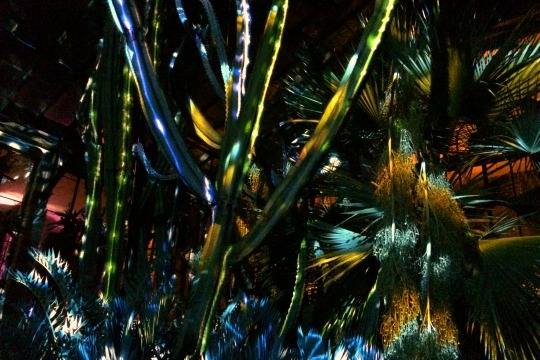
“We tried to fill in gaps this year,” he said, noting that his favorite plant is definitely the bismarkia palm, which is featured in the center arrangement in the Rose Arbor and becomes a kaleidoscopic display during Nightscape.
Originally, Rivera referred to that installation as “The Beacon,” because he wanted visitors to walk through the Visitors’ Center and gravitate toward it, beginning an otherworldly odyssey. From there, guests navigate the Flower Garden Drive, which envelops them in a sea of pulsing light and music.
“As you walk through, stop and look up,” Rivera advised.
Roland also has some counsel for spectators. “If you want to take photos, turn off your flash,” he said, explaining that the camera’s extra burst of light would prevent the desired effect.
Those who want more insiders’ insights should get tickets for Friday, Sept. 9, and Friday, Oct. 7, when the Artist & Friends series will continue. On Sept. 9, Julian Grefe of Pink Skull will join Rivera to discuss how the original music was created and how it has changed from last year.
On Oct. 7, the topic will be “Creating Immersive Realities and Virtual Experiences.” Kevin Ritchie and Mark McCallum from Klip Collective will explain how experiential installations and virtual reality are fostering a whole new way of creating and communicating.
Nightscape, introduced in 2015 as a way to fill the void created by the 2 ½-year restoration of the Main Fountain Garden, will be on view Wednesday through Saturday evenings from 6 to 11 p.m. through Saturday, Oct. 29. Many nights are expected to sell out again since Longwood limits the number sold to keep the exhibit from getting too crowded.
The gardens open at 9 a.m.; however, because the exhibit requires darkness, optimal viewing of Nightscape in August starts at 9 p.m., in September at 8 p.m., and in October at 7 p.m.
Admission is $27 for adults (ages 19 and up); $17 for students (ages 5 to 18); and free for ages 4 and under. For members, tickets are free; however, they need to make advance reservations to obtain them. Chimes Tower members and those included in their membership level do not require reservations.
Nightscape is a rain-or-shine event. If rain threatens, guests are encouraged to bring umbrellas to view the outdoor portion of the display, and comfortable shoes are recommended in any weather. Seeing Nightscape in its entirety takes more than an hour. Visitors who are unfamiliar with the gardens might want to arrive early enough to visit the display sites during daylight, which will make their nighttime transformation even more striking.
Longwood Gardens dates back to 1906, when industrialist Pierre S. du Pont purchased a small farm near Kennett Square to save a collection of historic trees from being sold for lumber. Today, it is one of the world’s great horticultural displays, encompassing 1,077 acres of gardens, woodlands, meadows, fountains, a 10,010-pipe Aeolian organ and 4.5-acre conservatory. Longwood is located on Route 1 near Kennett Square. For more information, visit longwoodgardens.org or call 610-388-1000.
To learn more about Klip Collective, whose installations run the gamut from the Sundance Film Festival to the Philadelphia Flower Show to Nike commercials, visit http://www.klip.tv.

Interim vampires revel in Longwood darkness Read More »