

December 20, 2015

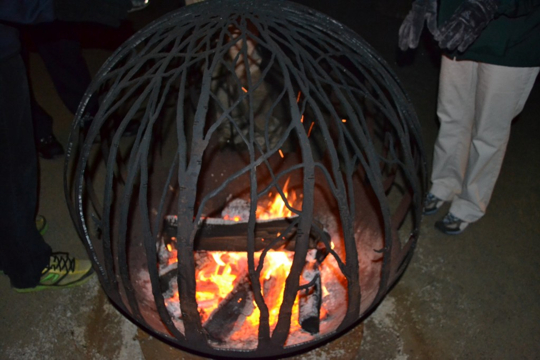
A fire pit in the Hourglass Lake Pavillion warms visitors on Thursday, Friday and Saturday evenings at Longwood Gardens.

Longwood intensifies its holiday glow
A fire pit in the Hourglass Lake Pavillion warms visitors on Thursday, Friday and Saturday evenings at Longwood Gardens.

Longwood Gardens is offering multiple ways to warm hearts this year during “A Longwood Christmas,” including a new fire pit.
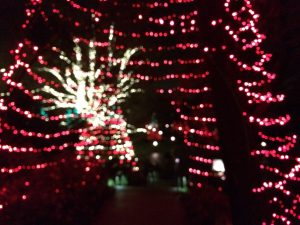
Outside at Longwood Gardens, a half million lights lend a festive air to the grounds.

Although daytime temperatures have been unseasonably high, the mercury has dipped in the evening, making the new glowing feature adjacent to the meadow at the Hourglass Lake Pavilion a popular spot on Thursday, Friday, and Saturday evenings.

Weather permitting, Longwood staffers stoke the aromatic blaze from 4:30 to 9 p.m. The pit itself is constructed from a recycled propane tank, according to Longwood staffers. Nearby, the new Meadow Garden-inspired tree, a 12-foot-tall white fir, features ornaments crafted from materials found or inspired by the Meadow Garden.
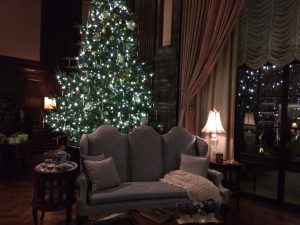
The Music Room inside the conservatory features two large trees decorated
The Music Room inside the conservatory features two large trees decorated with natural materials collected or inspired by the gardens.

In addition to the half-million lights twinkling outside on 124 trees, the heated, four-acre conservatory boasts 16,000 seasonal plants, including poinsettias, cyclamen, and anthurium. Elegantly decorated trees sparkle with fountain-inspired glass ornaments, including a 24-foot Fraser fir adorned with 2,000 crystal ornaments.

This year’s Music Room décor features two 15-foot trees decorated with dried water lilies, hydrangeas, peonies, and yellow roses, all preserved from gardens at Longwood. Fountain-inspired decorations also grace the Silver Garden and the Mediterranean House.

The fountain show in the Open-Air Theater is always a favorite Christmas attraction.

The sounds of the seasons will resound in Longwood’s Ballroom, featuring free and ticketed holiday-inspired performances. Daily holiday carol sing-alongs are scheduled on Longwood’s grand 10,010-pipe organ, and additional free holiday performances, ranging from regional choirs and strolling performers, will enhance the festive atmosphere. For a complete listing of performances, visit longwoodgardens.org.

On New Year’s Eve, the gardens will offer a variety of performances for the entire family. Organ music will fill the ballroom from 3 to 9 p.m.; Rob Dickinson and the Brandywine Christmas Minstrels will perform from 2 to 8 p.m.; and Barbershop Quartet Frank the Dog will harmonize throughout the conservatory from 6 to 9 p.m. Other performances include the brass ensemble GalenaBrass from 4 to 9 p.m. and Olde Towne Carolers from 5 to 9 p.m.
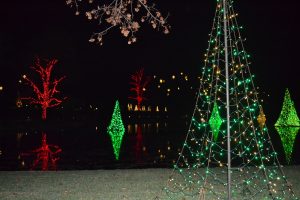
Lights on the Large Lake create a vibrant array of reflections.

Longwood officials recommend checking the gardens’ website to plan visits since sell-outs are frequent. Admission to the Christmas display requires timed tickets, which should be purchased in advance to ensure admittance. Tickets can be purchased online at www.longwoodgardens.org, or in person at Longwood Gardens, which is located on Route 1 in Kennett Square.

Admission is free for all members, but if visiting after 2 p.m. on a Peak Day – Saturdays and Sundays through Jan. 10 and Dec. 26 to Jan. – free, untimed reservations are required.

About CFLive Staff

See Contributors Page https://chaddsfordlive.com/writers/

Longwood intensifies its holiday glow Read More »

Dinniman receives WCU President’s Medal

State Sen. Andy Dinniman was awarded West Chester University’s President’s Medal for Service for his leadership and service to the university, its students and educators, according to a press release from his office.

The award is presented to “a distinguished educator and public servant [who] exemplifies commitment to the mission and values of this university and a spirit of service that has greatly enriched the lives of students, educators and the citizens of the Commonwealth,” the release said.

Dinniman, who has served on the faculty of West Chester University for many years, said he was honored and humbled by the recognition, which was presented by West Chester University President Greg R. Weisenstein during recent commencement ceremonies.

“It’s been a privilege to serve West Chester University, to be a part of the academic and larger community and to contribute in a meaningful way to the scholarly discourse that continues to make public institutions of higher education, like West Chester, so great,” Dinniman said in the release.

Dinniman, who holds a doctorate in education from Penn State, served on the faculty at West Chester University in a variety of capacities over the years, including teaching a popular course in Global Perspectives as part of the university’s Interdisciplinary Course Curriculum.

In the Senate, he serves as minority chair of the Senate Education Committee. In addition, Dinniman has led efforts to make higher education more affordable and accessible to all, such as measures to rein in the rising costs of textbooks and materials.

“Like public service, part of the joy of teaching is having the opportunity to work with a diverse group of individuals from all walks of life,” he said. “I enjoy having the chance to interact with the students and young people who represent the future of our Commonwealth and our nation.”

Dinniman also serves on the Education Commission of the States, the Pennsylvania State Board of Education, the Pennsylvania State Public School Building Authority and the Pennsylvania Higher Educational Facilities Authority.


Dinniman receives WCU President’s Medal Read More »

Rabbinic Reflections: The force of mindsets

Forget the platitudes about giving and receiving. At this time of year, we are all inundated with pressure to think about gifts. Having just survived eight nights of Hanukkah with multiple children, I can tell you that neither giving gifts nor receiving them is without moral complexity. While it may be better to give than to receive, one can give poorly or receive graciously. Under the assault of seasonal consumerism, the goodness of one’s behavior is going to depend less on proverbial teachings and much more on mindset.

Do you see your resources as scarce or abundant? Do you experience life as a rat race, zero-sum game, or as a world of opportunity, community, or grace? When we focus on scarcity, our mind is set to worry, blame, anger, and fear. When we focus on abundance, our mind is set on generosity, confidence, joy, and faith. These mindsets are not mutually exclusive; we inhabit both of them sometimes in balance, other times in alternation, and often singly for extended periods.

With “Star Wars Episode VII: The Force Awakens” opening this weekend, it is hard not to think of Anakin Skywalker’s path from Jedi to Sith, to the “dark side” embodied by his Darth Vader identity, and then of his redemption. When his anger ruled, he was turned. When his son Luke saw the good in him, he overthrew an emperor. I do not know what the new movie holds for us, but I think it is safe to say that the question for the new generation will be whether they can see abundance even when things become scarce.

This year, the Hanukkah candles helped me to see abundance. The ancient rabbis argued whether we should light candles as we do, increasing the number from one to eight, one night at a time, or decreasing the number from eight to one, one night at a time. The Talmud records different reasons from increasing in holiness to paralleling the sacrifices offered in the Temple. The metaphorical difference between the two schools of thought reflects the difference between a world of expansion and a world of status quo limitations. I mentioned that we follow the school that says to increase the light, so too should we increase our openness to abundance thinking.

How much brighter is this time of year than early autumn even though the sun sets earlier in the day? There are lights everywhere. How much more do we think about others (as we try to find the right gift) now than at other times of year? How much more do we, if we get beyond greedy expectation, ideally feel loved as we open gifts? How much more harmony and joy do we experience when we celebrate with others instead of merely showing up to obligatory parties? The actions are largely the same, but the mindset makes the difference.

Rabbi Shlomo Wolbe teaches that there are two parallel worlds matching the abundance and scarcity mindsets: olam ha’yedidut (the world of friendship) and olam ha’zarut (the world of estrangement). The very names of these worlds point to the challenge: if we want to be able to connect to others, we have to recognize scarcity thinking as an estrangement, from others and from ourselves.

Each of us has divine light within. To let that light shine, we must acknowledge that which keeps our flame lonely and that which adds fire, heat, and light in our lives. Sale prices that grab shoppers change rapidly, while finding someone to whom to give a meaningful gift happens slowly. It is easy to get frustrated online or in a store; it is harder to see the variety on a shelf as an opportunity to demonstrate care for another. If, on balance, we do more of the latter, we will increase the holiness in our lives. We will experience more joy, more happiness, more harmony, and more gratitude. By seeing abundance, we can dwell in the mindset that gives us faith to get through winter.

Happy Holidays.

The opinions expressed are those of the author and do not necessarily reflect those of the ownership or management of Chadds Ford Live. We welcome opposing viewpoints. Readers may comment in the comments section or they may submit a Letter to the Editor to: editor@chaddsfordlive.com


About Rabbi Jeremy Winaker

Rabbi Jeremy Winaker is the executive director of the Greater Philadelphia Hillel Network, responsible for West Chester University, Haverford, Bryn Mawr, and other area colleges. He is the former head of school at the Albert Einstein Academy in Wilmington and was the senior Jewish educator at the Kristol Hillel Center at the University of Delaware for four years. Rabbi Winaker lives in Delaware with his wife and three children.

Rabbinic Reflections: The force of mindsets Read More »

Scroll to Top