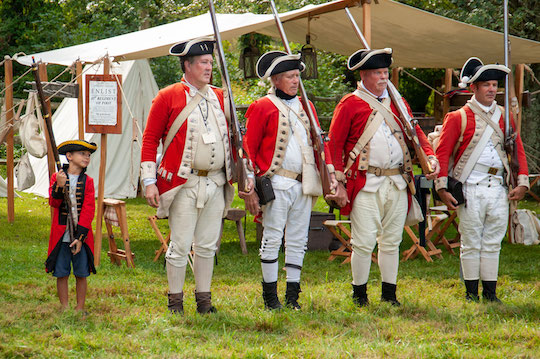
The enlistees get younger every year.Kade Olejack, 7, is the new recruit.
Nature might have cut the two-day battle event at the Chadds Ford Historical Society into a one-day event, but CFHS President Randell Spackman sees Saturday as a success.
“It was successful; it was a good community event,” he said sitting in the office while Sunday’s schedule was being rained out.
He felt Saturday was a “wonderful success that brought history back to Chadds Ford…History is often underappreciated.”
CFHS Operations Director Sandi Johnson said much the same, saying the turnout was wonderful and added, “I hope it brings back renewed interest in history.”
Johnson later added, “The mission of the CFHS is to further educate the public about life in the 18th century and to have a better understanding of the significance of the role this area played in the fight for our independence. The goal of this event was to achieve that and I think overall it was successful.”
Saturday’s event began with a bang as early arrivals were greeted with a cannon salute at 10 a.m. From there, visitors could check out the various camps, talk with the reenactors, listen to talks about the Battle of Brandywine and other facets of Chadds Ford history, listen to live music, and, of course, wait for the skirmish reenactment with cannon and musket fire.
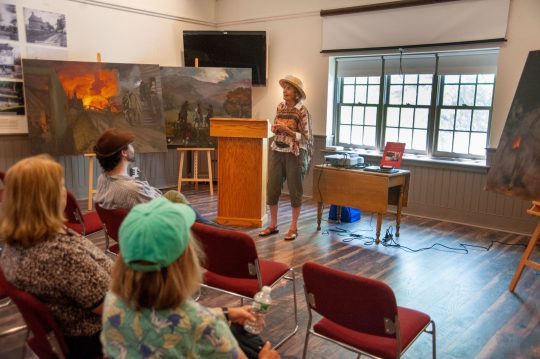
Helen Sipala, of Chadds Ford, gives a talk about the friendship she and her late husband George had with Andrew Wyeth as he painted at their property, Painters Folly.
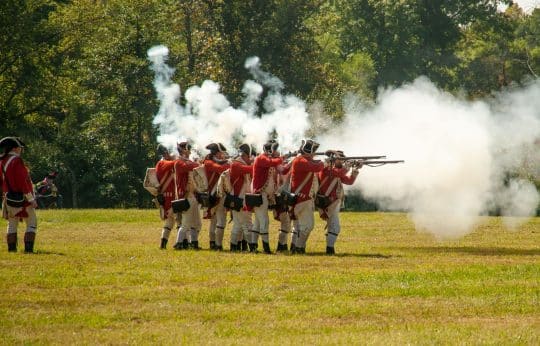
Elements of the 43rd Regiment of Foot chase the colonials from the field of battle.
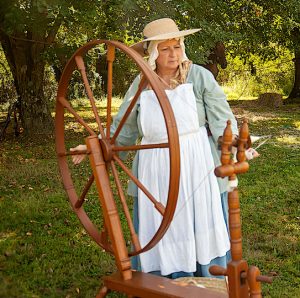
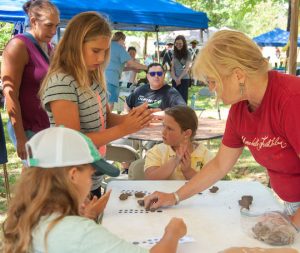
Kathleen Crippen, a camp follower with the 43rd Regiment of Foot, tends to some necessary spinning.Kids learn how their counterparts made marbles in Colonial America.
Rich Schwartzman has been reporting on events in the greater Chadds Ford area since September 2001 when he became the founding editor of The Chadds Ford Post. In April 2009 he became managing editor of ChaddsFordLive. He is also an award-winning photographer.
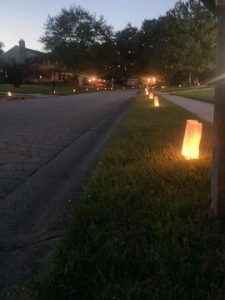
What does the New Year celebrate? The Jewish New Year, Rosh HaShanah, is two weeks away. As part of Judaism’s Days of Awe, it is rich in meaning, and interpreted in many ways throughout the ages. On this 9/11, those interpretations take on additional resonance. Tonight, my neighborhood will place luminaries along our sidewalks to remember the lives lost, the lives changed, and the lights we kindled in response to this day’s events 21 years ago. The paper bags lit from within will be like beautiful towers at once mournful and hopeful.
Luminaries along a walkway in honor those killed on Sept. 11, 2001. (Courtesy photo)
The story of creation begins with God speaking light into existence. One major understanding of Rosh HaShanah is that it is the world’s birthday. The Jewish New Year can mark the birth of the divine light (the sun and moon, and stars are not created until the fourth day), from which all life came to be. In this vein, we celebrate the power of possibility, of new beginnings. We will also celebrate in traditional, liturgical language God’s kingship, crowning God as the Ruler of Creation, the King of King of Kings. The many round foods served on Rosh HaShanah are meant to remind us of this crown.
The ancient rabbis considered an alternative moment as the New Year; they submit that the sixth day of creation, the day of humanity’s creation, is the New Year (Vayikra Rabbah 29:1). More than the creation of humanity, the rabbis focus on the progression of each daylight hour as a major step in humanity’s development including formation, placement in Eden, the command to not eat the fruit of the Tree of Good and Evil, the transgression of that command, judgment, and, at sunset, as the final act of the series of creative days, a pardon. In the rabbinic mind, God pardons Adam and Eve and all humanity as the culmination of creation before resting for the Sabbath. Adam and Eve are exiled from the garden, and they are placed in the sanctuary of Shabbat, with a New Year ahead. The power of this Rosh HaShanah is the power of pardon. Jews spend the 10-day period from Rosh HaShanah to Yom Kippur (the Day of Atonement) seeking to seal that pardon.
Is there a preference for one power over another: possibility or pardon, creation or forgiveness? Jewish wisdom tends to eschew binary thinking. Both are compelling. As Creator, God’s power is undeniably important, and we are asked to remind ourselves and God of that. Yet, does God’s power as Creator have meaning without humanity recognizing and crowning God? Likewise, the power of pardon means God created us flawed. Are our flaws and failure a baked-in part of God’s plan for a more perfect world?
This New Year, I will celebrate the complexity and richness of what it means to be created human. I will celebrate what it means to live in a world of conflict and cooperation. I will celebrate the awe and wonder, the joy and the sadness, the loss and the gain. This New Year, I will focus on the purpose of power as both making life possible and making life about getting up again. May it be a good, meaningful year!
Rabbi Jeremy Winaker is the executive director of the Greater Philadelphia Hillel Network, responsible for West Chester University, Haverford, Bryn Mawr, and other area colleges. He is the former head of school at the Albert Einstein Academy in Wilmington and was the senior Jewish educator at the Kristol Hillel Center at the University of Delaware for four years. Rabbi Winaker lives in Delaware with his wife and three children.