
August 18, 2022

PAW program at WCU

Paw Gallery

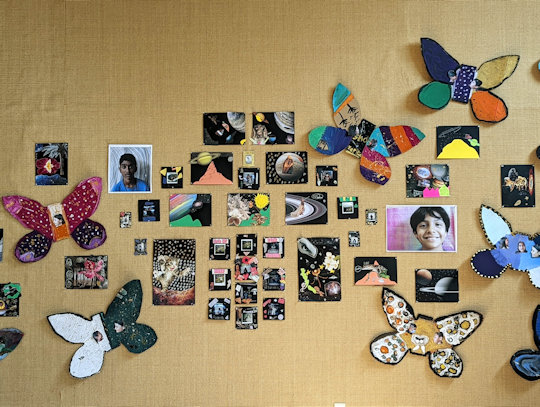
This summer, future photographers and photojournalists spent five weeks at West Chester University at the PAW—Photography and Writing—program. Started in 2021 by WCU professors Yanira Rodriguez and Kuhio Walters. The second year again brought together students in conjunction with West Chester Area School District’s Jump Start program, which focuses on historically underserved students. The program ended with a fantastic exhibition where students not only got to see what they had created, but display their artwork to friends, family, and visitors.

Focus!

PAW introduces a wide range of techniques and skills, from digital photography to using traditional cameras and developing the film in darkrooms to writing pieces to accompany their photographs. “Literacy happens in so many ways beyond specific skill acquisition and it also depends on exposure,” says Professor Rodriguez. “So while we teach photo literacy concepts like framing and point of view and do guided writing prompts, we also value the learning that happens through playful discovery.”

The program focuses on creativity above all. Students enjoyed both the content and the freedom of the program. “I liked the program because we learn to take pictures with cameras and we get to draw too,” one PAW artist said. Another didn’t want the camp to end: “I love the program, I wish I was always here.”

PAW Artist at Work

Rodriguez and Walters carefully considered how to create a program that expanded not just skillsets, but worldviews. “We also think of what knowledge can be relevant to children but are not always accessible to them through their school curriculum,” Rodriguez explains. “And so we make deliberate choices about what art, artists, and concepts we use as examples when we develop our lessons.”

The students work hard over the five weeks of the program, and it all comes together with an exhibit in the John Baker Gallery at WCU. “When they walk into the gallery at the end of the program has to be the most exciting moment for all of us,” Walters says. “Up to that point, the students have seen their photographs and know we’re printing them out to share with the world, but they don’t realize how big the images will look at those large sizes.”

The professors curate the gallery, surprising the students with their images and accompanying writing in a full art show format. “They produce really funny, touching, magical poems, photographs, and art, and when they walk into the Baker Gallery for the first time and see it all, they start pointing, gasping, laughing, running from image to image . . . it’s just an amazing, satisfying feeling of accomplishment for them and us,” says Walters.

PAW Artist

It is an exhilarating experience for all, including the professors and university students that have guided the PAW artists. “For me there are these moments of self-recognition and self-valuation that we get to witness throughout as the kids create art and images and see their own creations take form,” Rodriguez says. “It brings me deep joy to witness how the kids see and value their own and each other’s work.”

There is more than just pride in their artwork for the young artists. “Kids get to see themselves and their work valued in spaces they do not usually have access to,” Rodriguez explains, “which is why we wanted to have the kids work exhibited in a gallery at the University, as if to say, you belong here and we want you to join us when you are older.” Sharing that vision is important for not just the students. “My hope is everyone who comes to the exhibit can bask in the brilliance of these young creators, and value the knowledges, messages, and visions they are trying to share with us about the world we live in and the world we need to co-create.”

Walters has a similar vision for the program. “I hope the students take away a feeling of pride and accomplishment in their art, and a belief that their voices and their experiences matter.” In the world we live in today, this is so important for all ages. “I hope the parents feel validated and inspired to keep talking to their children about all the things emphasized by the exhibit—art, the value of literacy and self-expression, the importance of drawing strength and sustenance from one’s home community. And I hope the community at large and the university itself sees these students as a resource to be treasured—our future college students, our future leaders.”

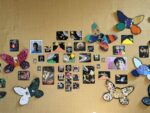
“This year we subtly worked with the theme of Another World is Possible,” Rodriguez says. This led to one of the motifs of the program, which inspired students throughout. As one future artist eloquently sums up the program, “Pintar las Mariposas”—Paint the Butterflies.

The PAW Program runs in the summer at West Chester University in conjunction with Jump Start of the West Chester Area School District. The exhibit was held at the John H. Baker Gallery in the E. O. Bull Center for the Arts, located at 2 E. Rosedale Avenue, West Chester, PA. For more information, check WCUPA.edu/arts-humanities/artdesign and on Instagram @artsatwcu.



About Victoria Rose

Victoria Rose (she/her) is an editor, writer, avid reader, self-described geek, and fan of all things creative. Her passion for words has led to her current career as a freelance editor, and she is the owner of Flickering Words, an editing service. When not wielding a red pen (or cursor), she loves reading books of all genres, playing video, board, and word games, baking ridiculous creations to show off on the internet, or enjoying the gorgeous outdoors. She is a board member of the West Chester Film Festival and part of the Thirsty Monsters, a team of streamers from around the world who fundraise for various charities supporting LGBTQIA+ and accessibility rights. She can be found online @WordsFlickering or the Brandywine Art Guide @BrandywineArtGuide.

PAW program at WCU Read More »

Op/Ed: U-CF distorts the truth

At its meeting on Aug. 15, the Unionville-Chadds Ford School Board tabled proposed amendments to Policy 203. According to its president, the board did so out of a concern for fairness and a desire to get things right. That is a remarkable distortion of the truth.

Policy 203 has an interesting history. It was adopted in 2017 and gave the school board the authority to require families to follow validly adopted laws and regulations regarding immunizations and certain disease control measures. In other words, from 2017 until 2021 the school district only had the authority to require families to comply with valid lawspassed by the state General Assembly or the U.S. Congress, even though it behaved otherwise starting in August 2020.

By 2021, just as citizens stripped Gov. Wolf of his self-claimed and oppressively-wielded emergency powers, “the state” coincidentally instructed our supposedly independent school board to adopt amendments to Policy 203 that radically expanded the school board’s authority and would require families to follow not only validly adopted laws but also things like “local guidance,” “board policy” and “board-approved health and safety plans” on matters of fundamental personal liberty like mandatory masking and vaccines. The school board dutifully obliged and unanimously adopted those amendments without any discussion.

As a matter of basic civics, however, public schools can only adopt policies that implement authority expressly granted under the governing statute. Contrary to their behavior over the last two years, school boards don’t have the authority to tell you to do whatever they want you to do. The process of adopting policies takes about two full months and the matter is on the agenda for at least six meetings (three work sessions and three board meetings), which in theory gives the board time to publicly debate things like whether the amendments are necessary and whether the district has the legal authority to enforce the policy as proposed.

Yet, over the six meetings in 2021, the school board devoted less than a minute of public discussion to Policy 203. When the policy was back on the agenda for six meetings in 2022, the board spent less than a minute discussing the scope of their authority or how much power the district should have to determine whether a parent’s religious or deeply held moral/philosophical beliefs are a valid reason to allow that parent to decide what is best for her children. They didn’t think the issue warranted a robust public discussion even though (or maybe precisely because) they used this new authority to deny many religious and moral/philosophical exemptions over the last two years.

When I discovered the shockingly broad authority the school board unlawfully gave itself, I privately demanded that the board explain what statute they believe gives them this broad authority. They never answered. I persistently reminded them that the district was acting without proper legal authority and was harming children in the process. They never responded. After the state Supreme Court reached the same conclusion in December 2021, I again asked the school board to address this matter and to allow me to speak with the district’s solicitor. They still ignored me.

After being stonewalled for two years, I took this issue to two state senators who have oversight responsibility for public schools and for the health and safety of children. In June 2022, one of those senators sent a letter to the district seeking information about the May 2021 amendments to Policy 203. In what was probably just another coincidence, that is the same month the newly proposed amendments to Policy 203 first appeared on the school board’s agenda. Yet, over the next five board meetings, not one school board member or administrator made a single public comment about the controversy over Policy 203 or publicly acknowledged the fact that a state senator was asking questions about it.

On Aug. 4, the district finally responded to the senator but did not answer a single question or provide a single record he requested. Instead, the superintendent and school board president embarrassingly claimed that the reason it took nearly two months to respond was because the letter got lost in the mail. That letter asked questions like: Where does the district believe it has the statutory authority for the 2021 amendments to Policy 203, and what did the Unionville board member mean when he said “the state” told the district it had to amend Policy 203? The district has not answered those questions (or many others) for two years — first from parents in this district and now from the chairman of the Senate Education Committee. Why is that?

Don’t take my word for it, though. If you’re curious, go to the next school board meeting and ask the district if this is true. Ask them if an email they received after the Aug. 8 work session had anything to do with their abrupt decision to “table” amendments that they would have otherwise (unanimously) adopted on Aug. 15.

Unfortunately, they will most likely refuse to publicly discuss this matter, just as they refuse to publicly discuss the misconduct by Patton middle school employees that was exposed through public records earlier this year. If you’re lucky, though, the superintendent will offer to meet with you privately, where he will most likely tell you there is really nothing to worry about. This is Unionville. Just trust them.

Chad Williams
Birmingham Township

About CFLive Staff

See Contributors Page https://chaddsfordlive.com/writers/

Op/Ed: U-CF distorts the truth Read More »

Around Town Aug. 18

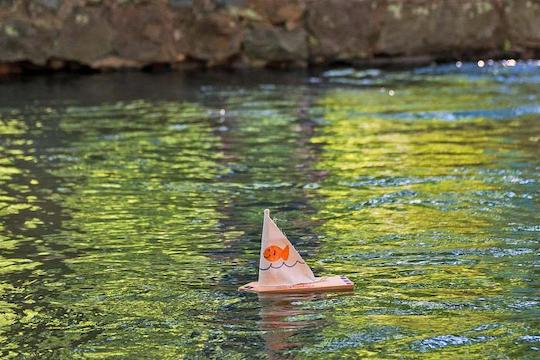
Learn what floats your boat at Hagley Museum on Aug. 27.

Kids can learn how to float their boat at Hagley Museum on Saturday, Aug. 27. Visitors can learn about buoyancy, density, and how boats stay afloat. Folks from the Kalmar Nyckel will be on hand to give a demonstration. This is a drop-in activity running from noon to 4 p.m. and is part of Hagley’s Summer Saturdays Program. Activities are included in the price of admission.

The Chester County History Center at 225 North High Street in West Chester will hold two walking tours of the Underground Railroad in West Chester next week, Wednesday, Aug. 24, from 6:30 to 8 p.m., and on Saturday, Aug. 27, from 11 a.m. to 12:30 p.m. The tour covers approximately 1.25 miles, lasts 90 minutes, and is entirely outdoors; sidewalks and terrain may be uneven. The event is rain or shine, so please dress for the weather. The cost is $15. Register here.

Bike the Brandywine returns on Sept. 17.

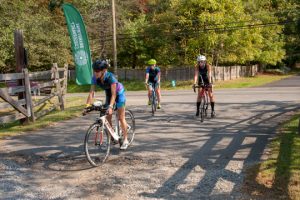
Bike the Brandywine is back. On Saturday, Sept. 17, cyclists can explore the scenery, glimpse the history, and discover the lure of the Brandywine Valley while peddling through the countryside after choosing one of three different routes with distances of 25, 45, or 62 miles. The event is run by the Brandywine Conservancy, and cyclists begin and end the ride at the Chadds Ford Historical Society. The cost is $55, and proceeds from the ride help support the Conservancy’s work in land preservation, land stewardship, and conservation services in the pursuit of clean, safe drinking water for our region. Register here.

The Unionville Community Fair is celebrating its 98th anniversary this year. The event, featuring the largest display of local agriculture, agribusiness, and handicrafts in southeastern Chester County, is set for Sept. 30 through Oct. 2 at 113 E. State Street in Kennett Square.

Chadds Ford Historical Society Director of Operations Sandi Johnson, center background, teaches women of the 1st Delaware Regiment how to bake bread colonial style, using the beehive oven at the John Chads House.

About CFLive Staff

See Contributors Page https://chaddsfordlive.com/writers/

Around Town Aug. 18 Read More »

Scroll to Top