

Latest Wyeth exhibit a must-see for fans

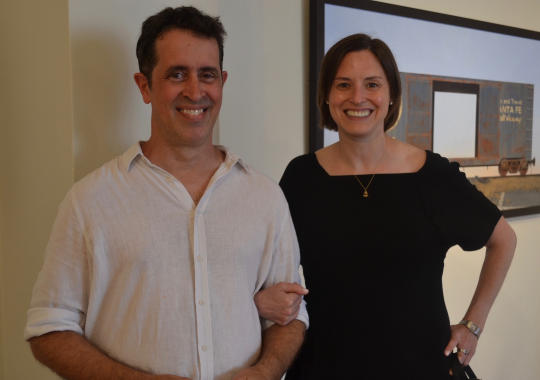
The youngest member of the Wyeth dynasty experienced a moment of disbelief as she entered the Stanek Gallery in Philadelphia last week to see more than 20 of her photographs on display.
“It seems like this should be an opening for one of my relatives,” said Victoria Browning Wyeth, 39, whose famous kin include her grandfather, Andrew Wyeth; great-grandfather, N.C. Wyeth, and uncle, Jamie Wyeth. “This feels surreal.”
But as she walked around the exhibit – a dual show that shares the space with contemporary painter Francis Di Fronzo – excitement and enthusiasm replaced the initial shock. She approached one of several photographs of her grinning grandfather and affectionately brushed her hand along his nose.
“He’s just so cute,” she exclaimed. “I wish he were here to see this.”
Wyeth fans will certainly feel the late painter’s strong presence. The many photographs featuring him date from the early 1990s to his death in 2009. In addition, Andrew Wyeth played an influential role in shaping Di Fronzo’s artistic odyssey, providing the California native with invaluable inspiration during a childhood injury.
Gallery director Katherine Stanek got the idea for the dual show, which she named “Storytellers,” after hearing both artists discuss Andrew Wyeth’s role as muse. What fascinated Stanek, she said, was the realization that both drew inspiration from him but used it to forge their own unique styles.
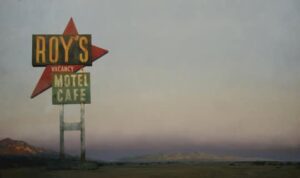
The pairing serves both well. No one is likely to mistake a Di Fronzo painting for one by Andrew Wyeth; however, the 48-year-old painter’s meticulous attention to detail and penchant for creating his own vision pay homage to Wyeth. Some of Di Fronzo’s paintings spotlight actual subjects, such as Roy’s Motel in “Before Sunrise,” but a depiction of a cargo ship named Alice May in “Night Flight” embodies his interpretation of an aging freighter.
Di Fronzo utilizes a painstaking process, not unlike Wyeth’s favored tempera, which required a precise mixture of pigments with egg yolks. Di Fronzo creates his exacting details by working on his paintings in two stages. The first involves applying watercolor and gouache to a canvas on a horizontal plane; during the second stage, oil paint is added while the painting rests in a vertical position. The result produces textures that invite scrutiny, such as peeling paint or rust that appears ready to flake off the canvas.
Andrew Wyeth’s influence also permeates his granddaughter’s work. Her photos reveal the type of creative perspective, eye for detail and pivotal narrative that fascinated her grandfather. They also offer an insider’s insight into Andrew Wyeth’s world, presenting images that demand a closer look.
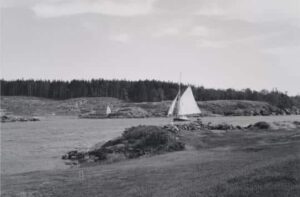
While some of the exhibit’s photographs capture Andrew Wyeth’s infectious laugh, others showcase locales that appeared on his canvasses, such as the Kuerner Farm in Chadds Ford or Benner Island in Maine. “Nome at the Mill,” taken at the Chadds Ford residence of Andrew and Betsy Wyeth in 1994, juxtaposes some familiar images, such as the Wyeths’ dog and the home’s exterior stone wall, with less familiar ones: an Urban Outfitter’s carton that contained an Easter present for Victoria.
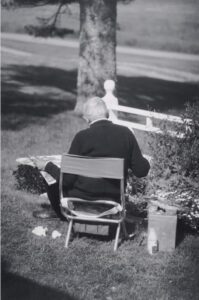
“Andy Painting ‘Only Child,’” reveals the painter honing his craft in 2000. His granddaughter, the painting’s subject, snapped the photo from behind him as she was returning to resume her posing. In 1994, “Andy Reclining in Studio” captures him sleeping at an angle that required her to step on him to get the shot. And despite the shock of being awakened with a camera lens in his face, her grandfather embraced and nurtured her photography, Victoria Wyeth said. In fact, he quickly became one of her favorite subjects.
Even a shadow of Victoria Wyeth that cleverly doubles as a self-portrait boasts a connection to Andrew Wyeth that extends beyond genetics. Area residents may recognize the backdrop since the photo was taken from the driveway of the Wyeths’ Chadds Ford home.
Victoria Wyeth traces her love of photography back to the seventh grade when she received a Canon AE-1 camera from her mother as a gift. She has been using it ever since. She said she experimented briefly with color film but always seemed to prefer the nuances of black and white.
Over the years, her photographs became focal points at her grandfather’s various exhibits, and in 2017, her work appeared in two museum shows. She said when the opportunity to make her gallery debut surfaced, she was ready – and thrilled.
“This is like a family photo album,” she said as she surveyed the exhibit. “It’s very special.”
“Storytellers” will run through Oct. 27 at the Stanek Gallery, located at 242 N. 3rdSt., Philadelphia, Pa., 19106. On Saturday, Oct. 13, from 1 to 3 p.m., Wyeth will give a special lecture at the gallery entitled “My Andy.” The free program promises an intimate look into her grandfather’s world and its impact on her own artistic evolution.
Those who think they’ve already heard the presentation – Wyeth has given similar talks at various venues – should know that her unscripted approach and ebullient delivery make each one very different. To reserve your spot, visit https://www.eventbrite.com/e/my-andy-a-lecture-with-victoria-browning-wyeth-tickets-48302606396.

Latest Wyeth exhibit a must-see for fans Read More »