
Art Watch: Stop, look, and read
As most of Chester County knows by now, July 2017 marks the 100th anniversary of the birth of artist Andrew Wyeth, which is being celebrated locally in an exceptional exhibit at The Brandywine River Museum of Art, “Andrew Wyeth: In Retrospect.” The Brandywine River Museum of Art offers an opportunity to see over 100 works by Andrew Wyeth, created from age 20 to his last known painting done at the age of 91, from sketches to large scale masterpieces. The exhibition was three years in the making, with network of scholars, art lovers and museums around the world working together to present a once in a lifetime opportunity to explore the talent of this iconic American artist. Open to the public through September 17th, this exciting show will forever change the way you look at Andrew Wyeth’s work.
For those of us who live in the Brandywine Valley, Andrew Wyeth’s work may seem over-familiar. Wyeth prints abound in restaurants, shops, and frame stores. Andrew Wyeth is everywhere. With such repetition, particularly of certain images, they become less interesting and we move on. The Brandywine River Museum of Art’s “Andrew Wyeth: In Retrospect” is guaranteed to awaken your artistic senses. In fact, it is like seeing Andrew Wyeth’s work for the first time. It is an extraordinary accomplishment.
Visit the museum, start at the beginning, with Andrew Wyeth’s earliest paintings, stop, look, and listen to the stillness. Careful time and attention was given to the placement of each image, moving with the chronology of time and period, but also juxtaposing imagery that carries on a theme in a different way, or offers examples of a few of his hundreds of sketches that he made, next to a final work. You get a palpable feeling of what Andrew Wyeth is aiming for, as you bear witness to the development of the artist through the decades.
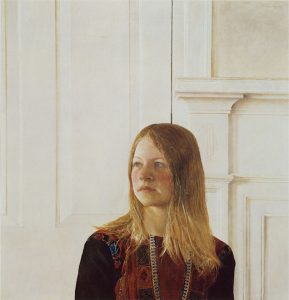
When you visit the show, it is always interesting to read the commentary on the paintings. Look first, read second, and then look again. Normally, the written information next to a painting is interesting, but not necessarily compelling. At the Museum, the information offers some personal insight into the story behind the scene or the portrait. A bit of story encourages us to look again and see new things. Andrew Wyeth’s talent with a brush is mesmerizing, but when you understand something about the subject matter, his work becomes more intriguing. You learn about the people that he painted, the places that were important to him, and what he edited out to reveal his own personal symbolic realism. Andrew Wyeth strips down his subjects, and his painting techniques are completely exposed as well; every stroke, every splash, give clear evidence of the undisguised hand of the painter.
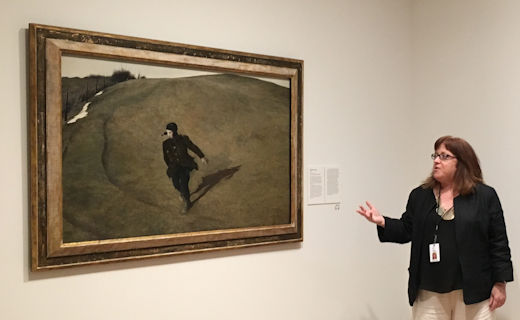
So much of his work has a sense of death, loss and isolation, but when you are in a room full of his work, Andrew Wyeth’s world can seem almost cinematic in scale, soaring, beautiful, painful and heroic. In a recent tour of the museum, the show’s co-curator, Audrey Lewis, revealed many little known stories about events that had an impact on the artist’s world, including that he had seen a particular silent war film over a hundred times.
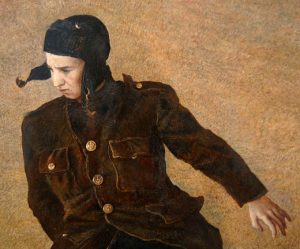
Standing in front of Andrew Wyeth’s 1946 painting, “Winter”, which was Andrew Wyeth’s first painting made after the death of his father N.C. Wyeth, Audrey Lewis discussed different influences on the creation of that painting. She said that young Andrew Wyeth saw a King Vidor’s silent film from 1925, called “The Big Parade” over one hundred times. I couldn’t help thinking that if I ever watched a film with no sound about the horror of war and the welcome of what is home, over a hundred times, that it would affect the way I see life and represent it. But then, I would never have sat and watched a movie like that more than once, so, it spoke to him, and he spoke back. The movie deals with an American soldier’s return home from fighting in World War One, and the last scene in the movie features an enormous hill that the soldier walks down. The movie has many themes and images that recur throughout Wyeth’s work.
How often do large hills dominate the Wyeth paintings? The large hill of the Kuerner Farm loom over the whole painting “Winter” as a teenage boy runs down the hill. Wyeth worked on “Winter” for over a year, and this is the final image that he chose to represent his father’s death and the artist’s loss. Think if your father, mentor, greatest person you have ever known, dies tragically in an accident on the very land that you were raised to love and admire. You never said goodbye, you are young, home schooled and isolated, and now you are tasked with creating an image to stand for your grief, honor his memory, and somehow raise the personal story to a grander statement about life and death. The personal way the exhibition is revealed, encourages this kind of musing, to see the great swirl of art and life that Andrew Wyeth lived and breathed.
The Brandywine River Museum of Art’s “Andrew Wyeth: In Retrospect” will be on view through September 17th. Throughout the coming months there are many opportunities to hear curatorial discussions, docent tours, and other exhibition related events to enhance your experience of viewing the exhibition. The museum also offers tours of the Wyeth studios, the much-painted Kuerner Farm, as well as art workshops, tempera demonstrations, music performances, a terrific cafeteria overlooking the Brandywine River, and a wonderful gift shop. The exhibition catalogue is a remarkable book written with chapters of scholarly insight and personal reflections from different perspectives and has over one hundred art reproductions. It is an important book to have in your collection, and a great book to give as a special gift.
This Wednesday from 1-1:30 pm Art Watch Radio WCHE 1520 has guest host Margaret Winslow, Curator of Contemporary Art at The Delaware Art Museum, speaking with guest Michael Komback, Director of Creative Vision Factory in Delaware. Check into Art Watch Radio every Wednesday from 1-1:30 for interesting interviews and discussion about art happenings in the Brandywine Valley.

About Lele Galer
Lele Galer is an artist who has chaired numerous art shows, taught art history and studio art, public art and has chaired, written and taught the Art in Action Art Appreciation series for the UCFD schools for the past 12 years. She worked at the Metropolitan Museum of Art, and wrote for the Associated Press in Rome. She has been dedicated to Art History and art education for most of her adult life. Lele and her husband Brad own Galer Estate Winery in Kennett Square.
- Web |
- More Posts(141)
Art Watch: Stop, look, and read Read More »