
February 6, 2017

Chesco sheriff welcomes 7 new deputies

Following an eight-week training regimen that ended last week, seven new deputy sheriffs will be assuming duties throughout Chester County, and Sheriff Carolyn “Bunny” Welsh couldn’t be prouder.

“I call them the Magnificent Seven,” said Welsh, praising their backgrounds and attitudes. “The selection process for deputy sheriffs is very competitive. These men were exceptional, and I’m so pleased to have them as part of our agency.”

Sheriff Capt. Jason Suydam explained that the new hires, who started in November, participated in three weeks of orientation. Eight weeks of field training followed, offering an opportunity to experience the multitude of sheriff’s duties, such as handling courthouse security, prisoner transport, fugitive apprehension, civil processing, and gun permits.

The newest members of the office share a love of the outdoors with enthusiasm for the job, repeatedly listing the chance to help others and make a difference as key benefits of the position.

Joel W. Buccialia, 24, a native of Newtown Square, wasn’t positive that law-enforcement would be a good fit for him when he enrolled in Delaware County Community College’s Police Academy. By the time he graduated in 2012, he was hooked and immediately enrolled in an administration of justice program, receiving an associate’s degree in 2014.

While he was in school, he worked as a security officer, fueling his desire to complete his Act 120 certification. In his spare time, Buccialia is likely to be outdoors, pursuing interests that include four-wheeling, camping and hunting.

Brian M. Carr, a 28-year-old who grew up in Phoenixville, graduated from Immaculata University with a criminology degree in 2014. He then attended Delaware County Community College’s Police Academy, completing the program in 2015.

Carr, an Eagle Scout who was active in Valley Forge Boy Scout Troop 73, said his drive to pursue a law-enforcement career was inspired in part by his father, a U.S. Navy commander. When he’s not working, Carr said he enjoys working out and other physical activity.

Mario J. Dioguardi, a 24-year-old native of Broomall, attended Penn State and then West Chester University, where he received a criminal justice degree in 2015, the first member of his family to pursue law enforcement. He graduated from Delaware County Community College’s Police Academy in 2016.

A seasoned athlete, Dioguardi played ice hockey, football and baseball teams at various times in high school and college. He continues to play roller hockey and softball, and when time permits, he has enjoyed coaching baseball at his former high school.

Peter S. Gardner, 26, spent his childhood in Merion and recalled being unsure of his career path when he was a junior in high school. A teacher, assessing Gardner’s demeanor and work as a volunteer firefighter, steered him into law enforcement by suggesting he would make a good U.S. marshal. Gardner went on to complete fire and police training at the Montgomery County’s Municipal Police Academy.

Gardner has been active with the Philadelphia Police Explorers, a program that provides police academy-style training to members of ROTC and Boy Scouts ages 14 to 21. Off the job, Gardner spends a lot of time outdoors, riding his motorcycle or hiking in one of the county’s preserves.

Christian J. Medina, a 23-year-old Coatesville native, found inspiration to become a police officer from his father, whose dream of pursuing a police career after enlisting in the Army was interrupted by parenthood. Medina said his father’s passion for law enforcement manifested itself in numerous ways, including his car choice: a used police vehicle. Medina embraced those sentiments, honored to fulfill his father’s elusive dream.

Medina graduated from Delaware County Community College’s Police Academy in 2016. He counts basketball, bowling, and movies among his outside interests.

CaTray D. Parker, 23, envisioned a career in law enforcement as a boy growing up in Lancaster. His extensive training includes EMT and firefighting courses at the Protective Services Academy in Lancaster County, completion of National Guard infantry training at Fort Benning, Ga., in 2014, and graduation from Delaware County Community College’s Police Academy in 2015.

Parker enjoys wrestling as well as coaching wrestling and can often be found cheering at his old high school, where his little brother is on the team. He has been told to expect deployment in 2018, most likely overseas.

Josue D. Pifer, 25, received career inspiration from his grandfather, who worked as a police officer in Mexico City, as well as a West Whiteland Township officer who offered periodic encouragement as Pifer grew up in Exton. After working as a roofer for several years after high school, Pifer enrolled in Delaware County Community College’s Police Academy, receiving his certification in 2014.

One of his early thrills in his new post occurred when his West Whiteland mentor spotted Pifer in the Chester County Justice Center. Pifer, who is bilingual, shares his co-workers’ love for outdoor activities, especially fishing and trap shooting.

Chesco sheriff welcomes 7 new deputies Read More »

Pedro Perez Lara of Kennett Square

Pedro Perez Lara, 50, of Kennett Square, died Friday, Feb. 3, at the Brandywine Hospital. He was the husband of Maria Guadalupe Cisneros.

Born in San Isidro, Yuriria, GTO, Mexico, he was the son of Jacinto Perez and Maria Lara of Mexico.

He was a laborer at Gama Mushrooms in Kennett Square.

Pedro enjoyed working, going to the casinos, helping others and living life to the fullest.

You are invited to visit with his family and friends from 5 to 7 p.m. on Friday, Feb. 10, at St. Rocco Catholic Church, 333 Sunny Dell Road in Landenberg. His Funeral Mass will follow at 7. Burial will be in Mexico.

Online condolences may be made by visiting www.griecocares.com

Arrangements by the Cleveland & Grieco Funeral Home, Avondale, Pa.

About CFLive Staff

See Contributors Page https://chaddsfordlive.com/writers/

Pedro Perez Lara of Kennett Square Read More »

‘From Homer to Hopper’ opens Feb. 25 at BRM

Fifty-four paintings by Stuart Davis, Arthur Dove, Thomas Eakins, Marsden Hartley, Childe Hassam, Winslow Homer, Edward Hopper, Jacob Lawrence, Georgia O’Keeffe, Horace Pippin, Maurice Prendergast, John Sloan, and many others that reflect the rich diversity of style and expression in American art created between 1870 and 1950 will be on view at the Brandywine River Museum of Art staring Feb. 25.

“From Homer to Hopper: Experiment and Ingenuity in American Art,” organized by The Phillips Collection in Washington, D.C., traces the course of American modernism in the works of these artists—from the bold, investigative realism of Winslow Homer and Thomas Eakins at the end of the 19th century to the reductive views and psychological insights of Edward Hopper and Morris Graves at mid-20th century.

The Phillips Collection, founded in 1918 by Duncan Phillips and opened in the Phillips family home in 1921, has always championed modernism and the rich diversity of America’s talented artists. Phillips formed his groundbreaking collection with a strong emphasis on works by artists whose critical thinking and creative originality raised American art out of relative obscurity.

He challenged the perceived superiority of European over American art and sought works by women, artists of color, and native and foreign-born artists, as well as those who were self-taught, so that the collection represented a “fusion of various sensitivities” and a “unification of differences” that would parallel the multicultural character of the nation.

The Phillips Collection was the first museum to give living artists solo exhibitions, and Duncan Phillips’s support for American artists through acquisitions, commissions, exhibitions, and financial stipends was a critical factor in the careers of many.

"Contemplation," by Jacob Lawrence..
“Contemplation,” by Jacob Lawrence..

The exhibition presents a thematic chronological journey outlining Duncan Phillips’s broad collecting interests and major developments in American art. In recognition of the important connections between modern artists and the artistic innovators of the past, the exhibition begins with Romanticism and Realism. This section includes late 19th-century artists such as romantic painters George Inness and Albert Pinkham Ryder and innovative realist painters Winslow Homer and Thomas Eakins, whom Phillips viewed as America’s modern “old masters” who looked for alternatives to the prevalent art idioms of their time.  A witness to the heroism of mariners along the coast of Maine, Homer succinctly captured man’s universal struggle against nature in works such as “To the Rescue” (1886) by distilling key elements to their most compelling components.

The exhibition “From Homer to Hopper: Experiment and Ingenuity in American Art” provides a unique opportunity to see and experience the stunning range of artistic innovation in the United States between 1850 and 1950. Duncan Phillips was ahead of his time in finding, fostering, and collecting works by artists who were guided by their individual visions rather than popular trends. This exhibition celebrates that achievement and the diversity and innovation of American art.

Impressionism reveals the impact of French Impressionism on Childe Hassam, Theodore Robinson, John Henry Twachtman, and Julian Alden Weir. Adopting the spirit rather than the letter of the French model, American artists took up painting en plein air and applying pure unmixed color in dabs and expressive brushstrokes even as they favored a more silvery palette and a reluctance to dissolve form with color. Their subjects were those of their French counterparts—people at leisure or strolling down elegant city avenues, American life painted with a sparkling sense of light, color, and atmosphere.

In the 20th century, several artists moved away from the influence of Impressionism and its heightened use of light, color, and texture. Forces in Nature presents a new kind of expressive realism in paintings by Rockwell Kent, Marsden Hartley, John Marin, and others who were enthralled by rugged, remote locales untouched by modern civilization. These American modernists chose to explore dramatic and remote landscapes in isolation to convey a personal sense of place through their paintings. They intuitively grasped nature’s raw elemental power and met it head on.

In the aftermath of WWI, another group of American artists looked for meaning through a spiritual interpretation of nature. Nature and Abstraction showcases the works of Arthur Dove, John Marin, and Georgia O’Keeffe, who were among the first wave of artists in the United States to work in a conceptual rather than representational mode of art. Encouraged by photographer and gallerist Alfred Stieglitz and inspired by the theories of Wassily Kandinsky, these American artists pared away surface realism and context, using color, line, and form to express the inner essence of things and their connection with nature. Escaping urban centers for rural New England, Long Island, and the austere desert landscape of New Mexico, these artists distilled landscapes into their basic geometric forms, using emotive color and modulated tones, as in Arthur Dove’s painting “Red Sun” (1935).

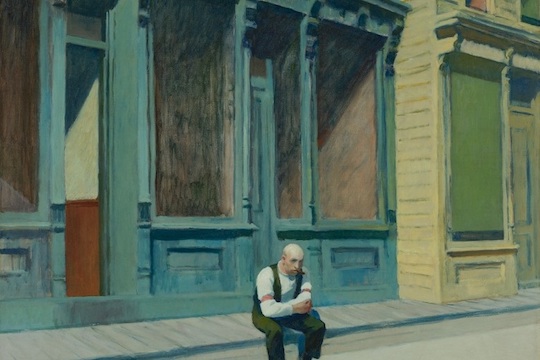
Modern Life features works created during the early decades of the 20th century that reflect the impact of industrialization on American life. In their paintings, George Bellows, Guy Pène du Bois, and Edward Hopper delineated a new undercurrent of tension and disquiet in American life. In Sunday (1926), Hopper isolates a shopkeeper on an empty street lined by buildings with vacant windows. His use of acidic colors heightens the sense of dislocation and alienation.

The City presents works by artists who embraced the new face of urban America through its architecture, engineering, and industry. Charles Sheeler, Ralston Crawford, and Stefan Hirsch analyzed and translated structural forms in the urban landscape into abstract precisionist designs.

"Large Dark Red Leave on White," by Georgia O'Keeffe
“Large Dark Red Leave on White,” by Georgia O’Keeffe

They abandoned modulated form, preferring to organize their urban imagery into simple lines, flat geometric shapes, and repeating patterns, using neutral tones shocked with red and yellow, and sharp contrasts between black and white to convey the scale, weight, and distance of structures. Eliminating people and nature from their paintings, these American modernists portrayed a dual message about the triumph and eclipse of man in the modern age.

Memory and Ienity brings together works by Horace Pippin, Jacob Lawrence, Yasuo Kuniyoshi, Allan Rohan Crite, and others who painted the unique voice of non-white communities and the immigrant experience in America. Their social realism, a blend of representation and abstraction, vividly captured the physical reality and emotional tenor of the country’s poor and oppressed. A leader in this movement was Jacob Lawrence, whose series “The Life of Toussaint L’Ouverture” (1937-38) — translated into silkscreen prints that appear in this exhibition — were his first works dedicated to the depiction of black life and history.

Awareness of the broadening ethnicity of the country’s population also brought increased attention to American folk traditions in art. The exhibition’s paintings by Doris Lee, John Kane, and Grandma Moses demonstrate their interest in simplified descriptive views that capture the day-to-day rituals of rural and small-town life in America.

Legacy of Cubism highlights artists working in the 1920s and 1930s — Stuart Davis, John Graham, Karl Knaths, George L. K. Morris, and Bradley Walker Tomlin—who identified with the ideals of Cubism. That art movement was born in France and early in the 20th century and burst onto the American scene in 1913 at the Armory Show in New York, stunning the public with its radical reinterpretation of the physical world based completely on geometric form. While repellent to some, the new movement was revelatory to artists who chose to break completely from traditional modes of representation. Freeing themselves from representational styles, American artists braved overt criticism of their experimentation with Cubism’s new ideas about the order and balance of objects in spacer.

In the final section, Degrees of Abstraction, Arthur Dove, Morris Graves, Marsden Hartley, and Theodoros Stamos took abstraction beyond Cubism. They explored ideas about philosophy, mathematics, science, religion, and music as influences for their art. Morris Graves integrated Far Eastern philosophies such as Zen Buddhism and Taoism in brooding metaphorical images of plants, animals, and birds. Arthur Dove bridged the divide between Cubism and representation by keeping recognizable forms embedded within his organic, amorphous shapes.

‘From Homer to Hopper’ opens Feb. 25 at BRM Read More »

Scroll to Top