

November 13, 2016

Free film to offer insight into mental illness

The Hadley Fund is inviting area residents to a free screening of a documentary film that focuses on the poignant story of a songwriter’s battle with mental illness.
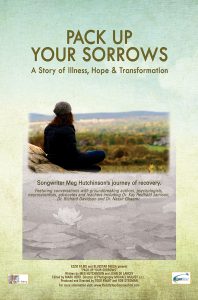
PuYS_Poster-FINAL_qrtr
The documentary will be shown on Saturday, Nov. 19, at 2 p.m. at West Chester University’s Sykes Theater.

“Pack Up Your Sorrows: A Story of Illness, Hope & Transformation” will be shown on Saturday, Nov. 19, at 2 p.m. at Sykes Theater at West Chester University. The film chronicles the story of singer-songwriter Meg Hutchinson as she learns to live a healthy life with bipolar disorder. A Q&A with Hutchinson will follow the screening, a Hadley press release said.

Through Hutchinson’s eyes, viewers will explore different aspects of mood disorders–– how families try to deal with the illness in their midst, the biology of these diseases of the brain, and the effects of traditional and alternative therapies like medication and meditation. Along the way, Hutchinson seeks to understand the role mental illness has played in the lives of authors and historical figures, the release said.

In addition, Hutchinson asks some of her heroes what steps society can take to reduce the epidemic of suicide, especially among young people. Viewers will learn, as Hutchinson has, that these illnesses of the brain are not a moral failing or a character weakness, and that treatment options are improving.

The film, which was released in 2015, features interviews with leading psychologists, neuroscientists and advocates. It has been hailed as a vital tool in reducing the stigma associated with mental illness. It aims to diminish discrimination, promote outreach, and encourage community conversation.

For more information on the film, visit packupyoursorrowsfilm.com. Sykes Theater is located at 110 West Rosedale Avenue on West Chester University’s campus.

All Hadley Fund events are free and open to the public, but tickets are required. For more information or to learn about other upcoming events, call 610-444-1855 or visit http://www.hadleypresents.org. Event registration is available at www.HadleyPresents.TicketLeap.com.

The Hadley Fund started in 1962 when Hal Holbrook presented “A Night with Mark Twain.” Since then many musicians, lecturers and performers have graced Hadley’s stages, many of whom became famous after they appeared Kennett Square.

Notable past performers have included Martin Luther King Jr., Linus Pauling, Julius Erving, Marian Anderson, Alex Haley, Norman Cousins, Ogden Nash and Gloria Steinem. More recently, Hadley seasons have included lectures by Stephen Kress on puffins, Jerrold Post on terrorism, Linda Ales on photography, and award-winning journalists Donald L. Bartlett and James B. Steele on health policies.

 

About CFLive Staff

See Contributors Page https://chaddsfordlive.com/writers/

Free film to offer insight into mental illness Read More »

Rabbinic Reflections: Internally ever after

I planned to write about the Cubs winning the World Series. Rabbi Solomon Schechter, the second president of The Jewish Theological Seminary of America, from which I am ordained, famously said, “Gentleman, in order to succeed in the American rabbinate, you must be able to talk baseball.”

Indeed, the 108-year wait to win a World Series had taken on messianic overtones. The Chicago faithful had to wait until the end of an extra inning, after a rain delay, at the end of Game 7 of the 2016 World Series to see the end of the curse and to fly the “W.”

Jewishly, the idea that no fate is written in stone, that we must believe that our free will can change the future now is encapsulated in the phrase ayn mazalot l’yisrael [there is no horoscope for Jews]. Well, the world is certainly different now.

Let me note right away that I will not be addressing the election’s politics. Instead, I would like to explore the religious ideas that I came across because of the election and that I think have promise for us all. In particular, I wish to share some of the thoughts of Henri J.M. Nouwen.

Nouwen was a Dutch Catholic priest and theologian who lived most of his life in the latter half of the 20th Century. A gentle spirit with clinical training in psychology, he has a way of writing about people that is so real, so full. In his book “Life of the Beloved: Spiritual Living in a Secular World,” he writes to his friend Fred whom he first met when Fred was a journalist interviewing him because it was a job that paid Fred. Somehow, Nouwen just knew that Fred was holding himself back in life and pushed Fred to be himself.

The rest of the book, though, is about avoiding becoming a slave to today’s world, about not feeling trapped, and about gaining perspective beyond the daily grind. All the more so in a stagnant economy, in a world where we seem to be going nowhere or slipping backward, Nouwen’s message resonates 20 years after his death. His message: we are beloved.

As beloved sons and daughters, we can access a spiritual life that changes how we experience joy and sorrow. Since Fred is Jewish, Nouwen translates Christian belovedness into Jewish chosenness. Neither is to the exclusion of others; both are conceptions of purpose in the world. For Nouwen, being beloved means being taken, blessed, broken, and given. Like bread to be eaten and shared, so are we meant to see ourselves as a gift.

Whatever our challenges, the challenges are external to who we are as beloved creatures. The pain is no less but it is not who we are. Moreover, if we remember who we are (beloved, chosen) we can see the same gift in others. We can be like Nouwen was to Fred, lifting ourselves, and others, out of self-destructive drudgery to be “given,” to be contributors.

Nouwen’s ideas are beautifully expressed. His love for others is palpable. I felt uplifted by reading his book. I don’t think his concept is easy to live, not for me and not for many. What makes it all the more striking, though, is that I learned about it from an answer to a question asked during the primaries. This concept speaks to Hillary Clinton.

I have to imagine that her ability to accept defeat, the defeat of a lifetime of effort, hinges on her strong sense that she is beloved by God. Internally, she knows who she is, how she was taken into public service, how she was blessed, how she was broken, and how she has given.

After this election, forever after, what would happen if we saw ourselves as beloved, as chosen? Externally, we will still have many difficult challenges, but internally ever after, how might we be?

* The opinions expressed are those of the author and do not necessarily reflect those of the ownership or management of Chadds Ford Live. We welcome opposing viewpoints. Readers may comment in the comments section or they may submit a Letter to the Editor to: editor@chaddsfordlive.com


About Rabbi Jeremy Winaker

Rabbi Jeremy Winaker is the executive director of the Greater Philadelphia Hillel Network, responsible for West Chester University, Haverford, Bryn Mawr, and other area colleges. He is the former head of school at the Albert Einstein Academy in Wilmington and was the senior Jewish educator at the Kristol Hillel Center at the University of Delaware for four years. Rabbi Winaker lives in Delaware with his wife and three children.

Rabbinic Reflections: Internally ever after Read More »

Scroll to Top