Unless you want to lose an hour of sleep or show up quite early for an event, it’s time to “fall back” with clocks.
Daylight Saving Time ends at 2 a.m. on Sunday, Nov. 6, which means area residents should turn their manual clocks back before going to bed Saturday night, Nov. 5; most devices that are connected wirelessly to the Internet will automatically “fall back” to 1 a.m. local standard time.
Daylight saving is the practice of advancing clocks during summer months by one hour to extend evening daylight.
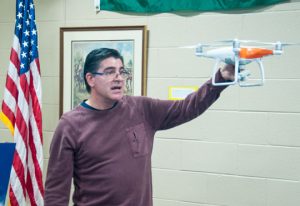
While rain grounded a demonstration of a drone in flight, members of the Chadds Ford Business Association had some ground schooling of how those unmanned aerial vehicles can be used for business.
Michael Mogavero, president of GooseView Technologies, told the group that the power in the technology is not the drone, but the data the drone can gather. And that data is more than just a simple photograph or video.
“It’s about getting data and turning that data into information so engineers can understand their assets,” he said. “The drone is just a tool to put a camera or sensor into a low altitude position.”
Data accumulated can show carbon, nitrogen, pollution, anything a scientist, engineer or maintenance person would want to know.
According to Michael Mogavero, president of GooseView Technologies, the power of a drone is not the drone itself, but the information it can obtain.
GooseView provides infrared thermographic imaging for clients in a variety of industries. Mogavero showed several 360-degree-videos of several work sites. One was a quarry in New Jersey, but the other showed a building site in the Chadds Ford Business Campus, the future headquarters of Franklin Mint Federal Credit Union, next to Hillman Drive.
Those videos, recorded by a drone flying specific patterns over a work site, provide images that can be put together in what Mogavero called a “3-D mesh capture” and can be viewed from different angles and elevations. He described the viewing experience as “inserting yourself into virtual reality.”
The drones Mogavero and his pilot, Paul Tauskey, use lock on to 17 different satellites so they always know their own exact location and can pinpoint GPS locations on the ground. Overlapping photos are taken and put together for a fully detailed image. Software can show the distance between two points and show the difference in elevation with accuracy of two to three centimeters, Mogavero said.
A 15-minute flight can provide as much data as a team of surveyors can after spending a day in the field, he said.
In addition to their use as surveying instruments, drones can be used to record storm damage and more. Mogavero said infrared imaging has been used in Africa to detect people with fevers in areas where the Ebola virus has been active.
The future of commercial drone use, as GooseView operates, is limited only by weather conditions and the advancement of technology. Mogavero speculated that it’s only a matter of time before ground-penetrating radar becomes small enough and light enough to be carried by drones to show what’s beneath the surface of an area being surveyed.
During a question and answer session several business owners asked about the legalities of flying drones. Mogavero said only pilots certified by the Federal Aviation Administration may operate drones used for commercial purposes, but there’s no such restriction for the hobbyist.
Restrictions that all drone operators must abide by include not flying over traffic or over people unless those people have some shelter. The FAA leaves privacy regulations regarding drone use up to the states and local municipalities.
Rich Schwartzman has been reporting on events in the greater Chadds Ford area since September 2001 when he became the founding editor of The Chadds Ford Post. In April 2009 he became managing editor of ChaddsFordLive. He is also an award-winning photographer.
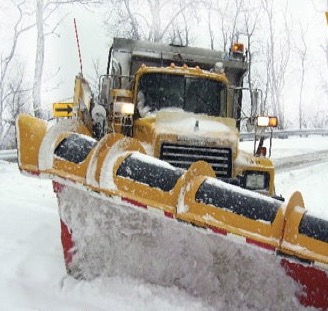
Even if area motorists aren’t ready for snow, PennDOT says it is.
PennDOT says all its plows are equipped with technology that will enable the public to track them.
“Our residents count on PennDOT to keep them moving regardless of the weather and we take that mission very seriously,” PennDOT Secretary Leslie S. Richards Richards said during a press conference this week at the PennDOT maintenance facility in Norristown. “We have our materials and equipment in place and our staff of dedicated equipment operators, district-level staff and staff in maintenance and operations are ready to go.”
New this year: All of the more than 2,200 PennDOT-owned and rented plow trucks will be equipped with AVL technology so that the public can view the trucks on interstates and expressways this winter at www.511PA.com. PennDOT started the AVL program in 2014 with 119 plow trucks and expanded it to more than 700 trucks last winter, a PennDOT press release said.
Want to see if a plow is getting close to your neighborhood? The AVL unit in each truck sends a cellular signal through the system showing where a truck is located and whether or how much material is being spread from the truck, the release said.
Richards noted that PennDOT has compiled all of its information about winter series into a special page on its website at http://www.penndot.gov/TravelInPA/Winter/Pages/default.aspx. The site also has a complete winter guide with detailed information about winter services in each of PennDOT’s 11 engineering districts.
PennDOT said it has more than 768,000 tons of salt on hand across the state. The state’s plows are equipped with computerized salt spreaders that allow operators to calibrate the exact amount of salt to be distributed regardless of the speed of the truck.
When winter weather hits, PennDOT’s primary focus is on interstates and expressways, and equipment may be redirected to those routes during significant winter events. The more traffic a roadway has, the more attention it will receive from plows, so motorists may find deeper accumulations on less-traveled routes and should adjust their driving for those conditions, the release said.
Richards suggested that vehicle preparation is critical to safe winter travel. If motorists encounter snow or ice-covered roads, they should slow down, increase their following distance and avoid distractions. Last winter in Pennsylvania, preliminary data shows that there were 224 crashes resulting in 103 injuries on snowy, slushy or ice-covered roadways where aggressive-driving behaviors such as speeding or making careless lane changes were factors, the release said.
Tires should be checked often for the correct level of air pressure and adequate tire-tread depth to perform on ice and snow. A quick way to check tread depth is to insert a penny in the tread groove with Lincoln’s head upside down. If you can see the entire head, the tires are worn and traction will suffer.
Once vehicles are travel-ready, drivers, especially those traveling long distance, should be prepared for emergencies with kits that include items such as non-perishable food, water, first-aid supplies, warm clothes, a blanket, cell phone charger and a small snow shovel. However, motorists should tailor their kits to any specific needs that they or their families may have. Consider adding such items as baby supplies, extra medication, pet supplies, or even children’s games, the release said.
Motorists can check conditions on more than 40,000 roadway miles, including color-coded winter conditions on 2,900 miles, by visiting www.511PA.com. 511PA, which is free and available 24 hours a day, provides traffic delay warnings, weather forecasts, traffic speed information, and access to more than 800 traffic cameras.
Research and recommendations from the American Medical Association, the American Academy of Pediatrics, and the Centers for Disease Control to start middle schools and high schools at 8:30 a.m. have prompted the Unionville-Chadds Ford School District to reconsider its schedule, which has teens beginning their school day at 7:35 a.m.
Research suggests that teens would function better if they started school later in the morning.
An advisory committee of community stakeholders was formed to assess the benefits, obstacles and options for later start times, which is expected to lead to a recommendation to the school board later this school year.
In an effort to involve the community in the evaluation process, the district will be hosting a special event in the new Patton Middle School Auditorium, on Monday, Nov. 7, from 7 to 8:30 p.m.
The session, entitled “The Science Behind Later Start Times,” will feature Judith Owen, director of sleep medicine at Boston Children’s Hospital in Boston, Ma.
Owens is a nationally renowned pediatric sleep expert whose particular research interests involve the neurobehavioral and health consequences of sleep problems in children and adolescents, sleep health education, and cultural and psychosocial issues impacting sleep.
This past week the American Academy of Pediatrics published a new study and report that Owens co-authored on teen sleep. Titled “Self-Regulation and Sleep Duration, Sleepiness, and Chronotype in Adolescents,” the research, which tracked more than 2,000 students in Fairfax County, Va., supported the value of a later start time.
To help plan for the presentation, district officials are requesting that those interested in attending send an email to communications@ucfsd.net The event will also be live-streamed and archived on the district.