


May 15, 2016

Popular parade keeps focus on veterans

The 2016 Kennett Square Memorial Day Parade kicks off at 10 a.m. on Monday, May 30.

At this time of year, it takes a large binder to contain all of the information relevant to the 2016 Kennett Square Memorial Day parade – details ranging from how many Scouts will participate to how many water bottles will be needed.

According to Historic Kennett Square, Bill Taylor, the parade chairman and the owner of Taylor Oil & Propane, is seldom seen without the large, stuffed, orange binder covering every conceivable aspect of the parade, which begins at 10 a.m. on Monday, May 30.

Taylor has been the force behind Kennett’s ever-growing parade for 11 years, ever since the borough asked him to help “jazz” it up, he said in a recent interview. The binder is a testament to the months of behind-the-scenes work that goes into the parade, which has drawn more than 1,000 participants and more than 12,000 spectators.

To help with the planning, Taylor has assembled a posse that includes his assistant at Taylor Oil, Lorraine Spencer; his son, Michael; Taylor Oil employees; family members; and the parade committee that comprises members of the local American Legion and Veterans of Foreign Wars posts. Administrative and marketing support comes from Historic Kennett Square.

Emceeing the popular parade will be Matt Grieco, owner of Grieco Family Funeral Homes, and former Kennett Consolidated School Board President Doug Stirling. In addition to announcing the different participants, a wide range of floats and musical performers, Grieco and Stirling will also introduce the grand marshals and share some of their histories from World War II.

This year’s grand marshals are Ralph D. Doss, Anthony L. DiFabio, Raymond J. Natale Sr., and the late Horace J. Brown Sr. All served in WWII. Brown, who died April 11 at the age of 92, was born in West Chester, raised in Kennett Square, and served in the war under Gen. Douglas MacArthur, according to a press release from Historic Kennett Square.

Veterans of all wars are the most important part of each Memorial Day parade, Taylor said. Invitations were sent this year to 316 veterans, and Taylor expects many of those who participate to be in the parade. After the parade ends, veterans will be honored at Union Hill Cemetery with a 21-gun salute. They and their families are then invited to a luncheon at the American Legion.

The patriotic theme is included in even the smallest details. Boy Scout Troop 53 will hand out 5,000 American flags for veterans and Girl and Boy Scouts, among others, to wave during the parade.

In addition to the volunteers who donate their time to the parade, a number of businesses donate sponsorship and services to ensure a successful parade. Besides Taylor Oil, major donors include RJ Waters & Associates, the Mushroom Festival, Fenstermacher & Co., Genesis Healthcare, VFW Post 5467, and the Mushroom Farmers of PA.

Kennett High School and Genesis Healthcare will donate their parking areas along South Street for parade acts to gather. Floats, groups, bands, and vehicles will line up in the high school parking lot, in the Genesis parking lot across the street, and along Birch Street. The Kennett Run organization donates road cones for those areas, and QVC will record the parade this year.

“This year’s two-hour parade promises to be one of the best ones yet,” Taylor said in the release.

Organizers suggest arriving well before the 10 a.m. start time to stake out a stop along the route, which includes East South Street to South Union Street to East Cypress Street to South Broad Street to North Union Street. For more information, visit www.historickennettsquare.com.

 

About CFLive Staff

See Contributors Page https://chaddsfordlive.com/writers/

Popular parade keeps focus on veterans Read More »
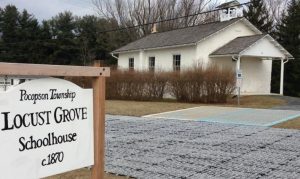
Garage sale to benefit historic schoolhouse

During a time when Pocopson Township’s renovations of the Barnard House stirred rancor as the costs to restore the early 1800s Underground Railroad stop kept rising, another historic renovation project progressed without making headlines.

A garage sale on Saturday, May 21, will benefit the restoration of the Locust Grove Schoolhouse in Pocopson Township.

Pocopson Township purchased the Locust Grove Schoolhouse, one of three one-room schoolhouses originally located in the township, in 2003 using state grant money. Since then, its preservation has been totally funded through grants and donations.

On Saturday, May 21, from 8 a.m. to 3 p.m., the Pocopson Township Historic Committee, a group that has stood firm in its resolve to avoid using township money on the renovations, is asking for support in another way. It will hold a garage sale to raise funds for the restoration of the schoolhouse, which is located at 525 Locust Grove Road, near Corinne Road.

During the past two years, a new heating and cooling system was added to the building, the ceiling was constructed, walls were repaired and re-plastered, and a chalk board was installed, according to a press release from the committee. The next project is replacing the floor, expected to cost approximately $10,000.

Once the floors are done, the first phase of the project will be completed, and area elementary classes can visit the schoolhouse. Students will be able to learn the rich history of the township by experiencing a day in the life of a student in the late 1800s.

The garage sale will be held at the schoolhouse and will include furniture, housewares, vinyl records, tools, sporting goods, toys, books, and collectibles. To learn more about the project as well as Pocopson history, visit www.locustgroveschoolhouse.org.


About CFLive Staff

See Contributors Page https://chaddsfordlive.com/writers/

Garage sale to benefit historic schoolhouse Read More »

Rabbinic Reflections: Grounding competitiveness

We are all coming up empty. Striving for success as measured by grades, degrees, and dollars has hollowed out our souls. We have taken to competing against our own limitations to feel accomplished. It is high time we looked down at the basis for our efforts.

As an educator, I am keenly aware of the dangers of a school turning into a hamster-wheel of learning, how to keep going rather than learning how to learn. High stakes testing replaced ideas with information, thinking with data, and wisdom with knowledge.

Those more focused on students than on content latched onto effort and resilience as elements of “mindset” and “grit,” the holy grails of 21st century success. So we praise students for rising to the challenge, we even seek to rise to the challenge ourselves, and the point of the challenge has become to test our grit. Education and work are meant to be so much more than daily trials to see if we can make it to tomorrow.

On Monday last week, Albert Einstein Academy Jewish Day School, where I am the head of school, exhibited what education is meant to be about. Students impressed parents and special friends with their Hebrew skills across disciplines; they took their friends on a learning art walk, bringing their own works together with knowledge of other cultures and symbols; they experimented with engineered contraptions for protecting a raw egg on a one-story drop; and they joyfully sang and danced in celebration of the arts. The day’s events were a stark reminder that learning is about the whole child, not just that part than can sit still and complete a test. Learning is about the turning the soul onto the light of knowledge, kindling the desire to discover more and sharing it in increasingly complex communications.

The very next day, David Brooks’s New York Times column, “Putting Grit in its Place,” addressed the widening distance between what society is making school be about and what I saw the day before. He wrote about the culture of emphasis on GPAs. His critique centered on Angela Duckworth’s new book “Grit,” in which she argues that moral purpose and longing contribute greatly to people’s grittiness. Knowing deeply why we are doing something empowers us to do the hard work it requires; our grit comes not from practicing perseverance but from being grounded.

What awed me about our students’ successes was not their performance. I was in awe of their genuine happiness: their sense that, in sharing with the community what they learned, they had grown as individuals and as a group. We talk often about our Core Value of Individuality, the idea that because we are each created in God’s image we each matter uniquely. Talk is nothing compared to each student having a chance to shine, each having art on display, each taking the hand of a peer and dancing together. They competed to lift themselves to new heights and succeeded. By grounding their learning in an environment of lived values, they not only came up full, their cup overflowed and filled all who bore witness. I pray that as a society, we can begin to build communities of shared values that anchor us deeply and inspire us to make a positive difference in our own lives and the lives of others. It is a competition worth enduring from the ground up.

About Rabbi Jeremy Winaker

Rabbi Jeremy Winaker is the executive director of the Greater Philadelphia Hillel Network, responsible for West Chester University, Haverford, Bryn Mawr, and other area colleges. He is the former head of school at the Albert Einstein Academy in Wilmington and was the senior Jewish educator at the Kristol Hillel Center at the University of Delaware for four years. Rabbi Winaker lives in Delaware with his wife and three children.

Rabbinic Reflections: Grounding competitiveness Read More »

Scroll to Top