

October 28, 2015

Protocol to prevent domestic violence lauded

From July 2014 through September 2015, about two-thirds of the 316 Chester County residents identified as possessing a high risk for domestic violence received preventive services, according to the Chester County District Attorney’s Office.
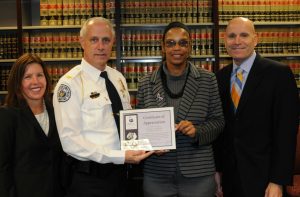
Flanked by Deputy District Attorney Michelle Frei (left) and District Attorney Tom Hogan, West Goshen Police Chief Joseph Gleason receives an award for participating in the LAP program from Dolly Wideman-Scott, CEO of the Domestic Violence Center of Chester County.
Flanked by Deputy District Attorney Michelle Frei (left) and District Attorney Tom Hogan (right), West Goshen Police Chief Joseph Gleason receives an award for participating in the LAP program from Dolly Wideman-Scott, CEO of the Domestic Violence Center of Chester County.

In recognition of Domestic Violence Awareness Month, Chester County District Attorney Tom Hogan announced in a press release that Chester County leads the state in its use of the Lethality Assessment Program (LAP), considered a best practice to protect the safety of victims of domestic violence.

“LAP is about saving lives.  Many victims do not realize the danger they are in at the hands of their abusers until they go through the LAP screening or are already badly injured, and the latter is too late,” Deputy District Attorney Michelle Frei, the county’s lead domestic violence prosecutor, said in the release.  “Once the LAP screening takes place, domestic violence victims hopefully will recognize the danger and reach out for the services that we have available here in Chester County.  The goal is to identify the danger before the case turns into a homicide.”

LAP is a comprehensive protocol followed by police when responding to domestic violence calls.  LAP uses a series of screening questions that have been proven to be strong predictors of both past and future extreme violence.  Some of these questions include: (1) Has he/she ever tried to kill himself/herself? (2) Does he/she have a gun, or can he/she get one easily? and (3) Do you have a child that he/she knows is not his/hers?

Application of LAP provides two primary benefits.  First, LAP is a strong predictive tool.  The data gathered from LAP allows the police to determine which domestic violence incidents are likely to accelerate later into extreme violence.  The police can use this information to allocate resources effectively for these cases, potentially preventing a homicide.

Secondly, following the guidelines in LAP protects victims by providing them immediate access to the services of the Domestic Violence Center of Chester County (DVCCC), which has resources to provide counseling, shelter, and other immediate needs for domestic violence victims.

Thirty-five police departments in Chester County have been trained on how to implement the LAP protocol and 30 of those departments are actively using LAP.  From July 1, 2014, through September 2015, Chester County police departments screened 479 victims, 201 of whom received services.

Dolly Wideman-Scott, CEO of the Domestic Violence Center of Chester County (DVCCC), praised the practice.

“LAP gets victims to services faster,” she said in the release.  “We know when the police are at the scene of a domestic violence situation, victims will get connected to life-saving services provided by the Domestic Violence Center and this will impact their safety.”

DVCCC has awarded certificates of appreciation to the participating police departments, which include Kennett Square, Lincoln University, New Garden, Westtown-East Goshen, West Goshen, West Chester, and West Whiteland.

“Some of the most chilling homicides in Chester County have been the result of domestic violence…,” said Hogan in the release.  “The LAP protocol gives law enforcement a powerful tool to combat domestic abuse.  Moreover, victims are empowered to seek help and made aware of the danger they are in. “

 

About CFLive Staff

See Contributors Page https://chaddsfordlive.com/writers/

Protocol to prevent domestic violence lauded Read More »

PennDOT: Time to get ready for winter’s blast

As cooler air and the potential for winter weather settle into Pennsylvania, PennDOT is urging motorists to join the department’s 4,800 operators and roughly 2,200 trucks in preparing for the season.

PennDOT suggests residents start to prepare for winter's fury.
PennDOT suggests that residents should start to prepare for winter’s fury.

“PennDOT’s staff and equipment are working hard to be ready for winter’s arrival, and drivers are a huge part of our mission to keep roads as safe as possible this winter,” PennDOT Secretary Leslie S. Richards said in a press release. “Motorists should prepare themselves and their vehicles now, before winter weather hits.”

PennDOT is responsible for more than 40,000 miles of state-maintained roadway or 96,000 snow-lane miles – enough miles to circle the globe nearly four times. A snow-lane is calculated as the miles of road multiplied by the number of lanes, which means a one-mile section of four-lane roadway would equal four snow-lane miles.

The department maintains roughly the same number of miles maintained by the state in New York, New Jersey and all of the New England states combined.

“With this number of road miles, we have to prioritize our services,” Richards said in the release. “By preparing for winter weather now and making smart decisions about travel when storms are approaching, the public can help make this winter a safe one.”

To prepare for winter driving, especially if long-distance travel is planned, motorists should carry an emergency kit, including items such as non-perishable food, water, first-aid supplies, warm clothes, a blanket, cell phone charger and a small snow shovel. However, motorists should tailor their kits to any specific needs that they or their families may have. Consider adding such items as baby supplies, extra medication, pet supplies, or even children’s games.

When winter weather hits, PennDOT’s primary focus is on interstates and expressways, and equipment may be redirected to these routes during significant winter events. The more traffic a roadway has, the more attention it will receive from plows, so motorists may find deeper accumulations on less-traveled routes and should adjust their driving for those conditions.

If motorists encounter snow or ice-covered roads, they should slow down, increase their following distance and avoid distractions. Last winter, there were 552 crashes resulting in four fatalities and 279 injuries on snowy, slushy or ice-covered roadways where aggressive-driving behaviors such as speeding or making careless lane changes were factors in the crash.

PennDOT last winter used nearly 1.2 million tons of salt on state-owned roads. Currently, PennDOT has more than 667,000 tons of salt stockpiled and will continue to take salt deliveries throughout the winter. PennDOT has agreements with 659 municipalities for them to clear state roads within their borders. The department also rents approximately 270 trucks and operators to assist with snow removal.

Motorists can check conditions on more than 40,000 roadway miles, including color-coded winter conditions on 2,900 miles, by visiting www.511PA.com. 511PA, which is free and available 24 hours a day, provides traffic delay warnings, weather forecasts, traffic speed information and access to more than 770 traffic cameras.

For more information on PennDOT’s winter preparations and additional winter-driving resources for motorists, visit the department’s winter Web page, www.PennDOT.gov/winter.

PennDOT: Time to get ready for winter’s blast Read More »

Op/ed: Candidate decries bankruptcy attack

Yes, bankruptcy is no fun. When my business, like so many other printing and direct mail firms at the time, encountered very difficult shrinking markets and hyper-competitive pricing battles, my firm suffered. The banks that financed the expensive equipment my company needed opted not to negotiate. Why bother? I had used my own assets as collateral, and the bank knew that whatever debt remained after it took what I owned was insured by the SBA. I lost everything. That story was repeated dozens of times during those days, shattering the lives of many people in the same industry.

Lesson learned. But how fortunate in our wonderful nation that people like Abraham Lincoln, Walt Disney, Milton Hershey, Gov. John Connally of Texas and countless thousands of little guys like me were and are able get a second chance after experiencing the disappointment of a bankruptcy. I am not the first to have succumbed to bad economic times and will not be the last. The honor is in the effort to achieve, and it has made me a wiser man.

I’m still an entrepreneur, but on a much smaller scale and at a much lower risk.

All that unfortunate history aside, I am greatly saddened by the cowardly anonymity of some of my opponent’s supporters. Attacking me by using a straw-dog in the form of a mud-slinger from across township lines is pretty despicable. I’ll give my opponent the benefit of the doubt and assume she had nothing to do with rummaging through my personal history to find events that occurred over a decade ago. As I have mentioned publicly, I have not the slightest interest in hunting for any skeletons in my opponent’s closets. We should all be better than that. But, I do wonder who paid for the background check. Public record yes, but you don’t get that level of detail without buying it.

This election is not about the past, it is about the future, and as a supervisor of Kennett Township, I will be a stalwart guardian of the public’s trust. That really is what my whole campaign is about.

Ted Moxon
Candidate for Kennett Township Supervisor


About CFLive Staff

See Contributors Page https://chaddsfordlive.com/writers/

Op/ed: Candidate decries bankruptcy attack Read More »

Mind Matters: Transitions

The “Fiddler on the Roof” story sings about “Tradition.” Perhaps the song could have carried the refrain “Transitions, Transitions!”

Transitions. Transitions carry us from one place in space and time to another. They may feel un-grounding and destabilizing because they are a sort of leap before a landing. Perhaps this is why some people fear bridges or flying. A bridge is a transitional connector from one land to another. Flying, too, is a transition—a literal taking off into the air, leaving ground, then landing, sometimes thousands of miles away.

Transitions take energy and trust—trust that it’s okay to jump off the diving board and hurtle oneself into the air to plunge into the deep water. Ironically, deep water is what you need here to make a safe “landing.” Yet, even when you know the terrain and the water, making the transition requires pushing past resistance. My daughter, for many years a competitive swimmer, says that the first jump into the pool is always hard. My own personal experience attests to this. Yes, I’ve got my swimsuit on and goggles affixed, and yet the transition from solid surface to that “liquid solution” always catches me.

When my kids were little, I would talk about “transitions,” and how hard it could be to change gears and go from one activity to another or get organized to leave the house to go somewhere. I remember more than 30 years ago when my son was barely out of toddlerhood that for seven hours he insisted he wanted to stay home and didn’t want to go to wherever it was we were going for vacation. A week later, he didn’t want to leave the little cottage in Rhode Island and so for seven hours on the ride home he considered that wanted to stay where he had been. Transitions can be difficult because change is usually not easy. Some of us are more adaptable, but all of us are affected by transition and change whether we acknowledge it or not. It helps, actually, to face our fears and anxiety about transitions and change. Naming our experience is the first step in coping with it.

Admittedly, transitions have been thematic in my life lately. For one, I have just returned from a pilgrimage to Crete. I wonder if the return from a journey that was vastly different from a person’s daily routine is more jarring than the entry into a new place. For me, when I go to a country I’ve never been, I expect my senses to be “assaulted” and I welcome the novelty. On the other hand, re-entry home is both comforting and unsettling. Being with family is a joy, yet the bigness of life here is, at first, overwhelming—big box stores, big roads, big cars. America on steroids?

However, the more personal context of transitions for me is not about going from the rugged rocky mountains of Crete with nary a McDonald’s or Walmart in sight back to the mammoth malls and shopping sprawls here.

On the heels of my return home, we hosted a gathering of family and friends in honor of my daughter and spouse’s baby, scheduled to be born in December. What a marker for major change this is! Moving into parenthood and grandparent-hood is formidable — wondrous, yes — but life changing indeed!

For me, it is the carrying of hope — and love — from the past into the future. Lately, I feel peculiarly connected to my mother, who died almost twenty years ago, remembering her in her grammy-hood and wishing to carry her love and care forward. Quite a transition: bridging the love of generations!

* Kayta Curzie Gajdos holds a doctorate in counseling psychology and is in private practice in Chadds Ford, Pennsylvania. She welcomes comments at MindMatters@DrGajdos.com or 610-388-2888. Past columns are posted to www.drgajdos.com. See book.quietwisdom-loudtimes.com for information about her book, “Quiet Wisdom in Loud Times: The Rise of the Wounded Feminine.”

The opinions expressed are those of the author and do not necessarily reflect those of the ownership or management of Chadds Ford Live. We welcome opposing viewpoints. Readers may comment in the comments section or they may submit a Letter to the Editor to: editor@chaddsfordlive.com


About Kayta Gajdos

Dr. Kathleen Curzie Gajdos ("Kayta") is a licensed psychologist (Pennsylvania and Delaware) who has worked with individuals, couples, and families with a spectrum of problems. She has experience and training in the fields of alcohol and drug addictions, hypnosis, family therapy, Jungian theory, Gestalt therapy, EMDR, and bereavement. Dr. Gajdos developed a private practice in the Pittsburgh area, and was affiliated with the Family Therapy Institute of Western Psychiatric Institute and Clinic, having written numerous articles for the Family Therapy Newsletter there. She has published in the American Psychological Association Bulletin, the Family Psychologist, and in the Swedenborgian publications, Chrysalis and The Messenger. Dr. Gajdos has taught at the college level, most recently for West Chester University and Wilmington College, and has served as field faculty for Vermont College of Norwich University the Union Institute's Center for Distance Learning, Cincinnati, Ohio. She has also served as consulting psychologist to the Irene Stacy Community MH/MR Center in Western Pennsylvania where she supervised psychologists in training. Currently active in disaster relief, Dr. Gajdos serves with the American Red Cross and participated in Hurricane Katrina relief efforts as a member of teams from the Department of Health and Human Services' Substance Abuse and Mental Health Services Administration.Now living in Chadds Ford, in the Brandywine Valley of eastern Pennsylvania, Dr. Gajdos combines her private practice working with individuals, couples and families, with leading workshops on such topics as grief and healing, the impact of multigenerational grief and trauma shame, the shadow and self, Women Who Run with the Wolves, motherless daughters, and mediation and relaxation. Each year at Temenos Retreat Center in West Chester, PA she leads a griefs of birthing ritual for those who have suffered losses of procreation (abortions, miscarriages, infertility, etc.); she also holds yearly A Day of Re-Collection at Temenos.Dr. Gajdos holds Master's degrees in both philosophy and clinical psychology and received her Ph.D. in counseling at the University of Pittsburgh. Among her professional affiliations, she includes having been a founding member and board member of the C.G. Jung Educational Center of Pittsburgh, as well as being listed in Who's Who of American Women. Currently, she is a member of the American Psychological Association, The Pennsylvania Psychological Association, the Delaware Psychological Association, the American Family Therapy Academy, The Association for Death Education and Counseling, and the Delaware County Mental Health and Mental Retardation Board. Woven into her professional career are Dr. Gajdos' pursuits of dancing, singing, and writing poetry.

Mind Matters: Transitions Read More »

Scroll to Top