
February 27, 2015

Letter to the Editor: Toomey bill protects kids

Last year, news broke that the Coatesville Area School District had hired multiple convicted felons and entrusted the safety and care of children to such criminals. For example, Victor Ford’s convictions for multiple state and federal felonies did not stop him from being hired as a special education classroom aide and coach. One year into his employment, Ford was arrested and charged with sexually assaulting a young girl, and later was convicted of corruption of minors for his conduct.

As prosecutors, we work day in and day out to protect our children from sexual predators in the classroom. But we cannot do it alone.

Fortunately, the Pennsylvania General Assembly has acted and strengthened our state child protection laws. Specifically, the General Assembly passed a bill which bans the practice of “passing the trash” within state boundaries. “Passing the trash” is the reprehensible practice of quietly dismissing or allowing a school employee suspected of a sexual crime to resign, while still providing a letter of recommendation and failing to alert other schools to the employee’s misconduct.

However, this legislation does nothing to stop other states from “passing their trash” to Pennsylvania. The only way to stop this is with federal legislation. Luckily, one of our own United States Senators, Pat Toomey, is leading the charge to add this protection for our children.

Sen. Toomey has introduced a bipartisan bill, the Protecting Students from Sexual and Violent Predators Act, to prevent abusers from reaching children in the first place. In addition to banning the dangerous practice of “passing the trash” from outside states into Pennsylvania, Senator Toomey’s bill requires any school receiving federal funds to perform background checks on all employees and contractors who have unsupervised access to children. Amazingly, 12 states do not require background checks for these coaches, teachers’ aides, and substitute teachers who are often hired as contractors and who have virtually unfettered access to vulnerable children. The background checks must be thorough, covering two state and two federal databases, and must be periodically updated. Many states do not check the FBI’s national database, and Pennsylvania’s background checks do not include the National Sex Offender Registry. Under Senator Toomey’s bipartisan legislation, a school may not hire a person if he or she has committed certain crimes, including any sexual or violent crime against a child.

Sen.Toomey’s bill directly reflects some of the recommendations that the Chester County District Attorney’s Office made in the Coatesville Area School District Grand Jury Report about preventing criminals from gaining access to our children. Moreover, these requirements are supported by prosecutors across Pennsylvania as a common sense way to protect kids from sexual predators and other criminals. Senator Toomey’s bill passed the House of Representatives unanimously during the last Congress. We urge the United States Senate to follow suit, and provide our children the protection they need

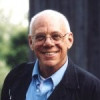
Thomas P. Hogan
Chester County District Attorney

About CFLive Staff

See Contributors Page https://chaddsfordlive.com/writers/

Letter to the Editor: Toomey bill protects kids Read More »

U-CF cautions over measles

The Unionville-Chadds Ford School District has issued the following advisory regarding measles:

The recent cases of measles around the nation have created concern in our own community. At this time, there have been no cases in U-CFSD or Chester County. However we want to share information about the policies and procedures for vaccinations and what will happen if there is a case.

As outlined in § 23.83 of The Pennsylvania Code students must be immunized against measles (and other diseases). Approximately 97 percent of U-CFSD students have received all required vaccinations.

The Pennsylvania Code does provide several exemptions to this requirement in §23.84. In the event of a case of measles there are specific protocols for any student who has not been vaccinated. These parents will receive notification requiring that their children be kept home for 14 days. A student who is not properly immunized for measles would be excluded from school until immunized or for 14 days after the last reported case in that school.

The best preparation for any scenario is knowledge. Below are links with detailed information about measles.

The CDC: www.cdc.gov/vaccines/vpd-vac/measles/faqs-dis-vac-risks.htm

The Mayo Clinic: www.mayoclinic.org/diseases-conditions/measles/basics/risk-factors/con-20019675

Chester County Health Department: www.chesco.org/index.aspx?nid=359

The best things about U-CFSD are the people in it — especially the students — and we do our best to keep them safe at all times. The good health and wellbeing of your children is always first and foremost. Towards that end we will make sure you are apprised of anything that could impact them.

U-CF cautions over measles Read More »

Pennsbury toasts the end of a controversy

Pennsbury toasts the end of a controversy

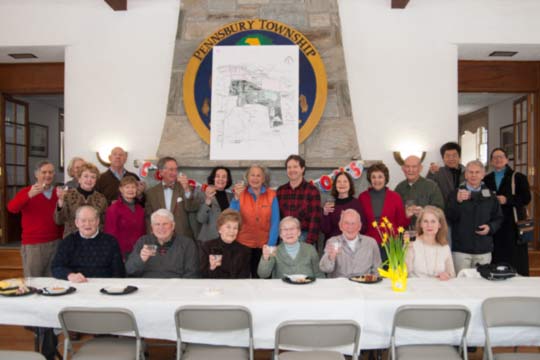
With a closing chant of “PVA, PVA, we are glad you went away,” more than a dozen Pennsbury Township activists cheered the end of more than a decade of controversy.

The group met at the township building for a light lunch on Feb. 26 in honor of the township buying — for $4.8 million — 23 acres of land that had previously been slated for a hotly contested development, known as Pennsbury Village. The developer was Pennsbury Village Associates, known as PVA.

The chant was written as a chorus to a rhyme penned by township Supervisor Wendell Fenton, who came into office in 2006 amid the controversy. He said he was surprised by the final outcome.

“I never assumed we could buy the property,” he said. “Maybe reduce the density, but not save it. I never thought this would happen.”

Supervisors haven’t decided what to do with the acreage, but Fenton thinks it might be appropriate to have a questionnaire asking residents what they would like to see happen, he said before reading his doggerel to the assembled group.

Lynn Luft and Bob Crandell were among those celebrating. They were part of the fight against the development from the beginning.

Crandell was a member of the Planning Commission when the idea was still just a sketch plan.

“This is what we’ve been striving for the last 15 years,” Crandell said. “When they first came up with this plan, the developer came in and said, ‘Here’s a new ordinance that we wrote and that you will adopt to allow us to do this.’”

Crandell’s response at the time was, “You’ve got to be kidding,” he said, adding that the supervisors at the time wanted the development to become reality.

A major point of contention was the desire of those former supervisors and the developer to allow township land — part of the parcel where the township building and park are located — to become part of a commercial and residential development. That land had been gifted to the township and deed restricted for public use only.

Several residents sued the township because supervisors were seeking to violate the deed restriction. A flurry of other lawsuits followed. Over time, the developer filed for bankruptcy and the project fizzled despite a settlement agreement being reached.

Luft is a current member of both the Planning Commission and the Historic Commission. She said former supervisors just didn’t accept what residents wanted.

“I felt that the supervisors weren’t doing what the residents of the township wanted done, so they weren’t really representing their constituents,” Luft said. “Everybody who lives where I live thought the plan was a trespass onto what the philosophy had been as far as preserving open space and the deed restriction that was on the property.”

She said she feels a major sense of relief because of the land purchase, and part of that relief deals with an environmental issue. The township property would have been used as part of a sewage treatment system that would discharge treated effluent into a small stream in the park area.

“That’s huge relief that that’s not going to happen,” Luft said.

She’s also pleased that the Hope House won’t be moved or demolished and said saving that structure is “a major accomplishment. And we’re going to have park land for use by residents.”

The controversy led to one supervisor losing a re-election bid in the 2005 primary election, and two others deciding not to seek re-election because of the flak they had received.

In December 2014, the township completed a deal to buy three parcels of land from a subdivision of Toll Bros., which had bought the land from PVA. One parcel is a three-acre piece at Route 1 and Hickory Hill Road. The other two parcels, totaling 20 acres, are on either side of the township building. Those are the two parcels that would have been connected by the township property had Pennsbury Village been built.

To buy the parcels, Pennsbury borrowed $4 million, while the Land Trust gave $125,000. The remainder of the $4.8 million price tag is being paid for with open space funds.

Another celebration, one for the entire community, is planned for this spring on the newly acquired land, Fenton said.

About Rich Schwartzman

Rich Schwartzman has been reporting on events in the greater Chadds Ford area since September 2001 when he became the founding editor of The Chadds Ford Post. In April 2009 he became managing editor of ChaddsFordLive. He is also an award-winning photographer.

Pennsbury toasts the end of a controversy Read More »

Facebook circa 1800

Facebook circa 1800

How did early Pennsylvania German settlers record the stories of their lives? If you think the answer is a two syllable word beginning with the letter F, you are right. Fraktur is a font and a decorative form of storytelling.

“A Colorful Folk: Pennsylvania Germans and the Art of Everyday Life” exhibit of folk art opens this weekend at Winterthur. The objects in the exhibit tell two stories. They tell of the individuals, families and community which created the artwork. There is also the story of reunion of objects once estranged in history.

Exhibit curator, Lisa Minardi, has created the exhibit from the collections of Henry Francis du Pont and Frederick S. Weiser in addition to objects from more than a dozen private collections. In 2014, Winterthur purchased 121 fraktur and nearly 200 textiles from the estate of Frederick S. Weiser.

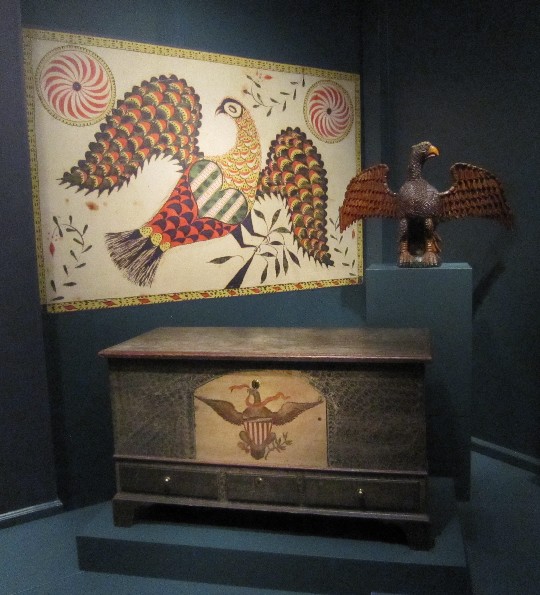
The exhibit is arranged in sections: Introduction, Looking Closely, Home, Church, School and Nation. Each section has a full wall sized fraktur. Minardi said those walls, particularly “The Schoolmaster,” would be a great background for a selfie.

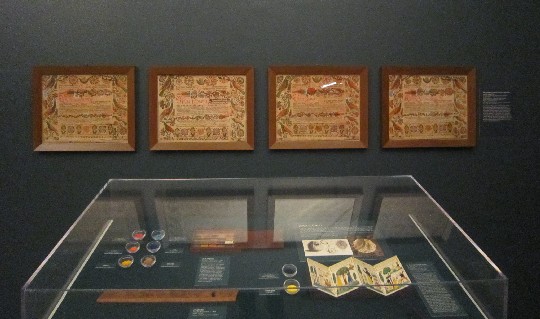
birth certificatesBaptism certificates were often rendered as fraktur. They were designed to convey the genealogy of the family as well as a being a work of art. Fortunately for preservationists, families often kept these ornate documents in drawers thereby protecting them from environmental degradation. The certificates for four siblings are exhibited together. In the case in beneath the certificates are the tools used to create the artwork.

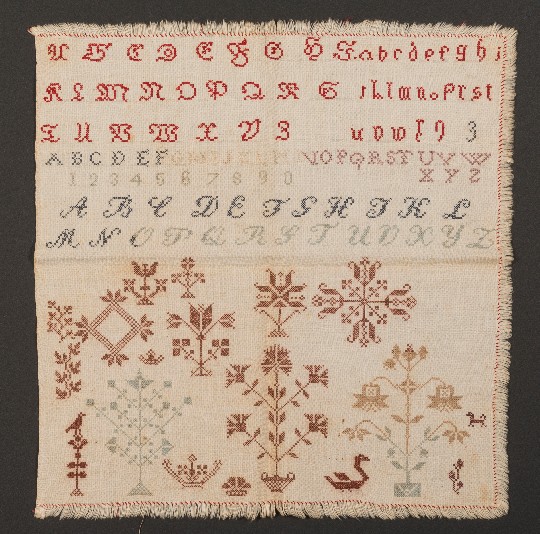
Alphabet Sampler


Upper case Fraktur refers to the font which was used in printing the Gutenberg bible. Lower case fraktur refers to the decorative manuscripts. The “Alphabet Sampler” shows the letters of the Fraktur alphabet in the upper left corner. Underneath are the Roman and script alphabets.

Many of the texts contain severe religious admonitions, for example, “O noble heart, bethink your end.”  So common was the expression it often appears as OEHBDE (O Edel Herz Bedenk Dein Ende).


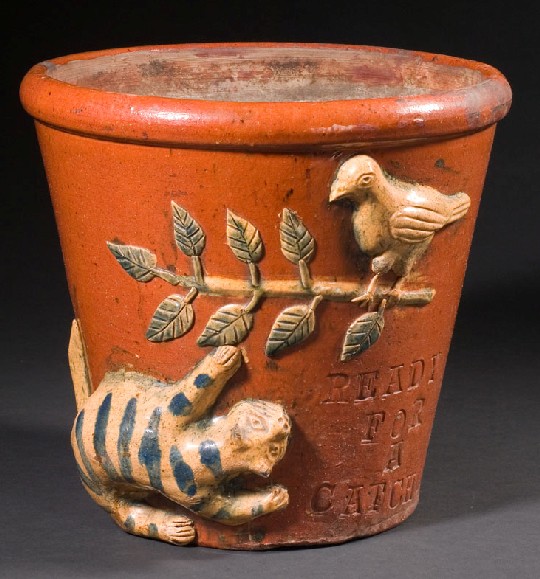
Ready for a catch


Some of the art is whimsical. The Flowerpot for Sarah Bixler is attributed to Absalom Bixler or his brother Jacob from Lancaster County. “Ready for a Catch” is printed on the side of the pot as the cat is ready to pounce.

The exhibit goes beyond fraktur to include furniture, metal work and pottery.


The Nation


The section entitled “The Nation” records the assimilation of the Germans into their new country. The eagle was the subject of many forms of art fraktur, wood carving, metal working and pottery.


Minardi has been studying the German language, culture and art since she was a pre-teen. Minardi is in the final stages of her doctoral dissertation at the University of Delaware. She has stories and detailed knowledge of each piece.


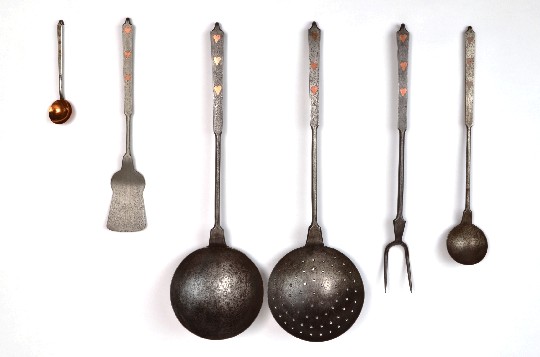
ThCooking Utensilse set of six cooking utensils had been separated. Three pieces were in the du Pont collection and the other three were in the Weiser collection. They are now reunited as part of the permanent collection at Winterthur. The handles have little hearts on them and were probably given as a wedding present.


Winterthur is one of three fraktur exhibits will be open by next Monday evening. The Philadelphia Museum of Art exhibit “Drawn with Spirit” is already open and will run through April 26. The Winterthur Exhibit opens Sunday and runs through January 3, 2016. The Free Library of Philadelphia’s exhibit opens Monday, March 2 and runs through July 18. Minardi has worked on all three exhibits.

About Emily Myers

Emily Myers has lived and worked in Chadds Ford for over thirty five years.  She founded the parent company of Chadds Ford Live, Decision Design Research, Inc., in 1982.  ChaddsFordLive.com represents the confluence of Myers' long time, deep involvement in technology and community. Myers was a founding member of the Chadds Ford Business Association and currently serves on its board of directors.  Her hobbies include bridge, golf, photography and Tai Chi. She lives with her husband, Jim Lebedda, in Chadds Ford Township.

Facebook circa 1800 Read More »

Scroll to Top