March 14, 2012

Robertson right on the drug war

Walter Cronkite had the
reputation of being the most trusted man in America. As the story goes, when
the CBS Evening News anchor did a commentary against the Vietnam War,
then-President Lyndon Johnson reportedly turned to an aide and said, “If I’ve
lost Cronkite, I’ve lost the country.”

While our involvement in
Vietnam did not end until years after the commentary, the writing was on the
wall. Perhaps another comment from another broadcaster will put the writing on
the wall for another improper war.

It’s unlikely that anyone would
confuse Pat Robertson with Mr. Cronkite. While both are known as broadcasters,
Robertson is an evangelical Christian and host of “The 700 Club” on
the Christian Broadcasting Network. He is part of the conservative religious
right. So what can we take from his latest comment?

He was quoted in a New York
Times story last week saying, “If people can go into a liquor store and buy a
bottle of alcohol and drink it at home legally, then why do we say that the use
of this other substance is somehow criminal?”

He was speaking about the
marijuana.

In the March 7 story, Robertson
said, “I really believe we should treat marijuana the way we treat beverage
alcohol…I’ve never used marijuana and I don’t intend to, but it’s just one of
those things that I think: this war on drugs just hasn’t succeeded”

Robertson’s view reflects
another parallel between the two wars. The pressure to get out of Vietnam increased
as middle class America became disenchanted with our involvement. If the
religious right is now turning against the drug war, that should send signals
to Washington and the various state capitols that support is waning and it’s
just a matter of time before legalization is reality.

Needless to say, Roberston’s
call to treat marijuana the same as alcohol is being hailed by pro-legalization
groups. Ethan Nadelmann, executive director of the Drug Policy Alliance is quoted in the NY
Times story as saying, “Pat Robertson still has an audience of millions of
people, and they respect what he has to say… And he’s not backtracking. He’s
doubling down.”

Robertson said the government
has “gone overboard” in its attempt to be tough on drug use.

Indeed, the police have been
militarized, kicking in doors to serve no knock warrants. Innocent people have
been killed by police in the headlong rush to stop drug use and there’s no
apology or change in policy.

Even President Obama’s promise
not to raid medical marijuana facilities in states that have legalized such
practices has gone by the way.

“It’s completely out of
control,” Robertson said in the story. “Prisons are being overcrowded with
juvenile offenders having to do with drugs. And the penalties, the maximums,
some of them could get 10 years for possession of a joint of marijuana. It
makes no sense at all.”

Mr. Robertson’s position stops
well sort of full legalization of all drugs. It pertains to marijuana only.
It’s a good start, though.

He’s correct, the
criminalization of marijuana is destroying lives, mostly young lives, and most
of them are black or Hispanic. It’s not that those kids use pot more than
others; they just get arrested more. Things get hushed up and covered up in the
richer white neighborhoods.

Lives are lost and wasted
because of the drug war, but that war also destroys the Constitution and, by
extension, respect for the concept of law and order and it destroys the
application of liberty.

Two states this year — Colorado
and Washington — are considering softening their marijuana laws. While
Robertson is not campaigning on behalf of those changes, his position could
influence more conservative voters in those states to realize that the laws for
prohibition do more harm than good.

The full NY Times story can be
found at www.nytimes.com/2012/03/08/us/pat-robertson-backs-legalizing-marijuana.html?_r=3&smid=tw-nytimes&seid=auto

About CFLive Staff

See Contributors Page https://chaddsfordlive.com/writers/

Robertson right on the drug war Read More »

Mind Matters: Transient global amnesia and emotional stress

One
client, one colleague, and two friends. What do they all have in common? They
all have been diagnosed with transient global amnesia (TGA), which is supposed
to occur to in 0.004 percent of the population. I feel statistically singled
out, on the “long tail.” Statistics don’t really disallow my experience, but I
do find it peculiar that this rare neurological syndrome would cluster in this
way (or as my husband quips, maybe I’m the “typhoid Mary” re-incarnated as “TGA
Kayta”).

Perhaps,
TGA is more prevalent than we realize, so allow me to define it briefly.
Transient global amnesia is a fortunately fleeting and probably benign syndrome
with an abrupt onset. For anywhere between four and twenty-four hours, a person
has no short-term memory. The individual knows who he or she is, and knows
family and friends, and is able to perform rote tasks—driving a car, shopping,
etc. All of a sudden, however, the questions arise, “What just happened?”
“Where am I?” or “We’re doing what?” With TGA, there are no physical
manifestations as there are with, e.g., a TIA, transient ischemic attack. That
is, there is no slurring of speech, no loss of words, no facial muscle
drooping. No loss of balance or immobility.

The
person may be in this short-term amnesia state for hours, then some awareness
of confusion and of being lost in time arises. (Sometimes the disorientation is
first observed by another.) One friend, upon return to linear time as we know
it, described her state as “being in limbo.” Another friend says that the “loss
of time still haunts me … twelve hours of my life totally gone.”

Fortunately,
TGA doesn’t usually linger and leaves as subtly as it appears. Of all the
neurological events that can occur to a human, perhaps it is the one with the
least lasting effects. Its recurrence is rare and there doesn’t seem to be any
deleterious result to the brain.

However,
as a psychologist, I think there may be an emotional component that, while
mentioned in the literature as a possible precipitating factor, may be getting
short shrift in the ER.

Research
has found over the years that anxiety and stress can engender panic attacks
that mimic heart attacks. Pardon my waxing simplistic for wondering if TGA’s
couldn’t be considered a sort of “panic attack” of the brain. There have been
some brain studies (PET—positive emission tomography—scans) of patients while
enduring TGA. These point to amygdala and hippocampus involvement. This is the
part of the brain most affected by trauma and stress and is important in
memory.

While
there may be other physiological factors involved — strenuous exercise or
diving into cold water where the breath is held — I would like to see more
attention given to the emotional components. A neurological assessment to
differentiate the diagnosis from TIA’s, brain tumors, infections, bleeds, etc.,
is, of course, important. Yet, any psychological stressors also need to be
explained.

Could
the TGA be a part of a stress response to an emotional trauma? Is there an
anniversary reaction to a past event that needs to be addressed? What part does
grief or loss play in the onset of a TGA? What part does repressed anger play?

I
facilitate a grief group for those whose loved ones died suddenly, often
violently. The members of this group recognize full well that anniversaries can
trigger severe emotional reactions—anniversaries of the death, birthdays,
holidays. While no one in this group (that I know of) has been diagnosed with
TGA, I do know of others who have had TGA where the onset coincided with a
grief anniversary.

The
emotional loss or trauma that precipitates the TGA may not be about a person
either. It may also be about a place or lost part of one’s life. In one case of
TGA, I encountered a young man who had an emotional attachment to a house where
he had lived and where his box of poetry and journals had been inadvertently
left behind. Unlucky for him, in what I believe to be an occurrence of TGA, he
was arrested and taken to jail for trespassing at his former residence. He had
no knowledge of how he had gotten there and was thoroughly confused at the
police station. For him, TGA was a nightmarish, Kafka-esque situation. And the
diagnosis was given qualitatively only after the fact of his arrest.

Better
to have loving family or friends (or knowledgeable police, for that matter)
take thee to a hospital ER than to jail when TGA might have occurred.

But at
the ER, after all the neurological workups, I trust that a thorough
history-taking would include questions about any and all emotional stressors,
about anniversary reactions, including grief and its emotional charge.

Emotional
stress creeps in on cat feet and CAT scans don’t show the tiger’s scars.

Our
bodies and our minds are not as separate as Descartes thinks. When mental
/emotional stress—be it financial anxiety, profound grief, post-traumatic
memories, fear, anger, sadness, is not expressed in healthy ways, our bodies
bear the burden.

No, we
can’t control life, but our attempt to control (not the same as healthy
containing) our feelings in the face of our fears is never the solution.

Take a
moment to reflect on your own life when different events have occurred. Might
you consider an emotional precipitant you never considered before?

I
certainly know in my own life there are emotional connections to a few
“accidents.” I have several broken bones as a result of some angry feelings
turned inward. Sure, they were “accidents”—falls—a slippery rock, a funky
step—but they were also the result of mental pre-occupation with my feelings
that were not being resolved in healthy ways.

That
is, I was imploding with my feelings, which is a form of emotional reactivity.
Emotional reactivity can take opposite forms but neither is healthy. Turning a
feeling inward onto oneself is emotional reactivity that is implosive (gestalt
psychologists call it retroflection); turning the feeling on another is
explosive reactivity—e.g., when a person reacts hostilely and aggressively to
another. Neither is the solution.

The
solution is to be able to fully acknowledge the feeling in oneself first of all
and then to find healthy ways to express or discharge the feeling. (In the case
of anger at another, this could take the form of airing of grievances in a way
that respects both parties—the giver and the receiver of the communication).

In the
case of grief reactions, to know that we can give ourselves permission to feel
whatever arises.

Our
bodies carry emotional wisdom that needs to be heard. If we don’t take the time
to listen, our bodies will slow us down one way or another, giving us legs
akimbo or putting us in limbo.

For
more on the emotions and the body, see: Waking
the Tiger
by Peter Levine; Healing
Through the Dark Emotions
by Miriam Greenspan; Courage to Feel by Andrew Seubert; and The Body Remembers by Babette Rothschild.

* Kayta Curzie Gajdos
holds a doctorate in counseling psychology and is in private practice in Chadds
Ford, Pennsylvania. She welcomes comments at MindMatters@DrGajdos.com
or 610-388-2888. Past columns are posted to http://www.drgajdos.com.

About Kayta Gajdos

Dr. Kathleen Curzie Gajdos ("Kayta") is a licensed psychologist (Pennsylvania and Delaware) who has worked with individuals, couples, and families with a spectrum of problems. She has experience and training in the fields of alcohol and drug addictions, hypnosis, family therapy, Jungian theory, Gestalt therapy, EMDR, and bereavement. Dr. Gajdos developed a private practice in the Pittsburgh area, and was affiliated with the Family Therapy Institute of Western Psychiatric Institute and Clinic, having written numerous articles for the Family Therapy Newsletter there. She has published in the American Psychological Association Bulletin, the Family Psychologist, and in the Swedenborgian publications, Chrysalis and The Messenger. Dr. Gajdos has taught at the college level, most recently for West Chester University and Wilmington College, and has served as field faculty for Vermont College of Norwich University the Union Institute's Center for Distance Learning, Cincinnati, Ohio. She has also served as consulting psychologist to the Irene Stacy Community MH/MR Center in Western Pennsylvania where she supervised psychologists in training. Currently active in disaster relief, Dr. Gajdos serves with the American Red Cross and participated in Hurricane Katrina relief efforts as a member of teams from the Department of Health and Human Services' Substance Abuse and Mental Health Services Administration.Now living in Chadds Ford, in the Brandywine Valley of eastern Pennsylvania, Dr. Gajdos combines her private practice working with individuals, couples and families, with leading workshops on such topics as grief and healing, the impact of multigenerational grief and trauma shame, the shadow and self, Women Who Run with the Wolves, motherless daughters, and mediation and relaxation. Each year at Temenos Retreat Center in West Chester, PA she leads a griefs of birthing ritual for those who have suffered losses of procreation (abortions, miscarriages, infertility, etc.); she also holds yearly A Day of Re-Collection at Temenos.Dr. Gajdos holds Master's degrees in both philosophy and clinical psychology and received her Ph.D. in counseling at the University of Pittsburgh. Among her professional affiliations, she includes having been a founding member and board member of the C.G. Jung Educational Center of Pittsburgh, as well as being listed in Who's Who of American Women. Currently, she is a member of the American Psychological Association, The Pennsylvania Psychological Association, the Delaware Psychological Association, the American Family Therapy Academy, The Association for Death Education and Counseling, and the Delaware County Mental Health and Mental Retardation Board. Woven into her professional career are Dr. Gajdos' pursuits of dancing, singing, and writing poetry.


Mind Matters: Transient global amnesia and emotional stress Read More »

The Garden path: Have You Considered Herbs?

The Garden path: Have You Considered Herbs?

If you’ve made the leap to
growing your own vegetables, take the next step and grow your own herbs.
They’re easy, fun to grow, and some even discourage deer.

Herbs can be annual (having
one season of growth), biennial (two seasons of growth with flowers in the
second year), or perennial (ongoing growth, some lasting many years). If you
are interested in cooking, you may want to grow culinary herbs. If you are
interested in teas, you may want to try a tea garden. If you enjoy perfumes and
potpourri, grow fragrant herbs.

A good place to start is with
common, low-maintenance herbs such as basil, sage, mints, thyme, parsley, dill,
oregano, chives, tarragon, and lavender. They’re easy to grow, easy to
maintain, and can be used as companion plants with vegetables. Most herbs do
not require a lot of care and are pretty tolerant of conditions. You don’t have
to water every day or use fertilizers. Some, because of their odor, are
pest-free and may even keep deer away from surrounding plants.

Your first decision is
whether to grow from seeds or to purchase plants. Growing from seed is
generally more economical, but is also more complex and requires a greater
investment of time. With plants, you get instant green—and the herb will attain
a usable size more quickly. The downside is you will have fewer choices.

The size of the herb garden
depends on how much space you have and the time you want to invest. Most herbs
like lots of sun (although there are exceptions), so herb gardens should be
oriented south and west and should get four to six hours of sunlight a day.
Herbs like a loamy soil that has an organic compost base. They aren’t fussy,
but they do like good drainage.

Consider how you plan to use
your herbs. If you grow culinary herbs, locate the garden near the kitchen, so
you are more likely to use your herbs. If you are planting herbs to attract
butterflies, you may want to plant them amongst flowers. Label your plants
carefully (especially culinary herbs).

Herb gardens invite a create
approach to garden design. Options include formal knot gardens, wheels, or
other geometric shapes; theme gardens such as medieval, Shakespeare, potpourri,
or biblical; or herbs for a particular culinary style or region. An herb garden
can even be made in a container; strawberry pots and window boxes are
particularly well suited for planting herbs. Finally, herbs can be lawn
substitutes. Chamomile and creeping thyme are two that have been used in this
way.

There
is no need for chemicals in the herb garden. Most herbs do not need fertilizer
and some actively dislike it, so if you fertilize, do so sparingly. Avoid
pesticides, particularly if you plan to use the herbs for cooking.

Keep
plants in check by trimming, but do not cut back an herb more than one-third at
one time in fall. If you plant herbs that are aggressive, such as members of
the mint family, you may want to keep them in pots and then sink the pots in
the ground, rather than plant them directly in the garden.

A Note About Medicinal Herbs

While present medical knowledge recognizes some herbs
as having healing properties, others are highly overrated, and some can be
downright dangerous. Do not consume herbs for medical purposes or use them in
place of approved medical treatments unless under the supervision of a doctor.

Don’t Miss The Master
Gardener GARDEN FAIR & PLANT SALE April 28 at the East Goshen Township
Building on Paoli Pike. A wide range of
topics will be covered in workshops, seminars, and exhibits. Master Gardeners
will be available to answer your gardening questions and there will be a plant
sale offering great values. The $25 ticket gets you into all the talks and
workshops. Email nds13@psu.edu to register. Space is limit

About Nancy Sakaduski

Nancy Sakaduski is a Master Gardiner with Penn State Extension of Chester County.

The Garden path: Have You Considered Herbs? Read More »

Whole Foods is now open

Whole Foods is now open

They took off from work and
they took off from school. They reportedly clogged Route 202 and they
definitely filled the parking lot at Glen Eagle Square. Even the Eagle’s Pep
Band was on hand for the grand opening of the new Whole Foods store, located
where Genuardi’s used to be.

“I’ve been waiting for years,
since there was supposed to be a store on Beaver Valley Road,” said Rochelle
Johnson of Wilmington. “I’m just so excited.”

She’s shopped at other Whole
Foods locations and said the quality and selection are unbeatable.

“The produce, the quality of
the meats, it’s just an extraordinary variety of healthy things that are
sourced well,” she said.

She also likes the number of
free trade items the store carries.

“I just love the whole
concept,” Johnson said.

Standing in line with Johnson
was Tricia Gomella of Chadds Ford Township.

“I love the store and wanted to
be here for the opening because I’m very exciting having a store here,” Gomella
said.

“I liked the attention to
detail, the quality of the products, the people are all nice, it’s just a great
store” she said.

Gomella added that she’s a
physician and appreciates the nutritional value of the organic products at Whole
Foods.

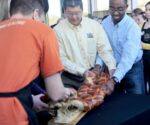
An estimated 200 people stood
outside the store waiting for the official opening time of 10 a.m. Instead of a
ribbon-cutting ceremony, the crowd witnessed a bread- breaking during which
store employees broke an over-sized loaf of challa.

While area residents such as
Johnson and Gomella had been waiting for a local Whole Foods, so was the
company. Regional Vice President Sam Park said prior to the bread breaking that
the company has wanted to open a store in the greater Chadds Ford area for five
years.

Store Team Leader John Frye was
as excited as the customers. He explained what he sees as the attraction for
the buying public.

“Above and beyond being one of
the best organic and natural retailers in our business, we have a couple of
exciting things going on specifically at our store here,” he said.

Specifically, he referred to
the stores’ pub, x where people can sit down with a coffee, tea, beer or wine.
The store has a liquor license.

“We have eight local beers on
tap and a wide selection of to go beers, but we also have a 100 percent organic
coffee bar, which is a first for Whole Foods in this region,” Frye said.

There is also a cooking at home
section where people can get tips on kitchen basics and how to prepare specific
foods.

“It’s really all about teaching
customers getting back to basics about cooking and bringing the family back
together at the dinner table and having a wholesome meal,” Frye said.

He said the class is really
constant education on the floor. People just need to come in and check with any
of the educators and get a lesson on everything from how to properly use a
knife to how to cook a given dish.

Frye said the store is about
great products, and service delivered by team members who are passionate about
what they do.

The store is 38,000 square feet
in area and employs 135 people. The store hours are 8 a.m. to 9 p.m., seven
days per week.

About Rich Schwartzman

Rich Schwartzman has been reporting on events in the greater Chadds Ford area since September 2001 when he became the founding editor of The Chadds Ford Post. In April 2009 he became managing editor of ChaddsFordLive. He is also an award-winning photographer.

Whole Foods is now open Read More »

Police log March 15

• Troopers from the Avondale
barracks of Pennsylvania State Police Troop J will be conducting a sobriety
checkpoint the weekend of March 16-18 at an undisclosed location in Chester
County.

• The manager of the Cosi
restaurant at the Concordville Town Center was arrested for stealing a
customer’s cash and credit cards. A police report said the customer placed a
black bag with cash and cards on the counter, then went to his car forgetting
the bag. Store Manager Joseph Edward Brown Jr., 25, of Boothwyn allegedly stole
the victim’s credit card and used it at a gas station. The report said the
victim returned to the store once he realized he left the bag. It was then he
realized his cash and cards were gone. Charges against Brown were pending.

• A 37-year-old woman was
arrested for DUI after arriving drunk for a DUI hearing. State Police from
Troop J, Avondale, said Alyson Laskas Kovatch, of Cochranville, showed up at
District Court for a preliminary hearing while under the influence. It was determined
she had driven to the hearing in that condition and was arrested on the spot,
the report said.

• Three people are sought in a
criminal mischief case that happened in the parking lot near Target at the
Concordville Towne Center. According to police, the three, two white men and
one white woman, pushed a shopping cart into another vehicle causing a dent and
some scratches. The trio then fled the scene. The license plate number of the
fleeing car is reported to be North Carolina tag AC 7728. The car is described
as an older Ford, white in color with a missing left front hubcap.

• Caitlyn Conly, 23, of
Philadelphia was stopped for speeding at Marshal and James Hayward roads on
March 8 and wound up arrested for DUI. A police report said Conly was determined
to be DUI after she was stopped at 1:31 a.m.

About CFLive Staff

See Contributors Page https://chaddsfordlive.com/writers/

Police log March 15 Read More »

Bits & Pieces March 15

Bits & Pieces March 15


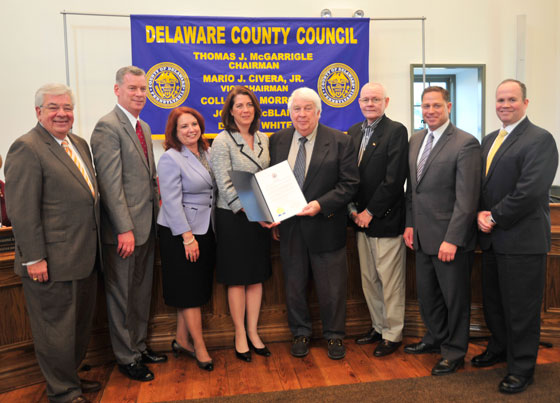
Click here to listen to report about Delco Council by Lloyd Roach direct from Brandywine Radio


• Scribner’s Magazine: The Early Years in Illustration, running at the Brandywine River Museum, March 17 through May 20, highlights the illustrators who contributed to the magazine’s success and presents the swift evolution of the image printing process at the end of the 19th century. Visitors will see works by Charles Dana Gibson, Thornton Oakley, Rose O’Neill, Maxfield Parrish, Howard Pyle, Frank Schoonover, N. C. Wyeth and others.


Illustrated magazines were a hugely popular form of entertainment in the days before radio and television. Through them readers were exposed to a wide variety of artistic styles and personalities. Scribner’s Magazine was launched in January 1887 with the editorial promise that each issue “will be fully and handsomely illustrated by the best work of the leading artists, engraved in the most skillful manner, or reproduced by the best methods known.” Only the best illustrators were chosen to meet this lofty standard.


• Penn State Extension Master Gardeners of Chester County will be holding a garden fair and sale on April 28, 9 a.m. to 3 p.m., at the East Goshen Township Building, 1580 Paoli Pike in West Chester. The event will include classes, workshops, plant sale, demonstrations, and a silent auction. A fee of $25 ($35 at the door, space permitting) provides admission to all talks and activities. The plant sale is free and open to the public.


• State Rep. Stephen E. Barrar (R-Chester/Delaware) will host his seventh annual Health and Safety Fair on Saturday, March 24, from 10 a.m. to 1 p.m. at the Upper Chichester Municipal Complex, located at 8500 Furey Road in Upper Chichester. The Health and Safety Fair is hosted in conjunction with the Upper Chichester Township Commissioners, Aqua America, Comcast and Exelon. Other co-sponsors of the event include local government organizations, area non-profit groups, state government agencies and community businesses. During the event, the Pennsylvania Farm Bureau will sponsor a food drive for the Delaware County Interfaith Food Assistance Network.


• The Chester County 4-H Poultry club will be holding an organization meeting on Saturday, April 14 from 10-11:30 a.m. at the Romano 4-H Center of Chester County on Route 82 just west of the intersection of Route 82 and 322. The 4-H Poultry club is a new club and is looking for interested youth ages 8- 18 to join the club. This is a great way for youth to learn about various types of poultry and fowl while having fun. 4-H is an educational organization for children 8-18 that promote hands on learning. For more details on the poultry club contact Jodi Peterson at 484-318-3931 or contact Toni Stuetz at the Penn State Extension 4-H office at 610-696-3500. Penn State is an affirmative action, equal opportunity university.


• Darlington Arts Center proudly presents Irish folk band Belfast Connection on Saturday, March 24 as part of their Coffee House Performance Series. A Belfast Connection show celebrates Ireland and her music from rollicking pub songs to reflective ballads. This concert will start with an open mic at 7:30 p.m. followed by the Belfast Connection at 8 p.m. Bring friends and a picnic (BYOB – corkscrew, coffee, tea and desserts provided) to enjoy this exciting performance! Darlington Arts Center is at 977 Shavertown Road in Garnet Valley, PA; for more information call 610-358-3632 or visit www.darlingtonarts.org.


About CFLive Staff

See Contributors Page https://chaddsfordlive.com/writers/

Bits & Pieces March 15 Read More »

Few residents attend first school budget hearing

The Unionville
Chadds Ford School Board March 12 public hearing provided opportunity for
resident taxpayer’s to comment on the district administration’s proposed 2012 –
2013 budget.

The work
session was well attended by teachers, who are concerned about potential staff
reductions. However, only a
handful of residents attended the public hearing.

Bruce Yelton,
of Pocopson Township, voiced several concerns.

“The district
budget process should address the impact of additional students next school
year triggered by the closing of St. Patrick’s parochial school in Kennett
Square,” Yelton said, adding. “Residents voted down the high school construction
budget, which the School Board then allowed to be creatively financed. Residents
were promised the interest on the debt incurred would be less than 10 percent
of the budget. The proposed 2012 – 2013 budget includes interest expenses
exceeding 11 percent.”

Yelton also
questioned Superintendent Sanville if the district planned to sue the architect
engaged for the high school project for costly mistakes.

Sanville
responded by saying the administration would “study Mr. Yelton’s questions
raised and respond to him in the near future.”

Harry Miller,
of Birmingham Township, said the number of district employees and their salaries
were way out of line.

Miller said,
“Superintendent Sanville’s salary exceeds Governor Corbett’s salary. Many
District residents live on fixed incomes and the proposed budget school tax
increase for Chester County residents is not acceptable.”

Robert Cochran,
director of business operations operations, provided a lengthy 31 page
PowerPoint presentation listing the challenges the district must address in the
2012 – 13 budget.

Page 26 of the
PowerPoint outlines 4 budget scenarios reflecting differing amounts of cost
cutting which the School Board Directors are considering. Among the budget
challenges are decreased real estate transfer tax revenues, resident real
estate tax assessment appeals which have reduced the current year’s revenue by
$2,800,000 and reduced funding from Harrisburg.

Additionally
the District’s portion of employee retirement contributions will continue to
spiral over the next three annual budgets. The PowerPoint is posted on the
UCFSD Web page under the caption UPDATED 2012 – 2013 budget information – March
12 Budget Hearing Presentation”.
The Internet link to the presentation is
http://www.ucfsd.org/pdf/031212bh_preso.pdf.

School Board
Director Keith Knauss said he can support a tax increase of 1.75 percent weighted
average between the Delaware and Chester County residents of the UCFSD school
district which would be more in line with current economic conditions.

UCFSD residents
can attend the March 19 School Board meeting which will be held at Chadds Ford
Elementary School at 7:30 p.m. There will be a public comment period where
residents are allotted up to three minutes to ask questions or make suggestions
to the School Board Directors and District Administration. The UCFSD School
Board Finance Committee Meeting scheduled for April 9, 2012 will also provide
District residents an opportunity to comment on the 2012 – 2103 school year
proposed budget.

About Jim Phreaner

After 41 years of auditing large NYSE global corporations, former IRS Agent Jim Phreaner was looking for a project in retirement with fewer regulations and more people. He joined the staff at Chadds Ford Live more than a year ago. James Edward “Jim” Phreaner, 64, died suddenly in his Birmingham Township home on Dec.17, 2012. Jim was a devoted husband, son, father, friend, and neighbor.

Few residents attend first school budget hearing Read More »

Brandywine Battlefield Park reopens

Brandywine Battlefield Park reopens

Brandywine Battlefield Park
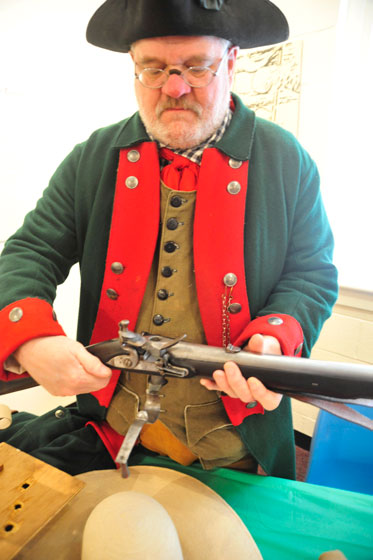
reopened with a bang on March 11. The park, situated on Route 1 in Chadds Ford
Township, hosted a lecture and demonstration on the Ferguson Rifle, first used
in combat during the 1777 Battle of Brandywine.

The weapon, which features a
rifled barrel and breach loading, was the design of British Capt. Patrick
Ferguson, a man who could have ended the colonials’ bid for independence during
the battle had chivalry not caused him to withhold firing.

As the story goes Ferguson and
others equipped with the superior weapon had two American officers in their
sights from a tree line but, since British rules of engagement frowned upon
officers killing one another, Ferguson himself stepped out from behind the
trees and ordered the men to advance and surrender. One officer beat a hasty
get away on horseback while the other, “a tall officer” rode calmly away.

Ferguson didn’t fire because he
thought it would be too much like murder, as he wrote in a letter to his
sister. But that officer who calmly road away was Gen. George Washington.

Had Washington known that the
weapon pointed at him was a rifle, he might have ridden away faster.

The British military musket
known as the Brown Bess was accurate to 80 yards while the Ferguson rifle was
accurate up to 300 yards. The rifle — with its breach loading — could also fire
up to six or seven rounds per minute while a good musketeer could get off only
three shots in that amount of time.

The story was told at the park
by Bryan Brown who, along with Ricky Roberts, gave a brief shooting
demonstration of the rifle. Included in the demo was a speed competition
between Roberts with his Ferguson and local re-enactor Brian Wolfe with a
replica Brown Bess.

Brandywine Battlefield Park has
been operated by the Brandywine Battlefield Park Associates since the state
stopped funding operation in August of 2009. It was closed in December for the
winter. It’s now open on the weekend and will later open four days per week.

Also during Sunday’s
attractions were guest lecturers John Graf and Gene Pisasale.

About Rich Schwartzman

Rich Schwartzman has been reporting on events in the greater Chadds Ford area since September 2001 when he became the founding editor of The Chadds Ford Post. In April 2009 he became managing editor of ChaddsFordLive. He is also an award-winning photographer.

Brandywine Battlefield Park reopens Read More »

Adopt-a-Pet March 15

Adopt-a-Pet March 15

Ophelia is an adult female ferret that was brought to the
shelter after she was discovered playing in a pile of leaves! Her finder knew that ferrets do not
belong outside, so Ophelia is now at the Chester County SPCA looking for a new,
indoor home. Ophelia is a friendly
and inquisitive girl who would make a great first ferret for anyone willing to
give her a chance. She especially
loves playing her favorite game of hide and seek. Like most ferrets, Ophelia can be adventurous and can easily
slip away when left unsupervised, so researching ferret care is a must before
considering adopting. If you are
able to provide Ophelia or any of our other animals here at the shelter a home,
visit the Chester County SPCA at 1212 Phoenixville Pike in West Goshen or call
610-692-6113. Ophelia’s
registration number is 96807274.
To meet some of our other adoptable animals, visit the shelter or log
onto www.ccspca.org.

About CFLive Staff

See Contributors Page https://chaddsfordlive.com/writers/

Adopt-a-Pet March 15 Read More »

Charles Frederick Benzel Jr. of West Chester

Charles Frederick Benzel Jr. of West Chester

Charles Frederick Benzel Jr., 83,
of West Chester, died Thursday, March 8, at the Crosslands Retirement
Community. He was the husband of Ann Winslow Shelnutt with whom he shared
60 years of marriage.

Born in Milwaukee, Wisc.,
January 23, 1929, he was the son of the late Charles Frederick and Janet Bass
Benzel. Charles was a graduate of Friends School of Wilmington and The
University of Delaware where he majored in business.

After serving as a 2nd lieutenant
in the United States Army during the World War II era, he embarked on a long,
successful career as a financial advisor and stock trader, serving for many
years as manager of the Wachovia Securities office in Greenville. Charles was
an avid horseman and enjoyed competing in steeplechase races in his younger
years. His passions were the stock market, horses, his family and the farm he
and his wife Ann found and bought together in 1962.

Charles is survived by his wife
Ann, brother, John Benzel, daughters, Jan Benzel, Kathryn McConnell, Deri
Gawthrop, Jeanne Benzel, Nancy Benzel, son Charles Benzel III, sons-in-law,
Stuart Rohrer, William McConnell, James Gawthrop, daughter-in-law, Judy
Mimeault and his eleven grandchildren.

A memorial service will be
held, date to be determined.

In lieu
of flowers contributions may be made to the Red Cross: http://www.redcross.org/donate/donate.html

or the Brandywine Valley
Association, 1760 Unionville Wawaset Road, West Chester, PA, 19382. http://www.brandywinewatershed.org/2008/getinvolved/donation.asp

Arrangements are being handled
by the Kuzo & Grieco Funeral Home, Kennett Square.

About CFLive Staff

See Contributors Page https://chaddsfordlive.com/writers/

Charles Frederick Benzel Jr. of West Chester Read More »

Scroll to Top