October 20, 2010

Battlefield Park gets boost from civic association

Battlefield Park gets boost from civic association

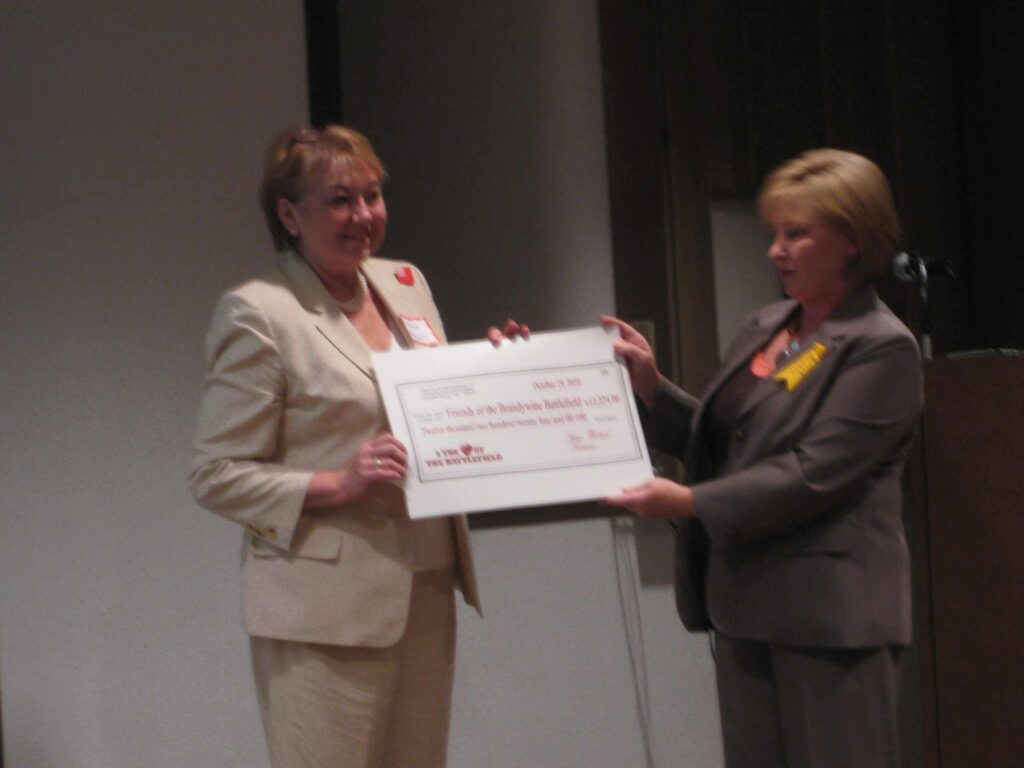
The Chadds Ford Civic Association presented a check for more than $12,000 to Linda Kaat, president of the Friends of the Brandywine Battlefield during the associations annual membership meeting.


The association held four fund-raising events for the park, “4 the love of the Battlefield.” Jill Egan, president of the Civic Association presented Kaat with a check for $12,224.


Egan reported that the organization established its not-for-profit status this year, enabling it to act as a conduit for funds to support the Brandywine Battlefield. Membership in the organization is down about 10 percent, she said, which corresponds to losses reported by other non-profits nationally.


Paul Reussille stepped down from the Civic Association Board of Directors. Vincent Del Rossi was elected. Egan, Barbara Guin, Amanda K Konyk, and Susan Worteck were re-elected for another term.


George Franz, president of the Chadds Ford Historical Society, showed pictures of early Chadds Ford and traced the preservation of the John Chad and Barns-Brinton House. One early picture of the Barns-Brinton house showed Route 1 as a dirt road. He described the new home of the Historical Society built on the exact footprint of an old barn. The sides of the building facing the road are wooden not to detract from the John Chad house stonework. The sides facing the meadow are stones recovered from a barn on Route 52 which got destroyed in a hurricane.


Peter Jesson gave a report on the Tick Reduction Task Force. His group is organizing a hunt to reduce the deer population. The preparation will not be completed for the whole township by this hunting season, but they will proceed as areas are ready. The question of liability was raised by township resident Ginger Tucker. A 14 page legal document has been created to address this issue.


A letter was read from the Chadds Ford Township Supervisors expressing gratitude for the many contributions to the community made by the association.

About Emily Myers

Emily Myers has lived and worked in Chadds Ford for over thirty five years.  She founded the parent company of Chadds Ford Live, Decision Design Research, Inc., in 1982.  ChaddsFordLive.com represents the confluence of Myers' long time, deep involvement in technology and community. Myers was a founding member of the Chadds Ford Business Association and currently serves on its board of directors.  Her hobbies include bridge, golf, photography and Tai Chi. She lives with her husband, Jim Lebedda, in Chadds Ford Township.

Battlefield Park gets boost from civic association Read More »

First Person Singular: Vote for what, not who

I can honestly say I’ve never voted for anyone who has
raised taxes, authorized an invasion into another country or promoted any legislation
that violated the principles of the Constitution or eroded individual liberty
or personal responsibility.

What that means is that I’ve never voted for a Republican or
a Democrat. Also, for the sake of full disclosure, I’ve never voted for a
candidate who won the election. That will continue this year. I vote for what I
want, not for someone just because I think he or she can win.

This year, as is often the case, the people who represent my
political philosophy are off the Pennsylvania ballot, so I will write in the
names of the Libertarian Party candidates running for U.S. Senate, governor and
lieutenant governor.

There’s no way I can bring myself to vote for any of the
government party candidates. The Corbett/ Onorato race for governor has been a
thumb-sucker, boring and flaccid. Listening to either candidate talk is a great
cure for insomnia and neither candidate can think outside the statist box.

The interesting race is the senate campaign between Pat
Toomey on the Republican side and Joe Sestak, the sitting Democrat U.S. Rep.
serving the 7th Congressional District, vying for the seat currently
held by Democrat-turned-Republican-turned-Democrat Arlen Specter.

I’ve never met Mr. Toomey. From what I’ve seen and read,
though, I expect him to be a typical right wing conservative who talks a great
game about the free market but would play the corporate welfare game once in
office and place basic civil liberties on the back burner.

Mr. Sestak is another story. I have met him and I like him.
As a former enlisted man in the U.S. Air Force, I recognize and respect the
proper quiet and confident command bearing displayed by the former three-star
admiral. But there’s no way I would trust him with either my money or my
liberty. Politically he is simply a left-wing statist who would control how I
spend my money and would also tell me what I can and can’t eat.

For those living in Chadds Ford Township and other parts of
in the 7th Congressional District, there is the race between
Democrat Bryan Lentz, the incumbent state legislator representing the 161st
Legislative District, and Republican Pat Meehan, a former U.S. attorney.

Mr. Meehan hasn’t been available in Chadds Ford, but Mr.
Lentz did attend the Democratic Party fund-raiser at the Outback last weekend.
Voters should know that while he said representatives should cite
constitutional authority for legislation they propose, he also said he believes
the Constitution is a living document. All that means is that he, like others,
would treat the Constitution as meaning whatever they want it to mean in order
to rationalize a given political agenda. Would you want to play poker with a
guy like that?

So for whom should you vote? For what will you vote?

For me, I’ll be writing in the names of Libertarian
candidates that the Republican Party kept off the state ballot: Marakay Rogers
for governor, Kat Valleley for lieutenant governor and Douglas Jamison for U.S.
Senate. In all other races I’ll write in “None of the above.”

(Unfair ballot access is an issue to be addressed later.)

Will my candidates win? Likely not, but neither will half of
the other candidates. For almost 40 years I’ve been told I’m wasting my vote.
No, I’m not. My vote is for liberty and for those who I think will help make
that manifest. I would rather vote for what I want and not get it, than vote
for the lesser of two evils just because one of them would win an election.
Doing that would be the waste of a vote.

Look at the condition of the country and of the state then
ask whether you want more of the same, Tweedledum vs. Tweedledummer. People
base their votes on various reasons. Some make a selection based on a
candidate’s personality (perceived personality, really) while others make the
choice based on a candidate’s party affiliation. Still others vote for a
candidate who they think agrees with them on at least one issue. Some of us
vote based on a candidate’s political philosophy. I’d vote for Republican Ron
Paul if I had the opportunity, but I don’t so I vote Libertarian.

My endorsement is to say vote as if your liberty depends on
it—because it does.

About CFLive Staff

See Contributors Page https://chaddsfordlive.com/writers/

First Person Singular: Vote for what, not who Read More »

Mind Matters: Strategies of grief

Elisabeth Kübler-Ross, when she
delineated the five stages of grief (Denial, Anger, Bargaining, Depression,
Acceptance), never meant them to be written in stone. In fact, she never even meant
them to be a description of grief after the death of a loved one. The stages
were based on her observations of the dying person in relation to his or her
own death.

We can be grateful to Kübler-Ross
for her pioneering efforts in the field of death and dying. However, to remain
wedded to her stages limits a deeper understanding of how we grieve.

Recently, I attended a
conference presented by Robert Neimeyer, Ph.D., on grief therapy.

As humans, we all must at some
point in our lives face loss. Try hard as we may, by keeping busy with work,
shopping, etc (or by mind-numbing non-activity), we all encounter loss (and
eventually we must face our own death). Neimeyer himself was confronted with a
traumatic grief as a twelve-year-old, when his father committed suicide. It
appears that this tragedy may indeed have given impetus for him to find meaning
in his own life, eventually becoming a master therapist and teacher on coping
with grief.

Words to forget when it comes
to grief:

·
Closure—we
never have “closure” when a loved one dies. We may integrate the loss in our
lives and have a different relationship to the deceased, but we do not let go
and detach ourselves from the relationship. We love and remember forever.

·
Stages—grieving
is not linear, but a nonlinear process.

·
Sameness—there
is no “one way” of grief. “Loss and grief are highly personal experiences that
do not suggest a single path for all mourners.” (Neimeyer, Lessons of Loss. A Guide to Coping)

Neimeyer reminds us that the
death of a loved one can tear apart our assumptive world. Our fundamental
belief system is shaken. This loss of our assumptive world that accompanies the
loss of a loved one hurtles us into a search for meaning in a vastly changed
universe. The trauma repair necessitates the integration of the loss into our
own personal narrative so that we can come to some sense of restoration, and
new, albeit changed, relationship with our loved ones who died.

While some of us may be
fortunate enough not to have major losses affect us until much later in life,
no one escapes the little losses that occur throughout life. These little
events can be our teachers.

Neimeyer gives ten practical
strategies for coping—some to be practiced well before a major loss, others to
be utilized in the event of a great loss:

1.
Take the little losses seriously: moving, friend moving
away, death of a pet (although for some, this is a major loss).

2.
Take time to feel—find some alone time.

3.
Find healthy ways to relieve stress.

4.
Make sense of your loss.

5.
Confide in someone. Ask for help, a listening ear.

6.
Let go of the need to control others.

7.
Ritualize the loss in a personally significant way.

8.
Allow yourself to change.

9.
Harvest the legacy of the loss.

10. Center
in your spiritual convictions.

[For anyone of any age who
feels touched by grief, the Grief Awareness Consortium of Delaware is hosting a
free event, Life After Loss:Sunday,
November 7, 2010, 1:00-4:30PM, Newark Senior Center, 200 White Chapel Drive,
Newark, DE 19713. For more information, or to register, go to http://www.degac.org/.]

References:

·
Robert Neimeyer, Ph.D., Lessons of Loss: A Guide to Coping.

·
Susan Olson, L.C.S.W., By Grief Transformed: Dreams and the Mourning Process.

* Kayta Curzie Gajdos holds a doctorate in counseling
psychology and is in private practice in Chadds Ford, Pennsylvania. She
welcomes comments at
MindMatters@DrGajdos.com or
(610)388-2888. Past columns are posted to
www.drgajdos.com.

About Kayta Gajdos

Dr. Kathleen Curzie Gajdos ("Kayta") is a licensed psychologist (Pennsylvania and Delaware) who has worked with individuals, couples, and families with a spectrum of problems. She has experience and training in the fields of alcohol and drug addictions, hypnosis, family therapy, Jungian theory, Gestalt therapy, EMDR, and bereavement. Dr. Gajdos developed a private practice in the Pittsburgh area, and was affiliated with the Family Therapy Institute of Western Psychiatric Institute and Clinic, having written numerous articles for the Family Therapy Newsletter there. She has published in the American Psychological Association Bulletin, the Family Psychologist, and in the Swedenborgian publications, Chrysalis and The Messenger. Dr. Gajdos has taught at the college level, most recently for West Chester University and Wilmington College, and has served as field faculty for Vermont College of Norwich University the Union Institute's Center for Distance Learning, Cincinnati, Ohio. She has also served as consulting psychologist to the Irene Stacy Community MH/MR Center in Western Pennsylvania where she supervised psychologists in training. Currently active in disaster relief, Dr. Gajdos serves with the American Red Cross and participated in Hurricane Katrina relief efforts as a member of teams from the Department of Health and Human Services' Substance Abuse and Mental Health Services Administration.Now living in Chadds Ford, in the Brandywine Valley of eastern Pennsylvania, Dr. Gajdos combines her private practice working with individuals, couples and families, with leading workshops on such topics as grief and healing, the impact of multigenerational grief and trauma shame, the shadow and self, Women Who Run with the Wolves, motherless daughters, and mediation and relaxation. Each year at Temenos Retreat Center in West Chester, PA she leads a griefs of birthing ritual for those who have suffered losses of procreation (abortions, miscarriages, infertility, etc.); she also holds yearly A Day of Re-Collection at Temenos.Dr. Gajdos holds Master's degrees in both philosophy and clinical psychology and received her Ph.D. in counseling at the University of Pittsburgh. Among her professional affiliations, she includes having been a founding member and board member of the C.G. Jung Educational Center of Pittsburgh, as well as being listed in Who's Who of American Women. Currently, she is a member of the American Psychological Association, The Pennsylvania Psychological Association, the Delaware Psychological Association, the American Family Therapy Academy, The Association for Death Education and Counseling, and the Delaware County Mental Health and Mental Retardation Board. Woven into her professional career are Dr. Gajdos' pursuits of dancing, singing, and writing poetry.


Mind Matters: Strategies of grief Read More »

The Garden Path: Those stinkin’ stink bugs

The Garden Path: Those stinkin’ stink bugs

The annoying dive bombers you have
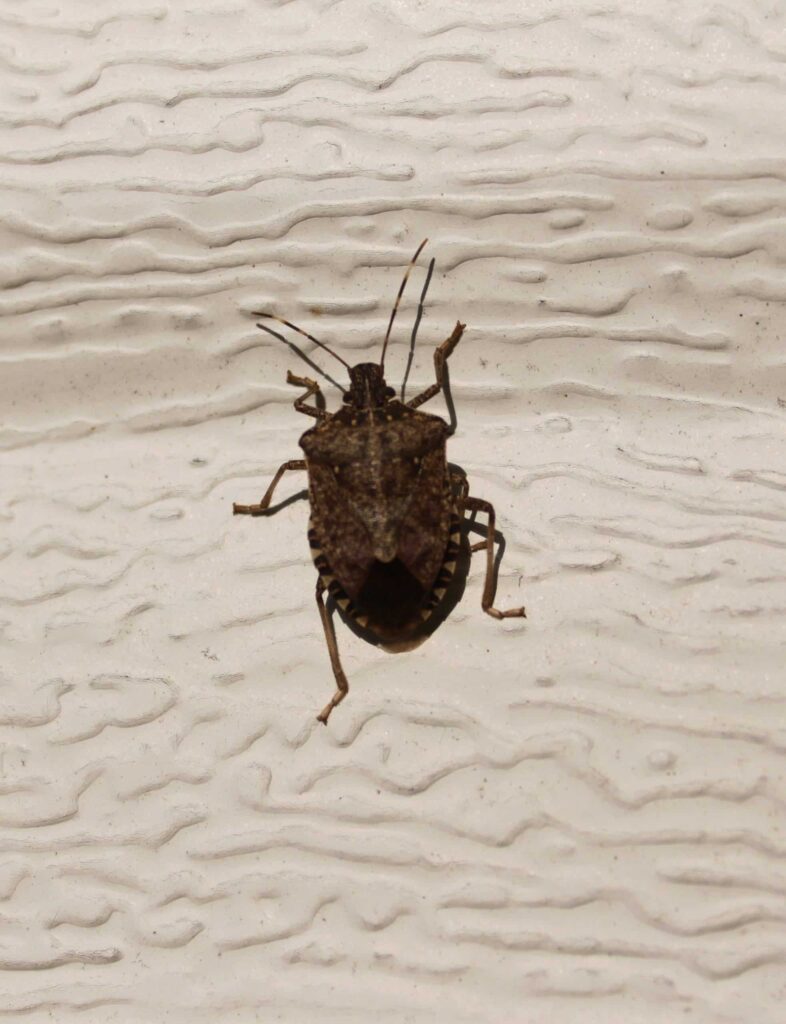
been battling are called brown marmorated stink bugs. This irritating insect was accidentally introduced into
eastern Pennsylvania a number of years ago from China. Stink bugs get
inside houses through tiny cracks and crevices, looking for a warm place to
spend the winter. If you step on one in an enclosed area (which I’m not
recommending) you will learn why they are called “stink” bugs.

Stink bugs can be a significant
agricultural pest in orchards, where they do damage to apples and pears. Inside
the home, however, they are harmless. They do not eat wood, nest, swarm, damage
clothing, have wild parties, borrow your car without asking, or harm people,
except to drive them a little crazy (ironically, a stink bug is buzzing around
me while I write this).

So the Big Question everyone is
asking is “What can I do about them,” which roughly translates as “What can I
spray on them that will annihilate them?”
Unfortunately, the answer is nothing.

Yes, there are pest companies and
enterprising entrepreneurs who will gladly take your money to “get rid of”
stink bugs. That’s fine if you want to flush your money, along with some stink
bugs, down the toilet. It’s sort of like spraying for house flies. Sure, if you
fill your house with a cloud of insecticide, you will kill the house flies. But
on his way out the door, your exterminator will let in a few more and you’re
back where you started, a few hundred dollars lighter. In addition, if you do
spray an insecticide, any stink bugs that expire in out-of-the-way places like
attics and wall voids, now become food for critters that do cause harm like carpet beetles and mice.

The best advice we can offer is to
locate the openings where the insects gain access and seal them.
Typically, stink bugs will emerge from cracks under or behind baseboards,
around window and door trim, inside air conditioner openings, and around
exhaust fans or lights in ceilings. Seal these openings with caulk or other
suitable materials to prevent the insects from crawling out. Make sure doors and windows are well
sealed on the outside as well.

Both live
and dead insects can be removed from interior areas with a vacuum cleaner,
although some people have reported the vacuum cleaner bag can absorb the odor,
and then transmit it back out through the vacuum’s exhaust. For this reason,
you may want to invest in a “bug vac” (the type used by kids to collect and
examine insects), or an inexpensive hand vac. While the chamber that holds them
gets stinky, it may be the least objectionable way to collect stink bugs. Once
the chamber has reached capacity, flush the bugs down the toilet.

Although aerosol pyrethrum foggers
will kill stink bugs that have amassed on ceilings and walls in living areas,
it will not prevent more of the insects from emerging shortly after the room is
aerated. For this reason, use of these materials is not considered a good
solution to long-term management of the problem. Spray insecticides, directed
into cracks and crevices, will not prevent the bugs from emerging and is not a
viable or recommended treatment.

The good news is, as winter comes,
the stink bugs will go into a sort of hibernation phase. The bad news is, they
will be back in the spring. So until scientists come up with a better solution,
seal up your house the best you can and keep that vac handy.

For more
information, go to:

http://ento.psu.edu/extension/factsheets/pdf/BrownMarmoratedStinkBug.pdf

Gardening
Question? Ask a Master
Gardener! Call 610-696-3500 or
email chestermg@psu.edu.

• Nancy
Sakaduski is the Chester County Master Gardener Coordinator. Master
Gardeners are trained volunteers who educate the public on gardening and
horticultural issues. In Chester County, they operate through the Penn
State Cooperative Extension office in West Chester. Nancy lives in
Pennsbury Township. She can be reached at nds13@psu.edu.

About Nancy Sakaduski

Nancy Sakaduski is a Master Gardiner with Penn State Extension of Chester County.

The Garden Path: Those stinkin’ stink bugs Read More »

Scroll to Top