Brody is an adult neutered male pit bull that is available
for adoption through the Chester County SPCA. He came to the
shelter on April 24 as a stray and is now looking for his new forever home. We
estimate his age to be between 1-3 years old. Brody is a loveable guy who loves
to give kisses and is very happy to be a lap dog. He still has a lot of energy
and loves a game of tug of war.Brody is now
looking for a responsible care giver who will give him the love and attention
he deserves. If you are able to provide that home, visit the Chester County
SPCA at 1212 Phoenixville Pike in West Goshen or call 610-692-6113. Brody’s
registration number is 96799095. To look at some of the other animals available
for adoption, visit the shelter or log onto http://www.ccspca.org/
More than 1,000 people took advantage of free admission at
the Brandywine River Museum Monday in honor of what would have been Andrew
Wyeth’s 93rd birthday.
The world-famous Chadds Ford artist was born July 12, 1917.
He died January 16, 2009.
In addition to the free admission into the museum, there
were also free tours of the N.C. Wyeth home and studio. There were three
showings of the documentary, “Snow Hill,” a one-hour film biography/self
portrait of Wyeth narrated by actor Stacy Keach.
Also on display were rarely seen photographs and portraits
of the artist from his youth into his adult life, and many of his medals and
awards including his 2007 National Medal of Arts and the Presidential Medal of
Freedom awarded in 1963. Wyeth was the first painter to receive the
presidential medal.
The museum also offered Jimmy John’s hot dogs and birthday
cake.
Hillary Holland, director of public relations for the museum
and Brandywine Conservancy said
“He made Chadds Ford famous around the world, but Chadds
Ford is still a small town and people still have wonderful memories about him,”
Holland said. “We miss him. He did wonderful things for us and made wonderful
art.”
She said Wyeth’s legacy was that “wonderful art” that makes
people “admire and appreciate what he was able to accomplish with his egg
tempera work and his watercolors.”
Wyeth’s work had a broad appeal, making an impact on young
and old alike. She shared a personal story, saying that her sister, who has
lived all over the country and in foreign countries, would always think of home
whenever she sees a Wyeth painting.
He was an “integral part of Chadds Ford life and people
still miss him,” Holland added.
Echoing much of Holland’s sentiment was Barbara Moore,
director of the Chadds Ford Gallery.
Moore also said that Wyeth knew his subject matter. He lived
in Maine during the summer and Chadds Ford the rest of the year, and those were
the two locations he painted.
“He brought Chadds Ford to the forefront of the art world,”
Moore said. “N.C. [Wyeth, Andy’s father] had done that, but Andy just really
brought it to be… The special thing to remember [about Wyeth] is that he
existed,” Moore said. “Unfortunately, we only had 91 years of a talent that
should have gone on and on and on.”
Moore said it’s possible to view his body of work, possibly,
as a story Wyeth was trying to tell. She referred to the fact that there were
tire tracks in a number of his paintings and she speculates that the tracks
represented the artist’s own passage through life.
“It’s the coming and going of life,” she said. “With death
there is always life, and that always came through in his artwork and whatever
he was portraying… He’s left us a wonderful legacy.”
Rich Schwartzman has been reporting on events in the greater Chadds Ford area since September 2001 when he became the founding editor of The Chadds Ford Post. In April 2009 he became managing editor of ChaddsFordLive. He is also an award-winning photographer.
The president of the Delaware County Chamber of Commerce
sees some positive signs that the economy is improving, though he admits it
will take time for all businesses to recover.
Mike Brady, a financial planner, said during a July 14
chamber sponsored “Coffee Connections” meet and greet, that larger
manufacturing companies are now reinvesting in themselves.
“They’re spending money again. As we come out of this, there
are leading indicators and lagging indicators. The leading indicator is
spending by large businesses. The reason being is that it’s easy for large
businesses with a long history to get credit. It’s very difficult for small,
local businesses, newer businesses to get credit from banks,” Brady said.
“Larger businesses with a great standing are able to go
borrow and invest, and they are now doing that. What you’ll see, as that
trickles down through the economy, the smaller businesses will benefit and
then, finally, the retailers will be the last ones to see people come back
through the doors, buy again, shop again and spend money again.”
Brady expects retailers to see their businesses improve
within the next 12 months. Even though money is beginning to flow again, he
said, consumer confidence is still low.
One of the things driving the recovery, Brady said, is that
many of the people whose companies have offered early retirement, people in
their 50s, are starting their own businesses.
“Instead of sitting in a rocking chair, they’re doing
whatever it was they were dong on the weekends that they were passionate about.
They’re doing it as their second life job,” Brady said. “They’re opening that
small business and taking a shot at the American Dream.”
He said 70 percent of all new hires are by small businesses.
The chamber’s goal is to continue adding value to membership.
Brady said the idea is like a three-legged stool with every chamber action
designed to serve at least one of those legs.
“Everything the chamber does must involve one of the three
following things for businesses,” Brady said. “Either great networking opportunities…education
for small business owners and employees of our larger business members…advocacy
for businesses at the local, state and federal level.”
Brady said every employee of a chamber member is a member
also. He added that the chamber does not endorse politicians, but it does
endorse specific pieces of legislation. The chamber will also come out against
a specific piece of legislation if it thinks it will be a “job killer.”
Rich Schwartzman has been reporting on events in the greater Chadds Ford area since September 2001 when he became the founding editor of The Chadds Ford Post. In April 2009 he became managing editor of ChaddsFordLive. He is also an award-winning photographer.
• Families will continue to enjoy Dino Days in December and
other popular educational activities throughout the year at the Delaware Museum
of Natural History thanks in part to a $20,000 grant recently provided by the
Bank of America Charitable Foundation. The grant will provide sponsorship
support for the museum’s annual dinosaur extravaganza and essential funding for
operating expenses.
• Seven works never before on
public view, as well as more than 30 other works by Andrew Wyeth, are currently
on view at the Brandywine River Museum. A unique study for Maga’s
Daughter (1956) with a grid system of string and nails, as well as two
pencil-on-paper studies for it, are displayed beside the completed tempera
painting. The exhibition continues through October 25.
While the Chadds Ford area may have rural roots, it’s not opposed to technological advances. The Internet is keeping residents and developers informed about what they can and can’t do.
Birmingham Township has had its ordinances codified since 1995, but they’ve only been on line for about two or three years, according to Township Manager Quina Nelling. She said General Code Publishers updates the site whenever codes are amended.
She said accessing information has become much easier since the code has been on line, even for her.
“I hardly ever use my own book now,” she said.
All people have to do to see the code is to go to the township Web site, click on “ordinances” on the left hand column and then follow the links.
The same basic procedure holds true for looking into the Pennsbury Township ordinances. The code is on line on Pennsbury’s site, but Township Manager Kathy Howley said the site is not automatically updated when an ordinance is amended. She said it’s best to view the ordinance on line and then check with her to make sure there were no changes made since the posted date on the ordinance.
Chadds Ford’s procedure is in a state of limbo at present. While ordinances are codified and there is a township Web site, the site has not been updated since last autumn.
Township Manager Joe Barakat said the site is being redesigned and will include the ordinances, but the project won’t be complete for a few more months. Codebooks can be reviewed at the township building and people can buy a CD with the code for $25.
Barakat said the site should be up and running within two months, though he’s hoping it will be sooner.
General Code Publishers also handles Chadds Ford’s code, and Barakat said there could be a lag time of anywhere from a few days to a month between the time an amendment is passed and the time the change is made on the site.
Even when Web sites are regularly updated, it would still be advisable to check with a township manager or code enforcement officer to ensure the most recent and accurate information is used.
Rich Schwartzman has been reporting on events in the greater Chadds Ford area since September 2001 when he became the founding editor of The Chadds Ford Post. In April 2009 he became managing editor of ChaddsFordLive. He is also an award-winning photographer.
Sure, it’s easy to buy
birdseed at the store, but there’s an even easier way to attract birds. In nature, birds eat more than seed;
they eat insects, nuts, and fruit. By planting the right trees and shrubs, you
can provide birds with months of food, and enjoy watching them in your yard.
Start by using native
plants. Plants and animals evolve together in a given area, so native plants
play host to a wide range of insects, birds, and other wildlife. If you fill
your yard with plants native to Asia, Europe, and other areas, these creatures
may not be able to find anything they can eat. A ready supply of insects is
particularly important, because nearly all birds need insects to feed their
young.
By planting a variety of
native trees and shrubs you can provide a year-round food source
for birds. Choose plants that bloom and fruit at different times to help
ensure that food is always available. If there are gaps, you can supplement
with commercial birdseed.
Here are some
good choices:
Downy Serviceberry (Amelanchier arborea)
is a small shade-tolerant tree that provides food for at least 19 species of
birds, including hairy woodpeckers, rose-breasted grosbeaks, red-eyed vireos,
and scarlet tanagers. This is a great choice for a small yard or woodland edge.
Black Cherry (Prunus serotina) is a large native tree
that produces abundant fruit that is food for at least 47 species of birds,
including northern flickers, red-headed woodpeckers, northern mockingbirds,
rose-breasted grosbeaks, and white-throated sparrows.
White Oak (Quercus alba) is a large native tree
that produces acorns that are an important food for mammals as well as birds,
including flickers, red-headed woodpeckers, and blue jays. It is also a top
insect host, making it doubly valuable to birds. If you’ve got the room, plant
this.
Flowering Dogwood (Cornus florida) is a small native tree
that produces nutritious fruit that is eaten by 36 species of birds, including
6 species of thrush, northern flickers, pileated woodpeckers, summer tanagers,
evening grosbeaks, and pine grosbeaks. Look for new disease-resistant
varieties.
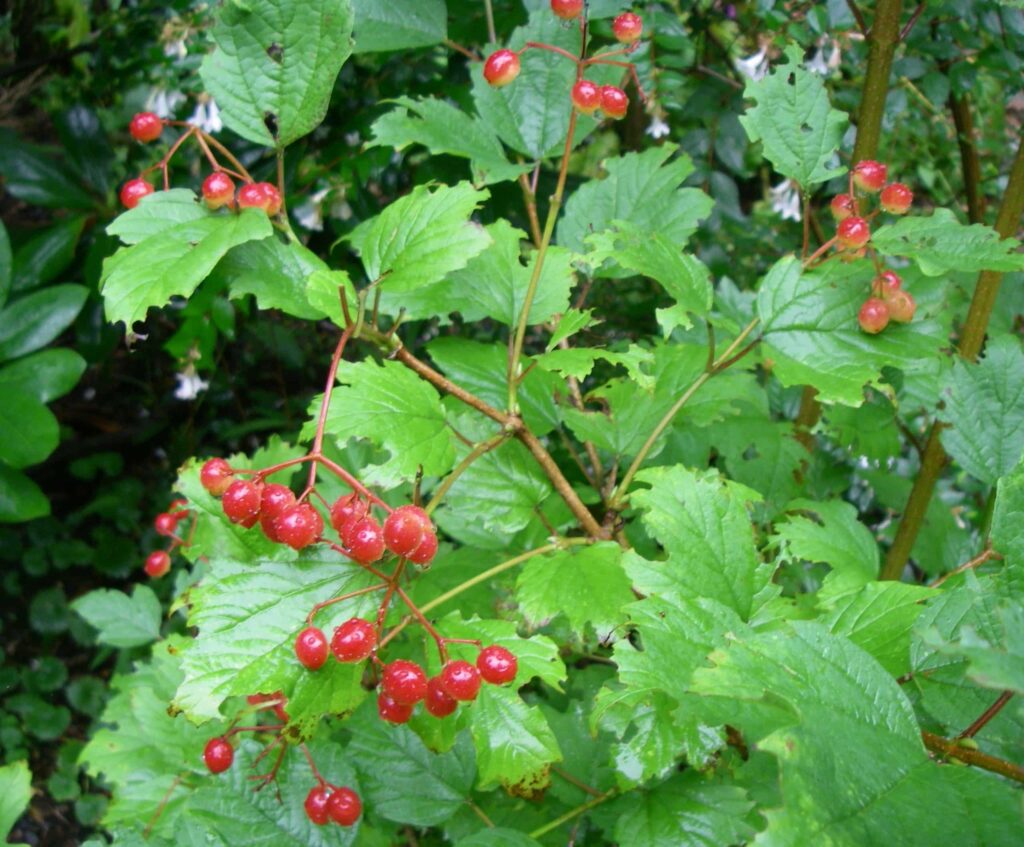
Viburnums
(Viburnum dentatum, Viburnum trilobum,
Viburnum lentago, and others) are shrubs that attract many species of
birds, including eastern bluebirds, northern flickers, gray catbirds, cedar
waxwings, and American robins. There are a wide variety of Viburnums, so choose
one you like, just make sure it’s a native.
Highbush
Blueberry (Vaccinium corymbosum)
is a large shrub that attracts 30 species of birds including: American robins,
eastern bluebirds, scarlet tanagers, eastern and spotted towhees, gray
catbirds, northern mockingbirds, brown thrashers, and northern cardinals. Eat a
few blueberries yourself and then let the birds put on a show.
Eastern
Red Cedar (Juniperus virginiana)
is a large evergreen tree that attracts many birds including cedar waxwings,
northern mockingbirds, brown thrashers, gray catbirds, American robins, mourning
doves, purple finches, common crows, northern flickers, downy woodpeckers,
evening grosbeaks, yellow-bellied sapsuckers, and eastern bluebirds.
Winterberry Holly (Ilex verticillata) is a deciduous holly
with gorgeous red berries that attract American robins, eastern bluebirds,
cedar waxwings, gray catbirds, brown thrashers, and northern mockingbirds.
American robins, eastern
bluebirds, thrushes, gray catbirds, cardinals, chickadees, wild turkeys,
pileated woodpeckers, and others (more than 95 species have been recorded).
Virginia
Creeper (Parthenocissus
quinquefolia)is a climbing
vine that produces fruit eaten by northern mockingbirds, American robins,
eastern bluebirds, thrashers, warblers, plus 35 other species. This vine can be
aggressive, but puts on a tremendous show of fall color. Spicebush (Lindera benzoin) is a favorite of
thrushes and at least 13 other bird species. This underutilized native shrub
will take shade as well as sun and is deer resistant, as well as being the host
for the spicebush swallowtail butterfly.American Elder (Sambucus canadensis) is a deciduous shrub that produces
elderberries, which are eaten by at least 33 species of birds. It is a good choice
for providing late-summer food and nesting cover in moist areas.
Sassafras(Sassafras
albidum)is
a native tree that attracts at least 22 species of birds, including pileated
woodpeckers, eastern bluebirds, northern mockingbirds, eastern kingbirds, gray
catbirds, thrashers, and flickers.
For
more information, contact the Audubon Society, which is headquartered right
here in Pennsylvania: http://www.audubon.org.
Have
a gardening question? Ask a Master
Gardener! Contact Penn State
Master Gardeners of Chester County at 610-696-3500 or chestermg@psu.edu. Please visit Chester County Master
Gardeners on Facebook!
• Nancy Sakaduski is
the Chester County Master Gardener Coordinator. Master Gardeners are
trained volunteers who educate the public on gardening and horticultural
issues. In Chester County, they operate through the Penn State
Cooperative Extension office in West Chester. Nancy lives in Pennsbury
Township. She can be reached at nds13@psu.edu.
Ever get tired of yet another pop psychology book on
“positive” thinking? Barbara Ehrenreich’s book, “Bright-Sided: How the
Relentless Promotion of Positive Thinking Has Undermined America” is one
antidote to the pap of positivism.
As a psychologist, I, of course, want to help people
re-frame their situations and find meaning and hope in their lives. But to have
an authentic life, we really do need to feel all our feelings and stop naming
happy as positive-good, and sad as negative-bad.
There is a popular positive psychology movement afoot that
Ehrenreich rightly takes to task, and not because she’s some sort of dour
sourpuss. She says:
“I do not write this [book] in a
spirit of sourness or personal disappointment of any kind, nor do I have any
romantic attachment to suffering as a source of insight or virtue. On the
contrary, I would like to see more smiles, more laughter, more hope, more
happiness and, better yet, joy. But we cannot levitate ourselves into that blessed
condition by wishing it. We need to brace ourselves for a struggle against
terrifying obstacles, both of our own making and imposed by the natural world.
And the first step is to recover from the mass delusion that is positive
thinking.”
Our culture is grounded in Calvinism which is rooted in the
notion of predestination. This gave us a very strong work ethic that eschewed
pleasure and play. (Picture the image of American Gothic—you know, the farmer
and his wife standing strong and stern.) However, Calvinism, with its
predestination also promoted the idea that if you did well in this life, you
deserved it and that you could expect to be well off in the hereafter too.
Hence, the poor “deserved” to be poor, and the rich were simply fulfilling
their own manifest destiny.
Well, now we seem to have tossed out the part of Calvinism
that spurns pleasure, while keeping some of predestination afloat. It’s an odd
combination we have here. On the one hand, we are urged to think positively—go
shopping, be consumers, that having, getting, and doing will make us happy. We
are informed that we can make things happen by thinking positive thoughts.
On the other hand, if we don’t pull this off, if we aren’t
always “positive” because we see that there are situations in our lives that
are difficult or see in the world that there is great suffering, or if we are
not making it by in the grand scheme of things—well then, we’re back to the
predestination of the Calvinist era—if you’re not rich or happy, it’s your
fault.
Of course, we need to take responsibility for our behaviors,
for our lives, but that is not to say we create our context. There is, to my
mind, something subtly sinister about both the old and the new Calvinism that
fosters a sense of “you get what you deserve” or “you can make your
materialistic dreams come true.” It’s the loss of a true sense of universality
and connection of the common good—the sense of care for each other.
Says Ehrenreich, “… the myth, fortified with bracing doses
of positive thinking, persists. As two researchers at the Brookings Institute
observed, … in 2006:”
“[the] strong belief in opportunity
and upward mobility is the explanation often given for Americans’ high
tolerance for inequality. The majority of Americans … believe they will be above
mean income in the future (even though that is a mathematical impossibility).”
This misguided optimism isn’t about hope—hope implies a
journey through obstacles, a struggle through adversity. This misguided
optimism is a denial of reality.
In order to have hope for a better world, I would agree with
Ehrenreich that we need to open our eyes to life as it is—“the full
catastrophe,” as Zorba the Greek would say, and to acknowledge the suffering,
acknowledge the pain, the injustices.
We don’t need to scowl, American Gothic style. We can still
smile—just without denial.
* Kayta Curzie Gajdos holds a
doctorate in counseling psychology and is in private practice in Chadds Ford,
Pennsylvania. She welcomes comments atMindMatters@DrGajdos.com or
(610)388-2888. Past columns are posted towww.drgajdos.com.
Dr. Kathleen Curzie Gajdos ("Kayta") is a licensed psychologist (Pennsylvania and Delaware) who has worked with individuals, couples, and families with a spectrum of problems. She has experience and training in the fields of alcohol and drug addictions, hypnosis, family therapy, Jungian theory, Gestalt therapy, EMDR, and bereavement. Dr. Gajdos developed a private practice in the Pittsburgh area, and was affiliated with the Family Therapy Institute of Western Psychiatric Institute and Clinic, having written numerous articles for the Family Therapy Newsletter there. She has published in the American Psychological Association Bulletin, the Family Psychologist, and in the Swedenborgian publications, Chrysalis and The Messenger. Dr. Gajdos has taught at the college level, most recently for West Chester University and Wilmington College, and has served as field faculty for Vermont College of Norwich University the Union Institute's Center for Distance Learning, Cincinnati, Ohio. She has also served as consulting psychologist to the Irene Stacy Community MH/MR Center in Western Pennsylvania where she supervised psychologists in training. Currently active in disaster relief, Dr. Gajdos serves with the American Red Cross and participated in Hurricane Katrina relief efforts as a member of teams from the Department of Health and Human Services' Substance Abuse and Mental Health Services Administration.Now living in Chadds Ford, in the Brandywine Valley of eastern Pennsylvania, Dr. Gajdos combines her private practice working with individuals, couples and families, with leading workshops on such topics as grief and healing, the impact of multigenerational grief and trauma shame, the shadow and self, Women Who Run with the Wolves, motherless daughters, and mediation and relaxation. Each year at Temenos Retreat Center in West Chester, PA she leads a griefs of birthing ritual for those who have suffered losses of procreation (abortions, miscarriages, infertility, etc.); she also holds yearly A Day of Re-Collection at Temenos.Dr. Gajdos holds Master's degrees in both philosophy and clinical psychology and received her Ph.D. in counseling at the University of Pittsburgh. Among her professional affiliations, she includes having been a founding member and board member of the C.G. Jung Educational Center of Pittsburgh, as well as being listed in Who's Who of American Women. Currently, she is a member of the American Psychological Association, The Pennsylvania Psychological Association, the Delaware Psychological Association, the American Family Therapy Academy, The Association for Death Education and Counseling, and the Delaware County Mental Health and Mental Retardation Board. Woven into her professional career are Dr. Gajdos' pursuits of dancing, singing, and writing poetry.
• A state police report from the Media barracks said five
vehicles were broken into at the Concord Country Club on Route 202 on July 13.
The break-ins happened between 5:30 and 8:30 p.m. All the vehicles were locked,
the report said, and several items—not listed—were stolen. The thief, or
thieves, gained access by breaking windows, the report said.
• Someone ripped off a large screen TV and a DVD player from
Garnet Ford on Route 202 in Chadds Ford Township. A police report said the
culprit gained entry by breaking a large window at the dealership.
• Pennsylvania State Police charged a West Chester man with
DUI after he was observed driving 65 mph in a 45 mph zone on Route 202 at
Applied Card Way. A police report said Kevin Ostien Hr., 27, was stopped at
1:56 a.m. on July 11. The report said Ostien showed signs of intoxication and
was given a field sobriety test. It was determined that he was unable to safely
operate a motor vehicle, the report said.
• A house on East Pennsbury Way was burglarized sometime
between 10:15 a.m. an 2 p.m. on July 10, according to a state police report.
The report did not say what was stolen, but police said entry into the house was possibly gained
through an unlocked sliding deck door. Anyone with information is asked to
phone police at 610-268-2022.
•
A 26-year-old Aston woman was charged with DUI following a traffic stop on
Route 1 near Ring Road in Chadds Ford Township. A police report said Chelsea
Lee Wright was stopped at 2:24 a.m. on July 10 for multiple traffic violations.
•
State policed reported a home on Camly Lane in Chadds Ford Township was broken
into on June 28. Police said the break-in occurred sometime between 7:45 a.m.
and 1:45 p.m. The front door was forced open, but the would-be thief fled,
police said, when an audible alarm was sounded.
Conservative columnist George Will ended a column last week
with this: “In the fight between law and appetite, bet on appetite. And:
Americans then were, and let us hope still are, magnificently ungovernable by
elected nuisances.”
What is interesting about those lines is that Mr. Will’s
column was on the failure of the first era of prohibition, the prohibition on
alcohol. While he never drew a direct parallel with the current prohibition on
some other drugs, everyone knows those parallels exist.
The column, “Another round of Prohibition, Anyone?” was in
the July 8 issue of the Washington Post, It is a review of Daniel Okrent’s
“Last Call:
The Rise and Fall of Prohibition.”
The book traces the history alcohol in the United States and
the thoughts leading to both the enactment and, later, the repeal of the 18th
Amendment.
Mr. Will calls the book “a timely tutorial on the law of
unintended consequences.”
When John Winthrop came to Massachusetts in 1630, the ship
also carried 10,000 gallons of wine and three times more beer than water.
Virtually all of the founding fathers were beer and wine drinkers.
But some people didn’t like anyone drinking alcohol.
Prohibitionists said it led to child and wife abuse and that putting an end to
demon rum would bring about a more heavenly state of affairs. So prohibition
was passed and “all hell broke loose,” as Mr. Will so eloquently said.
Bootlegging and rum running became a means to make good
money. Just ask Joe Kennedy. It also gave rise to the likes of Al Capone and
his crowd, two-bit thugs who rose to enormous power satisfying the natural
human urge to become intoxicated. And they did so with violence and cruelty.
Beer and wine predate the Bible. So does the use of
marijuana and other plant-based intoxicants.
The violence surrounding the first era of prohibition, along
with the abject failure of the law to keep people sober led to the eventual
repeal of the law.
Today’s drug warriors, while sipping the Scotch or martinis,
or downing their six-packs of beer refuse to acknowledge those lessons. They
claim that drugs today are so strong that legalization, even decriminalization,
will lead to a huge jump in addiction. Bunk!
Members of LEAP, Law Enforcement Against Prohibition, have
an interesting statistic.
Before 1914 there were no laws against drug use. At the
time, 1.3 percent of the population was addicted to drugs. The Harrison
Narcotics Act was passed in 1914. In the 30s, 40s and 50s, more laws were added
making marijuana use a federal offense. At the time, 1.3 percent of the
population was addicted. When President Richard Nixon declared war on drugs,
1.3 percent of the population was addicted. When Nancy Reagan told kids to
“Just say no,” 1.3 percent of the population was addicted. Today, 1.3 percent
of the population is addicted to drugs. Despite laws and governmental pleas, the
percentage has remained the same.
The level of gun violence dropped when alcohol prohibition
was repealed. The same will happen when the federal government drops the insane
war on some drugs.
Yes, everyone knows the parallels exist between both eras of
prohibition, but most legislators are too arrogant to admit the mistake and, so,
refuse to correct the situation.
The war on some drugs has cost at least $1 trillion and has
given the United States the highest per capita incarceration rate in world.
Worse yet, there is no constitutional authority for the
current era of prohibition. Legislators at least had enough respect for the
Constitution to pass an amendment authorizing the prohibition of alcohol.
Today’s legislators don’t have enough respect for the Constitution to do
likewise.
We don’t advocate anyone being “ungovernable by elected
nuisances,” but we do advocate the end of governmental stupidity. End this era
of prohibition.