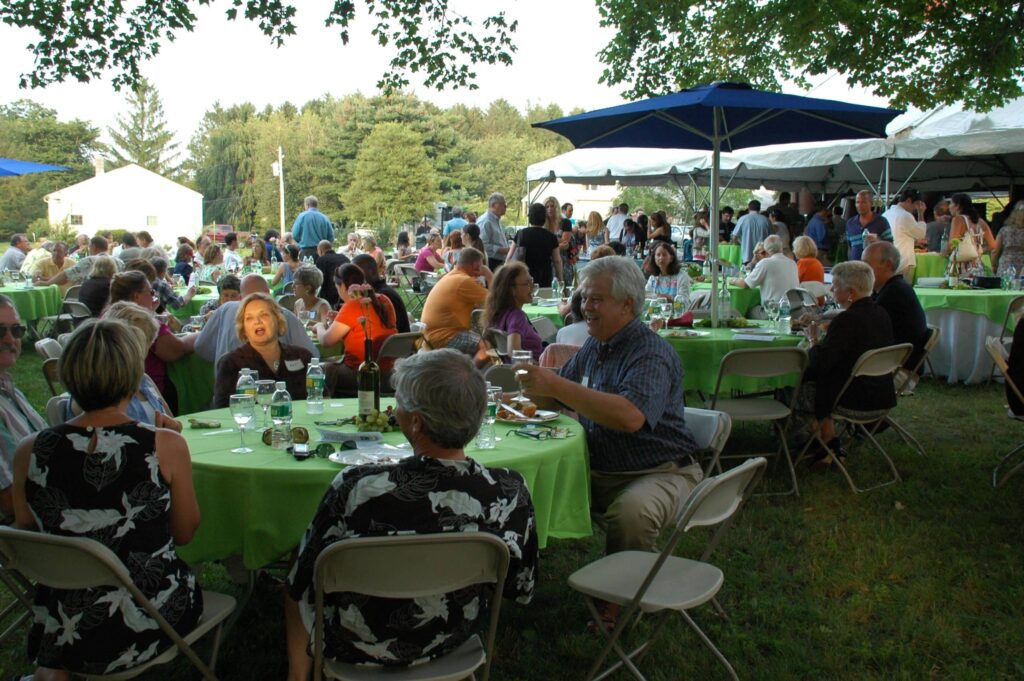
More than 300 business people from the Brandywine Valley
took part in a Brandywine Conference and Visitors Center hosted by Penns Wood
Winery Monday night. Seven wineries and five restaurants from the area provided
food and drink. And the event was free.
Tore Fiore, executive director of the CVB said it was the
second such mixer in about five years. He said most of the group’s gatherings
are geared more toward educating members of promotions and public relations
opportunities, but the mixers are a little different.
“We wanted to make it different, unique and free,” Fiore
said. “We wanted to offer our members more an the standard event. … With the
economy being bad, people need to relax and enjoy.”
Rich Schwartzman has been reporting on events in the greater Chadds Ford area since September 2001 when he became the founding editor of The Chadds Ford Post. In April 2009 he became managing editor of ChaddsFordLive. He is also an award-winning photographer.
Historic farm a part of community supported agriculture
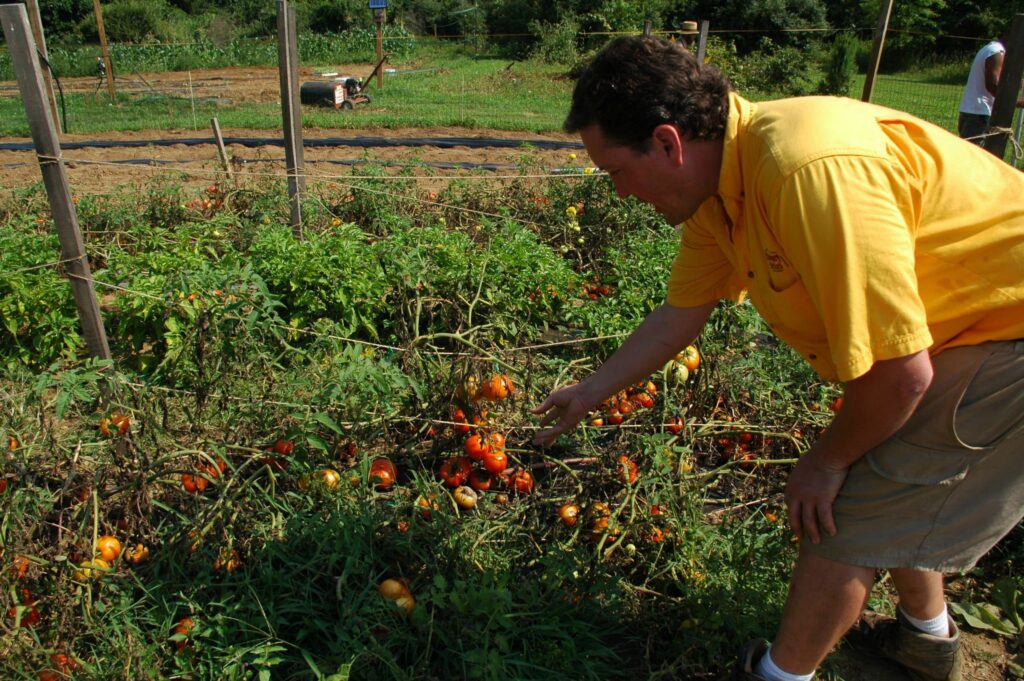
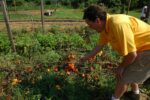
Thornbury Farm has been a Chester County fixture for 300
years, and owner Randell Spackman and his family want to keep it going,
combining traditional organic agriculture with the trend of buying locally.
The farm is taking part in the community supported
agriculture, a nationwide program where local residents buy shares in a local
farm’s growing season, or the production year as Spackman calls the time from
June to October.
“It’s local for local people,” he said. “We go directly to
the local community and get them involved.”
That involvement includes buying a share in the farms
production in exchange for getting fresh produce every week, or every two weeks
with a half share.
The farm has 65 to 100 members, he said. A full share this
year cost $550, a half share was $350.
According to Spackman, there are advantages for both the
farm and the public.
The advantage to the farm, he said, is that it keeps the
land in production so the farm becomes useful as a working farm and avoids
development.
“It preserves the land, gives the land a definition, a use,
a goal,” he said. “It keeps the heritage going.”
It also helps the local community.
“We actually meet our neighbors and people can see the farm,
get on the farm rather than just drive by and think pretty thoughts. They can
actually get involved in the farm activities and that creates a lot of
awareness. Another nice thing is that members get to buy their food locally,
it’s fresh, and it’s organic. And they get to meet their other neighbors.
Full share members get first choice of the variety of
produce picked that week. They pick up on Thursday afternoons. The rest is sold
to the general public at a stand on Saturdays near Route 926 and S. New Street.
Members also get recipes e-mailed to them so they’ll know
how to prepare what’s coming next.
Spackman said a full share usually provides enough food for
three or four people for the weeks.
Next year Spackman will build an outdoor classroom with a
beehive oven and will offer classes for members in bread making, canning and
candle making, stargazing and a class on the Battle of Brandywine.
The farm has been in the family for three generations, but
it goes back 300 years and was part of the 1777 battle site. It was used as a
hospital area and there are some battle graves on the property.
“We’ll be doing more as a whole educational series to create
community involvement. That’s really what it’s all about, to get people
together, plus to get good, ripe quality food.”
He said that much of the food in supermarkets travels 1,200
miles on average from farm to market. “Ours travels 200 feet.”
He admits that the produce may cost a bit more, but that,
for now at least, is because organic farming is more labor intensive than
standard commercial farming. But, the food is fresh and organic, he said.
“We have five people producing food for six families. Five
people could produce enough food for hundreds of families on a typical
[commercial] farm on mass production. This is very high quality, low
production.”
And while this production year has several months to go,
Spackman is already getting ready to plant next season’s early crop of onions,
salad greens, Chinese cabbage, broccoli and other vegetables.
Spackman’s grandfather Herb Spackman bought the farm in the
1940s. Randell Spackman said the farm is the site of the first public library
in Chester County. Approximately 110 acres of the 190 acre-property is under
easement
Thornbury Farm is on Thornbury Road between S. New Street
and Birmingham Road.
Rich Schwartzman has been reporting on events in the greater Chadds Ford area since September 2001 when he became the founding editor of The Chadds Ford Post. In April 2009 he became managing editor of ChaddsFordLive. He is also an award-winning photographer.
Band prepares for another season of music and marching
It’s not just preseason time for football teams. It’s that
time of year for the marching bands as well and the Unionville High School
Marching Band is no exception.
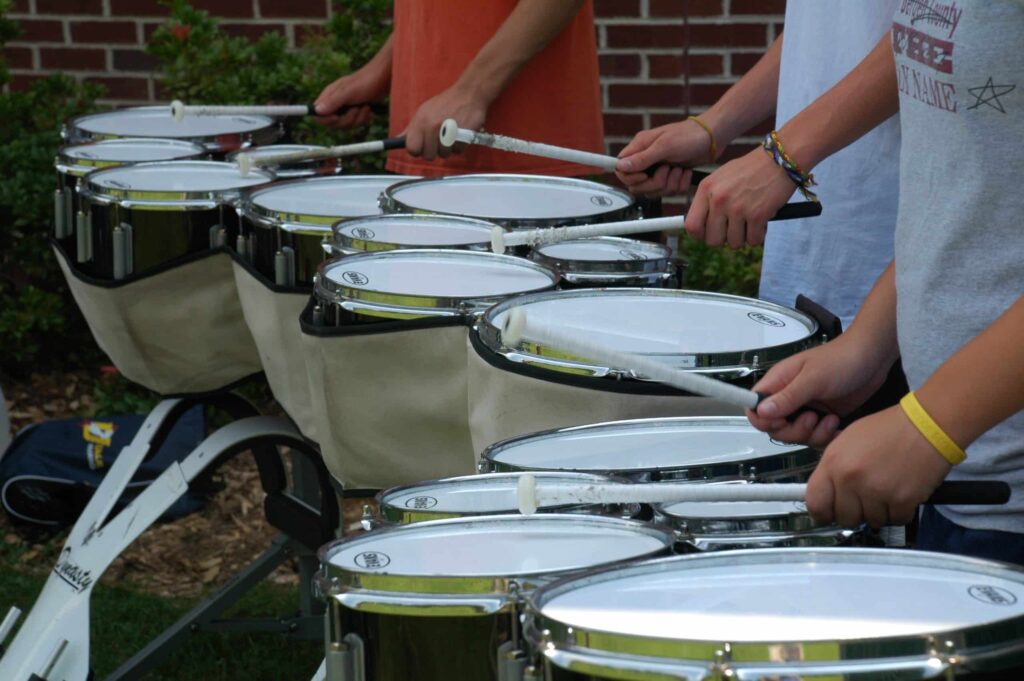
The band has been practicing at Chadds Ford Elementary
School this week, practicing its music and marching, sweating and sweltering
amidst the mid August heat and humidity.
All the practice has paid off over the years. Last year the
band took first place in a state competition in Hershey in November while in
January of 2008 the group performed at the Gator Bowl.
This October the band will host a cavalcade of bands
competition, the March on the Brandywine, and in May the band will travel to
Louisville to perform during the Kentucky Derby weekend festivities.
Band director Scott Litzenberg, in his 12th year
at Unionville, thinks his charges–81 musicians, color guard and drum
majors–continually improve.
“You can’t control what place somebody puts you in, but you
can control how well you perform. You can’t control if somebody else is better
than you, but the last number of years we’ve gotten better every year. … It’s
been kind of fun. I put that right on the kids and say, ‘ Listen you have to
step up. It’s your turn,’” he said.
The attrition rate for the band has been fairly constant.
Each year it loses about 20 members and gains about 20.
“As a staff we’ve been pretty lucky having a great bunch of
kids to work with,” Litzenberg added. “We have a really good time and we enjoy
being around them.”
He said he hasn’t talked about the derby appearance yet
because right now he’s trying to focus on the upcoming season. For the band
members, that preparation began with this first week of camp. For Litzenberg
and his staff of about 10, however, that preparation began in January.
The goal right now is just to get the band members ready.
They’re working on three pieces of music and the marching choreography. The
choreography for each member is detailed, maybe more so, than the X’s and O’s
the football team has to learn for its plays.
Diagrams for the marching show the places for 81 people,
every so many counts per song. The diagram for the first song shows 34 different
drill sets, Litzenberg said.
“They have to be in a specific spot and it takes a while to
learn all this,” he said. “We started writing this in January. It’s not just
show up and start playing.”
The band members will learn about two thirds of their
program by the end of the seventh day of camp, then learn the remainder once
school resumes.
“You can learn it pretty quickly, but doing it well is
another story,” Litzenberg said. “It will take a while for it to get to the
point where we want it.
He was certain the group would have it together by the first
performance, the first football game of the season. After that, it’s improve,
improve, improve.
“By the time of [The March on the Brandywine] we should be
cranking pretty good,” he said.
On Nov. 14 it will be to Hershey for this year’s state
competition.
The band will perform at UHS football games including the
playoffs.
Rich Schwartzman has been reporting on events in the greater Chadds Ford area since September 2001 when he became the founding editor of The Chadds Ford Post. In April 2009 he became managing editor of ChaddsFordLive. He is also an award-winning photographer.
Months ago, conservative radio talk show host Rush Limbaugh said
he hoped that President Barack Obama would fail. There was great buzz and hand
wringing from the left-liberal segment of the media as if they had never wished
failure of Mr. Obama’s predecessor, President George W. Bush.
There
were, and remain, many ways to view Mr. Limbaugh’s comment. One view is to
think he meant that he hoped the president would fail in his attempt to sell
his policies to Congress and the American people.
To
think the American public wouldn’t buy the liberal agenda was faulty since the
Democrat won the election by a sizeable margin of victory and the bulk of the
voting public was put off after eight years of a Republican administration that
had brought the economy almost to its knees. Remember, the bailouts started
during the Bush administration with even Republican candidate John McCain
voting for them.
And
to think that Congress wouldn’t accept the policies was also faulty since the
Democrats had control of both the House of Representatives and the Senate.
There
is another way to view the comment. That view indicates that Mr. Limbaugh
actually thought President Obama’s policies, as anti free market as they are,
could actually succeed in getting the United States out of the fiscal mess we
find ourselves, a mess the country has been in for generations. His comment
reflects his own lack of certainty that the free market is superior to statist
controls, be they deemed socialist or fascist, though the names are meaningless
at this point.
And
this interpretation, if accurate, is most disturbing because it indicates why,
as others have said in the past, that the conservatives have failed in their
attempts to maintain a free market, that they have caved in to the rhetoric of
the left and failed to understand the morality and legitimacy of liberty.
We’re
not talking about rank and file Republicans here, rather the elected and party
officials who abandoned the free market and liberty for the sake of winning
elections.
Sheldon Richman, a senior
fellow at The Future of Freedom Foundation, wrote in April, “the
best chance for freedom, prosperity, and peace is through a radical
retrenchment of government at all levels and a full flowering of the free
market.”
Consider that most of what government operates is broke, the
Post Office, Medicare, Medicaid and Amtrak just to name a few. Social security
makes Bernie Madoff look like a piker.
All that government has to sustain its statist policies is
force, the powers to tax and to incarcerate. In short, it’s the power of the
gun. And this is the case no matter which party controls that power.
The good news is that people are beginning to wake up to
this fact. While the liberals
ridiculed the Tea Party events this spring, the attitude those events
expressed–that government needs to get out of the private lives of individual
men and women–isn’t going away. That attitude is, in fact growing and being
adopted by the small remaining libertarian faction within the Republican Party.
Perhaps some light will finally shine where the country needs
it most.
Pennsylvania State Police report a burglary in Pennsbury Township about 5:50 a.m. on Aug. 15. The report said someone entered a home on Pennsbury Way by forced entry through a window. Jewelry and other items were taken.
• State police arrested 21-year-old Gary Yannuzzi, of Chadds Ford after he was seen trying to gain access into vehicles parked near the AMC Theater at Painters Crossing in Chadds Ford Township. The police report said theater employees saw Yannuzzi trying to get into cars. The arrest was made about 9 p.m. on Aug. 15.
• A 55-year-old Chadds Ford woman reportedly had a credit card stolen while she was watching a movie at the AMC Theater in Painters Crossing shortly before 3 p.m. on Aug. 15. A police report said fraudulent charges were made on the card at the Target store in Glen Mills. The investigation is continuing, the report said.
• State police report a 57-year-old woman from Folsom was the victim of a theft when a check was stolen from her purse at the Brinton Manor Nursing Home sometime between Aug. 13 and Aug. 17. The check was used at a Target store for the amount of $580.87.
• A Pottstown man reported his vehicle was stolen while parked at Glen Eagle Square in Concord Township. According to a police report, the vehicle was taken while parked in front of the victim’s business. Also taken, according to the report, was a credit card that was later used to make unauthorized purchases. Police said the theft occurred between 7 a.m. and 1 p.m. on Aug. 17.
• A landscaper had several pieces of equipment stolen from a vehicle and the theft was apparently caught on tape. According to a state police report, the incident happened across from the Wawa store on Route 202 at Naaman’s Creek Road at 11:30 a.m. on Aug. 17. The report said two white men, one heavy set and the other thin, took a leaf blower, weed wacker and a chain store from the landscapers truck that was parked across from the Wawa. Video was obtained from the Wawa and a storage facility. There were also eyewitnesses, the report said.
My sage and existential wine loving friends will tell you that the answer to this question is simply “as long as it’s there”. This might be born out by a recent impromptu tasting I did in New York in the cellar of a major league Bordeaux collector. On the table were 12 bottles of rather old First Growths that had been open for four days. None of the wines had turned to vinegar. All were oxidized but I expect the brownish color was in part due to being exposed to so much air for so long. When I thought about the thousands of dollars those bottles represented it occurred to me, I could drink ‘em. But when I thought about how they would taste if they were freshly opened I decided most of them were no longer good.
Which takes us back to the question of “How long is a wine good?” or perhaps more importantly, what is the acceptable definition of a good wine? And do we all share the same opinion?
So let me digress for a moment and talk about “good wines.” To this I must refer to what I call The Miracle of Perception. Some people look for fresh fruity flavors in wine (we winemakers may describe them as having hints of strawberry, raspberry, cherry, peach, apple, or any number of other common or uncommon fruits or flowers), while others seem to prefer more “earthy” notes (you may often hear this range of flavors described as barnyard, grassy, mushroomy, woody, sweaty armpit, wet dog and/or other equally graphic descriptors). Some admire light bodied delicate wines while others go for complex “big ass” wines you can almost chew. Some of us like high acid crisp wines while an equal number want the wines soft, smooth and velvety. And on and on. In the final element, we all have varying degrees of ability to discern smells and flavors and our palates are in a happy state of flux as we study and train for the Wine Olympics.
So, having established that there are many different kinds of wines (more on this next month), this naked winemaker will now give you a bare answer that strips away everything but the simple facts.
(1) If the wine is light, fresh and fruity (these are mostly white and usually quite inexpensive) it was made to drink young: a year or two from the vintage date on the bottle, definitely within three years. These wines are also best when just opened. Once the cork is out the wine begins to oxidize and go downhill. So drink the bottle and have fun. Some examples of this style wine: New Zealand Sauvignon Blanc, the hot new Spanish Alberino’s, light reds from Beaujolais, Chaddsford Pinot Grigio or Naked Chardonnay.
(2) If the wine is big, rich and earthy (usually red, typically barrel-aged, from moderately expensive to the-sky’s-the-limit) it was probably made for longer term aging and will improve with time, anywhere from a few years to decades. Don’t even think about drinking these wines until three years past the vintage date on the bottle. Air may enhance and “open-up” these bottles, so let it breathe and watch it change in your glass and in the bottle over a few days. Some examples: the big reds from Bordeaux and Burgundy, California Cabs, Italian Barolo, Chaddsford Merican (Cab/Merlot blend) or Due Rossi (Italian blend).
If you need more info than this I applaud you. You are now a Wine Nerd of the Highest Order. Send me an email at eric@chaddsford.com if you have particular wines you need to know more naked truth about.
I remember as a child
watching historical movies and, as fictionalized as they may have been, it
became clear to me that the status quo didn’t change very much and that common
beliefs held sway over evidence to the contrary.
Remember the time when
people thought the sun revolved around the earth? Galileo showed otherwise and
was ostracized from his faith for shaking its foundation. Pasteur, at first,
didn’t fare any better for pointing out that what was invisible (to the eye at
least) could make us sick.
However, as a child, I
also wondered (only to myself, for fear of what the status quo might do),
“well, if in those other ages, people had such a difficult time seeing a
different reality and couldn’t expand their perspective, what are people in my
own time doing that is constricted in vision as well?” Well, my words weren’t
exactly that, but as a 9-year-old, I did also question myself: “What will I as
an 11-year-old think of my 9-year-old’s thinking and doing? How will I change
my attitude? What will I see differently (or more clearly)?”
As a 50’s child, I looked
around and wondered why there were African-Americans (“Negroes”) on only one
street of my town. Why didn’t they belong to the swim club located right on
their block? The swim club that got built post-polio vaccine (thank you
Pasteur) where my cousins became fish. Then the civil rights movement came, and
I understood: again narrow thinking and the prejudice of narrow perspective.
I remember my aunt
commenting about the white mother of five children who had been murdered by
white men for having marched for civil rights in the South. My aunt
unempathically stated that the mother should have stayed home and had no right
being there. Not unemotional myself, I ran out of the room screaming into the
street, bereft at the callousness of the words of someone I loved.
I do not wish to set
myself up as the enlightened one. My 11-year-old was aghast at some of the
thinking of the 9-year-old and surely my 83-year-old (if I get that far) will
wonder at the perspective of my 63-year-old self.
However, at this moment,
my 63-year-old self wonders if we have had a major societal regression. It was
painful for Earth’s people to be knocked off center stage when Galileo galloped
in: “what do you mean, the sun is the center of the solar system? We on earth
are the center of the universe.” Further corollaries: “We in the U.S. are the
best and the brightest and the biggest.” “I, the person, am the center of my
own universe evolutionary connectedness? No way, DNA!” Somehow, we seem to be
going pre-Galilean here.
Hence, we don’t see the
interconnectedness of our lives; we don’t get that tribal “us and them” will do
us in. I cringe that the tissues in my office are manufactured from a virgin
boreal forest in Canada. I sigh when a younger acquaintance goes to Alaska and
comes back figuring there’s a lot of space there so what’s the big deal about
clearcutting those virgin forests? I deplore the heated conversation I had with
some elderly women who are affluent and on Medicare. These women decry why they
should worry about those other people “who could get healthcare if they wanted
it or shouldn’t be in this country in the first place.” (These latter folks
clean their houses and pick their vegetables.) Need I remind them that my
family, years ago, had an incredibly difficult time getting health insurance
because our 7-year-old son had a “pre-existing condition”—recurrent ear
infections!
Yes, I am a psychologist
who “should” be talking about the latest book I’ve read to help you with your
panic attacks. Well, we are suffering a collective panic disorder from
believing that life can be controlled as long as we keep our collective walls
up and believe that rugged individualism is not for sissies—and sissies are
those who might be “socialist”(!) because they recognize the interconnectedness
of nature and people.
Interestingly ironic how
corporations, including, if not especially, the health care corporations,
manage to be for the individuals at the top and yet are considered “one body”—a
“corpus”.
I have encountered health
insurance corporations as a provider, and as a patient. As a provider, my
experiences with insurers have been frustrating—late payments, no payments,
terminating treatment, etc. My experience as a consumer is also frustrating. In
a few years, I will be eligible for Medicare but my adult children become the
worry—what will happen if they lack healthcare for some reason—lack or loss of
a job or yet another “pre-existing” condition. This is far scarier than the
bugaboo word socialism that gets bandied about whenever the common good is at
stake. Here is a quote to ponder, from Dom Helder Camara (1909—1999), who was
Roman Catholic Archbishop of Brazil: “When I feed the poor, they call me a
saint, but when I ask why the poor are hungry [or lack healthcare] they call me
a communist [or socialist].”
• Kayta
Curzie Gajdos holds a doctorate in counseling psychology and is in private
practice in Chadds Ford, Pennsylvania. She welcomes comments at MindMatters@DrGajdos.com
or (610)388-2888. Past columns are posted to http://www.DrGajdos.com/Articles.
Dr. Kathleen Curzie Gajdos ("Kayta") is a licensed psychologist (Pennsylvania and Delaware) who has worked with individuals, couples, and families with a spectrum of problems. She has experience and training in the fields of alcohol and drug addictions, hypnosis, family therapy, Jungian theory, Gestalt therapy, EMDR, and bereavement. Dr. Gajdos developed a private practice in the Pittsburgh area, and was affiliated with the Family Therapy Institute of Western Psychiatric Institute and Clinic, having written numerous articles for the Family Therapy Newsletter there. She has published in the American Psychological Association Bulletin, the Family Psychologist, and in the Swedenborgian publications, Chrysalis and The Messenger. Dr. Gajdos has taught at the college level, most recently for West Chester University and Wilmington College, and has served as field faculty for Vermont College of Norwich University the Union Institute's Center for Distance Learning, Cincinnati, Ohio. She has also served as consulting psychologist to the Irene Stacy Community MH/MR Center in Western Pennsylvania where she supervised psychologists in training. Currently active in disaster relief, Dr. Gajdos serves with the American Red Cross and participated in Hurricane Katrina relief efforts as a member of teams from the Department of Health and Human Services' Substance Abuse and Mental Health Services Administration.Now living in Chadds Ford, in the Brandywine Valley of eastern Pennsylvania, Dr. Gajdos combines her private practice working with individuals, couples and families, with leading workshops on such topics as grief and healing, the impact of multigenerational grief and trauma shame, the shadow and self, Women Who Run with the Wolves, motherless daughters, and mediation and relaxation. Each year at Temenos Retreat Center in West Chester, PA she leads a griefs of birthing ritual for those who have suffered losses of procreation (abortions, miscarriages, infertility, etc.); she also holds yearly A Day of Re-Collection at Temenos.Dr. Gajdos holds Master's degrees in both philosophy and clinical psychology and received her Ph.D. in counseling at the University of Pittsburgh. Among her professional affiliations, she includes having been a founding member and board member of the C.G. Jung Educational Center of Pittsburgh, as well as being listed in Who's Who of American Women. Currently, she is a member of the American Psychological Association, The Pennsylvania Psychological Association, the Delaware Psychological Association, the American Family Therapy Academy, The Association for Death Education and Counseling, and the Delaware County Mental Health and Mental Retardation Board. Woven into her professional career are Dr. Gajdos' pursuits of dancing, singing, and writing poetry.
OK boys and girls. Today we are going to learn two
foreign phrases which relate to all of us who live in the 19317 zip code and
everyone else within shouting distance.
Now everyone repeat after me, “Noblesse
oblige”. It’s French.
In short. If you have been blessed with good
fortune, you are obligated to help
the less fortunate .
Or putting it another way, in Luke 12:48, Jesus teaches
“From everyone to whom much has been given, much will be required”
Do
you know what it means to live in the 19317 zip code? Ask your
friendly real estate agent.
Put
your address into www.zillow.com. Look, a
nice photo of your house with its current market value! Next click on “see home
info” and there is the year your home was built, the square footage, lot size,
the number of bedrooms and bathrooms, your neighborhood schools and what you
pay in property tax. If you think Big Brother does not exist, think again.
Now
take that home value from Zillow and check out your buying power in neighboring
communities. Surprised?
If
you don’t think you bought that Chadds Ford zip code, think again.
Your second phrase is, “Ora na azu nwa.”
It’s a Nigerian proverb whch means “it takes the
village to raise a child.” It has been in existence in Africa for centuries.
The saying was the source for the title of a
delightfully written and beautifully illustrated children’s book “It
Takes a Village to Raise a Child” by Jane Cowen-Fletcher, published in 1994.
(Two years later, then First Lady, Hillary R
Clinton, published her own book, “It Takes a Village”, largely ghost-written by
Barbara Feinman. It was not a children’s book)
In
Cowen-Fletcher’s book, young Yemi turns her back to buy some peanuts and finds
that her little brother Kokou has wandered off. She soon finds that the entire
village was watching out for him.
I’m
coming to my point, so hear me out.
A
few months ago, Beth Rorke of the Brandywine Battlefield staff had asked me to
testify at state Sen. Pileggi’s May 18 hearing about the Battlefield Park’s
future.
It
was gratifying to see the almost 200 people in the lecture room of the
Brandywine River Museum.
Thirty-seven
people had signed on the roster to testify.
They
spoke about their children learning to love history; how this was the site of
the largest land battle of the American Revolution; how the Brandywine
Battlefield was one of the 12 most significant Revolutionary War sites in
America and on and on. Granted many of the speakers were already supporters of
the park but what about all the people who are crying now that the State has
demonstrated they actually can shut-down the Battlefield?
We
are, by and large, a rather affluent community. Many of you bought this zip
code for the prestige of living here.
‘Fess
up, you know you did.
So
what are you doing to support and care for the institutions that make Chadds
Ford such a great place to live: The Brandywine Battlefield, the Brandywine
River Museum, the Chadds Ford Historical Society, the Sanderson Museum?
Come
on Chadds Ford. Let’s put it all together now.
Sally Denk Hoey, is a Gemini - one part music and one part history. She holds a masters degree cum laude from the School of Music at West Chester University. She taught 14 years in both public and private school. Her CD "Bard of the Brandywine" was critically received during her almost 30 years as a folk singer. She currently cantors masses at St Agnes Church in West Chester where she also performs with the select Motet Choir. A recognized historian, Sally serves as a judge-captain for the south-east Pennsylvania regionals of the National History Day Competition. She has served as president of the Brandywine Battlefield Park Associates as well as the Sanderson Museum in Chadds Ford where she now curates the violin collection. Sally re-enacted with the 43rd Regiment of Foot and the 2nd Pennsylvania Regiment for 19 years where she interpreted the role of a campfollower at encampments in Valley Forge, Williamsburg, Va., Monmouth, N.J. and Lexington and Concord, Mass. Sally is married to her college classmate, Thomas Hoey, otherwise known as "Mr. Sousa.”