
June 18, 2009

Two injured in tubing accident
Two injured in tubing accident

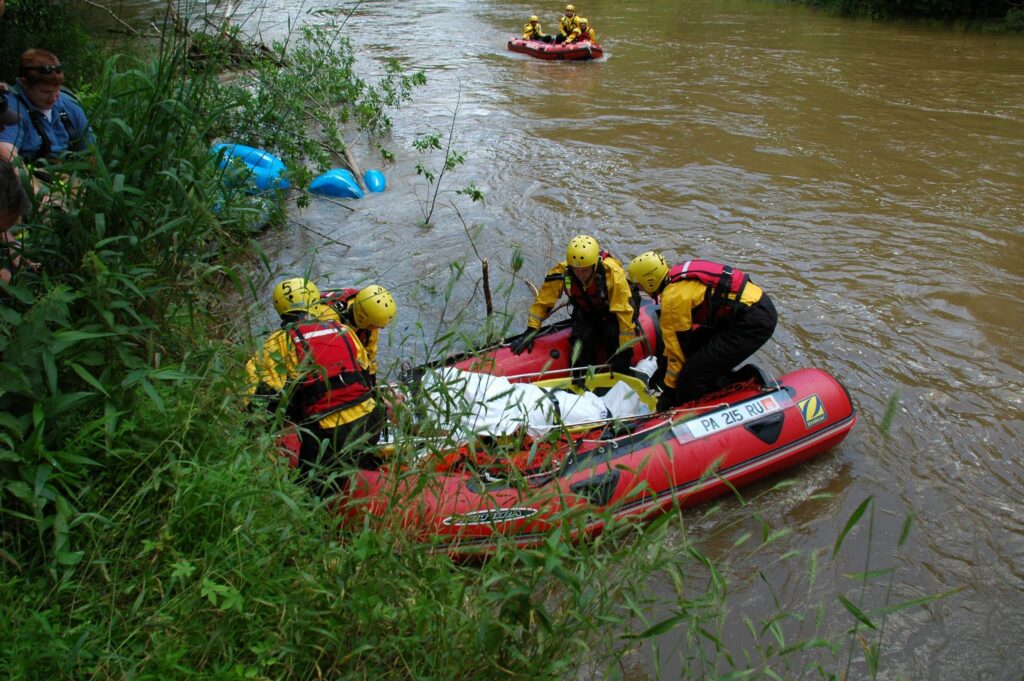
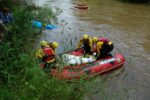
Two people were transported to Crozer Chester Medical Center Sunday following a tubing accident on the Brandywine Creek in Chadds Ford Township.

Rescue teams were called to the creek for the second time in less than a week after a group of about 21 scouts – boys and girls – ran into trouble while tubing the creek that was still running hard and fast after rain storms the previous week.

Neither the identities of the injured, nor the extent of the injuries, were released.

Squads from Concordville, Kennett and Longwood responded to the call, with Kennett and Longwood putting boats into the water. One of the victims was transported in one of the boats back to the museum parking lot that was used as a staging area for the rescue.

One unidentified Boy Scout, from Troop 443 of Boothwyn, said some of the tubers let go of the ropes and people got tangled up in trees and brush. The group came a stop about 200 to 300 yards south of the old railroad bridge at the Brandywine River Museum.

One of the adults on the trip was Chris Imburgia from Girl Scout Troop 51468 out of Boothwyn. She said the more experienced tubers were in the lead, but they started whistling and moving to the left bank of the creek when they realized the water was too rough and moving too fast for the group as a whole.

Imburgia said there was some panic within the group and that not everyone was sure how to get out of the tubes.

She said the trip was planned about two or three weeks earlier and that she had not heard about the fatal kayaking accident of last Tuesday.

In Tuesday’s incident, two brothers were attempting to kayak the creek after a severe thunderstorm when their kayaks went under at a low-head dam just north of the Brandywine Picnic Park. Chris Miller, 28, of Yonkers N.Y., was pulled from the creek that afternoon and was pronounced dead at Chester County Hospital. The body of the other brother, 34-year-old Chad Miller, from Wilmington, was found Saturday.

Safety on the Brandywine Creek

Zeke Hubbard, of Northbrook Canoe Co. in Pocopson Township, said safety on the creek is essential and is a matter of both common sense and checking with those who know the Brandywine.

When in doubt if the creek is safe, stay out of it.

Hubbard said the creek is a Class One Waterway, meaning it is has low-lying tree limbs, light rapids, water that is relatively placid and calm.

“You can walk out of it. There’s no problem with any major current.”

But, would be boaters need to take some precautions.

“Check the water conditions with your local livery, people who know the water. They can tell you what the levels are and if it’s safe or not safe to get in. It’s just common sense. If you look at the Brandywine and it’s turning chocolate, you can figure it’s in flood stage and it will suck you down and pin you,” Hubbard said.

Brandywine Outfitters, Wilderness Canoe Trips and Northbrook are the three groups on the water who know what’s safe and what isn’t. Hubbard said to check with any one of them to see if the creek is safe that day. And if they’re not sending people out, it’s best to stay on land that day.

He closed Northbrook Sunday because the creek was still too fast and rough for safe activities.

Hubbard stressed a difference between floodwater and white water. He said people get confused between floodwater and whitewater.

“Flood water will suck you down into a rolling ball or cylinder. If you get caught in that cylinder it pins you down against the bottom, and you stay there. White water pushes out on a flat, horizontal [plane.] You put your feet down stream and pushes you into an eddy, like a safe floating area behind a rock. … White water will spit you out into a safe area.”

Hubbard said the most dangerous time on the Brandywine is when it’s beginning to get into the flood stage.

“It’s still within its banks and the speed of the water has picked up. And that’s what causes the mud; the water goes down and picks up the mud, flips sediment up off the bottom.

He said the creek was at that most dangerous stage last Tuesday when the Miller brothers had their accident. Compounding that was the fact they went over a low-head dam. Going over such dams will suck a boat down bow first, then grab boat and occupants in that rolling cylinder.

The Web site www.boatsafe.com/nauticalknowhow/lowhead.htm discusses low-head dams in an article by Virgil Chambers, executive director, National Safe Boating Council.

According to the article, the dams pool water as it flows over the top of the dam, then drops to a lower level:

“This drop creates a hydraulic, which is a backwash that traps and recirculates anything that floats. Boats and people have been caught in this backwash. A person caught in the backwash of a low-head dam will be carried to the face of the dam, where the water pouring over it will wash him down under to a point downstream called the boil. The boil is that position where the water from below surfaces and moves either downstream or back toward the dam. A person who is caught in a low head dam struggles to the surface, where the backwash once again carries him to the face of the dam, thus continuing the cycle.”

The Pennsylvania Fish and Boat Commission Web site (http://www.fish.state.pa.us/safety.htm) offers the following information for people considering paddle sports:

Paddling sports are very popular recreational water sports in Pennsylvania. There are dangers that can be lessened with knowledge, preparation and practice. Primary hazards are capsizing, swamping or just falling out of the boat. Keep in mind that paddling is a “get wet” sport.

Paddling Tips:

• Wear your life jacket. Some 80 percent of all recreational boating fatalities happen to people who are not wearing a life jacket.

• Expect to get wet and dress properly. Even the best paddlers sometimes capsize or swamp their boats.

• Be prepared to swim. If the water looks too hazardous to swim in, don’t go paddling.

• If you capsize, hold on to your boat, unless it presents a life-threatening situation.

• Scout ahead whenever possible. Know the river. Avoid surprises.

• Be prepared for the weather. Get a forecast before you go.

• Wear wading shoes or tennis shoes with wool, polypropylene, pile or neoprene socks.

• Never take your boat over a low-head dam.

• Portage (carry) your boat around any section of water about which you feel uncertain.

• Never boat alone. Boating safety increases with numbers.

• Keep painter lines (ropes tied to the bow) and any other ropes coiled and secured.

• Never tie a rope to yourself or to another paddler, especially a child.

• Kneel to increase your stability before entering rougher water, like a rapid.

• If you collide with an obstruction, lean toward it.

File a float plan with a reliable person, indicating where you are going and when you will return. Remember to contact the person when you have returned safely.

About Rich Schwartzman

Rich Schwartzman has been reporting on events in the greater Chadds Ford area since September 2001 when he became the founding editor of The Chadds Ford Post. In April 2009 he became managing editor of ChaddsFordLive. He is also an award-winning photographer.

Two injured in tubing accident Read More »
Historical society benefits from Eagle Scout project

Historical society benefits from Eagle Scout project

Boy Scouts are supposed to make a positive impression on people and Vito Jacono has done just that.

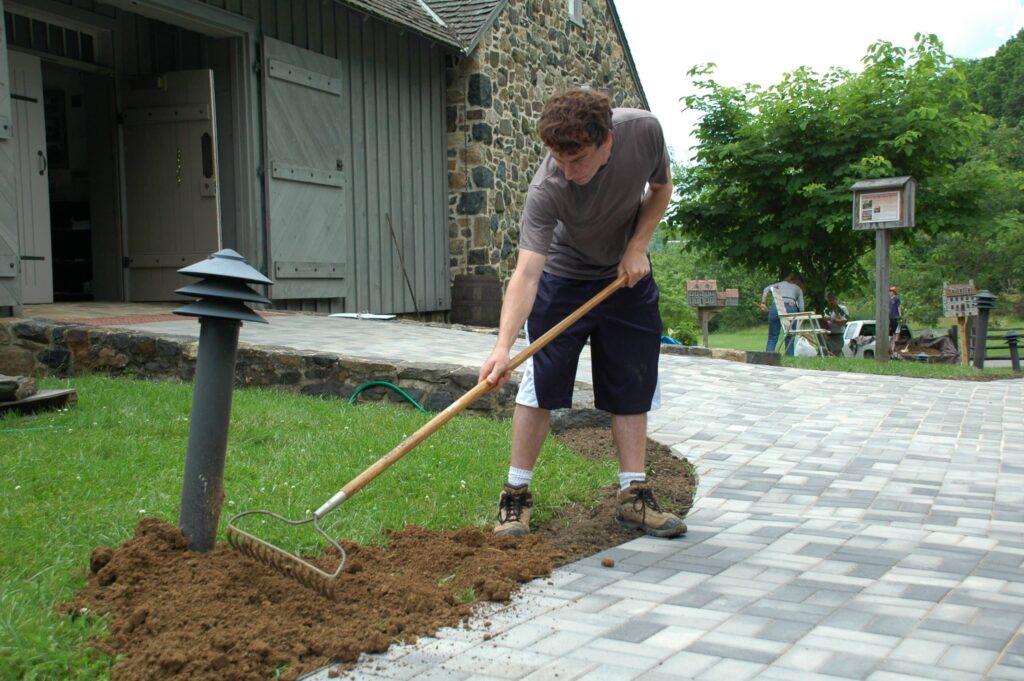
Jacono, from Birmingham Township, just finished his Eagle Scout project of putting in a brick walkway at the Chadds Ford Historical Society. Gone are 550 square feet of gravel and dirt, replaced with the same area of new brick pavers on the front of the Barn Visitors Center. Also gone is the step up into the building. All of which floored CFHS Executive Director Ginger Tucker.

Jacono finished the work last Sunday, and Tucker just returned from vacation on Monday.

“I’m speechless,” Tucker said. “Not only does it look fabulous, but it makes a statement that I wasn’t anticipating and I wasn’t expecting. When you walk up and see that gorgeous walk, somehow it says, ‘We’re serious about what we do.’ And I never expected that. It gives a sense of arrival to our visitors and a sense of our professionalism. I’ve always felt we are a professional organization and I always felt we looked very professional, but I didn’t realize how the old walkway subtracted from the way we are conceived, the impression we give our visitors. I’m just overwhelmed.”

Jacono, who will be entering his senior year at Unionville High School, spent about three weekends on the physical part of the work, he said. The paving bricks cost about $3,000, but he did get a break from Glen Mills Sand and Gravel.

The pavers start where the old step had been at the main entrance to the center, come down toward the fence, then flair out to the left and right, but stop before they reach the parking area.

Jacono said his project called for doing only the 550 square feet and he hopes that other scouts will choose to pick up where he left off to complete the job as part of their Eagle Scout projects.

About Rich Schwartzman

Rich Schwartzman has been reporting on events in the greater Chadds Ford area since September 2001 when he became the founding editor of The Chadds Ford Post. In April 2009 he became managing editor of ChaddsFordLive. He is also an award-winning photographer.

Historical society benefits from Eagle Scout project Read More »

Birmingham Friends host second Peace Fair

Birmingham Friends host second Peace Fair

The Birmingham Friends Meeting was the site for the second annual Peace Fair designed to bring awareness to the need for clearing out unexploded ordnance and to raise money for the purchase of a piece of surveying equipment that also serves as a land mine detector.

Last year’s event raised enough money to buy two detectors, but the manufacturer matched that and four detectors were sent to Nepal to clear mines left over from a civil war there.

But, last year’s event also brought in a person who decided to take an active part in the effort.

Hadley Dole, 16, of Landenberg, has taken up the cause. Dole is going into 10th grade at Kennett High School and is raising money for the mine detectors as his high school project, a requirement for graduation.

Dole was at last year’s Peace Fair and decided to get involved with the project. He’s been able to raise $725 so far this spring and said he’ll be working on the project at least into his senior year.

“I might do it afterward if I have time,” he said.

His goal is to raise money for as many land mine detectors as he can, he said.

The detectors cost $1,041 each.

Dole said he wanted to get involved after attending last year’s event and speaking with Frank Lenik, a Salem County, N.J. surveyor and clerk of the Woodstown Friends Meeting, who several years ago was pivotal in working with Schonstedt Instrument Co. in working out the matching program.

Lenik discovered that one piece of surveying equipment he uses to detect metal corner markers can also detect land mines. He said Schonstedt already had a matching program for large equipment, and was able to work with the company to get a matching program for the metal detectors.

According to Lenik, 98 percent of the people killed or maimed by the old weapons are farmers and children.

Since the project began in 2007, Lenik’s efforts have led, directly or indirectly to 277 detectors being sent to more than 30 countries.

“When you make a donation to anything … you always wonder how many hands are going to touch that donation before it actually arrives at the intention you have for your money. The fantastic thing about this is the Peace fair here raised enough money for two detectors. The company matched it. They sent four detectors and they went straight to the people of Nepal where they were needed,” Lenik said. “No money gets lost along the way. … The money is going right where it’s needed and I think that’s a wonderful thing.”

While Lenik downplays his role in the efforts, the New Jersey Society of Professional Land Surveyors named Lenik its Surveyor of the Year in 2009.

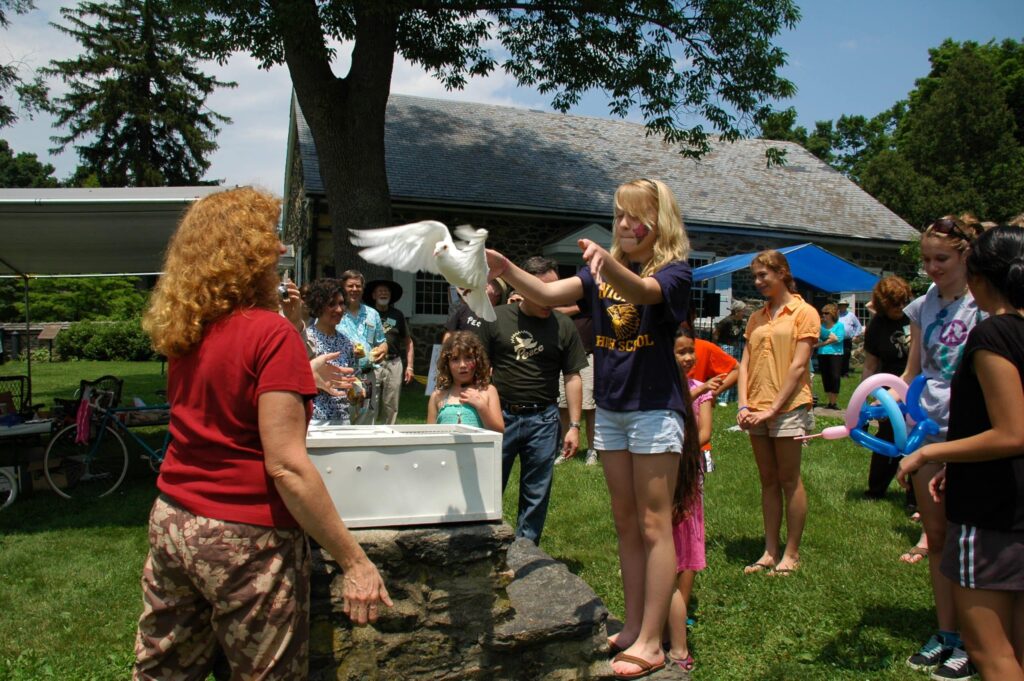
During the fair, Lenik demonstrated the use of the detector and there was a release of peace doves by Heartwings Dove Releases of Landenberg.

About Rich Schwartzman

Rich Schwartzman has been reporting on events in the greater Chadds Ford area since September 2001 when he became the founding editor of The Chadds Ford Post. In April 2009 he became managing editor of ChaddsFordLive. He is also an award-winning photographer.

Birmingham Friends host second Peace Fair Read More »

Keeping heads above water

The Brandywine Creek, like many if not most inland waterways, can get rough at times. And as long as people use common sense it’s a safe place for canoeing, kayaking, tubing and fishing.

But common sense also demands that people grasp the truth of Francis Bacon’s advice, “Nature, to be commanded, must be obeyed.”

When the creek, or any body of water is roiling and kicking up the bottom, it’s saying stay out, in a metaphorical way.

Most people understand that, which is why for years there had been no reportable accidents on the Brandywine, no incidents that would be newsworthy. True, some canoes have tipped over, but often that’s either deliberate or expected when certain groups get together.

After years of safe boating, though, things changed last July when a fluke accident claimed the life of a Kennett kayaker when a tree fell onto him and his boat. It was tragic and unavoidable since no one could have foreseen such an incident.

But that’s not the case of the accident two weeks ago when two brothers drowned after they paddled their kayaks over a low-head dam right after a ferocious thunderstorm that turned the creek a chocolate brown, running with rage and fury.

The brothers erred on several counts. They went in when the water was too rough for casual paddling. And even if they were experienced whitewater kayakers, they failed to take into consideration the difference between whitewater and pre floodwater.

And they took their kayaks over a low-head dam, ignoring warnings and likely unable to hear the water rushing over the dam because the rest of the creek was rushing so loudly.

The accident was their fault.

And it was also human error that led to the tubing accident that involved a group of Boy and Girl Scouts last Sunday. Two people had to be taken to Crozer-Chester Medical Center for minor injuries. Again the creek was too rough for recreational paddling–canoeing, kayaking or paddling, but no one involved in the scouting group–read that scout leaders, adults–looked carefully at the water conditions.

Had those leaders done due diligence, simple common sense would have kept the scouts out of the water for the sake of safety. And if there had been any doubt, a phone call to one of the boating outfitters would have given them the word.

The creek is an enjoyable body of water and recent accidents shouldn’t keep people away, but they should follow some basic guidelines such as those included in this week’s story on the tubing incident. If the water is too rough for swimming, don’t go paddling. If it’s running hard and chocolate brown, stay out. And if there’s any doubt, call one of the outfitters, Northbrook Canoe, Wilderness Canoe in Wilmington or Brandywine Outfitters in Coatesville.

And those unfamiliar with the creek should travel with those who are to learn where there are hazards such as low-head dams.

Kayaking, canoeing and tubing are fun activities as long as people use their heads to keep those heads above water–literally.

About CFLive Staff

See Contributors Page https://chaddsfordlive.com/writers/

Keeping heads above water Read More »

Police Log

Police Log

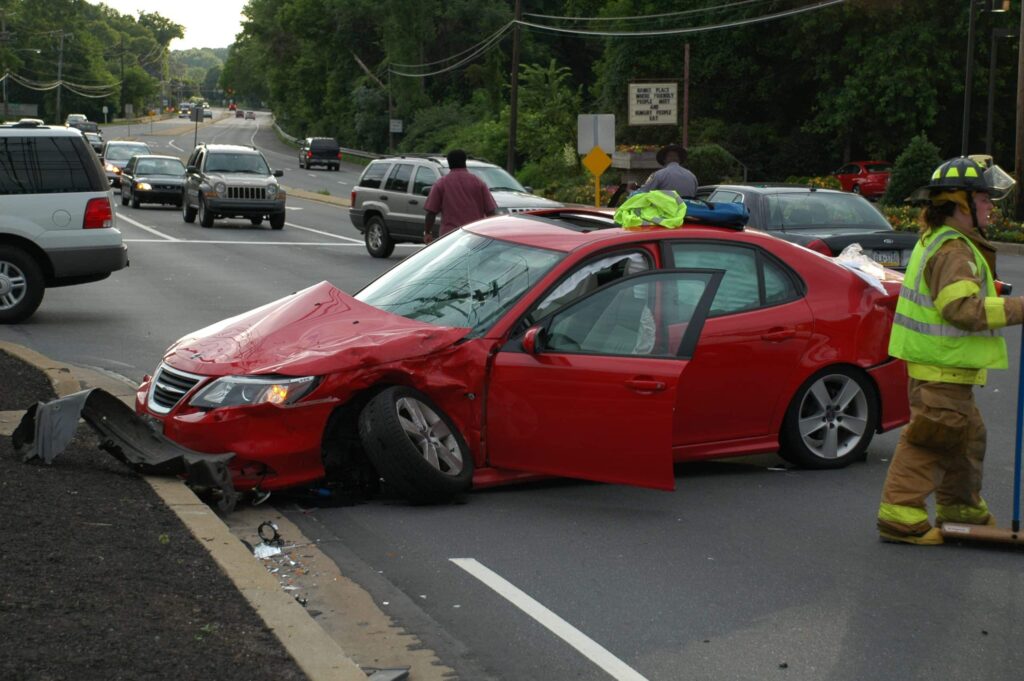
Pennsylvania State Police suspect driving under the influence to be involved in a two-vehicle accident at Route 1 and Station Way Road in Chadds Ford Township. Police a Nissan Rogue was traveling north on route 1 when it went through the red light striking another vehicle, a 2008 Saab. The Nissan came to rest on the southbound lane in front of the Brandywine Bistro. A police report said the driver of the Nissan is suspected of  DUI. A responder on the scene said both drivers  were transported to local hospitals. One was taken to riddle Memorial, the other to Crozer-Cheser Medical Center. The accident happened just before 7 p.m.on Wednesday, June 24.

• Police report more than $300 worth of baby formula was stolen from the Acme Market on Byers Drive in Concord Township about 1:30 p.m. Monday, June 22. According to the report, a white male in his late 20s, with light colored short hair and wearing a blue baseball cap, black shirt, khaki cargo pants and white sneakers is one of three suspects. The other two are described as white females. The report said 24 containers of various formulas were taken.

About CFLive Staff

See Contributors Page https://chaddsfordlive.com/writers/

Police Log Read More »

Mind Matters — Transitions are becoming more difficult

I found a note among old papers the other night—all because I was trying to kill a stink bug—ah, auspicious stink bug! The note says, “The kids are monkeys on Tuesday. Could you have Sofia (later to become Zofia more in accordance with her Polish grandmother’s spelling) wear something brown or dark?”

This missive from Montessori preschool teacher Marla becomes a familial archaeological treasure, found on the heels of having just attended Zofia’s PhD graduation ceremony. Tears well. I remember those wondrous schooldays, and all the curiosity, wonder, innocence, and freshness—all future before those little monkeys.

Transitions, hard as they were then, were easier than they are now. “Little children, little worries, big children, big worries,” my parents used to say. I, being one of the big kids they referred to, didn’t get it—until now.

Now that my children are grown, I see: they are a bigger worry. We as parents are always limited in our ability to protect our progeny. That said, years ago, I could, if fortunate enough, prevent my 3-year-olds from running out into the street. I could grab shoulders, pull them back. I could fling their tiny hands from flames of fire. I could swoop them up and carry them to bath, bed, and book. No longer. I can’t protect them from the uncertainty of a future that my generation, and generations before me, foolishly created.

The Native Americans say that one generation must consider what it does to affect the seven generations to come, who will be their descendents. Our culture not only snuffed out many Native Americans, it also eradicated their wise counsel. Well, that’s another story. Or maybe it isn’t.

Back to graduation. My daughter’s commencement exercises were awash with words about uncertainty and transition. Transitions, I repeat, are rarely easy. Change is loss, even when the change is necessary and for the better. We don’t like to let go of the familiar devil, even when the unfamiliar saint awaits in the wings (to paraphrase an old Spanish proverb.)

Every generation has its obstacles to face. However, I do believe the generation that my generation has engendered will encounter not just roadblocks and detours, but may also have to dive off a cliff to find ground. Like it or not, there is a huge shift of consciousness happening, and the old powers that be don’t like it and are fighting back with a vengeance. Unbeknownst to them, however, the status quo container has been broken. Humpty Dumpty has fallen off the wall, and all the King’s men can’t put him back together again, try hard as they might.

My concern is that there will be more for the rising generations to face. Consider the young Iranians voting against the regime in power. Consider the one-man militia enactments of hatred—whether it be the old guard storming the Holocaust Museum or an abortion clinic. These are horrifying events in themselves, but in the grander scheme of things, we might hope that they are the last vengeful gasps of an old (dis)order that has seen its day. We might hope that these violent outbursts are in the larger view an impotent reaction to a new order of change that is occurring.

So what about this generation graduating? The long view may take a long time: meanwhile we confront the uncertainty of the near years—the years in which the “pillars” of society that sustained us are found to be decaying. Old authority looks more “old” and less “authority”. Men in beards and long robes seem more apt to be abusers than advisers—no matter whether the patriarch wears a cross, a star, or a crescent.

Recently, I heard that a colleague’s twenty-something daughter couldn’t find her way to the airport and called home anxious and perplexed. What a metaphor that story is for our adult children. They are trying to fly the nest and test their wings, and yet they are still looking to mom and dad to help them find their own authority as outer authority devolves. The advice is, “give your child roots and wings”. Difficult time to grow wings: the flying is precarious when you don’t know if there will be a place to land.
Our children, our grown children, are in for some big changes on this earth. Many forces are pushing for a change-back, against the inevitable thrust forward into a new consciousness.

Ironically, this is just the time when we and our children need to look back and take heed of what gold we may be leaving behind in the debris of an old disorder.
Each generation loses something in the transition to the next. My grandmother could kill a chicken, pluck it, cook it, and make wedding dresses, as well. My mother added American recipes to her family’s Polish repertoire and could knit and sew—but not as well as her mother. I can cook up a feast for a hundred, but can’t sew a lick. My daughter has a PhD in genetics—but cook? Not so much. As we gain complex knowledge, we seem to lose some grounding wisdom. We need to find a way to bring with change what doesn’t abstract us from earth, but what connects us better. In addition to Native Americans, even colonists had some notion of working with the earth rather than against it. The old dis-order had its wisdom.

Certain rooms in my banked (built into the side of a hill), 1800’s house can stay at 55° all year. Down the road, the John Chad House kitchen (also built into the hillside) stays cool all summer as bread bakes in its beehive oven (which is on the outside of the kitchen wall). Also, years ago, prior to light pollution and electricity, Americans slept ten hours a night, now we average 6-7 hours a night; and we are sleep-deprived.

No, I do not hanker to go back in time, but to bring forward, into this next great leap of faith over the abyss, some of the wisdom of the earth we did know. So that in our tough transition from the old disorder perhaps we and our adult children can find ground again. Meanwhile, I wonder what Marla’s Montessori monkeys will do.

Kayta Curzie Gajdos holds a doctorate in counseling psychology and is in private practice in Chadds Ford, Pennsylvania. She welcomes comments at MindMatters@DrGajdos.com or (610)388-2888. Past columns are posted to http://www.DrGajdos.com/Articles.

About Kayta Gajdos

Dr. Kathleen Curzie Gajdos ("Kayta") is a licensed psychologist (Pennsylvania and Delaware) who has worked with individuals, couples, and families with a spectrum of problems. She has experience and training in the fields of alcohol and drug addictions, hypnosis, family therapy, Jungian theory, Gestalt therapy, EMDR, and bereavement. Dr. Gajdos developed a private practice in the Pittsburgh area, and was affiliated with the Family Therapy Institute of Western Psychiatric Institute and Clinic, having written numerous articles for the Family Therapy Newsletter there. She has published in the American Psychological Association Bulletin, the Family Psychologist, and in the Swedenborgian publications, Chrysalis and The Messenger. Dr. Gajdos has taught at the college level, most recently for West Chester University and Wilmington College, and has served as field faculty for Vermont College of Norwich University the Union Institute's Center for Distance Learning, Cincinnati, Ohio. She has also served as consulting psychologist to the Irene Stacy Community MH/MR Center in Western Pennsylvania where she supervised psychologists in training. Currently active in disaster relief, Dr. Gajdos serves with the American Red Cross and participated in Hurricane Katrina relief efforts as a member of teams from the Department of Health and Human Services' Substance Abuse and Mental Health Services Administration.Now living in Chadds Ford, in the Brandywine Valley of eastern Pennsylvania, Dr. Gajdos combines her private practice working with individuals, couples and families, with leading workshops on such topics as grief and healing, the impact of multigenerational grief and trauma shame, the shadow and self, Women Who Run with the Wolves, motherless daughters, and mediation and relaxation. Each year at Temenos Retreat Center in West Chester, PA she leads a griefs of birthing ritual for those who have suffered losses of procreation (abortions, miscarriages, infertility, etc.); she also holds yearly A Day of Re-Collection at Temenos.Dr. Gajdos holds Master's degrees in both philosophy and clinical psychology and received her Ph.D. in counseling at the University of Pittsburgh. Among her professional affiliations, she includes having been a founding member and board member of the C.G. Jung Educational Center of Pittsburgh, as well as being listed in Who's Who of American Women. Currently, she is a member of the American Psychological Association, The Pennsylvania Psychological Association, the Delaware Psychological Association, the American Family Therapy Academy, The Association for Death Education and Counseling, and the Delaware County Mental Health and Mental Retardation Board. Woven into her professional career are Dr. Gajdos' pursuits of dancing, singing, and writing poetry.

Mind Matters — Transitions are becoming more difficult Read More »

Blogging Along the Brandywine: There be plenty o’ trinket treasure waitin’ fer ye’

Avast me landlubber friends and all you Captain Jack Sparrow wannabes.
There’s hidden treasure in Chadds Ford that’s waiting to be discovered in the growing high-tech game of Geocaching.

According to Nancy Sakaduski of Pennsbury Township, “Geocaching is a worldwide outdoor hide and seek game.  A geocacher places a “geocache”, usually a box containing trinkets to trade and a log book to sign, in a good hiding spot and then pinpoints its location using GPS technology.”

The location coordinates are then posted on a website http://www.geocaching.com, where others can use the coordinates to find the geocache.  When they do, they sign the logbook and report their find on the website.

“Geocaches are generally placed on public land or parks, always with permission,” she explained.  “They cannot be buried, but are usually hidden so that passersby not involved in the game do not accidentally discover them.”

If you enter the zip code 19317 on the official web site, you will find fifteen GPS coordinates to caches with names like  “Chadds Ford Countryside,” “Pennsbury By Request” and “It’s OK to Wine.” Each cache listing has comments left by those who have found it often telling about the fascinating people they meet there.

Sakaduski recently hid and registered a new Chadds Ford geocache on Saturday, June 13, near an area museum known for its quirky collection, with the coveted “FTF” or First to Find prize.

Less than 24 hours later, four individual geocachers looking for new sites, had already found the hidden cache, left geocache IDs like “JerseyJoey” and “Squirtgun,” and registered their comments on line.

There are over 826,000 Geocaches located around the world, but just to confirm, I entered the name of the village of Brackenheim, Germany, where I had lived one summer. And sure enough, coordinates for 20 sites were listed with familiar names like Burg Neipperg, Zabergäu and Dürrenzimmern.

My sister Pat and her husband were introduced to the game when they stumbled across a geocache quite by accident on the island of Jost van Dyke, British Virgin Islands.

As she recounts, “Brian and I decided to hike to the highest point of the Island, 2,000 feet above the ocean. We got to the highest point and leaned back against a big bolder, and there in the crevice in the rock was a small plastic box.”

“We were curious and opened it and it was just full of these little trinkets and a piece of paper explaining Geocaching. We followed the directions on the paper, rummaged through our backpacks and left a trinket that would be fun for someone to find. We took a plastic Tyrannosaurus Rex and tucked the box back in the crevice “

Sakaduski got her GPS device for her birthday a couple of years ago and made her first find that day and adds, “Since then, my husband and I have found more than 40 geocaches, and have hidden several of our own,” she said. “It’s a great family sport that often involves hiking through the woods …[and] often takes you to new parks, secluded spots, and interesting locations you might never have visited otherwise.”

So what be ye waiting for matey?

Get your hand-held GPS, some trading trinkets and start treasure hunting!

And for a really great article read : http://en.wikipedia.org/wiki/Geocaching.

About Sally Denk Hoey

Sally Denk Hoey, is a Gemini - one part music and one part history. She holds a masters degree cum laude from the School of Music at West Chester University. She taught 14 years in both public and private school. Her CD "Bard of the Brandywine" was critically received during her almost 30 years as a folk singer. She currently cantors masses at St Agnes Church in West Chester where she also performs with the select Motet Choir. A recognized historian, Sally serves as a judge-captain for the south-east Pennsylvania regionals of the National History Day Competition. She has served as president of the Brandywine Battlefield Park Associates as well as the Sanderson Museum in Chadds Ford where she now curates the violin collection. Sally re-enacted with the 43rd Regiment of Foot and the 2nd Pennsylvania Regiment for 19 years where she interpreted the role of a campfollower at encampments in Valley Forge, Williamsburg, Va., Monmouth, N.J. and Lexington and Concord, Mass. Sally is married to her college classmate, Thomas Hoey, otherwise known as "Mr. Sousa.”

Blogging Along the Brandywine: There be plenty o’ trinket treasure waitin’ fer ye’ Read More »

Scroll to Top