
The Legendary Art of Pysanky
“Far off in the mountains . . . there is a terrible demon. If the envoys tell him that the people are poor and argue among themselves, the demon rejoices and laughs so hard that the mountains shake, loosening his chains. If the envoys tell him that the people live well and in harmony, the demon becomes very angry, scowls, and the chains squeeze his evil flesh all the harder.
The most fearful news for the demon is to hear that people are writing pysanky, that they haven’t forgotten this ancient tradition: in that case, he roars, tears at his bonds with all his might, and beats his head against the cliff so hard that sparks fly. This causes thunder and lightning and his chains become so tight, they nearly tear him apart.” Folk Customs of Our People By Oleksa Voropay
As families, grown and found, sit down at the table this week, it brings to mind the various traditions that bring us together. It may be memories of long meals, of carefully preparing hundreds of perfect dumplings, of sharing art supplies to create gifts, of stringing popcorn into garland, of packing bags of supplies to share with those in need. For artist Jennifer Domal, it is writing pysanky. “Some of my earliest memories are sitting at a table with eggs, hot wax, and family,” she remembers. “Writing pysanky is part of my ethnic heritage.”

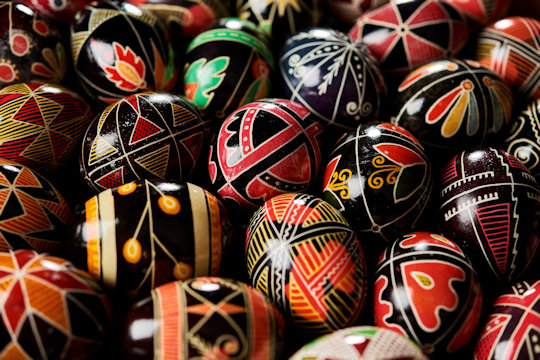
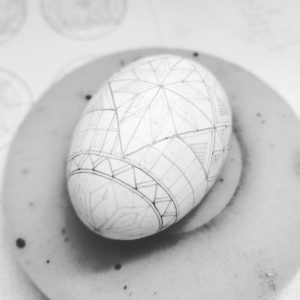
Pysanky, the highly decorated eggshells that originated in Central and Eastern Europe, are truly unique pieces of art. They are “written” rather than painted or drawn. The word “pysanky” comes from the root word “pysaty” in Ukranian, which means “to write.” The artist keeps their hand steady and turns the egg to create the pattern on the shell. Molten colored beeswax is written onto the eggs using a special tool, a type of stylus, and flame used to melt off the layers to reveal the final design. It is a meticulous, lengthy process.
“I didn’t know that the ordinary thing I did growing up was special until I was told,” Domal says. She gave them out to friends and teachers, and people called her “The Egg Girl” or later “The Egg Lady,” sometimes buying them by the dozen as ornaments or gifts. She was encouraged by others to expand her work and recognize its artistry, especially by fellow artists and craftspeople. Just this year, she was recognized as a Master Artisan by the Pennsylvania Guild of Craftsmen.

Designs are written directly onto eggs that have been blown—a small hole drilled into the end and the insides removed by blowing in air—and dried. This process is especially challenging for Domal, who, ironically, is allergic to eggs. No pysanky is the same, just as no egg is alike. “Sometimes the shape of the egg informs the design,” explains Domal.
“There is enduring power in being a folk artist,” says Domal. Oil painting is a newcomer compared to the art of pysanky, which has been around for over six millenia. While actual eggs do not last that long, examples of decorated stone and ceramic eggs have been found from the 3rd millennium BCE. The traditional patterns have been found on everything from cave paintings to neolithic pots to funerary objects. Egg decorating is rooted in pagan customs, which were absorbed into Christian traditions in more recent centuries to become the more common colored eggs seen each spring.
“Pysanky were written as talismans to protect the land, the water, and the people in pagan Slavic culture,” says Domal. “These talismans symbolized blessings for crops, rain, water, and so on. The individual elements that build the designs cannot be broken down like an alphabet or hieroglyphics, unfortunately, to weave a new story, but they do help give a sense of what the people in the past found important.” Designs may celebrate the harvest, or are traditional to give to the head of a household, or represent a mother goddess figure.
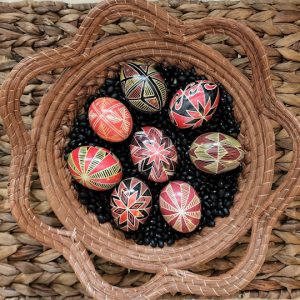
Creating art that has deep roots in tradition delves into ethnicity and identity. “There is power in the history,” Domal says. “Writing pysanky has helped me connect to people past and present like nothing else.” Pysanky, like many types of folk art, was traditionally created and passed down by women, which has a power of its own. At one point, the art was in danger of being lost entirely, as it was banned by the Soviet regime in Russia for much of the 20th century. It was one of the many cultural traditions seen as a danger to Soviet rule. It survived, in part, due to those like Domal’s family and others that form the diaspora of those from the region that kept the art alive.
The legend in the first paragraphs is often told when teaching pysanky writing, Domal explains. It ends, generally, with the storyteller extending their hands with a pysanky egg cupped within and saying, “and that is why we write pysanky.” Celebrating pysanky has a special meaning, which is extraordinary in every sense. “The word extraordinary is ordinary all dressed up,” says Domal, “and when you see someone who doesn’t know they are doing something special, tell them. And then tell them again. And again.”

About Victoria Rose
Victoria Rose (she/her) is an editor, writer, avid reader, self-described geek, and fan of all things creative. Her passion for words has led to her current career as a freelance editor, and she is the owner of Flickering Words, an editing service. When not wielding a red pen (or cursor), she loves reading books of all genres, playing video, board, and word games, baking ridiculous creations to show off on the internet, or enjoying the gorgeous outdoors. She is a board member of the West Chester Film Festival and part of the Thirsty Monsters, a team of streamers from around the world who fundraise for various charities supporting LGBTQIA+ and accessibility rights. She can be found online @WordsFlickering or the Brandywine Art Guide @BrandywineArtGuide.
- Web |
- More Posts(117)
The Legendary Art of Pysanky Read More »