

November 17, 2019

Student art stands out at UHS

Student art stands out at UHS

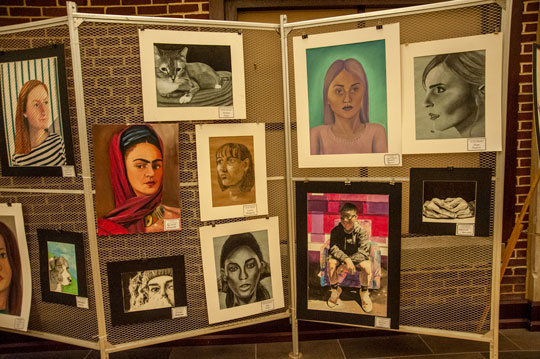
Student artists outnumbered professional artists during the 44th annual Unionville Art Gala, and the buzz was about the students’ work. Even the professionals were talking about it.

Carol Mangano, fresh off a two-person exhibit at Barbara Moore Fine Art in Chadds Ford, said it was great to see the students involved and praised the art program in the entire district.

“They see the whole process, it’s creative and mental growth, from kindergarten to 12th grade,” she said.

According to Diane Micklin, the artists’ liaison for the gala and a professional artist in her own right, “The student art gets better and better every year. The students show incredible talent.”

Other random comments mentioned not just the quality, but the vigor and energy of the students’ work.

A color pencil work by featured student artist Sophia Mayer.

Those comments were music to the ears of art teacher Louis Stamis. He said it’s the function of the art curriculum “to foster and harness the student’s passion.”

By teaching that something as simple as a line has meaning, he explained, and how to generate light and form gives the students an understanding of what they see and how to manipulate the simple forms to give depth to a two-dimensional image to give the impression of three dimensions.

Sophia Mayer was this year’s student featured artist. Her focus has been n portraiture and figures and has a fascination with the “many colors in the human face.” And while her work was featured, she doesn’t plan to go to art school. She might, however, minor in art.

Featured student artist Sophia Mayer, center, is flanked by honorable mention artists Claire Favor, left, and Ashley Kirk, right.

There were two honorable mentions to Mayer, Claire Favor and Ashley Kirk. Favor said she’s been drawing and painting all her life but didn’t begin studying art until high school. She thinks of her work as being more illustrative and plans to study graphic design and focus on illustration.

Kirk, too, has been drawing since her younger days, going to art camps, but didn’t consider herself good until she started studying during her sophomore year at UHS. That’s when the light went on for her.

“Time would just fly by in art class. I truly enjoyed it,” she said.

In addition to the 89 students who had works on display, 61 professional artists were also in the event.

The annual art gala is the second-largest fundraiser for the school’s PTO. According to Jen Hall, one of the co-chairs this year, the show usually nets about $12,000-$15,000 each year. The money goes toward all school programs, not just the art curriculum.
About Rich Schwartzman

Rich Schwartzman has been reporting on events in the greater Chadds Ford area since September 2001 when he became the founding editor of The Chadds Ford Post. In April 2009 he became managing editor of ChaddsFordLive. He is also an award-winning photographer.

Student art stands out at UHS Read More »
Exploring Hope: So many Bible translations

If you ever go to a bookstore and look at the Bible section, you’ll be surprised by the vast number of translations – NIV, KJV, NLT, CSB, ESV, NKJV, NRSV, NASB — just to name a few. And if you’re new to Christianity, it may feel bewildering. It could even make you doubt the trustworthiness of the Bible. You say, “If there are so many translations, then certainly we can’t trust the Bible, right? No one can even decide what it says.” However, as understandable as this sentiment is, it’s quite mistaken. Let me explain.

I want to give you a very brief introduction to the world of Bible translation. To begin, why so many translations in English? Well, that topic is too vast for a brief article in an online publication. But in short, there are so many translations because translation committees have different philosophies.

Some translation committees opt for what is called “formal equivalence” — or “word for word” translation. The basic idea is that the translators take the original Greek or Hebrew texts and try to maintain the original sentence structure as much as possible. If there is a word in Greek or Hebrew, they’ll try to find a word in English that corresponds. In other words, it’s super literal.

Conversely, other translation committees opt for what is called “dynamic equivalence.” This is where they focus on translating thought for thought, rather than word for word. The advantage of this strategy is readability. They’re generally not as clunky as more literal, word for word translations.

But which is better, formal equivalence or dynamic equivalence? Well, there is not a right or a wrong answer to that question. For certain types of Bible study, it’s better to use a more literal, word for word translation. For example, as I preach through books of the Bible verse by verse every Sunday at Hope Presbyterian in Garnet Valley, I use the ESV because it is more literal. I am confident that my congregation is confronting, as much as possible, the thought process of the original author. However, if I were ministering to young children, I might use a thought for thought translation, like the NLT, because of its readability and clarity.

But in the end, should the differences between Bible translations weaken or strengthen our trust in the Bible? Well, I am convinced that it should strengthen our confidence. If you are studying a passage of Scripture, you don’t have to rely on one translation committee’s opinion. Instead, you can compare countless translations and decide for yourself, even if you haven’t had the blessing of learning Greek and Hebrew.

So I would recommend reading multiple translations. Be like the Bereans who “received the word with all eagerness, examining the Scriptures daily to see if these things were so” (Acts 17:11 ESV). Or you could say, “They searched the Scriptures day after day to see if Paul and Silas were teaching the truth (Acts 17:11 NLT).

For further reading, check out this article by Daniel Wallace.

About Will Stern

Originally from Colorado, Will Stern is the pastor of Hope Presbyterian Church in Garnet Valley. He majored in violin performance for his undergrad and taught violin for a number of years before being called into ministry. He studied theology at Duke University and Westminster Theological Seminary.

Exploring Hope: So many Bible translations Read More »

Scroll to Top