

April 8, 2018

The Chadds Ford Tavern is back

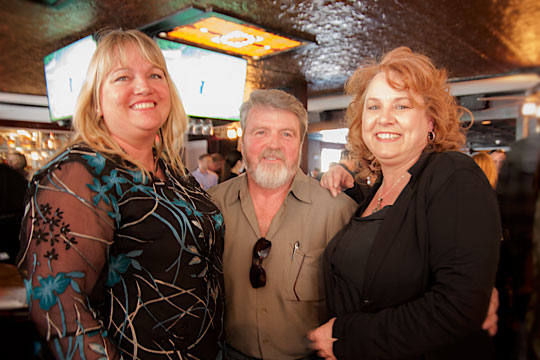
Anne Eunson, left, Jim Murphy and Lisa Vonderstuck celebrate the grand reopening of The Chadds Ford Tavern Friday night.

It was a packed house at The Chadds Ford Tavern Friday night for the longtime watering hole’s grand reopening. It was standing room only in the bar area and most of the regular tables on the other side were taken. Those that were open were held for people with reservations.

Several patrons, such as Jim Murphy of Tri-County Pest Control, and Lisa Vonderstuck of Brandywine View Antiques, were thrilled.

They each said it was like a homecoming.

“I’m in my old seat that I love. I can see who’s coming in the door. I’m so happy it’s back,” said Murphy who started going to the tavern in 1980.

Vonderstuck welcomed the reopening, exclaiming that “The old watering hole is back. It’s the way it used to be. It felt really good to open that door and see they kept the history.”

Part of that keeping history, she said, includes the sign on the front door that reads: “Through these doors have walked some of the most talented people in the world.”

Among others, the sign refers to the likes of Andrew Wyeth and George A. “Frolic” Weymouth.

The Tavern had been closed for several years after former owner Tommy Drane sold the restaurant. There were two different owners who tried to keep it running but failed. Late last year, Phil Ferro and partners Chet and Raj Patel — brothers who own the Brandywine River Hotel — decided to make a go of it.

Ferro has 24 years of experience in the food industry and already operates three Delaware County restaurants: TNT, Red Iron American Pub and the Crimson Lounge. But he’s eager to make his image of The Chadds Ford Tavern succeed.

“I’m here to stay,” he said.

Hours of operation were originally planned to be 11 a.m. to midnight Monday through Thursday, 11 a.m. to 2 a.m. Friday, 10 a.m. to 2 a.m. on Saturday and 10 a.m. to midnight on Sunday. However, General Manager Jay Schecter said in March that they would start with only dinner hours and expand to lunch later.
About Rich Schwartzman

Rich Schwartzman has been reporting on events in the greater Chadds Ford area since September 2001 when he became the founding editor of The Chadds Ford Post. In April 2009 he became managing editor of ChaddsFordLive. He is also an award-winning photographer.

The Chadds Ford Tavern is back Read More »

Rabbinic Reflections: The Passover table

The people who disagree most are sitting together. The stakes are really high. The recent past was fraught with machinations and secret deals. It is not just politics, not just leadership, not even worldviews; it comes down to their sense of purpose in the world. And we have a record of it.

The Passover Haggadah, the guidebook for the seder meal, gives order (the literal meaning of the Hebrew word seder) to the Exodus storytelling that marks the Jewish celebration of spring and redemption from slavery. One of the many paragraphs that often get skipped these days recounts how five great rabbis once had a seder together in B’nai B’rak that lasted through the night. The Haggadah only mentions a teaching of one of them by name even though much more of the Haggadah could easily have come directly from that night.

I happen to be reading a book called “The Orchard” by Yochi Brandes (and translated from the Hebrew by my friend Daniel Libenson) that brings these famous rabbis to life in such a rich way. A key moment in the plot is the very seder in B’nai B’rak. Brandes sets the table with heart-thumping tension as she weaves Talmudic tales into a history in which the disagreements between these rabbis will determine the future of the Jewish community’s relationship to its own past and future to a nascent Christianity and to Rome.

Rabbis Eliezer and Joshua have been on opposite sides of the School of Shammai and School of Hillel divide; they represent the culmination of each school’s guidance for the Jewish future. Rabbi Elazar ben Azarya served as the nasi (the president) when Rabban Gamliel was deposed for treating Rabbi Joshua unfairly; in Brandes’s telling Rabbi Eliezer gives Rabbi Elazar his appearance as a 70-year old. Rabbi Tarfon represents Rabban Gamliel who has been reinstated as nasi. In the novel, the seder takes place in Rabbi Akiva’s home as he is a central figure in the political intrigue between the key leaders.

I mention all that to say that we could learn something important for our day from the idea that these conflicted sages sat together all night talking. In Brandes’ story, that seder does not end well, but in the Haggadah, we are led to believe otherwise. Leading rabbis who training, outlook, reputation, and teaching differ greatly were telling the story of the Exodus together all night. Their students had to tell them dawn had come.

How often do we avoid conversations with those with whom we disagree? How often do we even sit with those with whom we disagree? This famous seder is a reminder that we can and should sit with those with whom we have differences big and small. We do not need to talk about topics usually debated to utter discomfort or instead left in echo chambers. We do need to talk about foundational stories, how we see them, how we understand them, and how we live because of them.

Right after the paragraph about the rabbis, we read about the four kinds of children at the seder. We are reminded not everyone thinks alike or connects the same way. None of these children is ideal. Yet, if we put ourselves in each of their mindsets, the Exodus means something different. The Passover table offers its own redemption by reminding us to talk about freedom, to talk about differences, and to talk with others. It is a timely opportunity, if not this year then next.

About Rabbi Jeremy Winaker

Rabbi Jeremy Winaker is the executive director of the Greater Philadelphia Hillel Network, responsible for West Chester University, Haverford, Bryn Mawr, and other area colleges. He is the former head of school at the Albert Einstein Academy in Wilmington and was the senior Jewish educator at the Kristol Hillel Center at the University of Delaware for four years. Rabbi Winaker lives in Delaware with his wife and three children.

Rabbinic Reflections: The Passover table Read More »

Scroll to Top