Eleanor M. Condy McLaughlin, 85, of Kennett Square, died Friday, March 11, at her home surrounded by her family. She was the wife of Joseph McLaughlin, with whom she shared 33 years of marriage.
Born in Darby, she was a daughter of the late Joseph and the late Agnes (Immediato) Condy.
Eleanor was a devout Catholic all her life and in recent years was a member of St. Patrick Catholic Church in Kennett Square.
For most of her career, she was an office manager for the corporate offices of K-Mart. Prior to her work at K-Mart she worked in the insurance industry. She and her husband enjoyed over 20 years of retirement in Port Charlotte, Fla. where she played bingo regularly and served on the board of directors for her local homeowners association.
Survivors include in addition to her husband, one daughter, Agnes O’Toole of Kennett Square; a stepson, Joseph Mclaughlin Jr. and his wife Linda of Boothwyn; a sister Agnes Leonore Condy, SSJ of Springfield; 11 grandchildren, three great grandchildren and many loving nieces and nephews. She was predeceased by four brothers, John, Sam, Joe and Pat; four sisters, Mary, Annie, Minnie and Lee; one son, Martin Hill in 1985 and a stepson Kenneth McLaughlin in 2015.
You are invited to visit with Eleanor’s family and friends from 9:30-10:30 a.m.Friday March 18, at the Kuzo & Grieco Funeral Home Inc. (610-444-4116) 250 W. State St. Kennett Square, PA 19348. A mass of Christian Burial will follow at 11 a.m. at St. Patrick Catholic Church 212 Meredith St. Kennett Square. Interment will be held at a later date. Contributions in her memory may be made to Willow Tree Hospice, 616 East Cypress Street Kennett Square, PA 19348. To view her online tribute and to share a memory with her family, please visit www.griecocares.com
There’s an artistic line of progression, or maybe it’s a train of thought that leads the creative process. In the case of the one-act play “Nureyev’s Eyes,” that train runs through Wyeth country.
The play is based on the relationship between Jamie Wyeth and the dancer Rudolf Nureyev when the Chadds Ford painter was doing his studies of the famous Russian-born Nureyev during the mid-to-late 1970s.
The dancer inspired the painter, and the painter inspired the playwright David Rush. Bill Dawes and William Connell, the actors who bring the drama to life as Nureyev and Wyeth, had the chance to go backstage at the Brandywine River Museum of Art this past week to learn more about the relationship between the dancer and the painter.
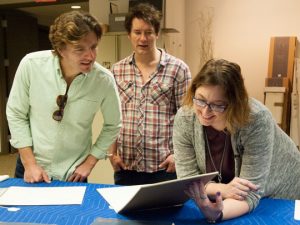
Brandywine River Museum of Art Associate Curator Amanda Burdan shows Jamie Wyeth sketchbooks to actors William Connell, right, and Bill Dawes.
The actors took time from the Delaware Theatre Company’s run of the play on Thursday to visit the museum and get a tour of the gallery where Wyeth’s Nureyev paintings are on display, as well as a chance to see the vault where more Wyeths are stored. They also saw Wyeth’s sketchbooks with original drawings of the dancer and the archive area filled with photos and other memorabilia, including Nureyev’s original French travel document from when he defected from the Soviet Union in 1961.
Connell, whose hair and facial expressions resemble Wyeth’s, was amazed when looking through the sketchbooks. “This is cool. This is so cool,” he said.
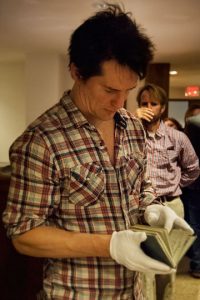
Dawes was a bit more playful. Wearing white cotton gloves to protect the documents, he jokingly said “oops,” pretending he had ripped out a few pages from the travel document.
According to Amanda Burdan, the museum’s associate curator, Wyeth bought many of Nureyev’s belongings, including papers and costumes, when they were auctioned off after the dancer’s death.
And it’s after that death in 1993 — and after the paintings were on display — when the story on how Jamie Wyeth’s work inspired the play begins.
The playwright was visiting the museum in 2010 when he saw Wyeth’s paintings hanging in the gallery. That art led him to write “Nureyev’s Eyes” long before he ever met Wyeth.
But, according to Burdan, the paintings themselves were not done until well after Nureyev died.
Actor William Connell, who portrays Jamie Wyeth, takes photos of some of Wyeth’s sketches of Rudolf Nureyev.
Burdan told the story during a Gallery Talk a day before the actors came to the museum.
The artist and the dancer got to know each other in the mid 1970s and Wyeth eventually talked Nureyev into letting him do some studies that would eventually become paintings. As someone who had studied anatomy, Wyeth spent a lot of time measuring Nureyev, the length of a forearm, the span of the hands, his feet, the angle of the head.
“There were a lot of measurements. Jamie would take the calipers and measure the calf, how long the big toe was, how long the neck is, how many eye widths there are across the face, or up and down the face,” she said. “The sketchbooks are filled with these basic building blocks.”
Burdan also likened the process of learning dance to that of painting.
“In ballet there are certain regimented things that happen. You do your barre work first. You do adagio. You do allegro…There are certain things that happen,” she said. “In painting, especially traditional, academic modes of painting, there’s a way that you learn. You begin with drawings of still life, of things that don’t move, blocks and cubes and cones. You move on to study the human form as a sculpture.”
But that was all drawing. There’s no painting until proficiency is reached in each previous stage, she said. That progression goes from drawing to crayon before using the full color palette.
“And that’s how Jamie Wyeth works,” Burdan told the Gallery Talk audience, which also included several ballet students from the Academy of International Ballet of Media.
Burdan pointed out several of Wyeth’s pieces that were done on cardboard with pencil and then with crayon that capture shadows and highlights. She said it’s simple, not fully composed.
“There were a lot of modeling sessions, a lot of time with Jamie following Nureyev around, visiting his ballet studio, being in the dressing room. These early works, especially in the ’70s, really represent the basics, the beginnings, the foundations and the building blocks of making the painting,” she said.
Bill Dawes examines Nureyev’s travel document the dancer used after defecting from the Soviet Union.
Burdan also explained that Wyeth used those building blocks as a virtual stand-in for Nureyev when the dancer wasn’t around, especially after his death. And he used the dancer’s costumes that he bought at auction to dress his painted figures, bringing to life the various characters that Nureyev danced.
Nureyev died in 1993 of complications from AIDS and Burdan thinks it was the costumes that had Wyeth return to the studies to do the paintings.
“Having the costumes around brought back the physical presence of the dancer to his studio, to his life. Suddenly we see a flourish, a flurry of all these Nureyev works coming back…in full costume,” Burdan said.
Wyeth discussed the play briefly during his retrospective at the museum last year, commenting: “Nureyev’s character has all the best lines.”
In an interview for a Wilmington News Journal review, Wyeth, now 69, said it was “a little embarrassing” seeing himself portrayed as he was 40 years ago when he was in his 20s, but that it “brought back so much.” He also called the play “very moving.”
“Nureyev’s Eyes” is at the Delaware Theatre Company through March 20.
The next Gallery Talk, on the same subject, is scheduled for Wednesday, March 16 at 2 p.m.
Video: Ballet students from the Academy of International Ballet of Media dance the “Révérence,” a traditional end of class dance expressing thanks for the teacher’s time and effort.
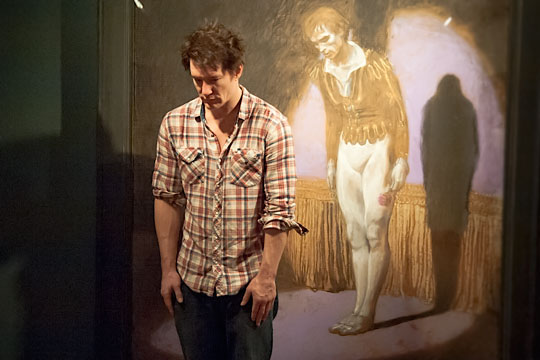
Top photo: Actor Bill Dawes, who portrays Rudolf Nureyev in “Nureyev’s Eyes” strikes the same pose as depicted in Jamie Wyeth’s “Curtain Call.”
Rich Schwartzman has been reporting on events in the greater Chadds Ford area since September 2001 when he became the founding editor of The Chadds Ford Post. In April 2009 he became managing editor of ChaddsFordLive. He is also an award-winning photographer.
Perhaps you have seen Amy Cuddy’s TED talk on power posing, which has empowered the lives of millions. Where that presentation is one glimmering nugget of her research, her book, “Presence: Bringing Your Boldest Self to your Biggest Challenges,” is a goldmine (and one without slave labor, I might add).
Weaving solid research from many disciplines with stories from her life and the lives of others, Amy Cuddy presents an enthusiastically engaging and deeply informative narrative on what it means to have “presence.”
Integrating the research of others before her, Cuddy notes psychologist William Kahn’s studies of presence in the workplace. He identified four determinants of presence in an individual as being attention, connection, integration, and focus. Simply put, presence is showing up being your “authentic best self.”
So when are we least present? Cuddy interviewed actor Julianne Moore and got an answer to this question. Moore believes that people feel least present when they don’t feel seen: “It’s impossible to be present when no one sees you. And it becomes a self-perpetuating process, because the more that people don’t acknowledge you, the more you feel you don’t exist. There’s no space for you. … Conversely, you are the most present when you are the most seen … and then people are always corroborating your sense of self.”
Invisibility, being unseen, evokes powerlessness. Powerlessness leads to withdrawal and the need to protect oneself. Moore notes, “If you’re protecting yourself against harm — emotional harm or humiliation — you can’t be present, because you’re too protected.”
The conclusion? That presence is about power, not domination and control of others but of being authentic to oneself. The ripple effect is that your presence can bring out the presence of those around you. Haven’t we all been in the presence of a singer or musician whose expansive presence has included us and we feel larger for the inclusion?
So how do we practice presence? Angeles Arrien, author of “The Four-Fold Way,” used to say we begin our authentic journey by “showing up.” You may not know what to do, or what the next step is but that is the start. It is saying, “Yes, I am here.”
How we “show up” has been researched by psychologists Susan Fiske and Peter Glick, as well as Cuddy. First encounters have a universal pattern. Two instantaneous questions arise: Can I trust this person? Can I respect this person? The researchers define these dimensions as warmth (trust) and competence (respect). Quickly, we evaluate the stranger accordingly and prioritize warmth. Makes sense evolutionarily: if a person can’t be trusted, he could be dangerous. Ironically, however, we have the errant notion that when asked how we want to be seen by another, we say we want to be seen as competent (not warm and trustworthy).
Research shows that competence without warmth doesn’t travel well: “The top characteristic associated with an executive’s failure is an insensitive, abrasive, bullying style.” Cuddy notes, “A warm, trustworthy person who is also strong, elicits admiration; but only after you’ve established trust does your strength become a gift rather than a threat.”
Presence also requires “shutting up.” That is, listening. Cuddy quotes William Ury, consummate negotiator and co-author of “Getting to Yes”: “When you listen to someone, it’s the most profound act of human respect.” In other words, or perhaps without words, rather than give advice, give attention—which is presence! The other person needs space and safety—and that means our being comfortable with silence.
If “presence” is one side of the coin, what is the other? Stayed tuned for “Presence, Part II” where “impostorism” — the other side of the coin — will be addressed. So will surfing, singing, slouching, self-nudging, and the power poses of presence. Till then, stand tall and don’t slouch.
*Kayta Curzie Gajdos holds a doctorate in counseling psychology and is in private practice in Chadds Ford, Pennsylvania. She welcomes comments at MindMatters@DrGajdos.com or 610-388-2888. Past columns are posted to www.drgajdos.com. See book.quietwisdom-loudtimes.com for information about her book, Quiet Wisdom in Loud Times: The Rise of the Wounded Feminine.
** The opinions expressed are those of the author and do not necessarily reflect those of the ownership or management of Chadds Ford Live. We welcome opposing viewpoints. Readers may comment in the comments section or they may submit a Letter to the Editor to: editor@chaddsfordlive.com
Dr. Kathleen Curzie Gajdos ("Kayta") is a licensed psychologist (Pennsylvania and Delaware) who has worked with individuals, couples, and families with a spectrum of problems. She has experience and training in the fields of alcohol and drug addictions, hypnosis, family therapy, Jungian theory, Gestalt therapy, EMDR, and bereavement. Dr. Gajdos developed a private practice in the Pittsburgh area, and was affiliated with the Family Therapy Institute of Western Psychiatric Institute and Clinic, having written numerous articles for the Family Therapy Newsletter there. She has published in the American Psychological Association Bulletin, the Family Psychologist, and in the Swedenborgian publications, Chrysalis and The Messenger. Dr. Gajdos has taught at the college level, most recently for West Chester University and Wilmington College, and has served as field faculty for Vermont College of Norwich University the Union Institute's Center for Distance Learning, Cincinnati, Ohio. She has also served as consulting psychologist to the Irene Stacy Community MH/MR Center in Western Pennsylvania where she supervised psychologists in training. Currently active in disaster relief, Dr. Gajdos serves with the American Red Cross and participated in Hurricane Katrina relief efforts as a member of teams from the Department of Health and Human Services' Substance Abuse and Mental Health Services Administration.Now living in Chadds Ford, in the Brandywine Valley of eastern Pennsylvania, Dr. Gajdos combines her private practice working with individuals, couples and families, with leading workshops on such topics as grief and healing, the impact of multigenerational grief and trauma shame, the shadow and self, Women Who Run with the Wolves, motherless daughters, and mediation and relaxation. Each year at Temenos Retreat Center in West Chester, PA she leads a griefs of birthing ritual for those who have suffered losses of procreation (abortions, miscarriages, infertility, etc.); she also holds yearly A Day of Re-Collection at Temenos.Dr. Gajdos holds Master's degrees in both philosophy and clinical psychology and received her Ph.D. in counseling at the University of Pittsburgh. Among her professional affiliations, she includes having been a founding member and board member of the C.G. Jung Educational Center of Pittsburgh, as well as being listed in Who's Who of American Women. Currently, she is a member of the American Psychological Association, The Pennsylvania Psychological Association, the Delaware Psychological Association, the American Family Therapy Academy, The Association for Death Education and Counseling, and the Delaware County Mental Health and Mental Retardation Board. Woven into her professional career are Dr. Gajdos' pursuits of dancing, singing, and writing poetry.