
February 6, 2016

At this court proceeding, sentences adulatory
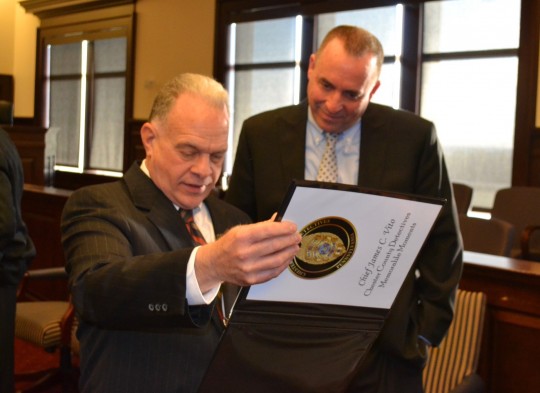
As Chester County Detective Lt. Michael McGinnis looks on, recently retired Chief Detective James Vito peruses a photo book presented to him following his selection as 2015 Detective of the Year.

Pulling one over on a longtime detective takes some savvy scheming, but the top brass in the Chester County District Attorney’s Office managed to ambush former Chief County Detective James Vito on Friday, Feb. 5.
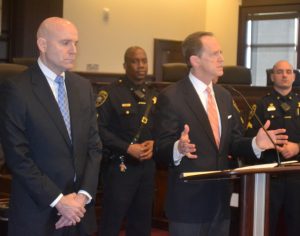
After being introduced by Chester County District Attorney Tom Hogan (left), Sen. Pat Toomey (right) extends thanks to those in law enforcement who put their lives on the line each day.
After being introduced by Chester County District Attorney Tom Hogan (left), Sen. Pat Toomey  extends thanks to those in law enforcement who put their lives on the line each day.

Vito, who was named 2015 Detective of the Year, was one of numerous honorees at the Chester County District Attorney’s Awards Ceremony at the Chester County Justice Center – and the only one who didn’t know exactly why he was there.

To what lengths did his former colleagues go to ensure his presence without divulging the reason? They told him that another detective was receiving the recognition. “I congratulated that person in the elevator on the way up here,” Vito said later.

Chester County District Attorney Tom Hogan called Vito “the backbone of law enforcement for three decades” as well as someone who espoused teamwork and shunned the limelight. Chester County Chief Detective Kevin Dykes described his former boss as someone who is “as honest, compassionate and loyal as they come.”

Vito said that he was honored and that he would put the award in a place where it would remind him to salute the great work that his former co-workers do every day.
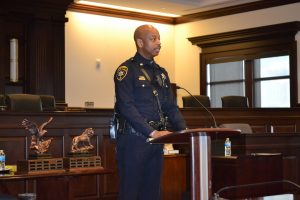
Chester County Deputy Sheriff Wayne Johnson sings a tribute to fallen officers.

Hogan presented a special commendation to Sen. Pat Toomey for his work on several issues this past year. Toomey pushed legislation to keep sex offenders out of schools, protected funds for crime victims, and stood up for embattled law enforcers, Hogan said.

Surveying Courtroom One, which was filled with men and women in blue, Toomey said that although it has been a difficult year for police officers, citizens value them. “I know because I speak to Pennsylvanians every day,” he said. “The vast majority of Pennsylvanians are grateful to you … My main message to you today is to say thank you for the great work that you do.”

District Attorney Chief of Staff Charles Gaza extended the praise, presenting commendations to departments and individuals involved in five events. Department of Emergency Services (DES) Executive Director Robert Kagel, Safe Schools Planning Coordinator Chrissy DePaolantonio, and Pat Davis, deputy director for law enforcement services at DES, were cited for coordinating a multi-department active-shooter drill, and members of the Sheriff’s Office garnered praise for their handling of a knife-wielding attacker at the Justice Center in August.

Former Pennsylvania State Police Capt. William White accepted honors for the role his department played in a high-profile child-abuse case. Hogan pointed out that White was recently promoted to major and would be leaving Troop J to work in Hershey.
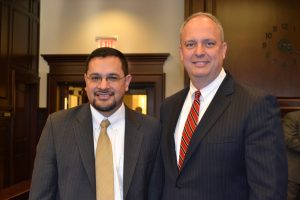
Prosecutor of the Year Carlos Barraza (left) poses with District Attorney Chief of Staff Charles Gaza.

During White’s supervision of the Avondale and Embreeville barracks, his investigators succeeded in bringing Warren Yerger Sr. to trial, where he was convicted and received a prison term of 339 to 690 years – the longest jail sentence in county history, Hogan said.

The Westtown-East Goshen Regional Police Department garnered accolades for bringing the last of six defendants, who had been on the lam for more than a decade, to justice for a terrifying robbery of a Genuardi’s supermarket in 2000. And the West Goshen Police Department was lauded for its work on the case involving Edward Charsha and Stephanie Matusky, who embezzled $200,000 from their employer, an electrical contractor.

The Prosecutor of the Year Award went to Deputy District Attorney Carlos Barraza. First Assistant District Attorney Michael G. Noone said Barraza had adeptly filled a variety of roles in the office, including mentoring new hires, handling grand-jury investigations, and heading the drug unit.

“Carlos is skilled in many areas. Just ask him; he’ll tell you,” Noone joked.

Barraza insisted that many others “could and should be here” receiving this award: his wife, for example. “Let’s be real. She’s married to me so she should be the one up here receiving this award,” he suggested.
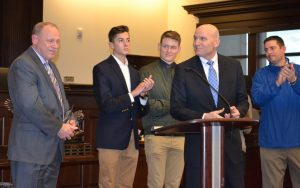
Downingtown Det. Andy Trautmann (left) receives congratulations from District Attorney Tom Hogan (second from right) as well as representatives from Downingtown West High School, including Principal Kurt Barker (right).

He expressed profuse praise for a host of people, referencing numerous colleagues and insisting that his support staff stand and be recognized. “You’re overworked, you’re underpaid. But the one thing you’re not is underappreciated,” he said.

Barraza delivered his tribute to his family in Spanish. Besides his wife and two of their three children, Barraza’s father, Luciano; his mother, Martha; his brother Luciano; his sister Alejandra; a niece, and two nephews all attended the ceremony.

Finally, Hogan presented Downingtown Det. Andy Trautmann with the Law Enforcement Officer of the Year Award. Hogan noted that Trautmann possesses police skills that normally don’t coexist. He works fearlessly as a SWAT officer and tenaciously as a white-collar crime investigator, but also excels as a resource officer for the Downingtown school district, a position that requires a very different demeanor, Hogan said.

“I am truly humbled. I am truly honored; This is not what I do my job for,” Trautmann said. “One thing I try to remember is that I work for those who can’t work for themselves.”

Hogan ended the program on a somber note. “We have a solemn duty to remember fallen officers,” he said, a prelude to an evocative song from Deputy Sheriff Wayne Johnson, who also opened the ceremony with an a cappella version “The Star-Spangled Banner.”

 

About CFLive Staff

See Contributors Page https://chaddsfordlive.com/writers/

At this court proceeding, sentences adulatory Read More »
W. Goshen teen hospitalized; father charged

A West Goshen Township father faces charges after an altercation preceded his 16-year-old son’s brain hemorrhage on Friday, Feb. 5, said a press release from the West Goshen Township Police Department.

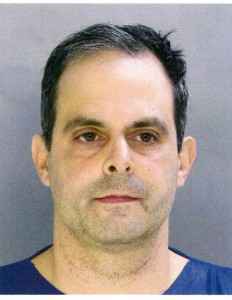
Christian Joseph Turse

West Goshen Township Police and medical personnel responded to the 500 block of Taylors Mill Road in West Chester at 11:32 p.m. on Friday night for the report of a cardiac arrest. Upon arrival, officers learned that the teenage male was unresponsive, the release said.

The victim’s mother told detectives that her son had been involved in a physical altercation with his father and then collapsed. The boy was transported to Chester County Hospital by ambulance, where doctors determined he was suffering a brain hemorrhage and had him flown to the Children’s Hospital of Philadelphia (CHOP). Police said the boy remains in the intensive care unit at CHOP.

After interviewing the 43-year-old father, Christian Joseph Turse, West Goshen detectives charged him with aggravated assault, simple assault, endangering the welfare of a child, and related offenses, the release said.

Turse was arraigned before District Justice Michael J. Cabry III, who set bail at $100,000 unsecured. Turse was released to await a preliminary hearing scheduled for Thursday, Feb. 11, at 8:30 a.m. in West Goshen district court, court records said.


About CFLive Staff

See Contributors Page https://chaddsfordlive.com/writers/

W. Goshen teen hospitalized; father charged Read More »

Chadds Ford chance encounter begets pioneer

An African American trailblazer with local roots seems more suited to modern times than life 150 years ago.

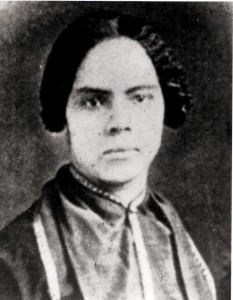
Mary Ann Shadd Cary Photo courtesy of the National Archives of Canada
Mary Ann Shadd CaryPhoto courtesy of the National Archives of Canada

Mary Ann Shadd Cary worked as a teacher, journalist, editor, lecturer, lawyer, civil rights activist, suffragette, abolitionist, wife and mother, fitting the profile of today’s super woman. Her accomplishments proved even more remarkable for a woman of color, making her a worthy subject for anyone inspired to research area notables during Black History Month.

Shadd Cary’s family roots date back to 1755, before America’s founding, according to Jane Rhodes, whose research led to the publication of Mary Ann Shadd Cary: The Black Press and Protest in the Nineteenth Century in 1998. Rhodes offers the following account of Shadd Cary’s journey from Delaware to Canada to Washington, D.C.:

In the year leading up to the French and Indian War, a Hessian mercenary under the command of General Braddock was wounded and sent to Chadds Ford to recuperate. His nurses were a free black woman, Elizabeth Jackson, and her daughter, also named Elizabeth. The younger Elizabeth and the soldier, Hans Schad, fell in love and married. The couple had two sons, Hans Jr. and Jeremiah, and eventually moved just over the Pennsylvania-Delaware line to Millcreek Hundred. Over time, the spelling of the family name changed to Shad and then to Shadd.

One of Jeremiah Shadd’s sons, Abraham (1801-1882), became a leader in Wilmington’s community of free blacks. He was a delegate to annual conventions for free blacks and served as president. He was also a delegate to Anti-Slavery Society conventions, where he met and formed lasting friendships with Pennsylvania Quakers. Working with Wilmington Quaker Thomas Garrett, he helped fugitive slaves travel through the northern Delaware portion of the Underground Railroad.

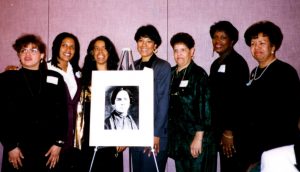
Female descendants of MASC in Dover at Hall of Fame for Delaware Women induction ceremony
Female descendants gather in Dover, Del., for the induction of Mary Ann Shadd Cary into the Hall of Fame for Delaware Women in March 1997.

Abraham Shadd’s 13 children grew up in a home centered on social activism, and as adults they all chose careers that gave them the opportunity to improve conditions for their race and fellow citizens. Among the activist children, though, Mary Ann Shadd was the most outstanding.

The eldest child, she was 10 years old when the family, with help from their Pennsylvania Quaker friends, moved to West Chester. The move made it possible for all the Shadd children – the boys and the girls – to receive an education, something that was not possible at that time in Delaware. Their father continued to prosper in business and became a leader in his new community.

Through her teacher, Phoebe Darlington, Mary Ann Shadd learned the values of the Society of Friends, including the brotherhood of man and the importance of education. When her studies were complete, she taught in several area schools while sharing her strong opinions about integration, slavery, and education in various newspapers. Casting her net further, she wrote a short pamphlet called, “Hints to the Colored People of the North” in 1949 in which she encouraged thrift and encouraged her readers to live within their means. The pamphlet caught the attention of Frederick Douglass, and soon she began writing articles on black independence and need for self-respect for his North Star publication.

Writer W.E.B. Du Bois described Mary Ann Shadd as “tall, slim and beautiful, having that ravishing dream-born beauty – that twilight of races that we call mulatto.” For her part, Shadd preferred not to think about her color and, when discussing color, referred to people as having “complexional differences.” By all accounts, her beauty, combined with her intellect and strong personality, made her remarkable in any setting. Although she could be abrasive, her arguments often sparkled with wit and humor.

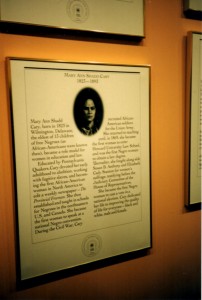
Shadd Cary plaque NWHF
Mary Ann Shadd Cary’s framed biography hangs in the National Women’s Hall of Fame Museum in Seneca Falls, N.Y.

With the passage of the Fugitive Slave Law of 1850, many blacks – those free-born and those “self-emancipated” – chose to leave the U.S. and settle just across the Detroit River in Canada. In “Canada West,” they could finally live without the constant fear of being sold into slavery in the South. It was to this safe haven that the entire Shadd family moved in 1852. Almost immediately, Mary Ann Shadd began to teach in a makeshift school, and with her brother Isaac, founded a newspaper to serve the immigrant population.

Called “The Provincial Freeman,” the paper’s masthead declared, “Self-reliance is the True Road to Independence.” During this same period of time, she wrote another pamphlet, printed in Wilmington, which extolled the advantages for blacks living in Canada. Ignoring the danger of travelling alone, Mary Ann Shadd lectured throughout the U.S., promoting immigration and selling her booklet, “Notes on Canada West.”

In 1856, Shadd took time out from her hectic schedule to marry a politically active Toronto barber originally from Virginia, Thomas Cary. Cary had three children from a previous marriage and added two more children to the family with his new wife. By 1860, “The Provincial Freeman” had stopped printing, and Thomas Cary had died, leaving his widow with five children to support.

To earn extra income and to support the Union cause, Shadd Cary accepted a commission to recruit black soldiers for the Union Army, excelling once again in her duties. After the Civil War, she and her children moved to Washington, D.C. Here, Shadd Cary taught children who were part of the huge migration of black families to that city following the end of the war. She continued her fiery writing and was a frequent contributor to Frederick Douglass’ “New National Era” and John Wesley Cromwell’s “The Advocate.“

Shadd Cary’s attention next turned to the issue of women’s suffrage. She became involved with the National Women’s Suffrage Association, where Susan B. Anthony and Lucretia Mott recognized her as a gifted speaker and invited her to address the association’s convention in 1878. Later, she appeared with Cady Stanton and Anthony to argue before Congress that the 14th and 15th Amendments provided the right to vote to all its citizens and taxpayers.

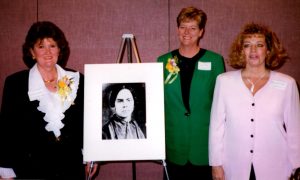
HFDW Inductees Dover 1997
The 1997 inductees into the Hall of Fame for Delaware Women include Dr. Harriet Nichols Smith Winslow (from left), Mary Ann Shadd Cary (posthumously), Karen E. Peterson, and Sherry L. Freebery.

At age 46, Shadd Cary entered Howard University’s newly established Law School with 45 other students. Research suggests that she was the first African American woman to study law and one of the first American women of any race to seek a law degree. Although she excelled in her courses, curiously she did not graduate with the 10 students who finished the program. Many explanations have been proffered, but it couldn’t have helped that the legal profession at that time was a white, male-dominated profession in the 1800s, and it was difficult for women across the country to get admitted to the bar.

Shadd Cary was 60 years old when she finally became a lawyer. With her license in hand, she focused on serving the downtrodden in her community until her death in 1893 at the age of 70. Several years earlier, Bishop Daniel Payne of the African Methodist Episcopal Church wrote that, “her energy and perseverance, as well as her ability to suffer in the causes she espoused, entitled her to rank among the reformers of the time. She left to others to carry forward the torch she had ignited.”

In recognition of her important contributions to the educational and economic advancement of blacks and women, her Washington, D.C. home, 1421 W. Street, NW, was placed on the National Register of Historic Places in 1976. In 1997, she was inducted into the Hall of Fame of Delaware Women, and in 1998, she was inducted into the National Women’s Hall of Fame in Seneca Falls, N.Y. Shadd descendants came from across the U.S. and Canada to witness the proud moment in their family history – a journey that began in Chadds Ford when a wounded Hessian soldier was nursed back to health 260 years ago.


About Lora B. Englehart

Lora has a passion for art, gardening, yoga, music and dancing. She continues to research the life of locally born abolitionist and 1998 National Women's Hall of Fame inductee Mary Ann Shadd Cary. She is a dedicated community volunteer, working with the American Association of University Women, Wilmington, DE branch (programs chair), Chadds Ford Historical Society (former board member) and Brandywine Conservancy & Museum of Art. Lora lives in Birmingham Township with her husband Bill and son Brad. Daughter Erika lives in Pittsburgh with husband Bob and baby Wilhelmina. She is a former French, Spanish and ESL teacher, bilingual life insurance underwriter and public relations coordinator for Delaware Art Museum and Brandywine Conservancy & Museum of Art.

Chadds Ford chance encounter begets pioneer Read More »

Scroll to Top