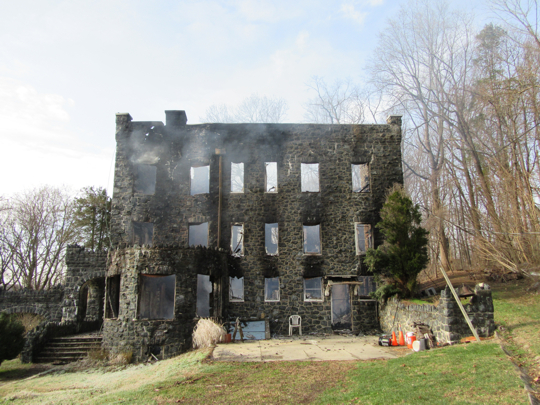
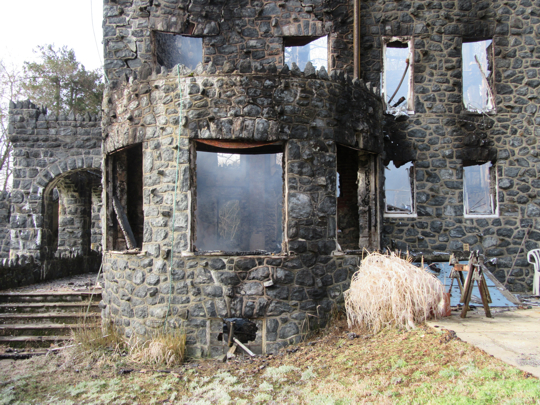
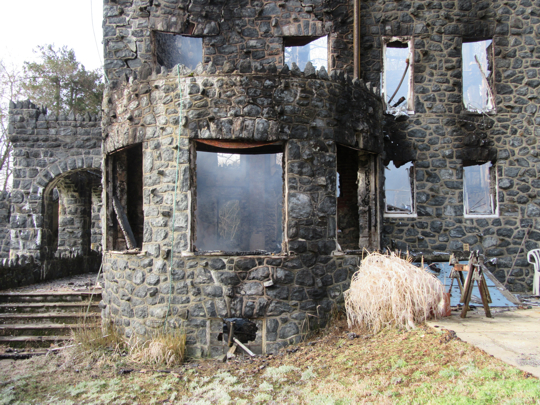
When a Delaware County woman got the news early on Tuesday, Jan. 12, that Rocky Hill Castle, her former home, had been gutted by fire, she was devastated.
“It’s just a terrible, terrible loss,” said Lois Saunders. “It was a unique, historic resource, a one-of-a-kind place; they don’t build them like that anymore.”
Saunders said when she met the man who would become her husband, Robert Saunders, he owned the property, and they got married there in 1989. Wedding photos showcased the couple in the grand, divided staircase that went from the first to the second floor of the elegant home’s three stories.
When Saunders’ husband died in 1997, she continued living in the palatial 12-bedroom residence with her stepdaughter, Nancy Saunders, and her son-in-law, Bill Hoffman. She moved out about 2007, she said, adding that her son-in-law and stepdaughter recently relocated to North Carolina and put the approximately 8,500-square-foot residence up for sale.
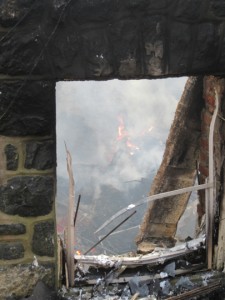
Castle fire burned throughout the night and continued into the next day
Lois Saunders said she understood that the 194-year-old home had once been a Victorian summer showplace for one of the du Ponts. “I used to envision carriages pulling up to the front porch. It must have been quite a spectacle,” she said.
Saunders said her husband bought the property long after it had been converted into a “castle.’’ According to the real-estate listing, that renovation occurred about 1912 and transformed the Victorian-style home into a stone chateau.
She said the home had already been dubbed “Rocky Hill Castle” when her husband bought it, and she surmised that the name probably came from the stone outcroppings on the property, which originally encompassed about 600 acres. Now it contains slightly fewer than five acres.
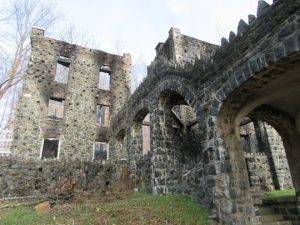
Arched entryway where horse drawn carriages once arrived speaks of another era
Chadds Ford Township Fire Marshal and Concordville Fire Company Chief Tom Nelling said the cause of the fire is as yet unknown and may never be determined because the damage was so severe.
Lois Saunders said no one was living in the home at the time of the fire. She said that her son-in-law has been gradually emptying out the home and that some possessions went up in smoke along with the interior of the home, which was mainly wood.
“It was really a unique place to live,” said Saunders. “It’s so sad to see it end like this … I hope they’re able to determine what the cause was.”
A 5-year-old Kennett Square boy who reportedly darted across the street to get to his bus stop, was struck by a car early Tuesday morning, Jan. 12, at 8:10 a.m., police said.
Police said the kindergartner, who is not being identified by police, was transported to Nemours/Alfred I. duPont Hospital for Children with injuries to his lower extremities that did not appear life-threatening.
Kennett Square Cpl. Rick Bell, the first officer on the scene, said his immediate priority was to get medical assistance for the boy, who was accompanied in the ambulance by his mother. “This appeared to be a tragic accident,” Bell said.
Bell said the investigation is continuing; however, witness accounts suggested that the 18-year-old driver of the Mini Cooper, who is also not being identified, did nothing wrong. Bell said the 18-year-old was headed south in the 200 block of South Union Street when the boy, a student at the Mary D. Lang Kindergarten Center, ran out from in between parked cars into the street.
The school bus, which was traveling northbound on South Union, was visible down the block but had not yet activated its lights. “We think the boy saw his bus, got excited, and ran across the street to get to the stop,” Bell said.
Bell said that there was no indication the teen was traveling above the speed limit, and he said that charges are unlikely.
He added that he hoped the accident would remind parents to stress to their children the importance of watching out for traffic. “This is a prime example of what can happen,” Bell said.
Rich Schwartzman has been reporting on events in the greater Chadds Ford area since September 2001 when he became the founding editor of The Chadds Ford Post. In April 2009 he became managing editor of ChaddsFordLive. He is also an award-winning photographer.
An overnight blaze destroyed the almost 200-year-old home “Rocky Hill Castle” at 119 Bullock Road in Chadds Ford.
An investigation into the blaze is continuing, but according to Township Fire Marshal and Concordville Fire Company Chief Tom Nelling, the cause of the fire is as yet unknown and may never be determined.
“The third floor is in the basement,” he said, adding that investigators might not even be able to get into the structure because the damage was so great. The house is unstable and will have to be torn down, he said.
Nelling said Concordville got the call about 1:23 a.m., but he has no idea how long the fire may have been going before the call came in. Nearly a dozen fire companies eventually responded to the fire, Nelling said.
No one was injured and no one was living in the house.
The house was for sale
Neighbors said they heard nothing overnight and were unaware of anything happening.
According to the real estate website Zillow.com, the home was built in 1821 and sits on 4.99 acres. The parents of the current owners bought the property in 1957.
Originally, the property included 600 acres. Major renovations occurred in 1912, which turned the Victorian home into a “stone castle” with 12 bedrooms and 3.5 bathrooms.
The home is currently up for sale with an asking price of $674,000, according to Zillow.
Rich Schwartzman has been reporting on events in the greater Chadds Ford area since September 2001 when he became the founding editor of The Chadds Ford Post. In April 2009 he became managing editor of ChaddsFordLive. He is also an award-winning photographer.
No specific proposals were made, but the Unionville-Chadds Ford School District administration will look at possibly cutting or changing some programs so that next year’s budget can be enacted without the need to go to a referendum for tax increases.
As discussed during the Jan. 11 school board work session, the proposed preliminary budget calls for tax increases beyond the Act I limit. The state-mandated limit for the upcoming year is a 2.4 percent increase, but the proposed preliminary budget has taxes increasing by 3.71 percent in Chester County and 3.92 percent for residents in Chadds Ford Township in Delaware County.
The Chester County millage rate is expected to increase from 26.99 mills to 27.99. Delaware County residents can expect an increase from 22.92 mills to 23.82 mills. (A mill is a tax of $1 for every $1,000 of assessed property value.)
State law prevents a school district from raising taxes beyond the Act I limit without a referendum. School Board President Vic Dupuis said the board wants to “take referendum off the table.”
One way to avoid a referendum is to ask for exceptions, a real-dollar amount based on money used for special education and for the state education retirement system.
The budget still shows exceptions, but the administration is also looking at the possibility of program cuts. Superintendent John Sanville said the administration would look at that during the next months of the budget process and make recommendations on possible program changes. School board directors would then vote on whether or not to accept those recommendations.
Jeff Hellrung, the board vice president, said the district needs to reduce spending by about $1 million to stay within the Act I limits.
Dupuis said the board would look at “program and taxing choices.”
The proposed preliminary budget reflects $82.5 million in anticipated revenue — $69.3 million from local sources. With fund balances and exceptions factored in along with state and federal monies, the revenue total would be $90.2 million. Expenses are anticipated to be $83.6 million.
Of the anticipated spending, $47 million is earmarked for instruction, $25.9 million for support, $1.6 million for non-instructional services and $8.9 for “other.”
The timetable for deciding on the 2016-2017 school year budget has the board voting on the proposed preliminary budget in two weeks, during the Jan. 25 regular meeting to be held at C.F. Patton Middle School, with public hearings scheduled for May 2, 3 and 4.
Any modifications would be made on or before May 6. Approval on the proposed final budget is scheduled for May 16, five weeks before the final vote on June 20.
Rich Schwartzman has been reporting on events in the greater Chadds Ford area since September 2001 when he became the founding editor of The Chadds Ford Post. In April 2009 he became managing editor of ChaddsFordLive. He is also an award-winning photographer.
Chester County’s agricultural and equine heritage has helped make it what it is today – one of the most desirable places to live in the commonwealth and the nation. If not for the equine agriculture, horse farms, and horse lovers, there is no question that the area’s rolling hills, lush open spaces and unfettered horizons would look a lot different.
While the horse community continues to be a driving force for environmental protection and preservation, the industry also serves as an economic engine. In fact, there are considerably more horses than homes in Newlin Township. By my rough estimates, the nearly 1,000 horses in Newlin generate more than an estimated $18 million dollars in revenue – revenue that comes without a smokestack, strip mall or office building. It is a unique situation and one that did not happen by accident.
So, why then do the Newlin Township supervisors continue to stand by a doomed ordinance that would jeopardize the horse industry’s continued growth and success here? Why did they enact the ordinance over the protests of more than 100 local residents (there are only 800 registered voters in the township to begin with) and without input from any equine experts? And why haven’t they changed course after the Pennsylvania Attorney General said the ordinance violates state law?
When Newlin Township enacted an ordinance restricting horse-farming activities and limiting the number of horses permitted per acre, we asked the Attorney General to review it under Act 38 of 2005, the Agriculture, Communities and Rural Environment Act (ACRE). ACRE is designed to protect normal agricultural operations from unauthorized local regulation. Under the law, the Attorney General can review local ordinances for compliance and bring legal action against a local government to invalidate those that don’t comply.
Predictably, the Attorney General’s office shot down the ordinance. Senior Deputy Attorney General Susan Bucknum took more than a year to thoroughly examine the ordinance before issuing a comprehensive decision that it is not only inconsistent with ACRE, but it also makes little sense to begin with. Like many townships that challenge farming through unlawful ordinances, Newlin and its attorneys were either misguided, misinformed, or both.
In Newlin, it did not have to come to this. Dozens of township residents, including skilled equine experts, several U.S. Olympic Gold Medalists, and internationally respected attorneys, offered to help work on a solution and reach a consensus. Instead, the supervisors ignored their pleas and brought in outside attorneys who, though skilled, had no knowledge of horse agriculture and how it works.
Today, it still doesn’t have to come to this. The Attorney General’s office has a policy of working with townships to negotiate changes on unauthorized or invalid ordinances. The vast majorities of the time, municipalities revoke them or work with the Attorney General to resolve the legal problems in question. If the township does neither, it risks being sued by the state! Haven’t enough tax dollars been wasted already?
The supervisors must come to their senses and pull the ordinance. Yet, incredibly they refuse to budge on the issue. Hopefully, they will finally listen to the Attorney General’s office and their constituents. However, I fear that their continued stubbornness will only lead to more wasted time and money.
When a community does not use its resources wisely, the entire area suffers. When local leaders are oblivious to constituents’ interests, government does not work. The supervisors are entrusted with the future of Newlin. Keeping the land as rural, as natural, and as undeveloped as it is now requires doing everything possible to promote and assist horse agricultural operations. It’s a no-brainer. It is high time for the supervisors to abandon the ordinance and, pardon the pun, stop beating a dead horse.
On the heels of a year punctuated by turnover and turmoil for the Kennett Public Library Board of Trustees, its first meeting of 2016 on Tuesday, Jan. 19, could represent a turning point.
The Board of Trustees of the Kennett Public Library, which still bears its former name on the building, is poised to elect new officers.
Board members, half of whom are new within the past year, are scheduled to vote on a slate of officers for the board’s Executive Committee. Susan Mackey-Kallis, the outgoing board president, had previously announced that she would step down from her executive post to pursue a Fulbright Association award that would require her to be in Japan for six months.
Since then, Mackey-Kallis, a Pennsbury Township resident, said she would remove herself entirely from the board during her stay abroad, a decision that prompted Pennsbury Township to appoint her replacement, Betsy Del Vecchio, at its reorganization meeting on Monday, Jan. 5.
Mackey-Kallis said that she would preside over the first part of Tuesday’s meeting, the election of officers. Mackey-Kallis said that she would not vote on officers unless the ballots of the other 12 board members resulted in a tie.
“Once a slate of officers has been approved, I will step down as president and turn over the running of the remainder of the meeting (which will be the bulk of the meeting) to the new president,” Mackey-Kallis said in an email. “I will step off of the board at the conclusion of the meeting. I am hopeful that Betsy Del Vecchio can attend the January meeting as an observer and be introduced to the new board as my replacement, effective at the conclusion of the January meeting.”
Although Doug Thompson, who heads the Board Development Committee, which is responsible for presenting a slate of officers to the board, had promised at the trustees’ December meeting to distribute a list of candidates before the end of the year, that did not happen. In the email, Mackey-Kallis said she could only speculate that the delay was caused by the influx of new board members who needed to be considered for executive positions.
Mackey-Kallis said that although she has no information on who would be selected, she expressed great confidence in the Board Development Committee’s fact-finding and leadership and said she would “fully support whatever slate of officers they present to the full board.” However, she noted that because she would be “absent for most of the upcoming year,” she did not feel it would be appropriate for her to cast a ballot unless needed to break a tie.
During the past year, the board’s leadership has come under fire from the public as well as through a feasibility report the board commissioned in preparation for the capital campaign needed to build a new library. A number of residents registered outrage when the board changed the library’s name from Bayard Taylor Memorial to Kennett Public and continued a plan set in motion by previous boards to expand by moving outside the Borough of Kennett Square.
The board has since changed course on the relocation and is pursuing a proposal to acquire the Weinstein property at the intersection of East State and South Willow Streets, as well as nearby parking, from the borough. An agreement of sale could be ready for approval at the Tuesday meeting.
The report by MacIntyre Associates, which was presented to the board in September, suggested that potential donors for a capital campaign – a project on the drawing board for more than a decade – diminished during years of board turnover and rancor. The recommendations to rebuild public trust included the resignations of Mackey-Kallis and Vice-President Geoff Birkett, who stepped down in July.
Criticizing the library board’s lack of accountability and “closed-shop” persona, respondents referenced in the MacIntyre report also urged the library to change the way it selects its board from the municipalities it serves: the Borough of Kennett Square and East Marlborough, Kennett, Newlin, New Garden, Pennsbury, Pocopson, and West Marlborough townships. Acting on those findings, the board revised its by-laws, a move that led to several of the new board appointments. It also vowed to post updated material online, a pledge that has yet to materialize.
When told that minutes and financial information had not been updated for six months, Mackey-Kallis said that Library Director Donna Murray cited glitches with the library’s new website. Mackey-Kallis said the third-quarter financial overview and minutes for meetings dating back to May would be posted soon.
The public is invited to attend the next board meeting, which will be held at 7 p.m. on Tuesday, Jan. 19, at the library, which is located at 216 E. State St., Kennett Square. Among the other expected agenda items are votes on the 2016 budget and the contract for the architect chosen for the new building project.