
June 26, 2013

Op/Ed: Transportation funding is crucial to Pennsylvania economy

Few assets are as clearly regional as transportation. Our roads and transit lines are the very foundation of our region, allowing people and goods to move safely and reliably from home to work to marketplace. So it’s not surprising that it would be one of the key areas of interest and agreement of the regionally-focused Metropolitan Caucus, a convening body of County officials from the five counties in Southeastern Pennsylvania that works to build consensus around regional objectives, achieve shared priorities, and promote regional prosperity.

While infrastructure upgrade and repair needs exist statewide, the caucus would like to highlight the needs in Southeastern Pennsylvania not only because of the importance to our region, but because of the importance of our transportation infrastructure to the entire Commonwealth.

Southeastern Pennsylvania is the geographic anchor of Pennsylvania’s economy. Situated on less than 5 percent of the state’s land area, the City of Philadelphia and Bucks, Chester, Delaware, and Montgomery counties are home to 31 percent of the state’s residents and account for 40 percent of total annual economic activity in Pennsylvania.

Communities across the commonwealth depend upon the economic wellbeing of southeastern Pennsylvania. By value, approximately 34 percent of all domestic freight in the Commonwealth originates or arrives in southeastern Pennsylvania. The region’s airports handle nearly 83 percent of the Commonwealth’s domestic airfreight by value, while ports in southeastern Pennsylvania accommodate 94 percent of domestic port shipments in the Commonwealth, by value. Freight-related industries in the five-county region provide more than 320,000 jobs.

More than 26 billion miles are traveled on southeastern Pennsylvania’s roads annually, accounting for nearly one-quarter of all miles traveled statewide each year.  And those roads are less congested because 77 percent of all transit rides in the state are taken on SEPTA – providing essential transportation service to residents making over 333 million trips to and from work, school, appointments, shopping or entertainment.

For all of those reasons and more, the members of the Caucus were glad to see Governor Corbett establish transportation as an early priority of his administration and commend him and his Transportation Funding Advisory Commission for their work on this issue.  The Commission met the formidable challenge of identifying revenue sources to begin closing the funding gap that jeopardizes the safety of our roads, transit systems, and bridges.

We applaud the Senate for passing Senator Rafferty’s bill to increase funding and urge the House to pass legislation this session to adequately fund transportation, using the revenue sources identified by the Governor’s Commission as a guide.

As the Transportation Funding Advisory Commission stated in its report, “The importance of our transportation system to the state’s economy cannot be overstated. Our transportation system facilitates the movement of workers to jobs, students to schools, consumers to stores, and products to their next stop in the global supply chain. As our economy becomes more integrated into the global economy, Pennsylvania requires an efficient and effective transportation system.”

Our region’s ability to provide reliable, effective, and efficient transportation options will determine our ability to remain competitive – and to ensure economic opportunity for the residents of each of our counties. We’ve waited long enough – it is time to take action and provide the funding needed to ensure that Chester County and all of Pennsylvania have a transportation system worthy of this great commonwealth.

Ryan Costello, Chair, Chester County Commissioners
Robert Loughery, Chair, Bucks County Commissioners
Joshua Shapiro, Chair, Montgomery County Commissioners
John McBlain, Delaware County Council
Michael A. Nutter, Mayor, City of Philadelphia

Members of the Metropolitan Caucus include the Mayor of Philadelphia, county commissioners from Bucks, Chester, and Montgomery counties, and county council members of Delaware County. The Caucus is staffed by the Economy League of Greater Philadelphia.

About CFLive Staff

See Contributors Page https://chaddsfordlive.com/writers/

Op/Ed: Transportation funding is crucial to Pennsylvania economy Read More »
One island, two artists and many spirits

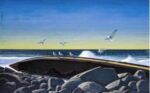
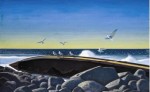
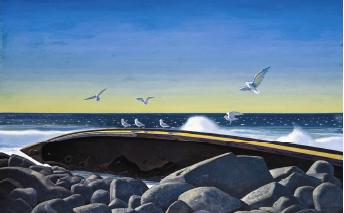
Wreck of the D.T. Sheridan By Rockwell Kent

Storms and shipwrecks contrast with tranquil horizons in the portrayal of island life at the current exhibit at the Brandywine River Museum. Amanda C. Burdan, curator for the Jamie Wyeth, Rockwell Kent and Monhegan exhibit,  guided visitors through artwork whose creation spanned a century.

Describing the process of selecting work to display for this exhibit, Burdan said there were many spirits. The spirits of the lost souls of the D. T. Sheridan shipwreck, the spirits of two artist who never met yet are somehow connected and the spirit of artistic legacy all  haunt the gallery.

The current exhibit is an expansion of the exhibit which opened at the Farnsworth Art Museum in Rockland, Maine in 2012.  In that exhibit, the work of artist Jamie Wyeth was on one side and the work of Rockwell Kent was on the other. For studying the artists, that presentation worked.

Burdan wanted to convey the island, Monhegan, itself.  For this she had the gallery opened up by removing walls because you need space to see the sea. She learned from the writings of the great seascape painter Winslow Homer that a painting changes when viewed from different distances.

Wreck of the D.T. Sheridan By Rockwell Kent
Wreck of the D.T. SheridanBy Rockwell Kent

The exhibit begins two artists’ painting of the wreck of the D. T. Sheridan. Kent’s painting has clean lines of the remains of the tugboat and rocky shore. Precisely painted birds survey the wreckage flying over a calm sea which belies its part of the calamity.


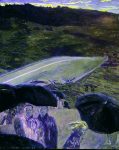
Shipwreck, first in a suite of untoward occurrences on Monhegan Island By Jamie Wyeth


Wyeth’s painting more than 60 years later shows a more weathered hull. In the foreground are spirits hovering around their lost ship. One of the spirits has florescent waving hair echoing the florescent cloud wisps on the far horizon. This exhibit is the first showing of Wyeth’s Shipwreck first in a suite of untoward occurrences on Monhegan Island.

Portrait of Rockwell Kent, second in a series of untoward occurrences on Monhegan Island By Jamie Wyeth
Portrait of Rockwell Kent, second in a series of untoward occurrences on Monhegan IslandBy Jamie Wyeth


Next to Wyeth’s Shipwreck is Portrait of Rockwell Kent, second in a series of untoward occurrences on Monhegan Island. The portrait shows artist and palette with a dark figure plummeting from the cliff in the background. The figure is thought to represent Kent’s former model who died while staying at Kent House.


The third of the series is being painted now.

More spirits appear in Wyeth’s two works created after his father’s death. In Recurring Dream two figures are standing on boulders looking out to sea.  Both are dressed in fisherman rain gear. They are said to be N. C. and Andrew Wyeth. In Sea Watchers, the elder Wyeths are joined by Andy Warhol and Winslow Homer. All look to the sea.

Although most of the exhibit is land and sea scapes, patriotism of the local people is shown by each artist in his own way. In Islanders Wyeth shows unassuming folks sitting on a porch with a flag draped over almost half of the house. In Memorial Day Kent shows islanders laying lilacs on graves in Monhegan Island cemetery.

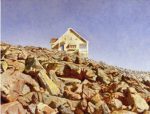
Kent House By Jamie Wyeth
Kent HouseBy Jamie Wyeth


Many of the paintings of the exhibit, both Kent’s and Wyeth’s are on loan from the personal collection of Jamie and Phyllis Wyeth. Not only has Wyeth collected Kent’s paintings, he purchased Kent’s house.  Kent House is the subject of one of the Wyeth’s island paintings.


For those interested in learning more about the exhibit, the curator will be giving two more talks.

Burdan will be giving a talk entitled, “Rockwell Kent: Notes on Roofing” on July 24 at 2 p.m. In this lecture, the curator will explore how Kent’s broader experiences on Monhegan—he worked as a lobsterman, architect and builder—may have influenced his paintings.

Unlike many artists who come to the island, Wyeth paints with his “back to the see,” concentrating his attention on the people and man-made landmarks rather than the epic seascapes. Burdan will focus on Wyeth’s choice of subject matter on Monhegan on August 21 at 2 p.m.

The exhibit continues through November 17. Catalogs of the exhibit are available in the Museum gift shop. The museum will be giving detailed presentations about each artist.

For hours and upcoming programs go to http://www.brandywinemuseum.org.

About Emily Myers

Emily Myers has lived and worked in Chadds Ford for over thirty five years.  She founded the parent company of Chadds Ford Live, Decision Design Research, Inc., in 1982.  ChaddsFordLive.com represents the confluence of Myers' long time, deep involvement in technology and community. Myers was a founding member of the Chadds Ford Business Association and currently serves on its board of directors.  Her hobbies include bridge, golf, photography and Tai Chi. She lives with her husband, Jim Lebedda, in Chadds Ford Township.

One island, two artists and many spirits Read More »

Conservancy receives grant from DuPont Clear into the Future


The Brandywine Conservancy has received a $10,000 grant from DuPont Clear into the Future to preserve and improve the water quality of the Brandywine at its source in Honey Brook Township, Chester County. The funds will help the conservancy to continue its work to protect farms in the headwaters of the Brandywine and help farmers and other landowners implement best management practices on their properties. The conservancy has worked for more than 45 years to restore and protect the Brandywine Watershed, which is the source of drinking water for more than 500,000 people in communities in Pennsylvania and Delaware.

“By focusing at the top of the watershed at its source in Honey Brook Township, the conservancy can help reduce sediments and pollutants in the water for all users living downstream,” said Sherri Evans-Stanton, director of the conservancy’s Environmental Management Center. “These funds will enable us to continue to help farmers stabilize stream banks, install stream bank fencing to prevent cattle from entering the water, and eliminate some sources of erosion and pollutants to reduce their impacts on water quality.”

Helping farmers with BMPs is one element of the conservancy’s Source Water Protection Program for the Brandywine. Once implemented, conservancy staff assist farmers in placing agricultural easements on their farms to permanently protect the farms. The conservancy has also embarked on a five-year initiative to plant 25,000 trees by the end of 2014. Already in its fourth year, the Conservancy is on pace to exceed that goal, with 6,000 trees planted in 2013 alone.

In a unique bi-state partnership, the conservancy worked with the City of Wilmington on its recent Source Water Protection Plan. This plan was created by city officials who understand that the cost of keeping pollutants out of the Brandywine at its source is dramatically less than the cost of cleaning the water in a treatment plant when it reaches Wilmington. The conservancy’s work funded under this Clear into the Future grant are listed as priority recommendations in the City of Wilmington’s Plan.

For more than 45 years the conservancy’s unique approach to watershed management has established models and provided technical assistance to municipalities while also providing direct land preservation assistance to private landowners to balance water quality and watershed hydrology in this developing watershed. The conservancy’s programs have crossed municipal and state lines and have involved municipal officials, government organizations and private landowners.

The Brandywine Conservancy holds more than 440 conservation easements and has directly protected and facilitated the permanent preservation of over 58,000 acres in Chester and Delaware counties in Pennsylvania, as well as New Castle County in Delaware. The Environmental Management Center provides conservation services to landowners, farmers, municipalities and developers. The staff of professional planners and natural resource managers offers technical assistance and expertise for conservation and comprehensive land use planning. Conservation easements, assistance to local governments and water protection efforts are the key elements of these programs. In 2008, the conservancy was among the first land trusts in the country to be awarded accreditation by the Land Trust Accreditation Commission.

Conservancy receives grant from DuPont Clear into the Future Read More »

Scroll to Top