August 30, 2012

Living History: Celebrating Chadds Ford Days

Living History: Celebrating Chadds Ford Days

Local residents and visitors to the Brandywine Valley know it as the home of the famous Wyeth family of artists and picturesque countryside, but few know the history behind Chadds Ford Days, which has been celebrated here since Dwight Eisenhower was in the White House.

The area around the village of Chadds Ford was inhabited by the Lenni-Lenape Indians for centuries before European explorers arrived. The first settlers were Swedish who arrived in 1638 and discovered the Brandywine River, which became important to local farmers as a source of water and also rich soil along its banks. In 1707 “Ye Great Road to Nottingham” — now U.S. Route 1 — was laid out from Baltimore to Chester and more settlers began coming to the region. One of the early settlers was John Chads, who operated a ferry service across the Brandywine in the 1730s and ‘40s at a ford in the river. The spot came to be known as Chadds Ford, the extra letter added due to colloquial spelling of his name.

The American Revolution arrived in Chadds Ford on Sept. 11, 1777 when Gen. George Washington faced off against British forces led by Gen. William Howe in what would be the largest land battle in America up until the Civil War. Combat raged all around the village, with fighting occurring from west of the river all the way up to the north around the Birmingham Meeting House and Dilworthtown. Although Washington lost, he proved his ability to stand up against a powerful British force and survived to fight again.

Village historian Christian Sanderson lived for many years in the nearby Benjamin Ring house where Washington had his headquarters during the battle. Chris enjoyed talking with visitors about the Battle of the Brandywine and gave numerous lectures on the topic. He collected thousands of pieces of Americana detailing our rich heritage and in 1958 he, Virginia Peters Morgan and other locals began celebrating what was called “Chadds Ford Days” to commemorate the conflict. Chris dressed up as the “Town Crier,” leading them in a local parade.

The Chadds Ford Historical Society was begun in 1968 to preserve some local historic buildings around at the time of the battle, the John Chads House and later the Barns-Brinton House. Since then, the society has promoted Chadds Ford Days as a way to honor our local heritage and enjoy arts, crafts, food, fun and music around the first week of September.

Chadds Ford Days 2012 will be celebrated on Saturday, Sept. 8 and Sunday, Sept. 9 from 10 a.m. to 5 p.m. on the grounds of the Chadds Ford Historical Society at 1736 Creek Road in Chadds Ford. This year’s event will include live music from The Brandywine Creek Boys, The Skyline Band and others, along with a colonial tavern serving beer and wine, arts and crafts, colonial demonstrators, games and hay rides for kids, Civil War re-enactors, tours of the John Chads House and an antique car display. For more information, please contact the Chadds Ford Historical Society at 610-388-7376 or visit their website at www.chaddsfordhistory.org.

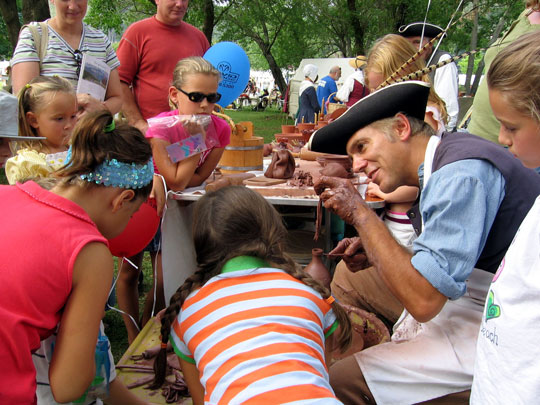
Photo caption: A demontrtation of 18th century pottery. (Courtesy image)

* Gene Pisasale conducts historical lectures series and is the author of four books, including historical novels of Chester County “Lafayette’s Gold- The Lost Brandywine Treasure” and “Abandoned Address- The Secret of Frick’s Lock”, along with the historical review “The Christian Sanderson Museum- Tom Thompson Remembers.” He can be reached at Gene@GenePisasale.com or by visiting his website at www.GenePisasale.com.

About Gene Pisasale

Gene Pisasale is an historian, author and lecturer based in Kennett Square, Pa. His eight books and historic lecture series focus on the history of the mid-Atlantic region. Gene’s latest book is Alexander Hamilton: Architect of the American Financial System, which delves into the life and many accomplishments of this important Founding Father who almost single-handedly transformed our nation from a bankrupt entity into the most successful country in the history of mankind. Gene’s books are available on www.Amazon.com. His website is www.GenePisasale.com; he can be reached at Gene@GenePisasale.com.

Living History: Celebrating Chadds Ford Days Read More »

Picturing Poe comes to BRM

Édouard Manet, Gustave Doré, Paul Gauguin, James Ensor, Aubrey Beardsley, Arthur Rackham, Harry Clarke, Barry Moser and Robert Motherwell are among the more than two dozen artists featured in Picturing Poe: Illustrations for Edgar Allan Poe’s Stories and Poems. From the seemingly straightforward to the abstract, each artist’s work reflects his or her own time and personal interpretation of Poe’s work. The exhibition is on view at the Brandywine River Museum from Sept. 8 through Nov. 15.

More than 150 years after his death, Edgar Allan Poe’s (1809-1849) macabre writings continue to appeal to a broad audience, and his troubled life and mysterious death have launched him into the pantheon of popular culture. His vivid writing and ability to suggest imagery in the mind of the reader have helped make him one of the most widely illustrated authors in the world.

Poe believed that illustrations should evoke or suggest rather than describe in detail, and he personally selected F.O.C. Darley, the greatest illustrator of the day, to illustrate his story, “The Gold-Bug.” Darley’s simple, uncluttered ink wash drawings appeared as woodcuts alongside Poe’s prizewinning tale in The Dollar Newspaper in 1843.

Poe’s popularity soared in France shortly after his death, especially with avant-garde French writers and artists who appreciated his emphasis on the psychologically dark, perverse and strange. Édouard Manet’s approach to The Raven was groundbreakingly modern in its style and departure from literal interpretation. As the narrator–in contemporary dress–flings open the shutters to admit the raven, we see a view of a modern city, a take on the story that is very different from the Victorian clutter and melodrama in Gustave Doré’s rendering of the same scene. Manet’s dramatic use of black opposing white, his bold simplification, vigorous handling of line, and lack of finish brought him critical praise and have been cited as an important turning point in book illustration. In particular, Manet’s final plate is remarkable for its starkness. It illustrates the last lines of Poe’s poem: “And the lamp-light o’er him streaming throws his shadow on the floor / And my soul from out that shadow that lies floating on the floor / Shall be lifted – Nevermore!” Manet’s removal of the narrator’s physical presence from the scene is unique. He opts instead to evoke the presence of the narrator’s soul–or spiritual self–now overcome by the looming shadow of the raven. Both of these illustrations are on view in the exhibition.

Some illustrators capture the theatricality in Poe’s stories of violence and revenge, including Arthur Rackham, whose interpretation of “The Tell-Tale Heart” is full of exaggerated, dramatic gestures and expressions. He incorporates an explicit view under the floorboards (not part of Poe’s text) that more or less summarizes the whole story with its inclusion of the bloody knife, dismembered corpse and focus on the victim’s “vulture eye”–the very cause of the heinous crime, according to the narrator/murderer.

Poe’s exploration of all aspects of the human psyche has appealed to modern artists through the present day, including those associated with the Symbolist movement, German Expressionism, Surrealism and Abstract Expressionism. Robert Motherwell created a series of Poe-inspired Abstract Expressionist collages and lithographs during the 1970s. One of the lithographs, entitled Poe’s Abyss, references Poe’s “Descent into the Maelstrom,” in which a fisherman describes his harrowing and horrifying fight for survival when caught in a ferocious ocean whirlpool. Motherwell uses bold brushstrokes and overlays of subtle color to suggest the darkness and swirling of the sea and its inherent chaos. Like Poe’s story, Motherwell’s lithograph symbolizes the descent into the turmoil of the subconscious, a theme resonant with Abstract Expressionists such as Motherwell, who saw Poe as one of the originators of modern art.

Picturing Poe: Illustrations for Edgar Allan Poe’s Stories and Poems consists of original paintings, drawings, prints and first-edition books, borrowed from public and private collection.  The exhibition is supported byThe Davenport Family Foundation Fund for Exhibitions.

Picturing Poe comes to BRM Read More »

Scroll to Top