
May 19, 2010

Mind Matters: Silence, sacred space, and a prayer for boredom

Every now and then, a friend enjoins me to go with her and
her meditation group to Holy Cross Abbey, a Trappist Monastery in Virginia to
spend a weekend there. When I mention this to people, they are sometimes taken
aback, perhaps considering sacrificial austerity and horsehair shirts. It is
not that.

But it is this: a place where silence is honored and
respected. And in the silence there can be relief. No droning TV’s, radios—not
even meal time chatter or loud carrying on in the halls of the guest house
where we stay. Just enough quiet to no longer be able to escape into busyness
and noisiness and away from the inner voices of your own inner longing.

The last time we travelled there, I drove through some heavy
D.C. traffic. Upon arrival, I fell onto the bed, breathing out the tension I
felt in my body after a long week of work and a stressful drive. After several
hours, I could feel myself slowly settling into the rhythm of the monks’
routine.

If you (and you are not required to) attend any prayer
services (3:30 a.m. is first of the day), you discover that the chanting and
the scriptural readings are not rushed. Even without attending any services,
the solitude and quiet is a palpable respite.

We live in such a world of noise—noise pollution is a fact.
(Light pollution and our lack of dark, yet brilliantly lit, starry skies is
also a problem—which I’ll not address here.) How can we hear our own still
voice within if we are being hammered incessantly by media news blitzes, “radio-crity”,
cell phones, iPods, electronic games ad infinitum.

I don’t espouse to be a Luddite. What is our vice can also
be our virtue. The media and our electronics, all have their place. What we do
need to recognize as part of our own stress reduction and healthy self-care is
that we need a time for silence.

Silence and solitude are not to be confused with loneliness
or isolation. We can feel isolated in a crowd, and feel quite connected to the
universe, when we experience silence and solitude. Ronald Rolheiser, theologian
and author reminds us, “Silence is a special language that is not in opposition
to words. Silence and words need each other. There are things we can only know
through silence, just as there are things we can only know through
conversation.”

In our hectic, busy lives, we all need to find time for some
silence. Of course, we can’t haul off to the mountain top or to the monastery
forever (if at all). So how do we find the sacred space for silence in the
everyday moments of our lives?

Some possibilities to consider:
• Taking an extra five minutes in the morning, perhaps sipping that coffee,
watching the birds?

• Taking a walk—sans iPod—around the neighborhood or at a
local garden (Longwood and Winterthur are my favorite haunts).

• Sitting somewhere—anywhere—just noticing your breath and
then noticing all the sounds around you.

• Sitting by some body of water—the Brandywine, perhaps?—and
then watch, wait, wonder.

• Take a moment of silence with the kids at dinner.

• Even stop lights are fair game for practicing silence.
Turn the radio off and become aware of your breath. Take a moment to slow
yourself down at that stoplight.

More on silence:
• The movie, Into Great Silence, Zeitgeist Films (available
from Amazon.com).

• Christopher Notes #524, Seeking Sacred Silence, http://www.christophers.org/Page.aspx?pid=1165.

* Kayta Curzie Gajdos holds a doctorate in
counseling psychology and is in private practice in Chadds Ford, Pennsylvania.
She welcomes comments at
MindMatters@DrGajdos.com
or (610)388-2888. Past columns are posted to
www.drgajdos.com.
About Kayta Gajdos

Dr. Kathleen Curzie Gajdos ("Kayta") is a licensed psychologist (Pennsylvania and Delaware) who has worked with individuals, couples, and families with a spectrum of problems. She has experience and training in the fields of alcohol and drug addictions, hypnosis, family therapy, Jungian theory, Gestalt therapy, EMDR, and bereavement. Dr. Gajdos developed a private practice in the Pittsburgh area, and was affiliated with the Family Therapy Institute of Western Psychiatric Institute and Clinic, having written numerous articles for the Family Therapy Newsletter there. She has published in the American Psychological Association Bulletin, the Family Psychologist, and in the Swedenborgian publications, Chrysalis and The Messenger. Dr. Gajdos has taught at the college level, most recently for West Chester University and Wilmington College, and has served as field faculty for Vermont College of Norwich University the Union Institute's Center for Distance Learning, Cincinnati, Ohio. She has also served as consulting psychologist to the Irene Stacy Community MH/MR Center in Western Pennsylvania where she supervised psychologists in training. Currently active in disaster relief, Dr. Gajdos serves with the American Red Cross and participated in Hurricane Katrina relief efforts as a member of teams from the Department of Health and Human Services' Substance Abuse and Mental Health Services Administration.Now living in Chadds Ford, in the Brandywine Valley of eastern Pennsylvania, Dr. Gajdos combines her private practice working with individuals, couples and families, with leading workshops on such topics as grief and healing, the impact of multigenerational grief and trauma shame, the shadow and self, Women Who Run with the Wolves, motherless daughters, and mediation and relaxation. Each year at Temenos Retreat Center in West Chester, PA she leads a griefs of birthing ritual for those who have suffered losses of procreation (abortions, miscarriages, infertility, etc.); she also holds yearly A Day of Re-Collection at Temenos.Dr. Gajdos holds Master's degrees in both philosophy and clinical psychology and received her Ph.D. in counseling at the University of Pittsburgh. Among her professional affiliations, she includes having been a founding member and board member of the C.G. Jung Educational Center of Pittsburgh, as well as being listed in Who's Who of American Women. Currently, she is a member of the American Psychological Association, The Pennsylvania Psychological Association, the Delaware Psychological Association, the American Family Therapy Academy, The Association for Death Education and Counseling, and the Delaware County Mental Health and Mental Retardation Board. Woven into her professional career are Dr. Gajdos' pursuits of dancing, singing, and writing poetry.

Mind Matters: Silence, sacred space, and a prayer for boredom Read More »
Blogging Along the Brandywine:An Eagle Flies in Calistoga

Blogging Along the Brandywine:An Eagle Flies in Calistoga

As some of you know, I flew out to a wedding in California’s
Napa Valley two weeks ago expecting the new…and finding an old friend.

We saw the Giant Coastal Redwoods in the Muir Woods National
Monument north of San Francisco; rode the historic San Francisco Cable Cars;
saw toppled redwood trees petrified into solid rock when covered by volcanic
ash over four million years ago; and watched one of only three “old faithful”
geysers in the world in Calistoga.

Then there was the California sticker shock. An ordinary
salad bar in the CalMart sold for almost $8 a pound, with not an ounce of
lobster, caviar, or pâté to be found. In addition a gallon of regular gasoline
was going for an average of $3.17 a gallon.

The tiny touristy town of Calistoga where we stayed in the
northern-most reaches of the Napa Valley was a combination of California funk
and Wild West quaint.

And what’s with that name…Calistoga?

In 1846, Sammuel Brannan purchased 2,000 acres of land with
the intention of creating spas to rival those of Saratoga Springs in New York.
Brannon was slated to boast in a speech, “This town will be the Saratoga of
California.” But somehow his pomp or perhaps the early Napa Valley wines got
the best of him, and it came out, “This town will be the Calistoga of
Sarifornia.” Ooops!

The name “Calistoga” stuck, and today on its one main
street, is the aptly named Café Sarifornia.

But we also found a nice surprise in Calistoga that made us
feel right at home.

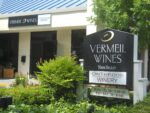
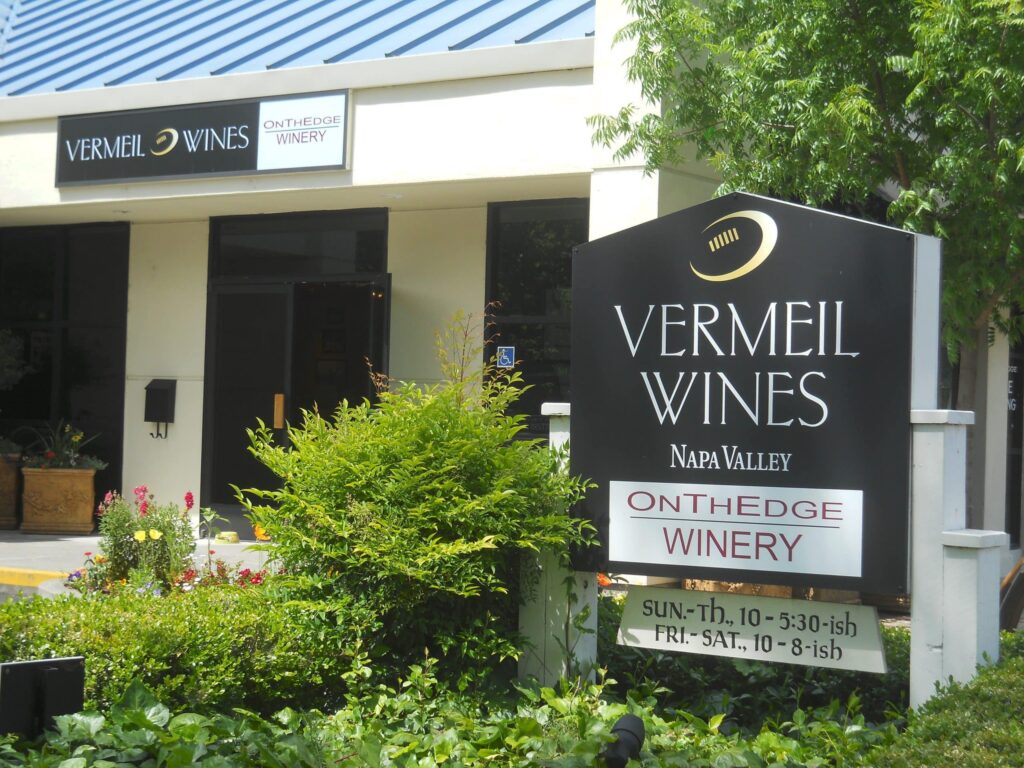
Perched precariously on the edge of the Napa River (less
than half the width of the Brandywine as it flows through Calistoga) sat the
Vermeil Winery with their appropriately named OnThEdge label. Its sign was
classic laid-back California, listing hours as “10:00-5:30-ish”

The walls of the reception room were adorned with framed
football posters and photos featuring Dick Vermeil former head coach of the
Philadelphia Eagles.

So what’s a hometown Philadelphia boy doing making wine in
the Napa Valley of northern California?

The surprising answer: Dick Vermeil was born in his great
grandfather’s home in Calistoga, Calif.

After successful coaching stints with Stanford, the Los
Angeles Rams and UCLA, Vermeil was hired to take over as head coach of the Philadelphia Eagles in
1976, a career that was highlighted by an NFC Championship in 1980 and a trip
to Super Bowl XV.

Returning to the L.A. Rams and leading them to their first
Super Bowl victory in 1999, Vermeil then teamed with winemaker Paul Smith of
OnThEdge Wines with over 30 years of experience in the wine field, including 17
years with Robert Mondavi.

The foundation for the majority of their best wines is the
Frediani Vineyards where the warm Calistoga days and cool foggy nights combine
to produce fruit rich in color and flavor density.

Winemaker Smith is married to the ultra vivacious Mary Sue
Frediani-Smith, tasting room manager and co-owner of the Frediani vineyards,
who greeted us that day and led us through the museum-like display of family
photos and history.

A current price list shows the Jean Louis Vermeil Cabernet
Sauvignon, named for both of Vermeil’s great grandfathers, selling at $85 a
bottle.

So what did I miss in California? The lush green hills of
Pennsylvania…and Dick Vermeil leading the Eagles again.

About Sally Denk Hoey

Sally Denk Hoey, is a Gemini - one part music and one part history. She holds a masters degree cum laude from the School of Music at West Chester University. She taught 14 years in both public and private school. Her CD "Bard of the Brandywine" was critically received during her almost 30 years as a folk singer. She currently cantors masses at St Agnes Church in West Chester where she also performs with the select Motet Choir. A recognized historian, Sally serves as a judge-captain for the south-east Pennsylvania regionals of the National History Day Competition. She has served as president of the Brandywine Battlefield Park Associates as well as the Sanderson Museum in Chadds Ford where she now curates the violin collection. Sally re-enacted with the 43rd Regiment of Foot and the 2nd Pennsylvania Regiment for 19 years where she interpreted the role of a campfollower at encampments in Valley Forge, Williamsburg, Va., Monmouth, N.J. and Lexington and Concord, Mass. Sally is married to her college classmate, Thomas Hoey, otherwise known as "Mr. Sousa.”

Blogging Along the Brandywine:An Eagle Flies in Calistoga Read More »

Police log for May 20

Police log for May 20

Pennsylvania State Police from Troop J, Avondale, reported
an attempted kidnapping of a 7-year-old-girl from the Willowdale Steeplechase
on Sunday, May 9. Police said the girl went to get ice cream with her brother
and another male friend when a white male, described as 50-75 years old, 6 feet
1 inch tall, 160-180 pounds with no facial hair and wearing a red cap and
yellow coat, grabbed the girl by her wrist. The suspect ordered the girl to come with him, the report
said, but was frightened by the reaction of the brother and friend. Anyone with
information is asked to call Troop J at 610-268-2022.

• Someone broke into a Chevrolet Blazer parked at the
Holiday Inn Express in Concord Township and stole two gym bags containing
$1,800 worth of auto racing equipment and clothing, a police report said. The
incident happened sometime between 8 and 8:30 p.m. on May 14.

• State police said an unidentified white male attempted
stealing a pack of beef jerky from the Wawa at Route 202 and Dilworthtown Road
by stuffing the meat into his pants. He discarded the jerky and fled and the
store when confronted by employees. The incident happened shortly before 1 p.m.
on May 14.

About CFLive Staff

See Contributors Page https://chaddsfordlive.com/writers/

Police log for May 20 Read More »

Was it anti DC? Will it last?

Some of the results from Tuesday’s primary elections raise
one basic question. Do they really stem from an anti D.C. or anti-incumbent
sentiment?

Two races, one in Pennsylvania and the other in Kentucky, point
to the answer being yes.

U.S. Sen. Arlen Specter is now a lame duck. Current U.S.
Rep. Joe Sestak sank Mr. Specter’s bid for a sixth term in office with an upset
win to earn the Democratic Party nomination for the senate seat in November’s
general election.

Was it a victory for anti incumbency? After all, both men
are current office holders. However, Mr. Specter has been treading the halls of
the U.S. Senate for 30 years, while Mr. Sestak has been a congressman for less
than four years. It’s obvious which one is more of a Washington insider.

But the Democratic Party, including President Barack Obama,
Vice President Joe Biden and Pennsylvania Gov. Ed Rendell supported and
endorsed the Specter campaign and their results failed.

Many Democrats didn’t, and still don’t, trust Mr. Specter.
After all, he spent most of his political career as a Republican and only
switched to the Democratic side of the aisle last year. He did that to avoid
getting into a primary race against Pat Toomey who, all knew, would beat him in
a Republican primary.

Writing for truthdig.com,Robert Scheer called the soon to be ex senator a “windbag
chameleon.”

The race for the Republican Party nomination for U.S. senate in
Kentucky was equally revealing. Ophthalmologist Rand Paul beat out the state
GOP endorsed Trey Greyson, the Kentucky secretary of state.Dr. Paul ran on issues of fiscal responsibility and constitutionally
limited government.

Mr. Scheer also addressed the Paul campaign in the same truthdig.com
column:

“Rand Paul, like his dad (U.S. Rep. Ron Paul, R, Texas,) is worthy of
praise for standing in opposition to the Wall Street bailout, which will come
to be marked as the greatest swindle in U.S. history and which was, as he noted
on his website, an unconstitutional redistribution of income in favor of the
undeserving rich.”

And Mr. Scheer calls himself ‘one lefty liberal” who’s not afraid of
the Paul victory.

Yet, the question remains. What does this all mean for November?

Right now, nothing. The anti Washington, anti incumbent sentiment may
or may not last. Such things rarely do, even when they should.

Remember the Republican Party contract with America in the mid 1990s.
They took control of the house and senate in the 1994 midterm election and
forced a balanced budget out of President Bill Clinton, but they soon became
the in party and helped George Bush multiply the debt several times over once
he took office.

So, it’s too soon to tell whether there will
be any major effect in November, but we can comfortably say there will be no
trickle down effect to the more local races. State reps Stephen Barrar and
Chris Ross will win reelection easily. The Republican machine will have its way
in those races regardless of other sentiment.

About CFLive Staff

See Contributors Page https://chaddsfordlive.com/writers/

Was it anti DC? Will it last? Read More »

The Garden Path: No room for a vegetable garden? Yes there is.

The Garden Path: No room for a vegetable garden? Yes there is.

We are lucky to have an abundance of farmers markets and
other sources for local produce in our area, but it can be a lot of fun to grow
your own vegetables and it can make good economic sense as well. Here are two
novel ways to bring vegetable gardening into your life.

Edibles in the landscape
If you went to the Philadelphia Flower Show, you may have noticed that many of
the exhibits included vegetables planted right in amongst the flowers. Some
vegetables are downright pretty, so why not use them as ornamentals instead of
banishing them to a regimented rectangular plot in the backyard?

When vacationing in the French Alps, I was surprised to
see Swiss chard used routinely as decorative foliage in municipal planters
along the streets. Oddly enough, the cuisine in that area, while delicious,
centers almost entirely on potatoes, smoked meats, mushrooms, and cheese. After
about five days of this unvarying diet, I wanted to yank the chard right out by
its roots and scream “don’t you people know you can EAT this?” But then I
realized no one spoke English and there’s no telling what they might think I
was saying, so I just stayed quiet and helped myself to another spoonful of the
tartiflette.

Herbs are a natural in the flower garden. Not only are
many ornamental, but the smell and taste that make them appealing to us often
steer deer away, so they can actually act as a deer repellent. There are many
appealing shapes and textures among the herbs, from the soft and silvery sages
to the airy and butterfly-attracting dills and fennels.

Here are just a few vegetables and herbs to consider
including in your flower garden: lettuces (many shades of green, red, and
purple are available), Swiss chard, dill, fennel (bronze fennel is particularly
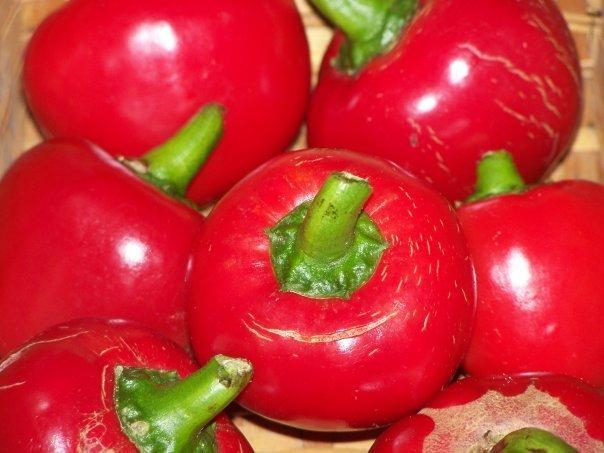
attractive), cherry tomatoes, peppers (there are a number of ornamental
varieties), berries, basil (particularly purple basil), sage, eggplant, fruit-producing
shrubs and trees, and asparagus (for its fern-like foliage). There are even
some edible flowers, such as nasturtiums.

For more information on edibles in the landscape, go to:
http://ohioline.osu.edu/hyg-fact/1000/1255.html.

A few words of caution: if you are going to eat plants
from your garden, be very cautious with pesticides (or avoid them altogether).
And obviously, be careful what you are picking. Some garden plants, such as
foxglove and monk’s hood, are highly poisonous.

Vegetables in Containers
This approach is perfect for those with limited space but also makes sense for
singles and small families that want to avoid the “what else can we do with all
this zucchini” problem. Vegetables that perform well in pots include tomatoes,
peppers, eggplant, and cucumbers. Herbs and lettuces, radishes, and greens such
as Swiss chard and kale also work very well. Root vegetables such as carrots,
turnips, and beets are not as well suited for containers, but nearly any
vegetable can be grown in a container with some effort.

Start with a large container. For a tomato plant, you’ll
need at least a 20” diameter pot; for single pepper, eggplant, or cucumber
plants, 14” may be large enough. The container should have plenty of drainage
holes and be deep enough for the large root systems. Use good quality potting
media designed for large containers (they will contain coarse material such as
bark or coir), or make your own. Texas A & M recommends mixing
horticultural grade vermiculite, peat moss, limestone, superphosphate, and
garden fertilizer. To one bushel each of vermiculite and peat moss, add ten
tablespoons of limestone, five tablespoons of 0-20-0 (superphosphate) and one
cup of garden fertilizer such as 6-12-12 or 5-10-10. Mix the material
thoroughly, adding a little water to reduce dust. Wet the mix thoroughly prior
to seeding or transplanting.

Even if the media contains fertilizer, you should
fertilize vegetables on an ongoing basis. For fruiting vegetables such as
tomatoes, eggplants, or cucumbers, it is important that the fertilizer be high
in potassium but low in nitrogen (unless you want a lot of greenery and no
vegetables). A good organic choice is a combination of fish emulsion, kelp
meal/extract, greensand, and bone meal.

Keep your containers watered (they may need to be watered
daily or even twice a day in very hot weather). It may help to keep them in a
sunny spot near the house. That way, you can keep an eye on them and easily
harvest the vegetables whenever you want.

Here’s a link to more information on vegetable gardening
in containers: http://aggie-horticulture.tamu.edu/extension/container/container.html.

A parting thought: whether you are using edibles in the
landscape or growing vegetables in containers, keep in mind the cardinal rule
of “right plant, right spot.” Vegetables need a lot of sun, blueberries need
acid soil, and fruit trees need room to grow. Be just as careful matching
edible plants to their location in the garden as you are with your ornamentals.

Visit the Chester County Master Gardeners at the Delaware
Center for Horticulture Private Gems Garden Tour, June 19. They are featuring
several Chadds Ford gardens. For more information, call (302) 658-6262.

Have a gardening question? Ask a Master Gardener! Call the
Master Gardener Hotline: 610-696-3500 or email ChesterMG@psu.edu. Become a fan
of Chester County Master Gardeners on Facebook.

• Nancy Sakaduski is the Chester County Master Gardener
Coordinator. Master Gardeners are trained volunteers who educate the
public on gardening and horticultural issues. In Chester County, they
operate through the Penn State Cooperative Extension office in West
Chester. Nancy lives in Pennsbury Township. She can be reached at
nds13@psu.edu.

About Nancy Sakaduski

Nancy Sakaduski is a Master Gardiner with Penn State Extension of Chester County.

The Garden Path: No room for a vegetable garden? Yes there is. Read More »

Scroll to Top