The Sept. 2 Board of Supervisors’ meeting for Chadds Ford
Township was dominated with a hearing for a massage therapy business.
Don Lim, the applicant, said he wants to operate his
business from the site of a current carpet store at Woodland Drive and Route
202.
Lim testified that he has been licensed as a massage
therapist in New York for nine years and will move into the community here if
the board approves his application.
He said that he will provide massage therapy only and that
he will start his business as the only person giving massage. Should he want to
hire other massage therapists, he said he would submit their names and
information to the township as required by township code.
He agreed to a stipulation that the township could shut him
down should he hire a therapist without township approval.
Lim said he is a graduate of the Helma Institute of Massage Therapy in Saddle
Brook, N.J. and testified that he has no criminal convictions in New
York. He also said he understands and authorizes Chadds Ford Township to
investigate his background.
Township solicitor Hugh Donaghue asked most of the questions,
but Supervisors George Thorpe and Deborah Love, and Township manager Joe
Barakat and Code Enforcement Officer Rich Jensen also questioned Lim.
Jensen wanted to know where Lim would be living and Barakat
asked for business tax records. Doubts were raised as to the viability of the
business and what was the length of his lease for the property.
Lim’s attorney, Brian Nagle, objected to some of the
questions saying they were irrelevant to the ordinance requiring the special
treatment of massage business applicants in Chadds Ford.
Donaghue noted Nagle’s objection, but rhetorically asked
what would happen if Lim couldn’t make enough money to pay the rent.
The board has 90 days from the date of the application in
which to decide. Lim agreed to provide supervisors with a copy of his massage
license from New York, his certificate from the Helma Institute and proof that
he ran a massage business in New York.
Chadds Ford Township enacted the ordinance requiring
stricter scrutiny of prospective massage businesses in the township after it
was learned in 2002 that a former massage parlor, The Lucky Spa, was a front
for prostitution.
Other business
• The board unanimously appointed Christine Ferry the new
township secretary/treasurer. She replaces Maryann Furlong who resigned the end
of July after seven years with the township.
• Barakat, who is also the township’s roadmaster and
emergency management coordinator, announced that the Pennsylvania Department of
Transportation would implement, on Sept. 4, a new information system, 511PA.
Motorists can phone 511 to get 24-hour information in
traffic delay warnings, weather forecasts and regional tourism information.
The service is free and may be accessed on either mobile or
landline telephones and may also be reached on the web at www.511PA.com.
Barakat also noted that September is National Preparedness
Month and provided a handout on what to include in a basic emergency kit.
Rich Schwartzman has been reporting on events in the greater Chadds Ford area since September 2001 when he became the founding editor of The Chadds Ford Post. In April 2009 he became managing editor of ChaddsFordLive. He is also an award-winning photographer.
Whether they love it or hate it, people have been voicing
opinions on a proposed national healthcare bill across the country.
Constituents of the 13th Legislative District had their chance last
week.
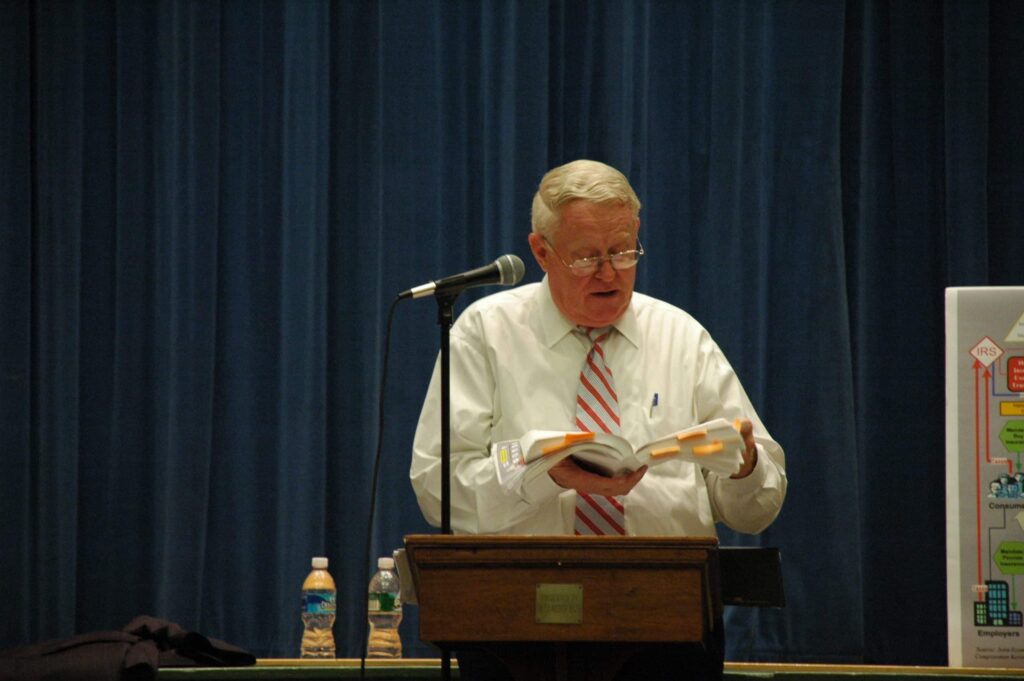
U.S. Rep. Joe Pitts, R-13, of East Marlborough held four
town hall sessions with the last one at Unionville Elementary School Friday
night.
“Good ideas will get bipartisan support,” Pitts told a crowd
in the school’s auditorium. However, the current bill is one he thinks isn’t
good.
“There are many problems with
this bill, as I see it. I cannot support this bill,” he said.
The bill under question is HB
3200, a Democratic Party sponsored bill that Pitts said will cost the American
taxpayer $1.6 trillion.
He said House Speaker Nancy Pelosi wanted the bill voted on
before the August congressional break, but Blue Dogs, about 52 fiscally
conservative Democrats, told Pelosi they would not vote for the bill if she
forced it to floor that soon.
The bill could still be radically changed depending on what
the Democrats do. Pitts will hold more town meetings if possible, should that
happen.
All of the various spending bills, from TARP during the Bush
administration through the auto bailout, stimulus bills and infrastructure
spending have an interest of $1.1 trillion.
He said the bill needs to be discussed properly and that if
a Republican backed bill, HR 3400, could be incorporated into the current HR
3200 as an amendment, the reform would likely pass.
Pitts did his best to put to rest one fear that people have
about the bill. Pitts said, “There are no death panels. That’s something that’s
being demagoged (sic) by my side.”
People on both sides of the issue agree on one thing,
however, that medical and insurance costs are too high and insurance coverage
is spotty and inconsistent.
There were those who came to the meeting with their own
horror stories about the current system’s failures.
There was the mother of two 4-year-old girls with cancer
whose family finances have been devastated while the girls still need expensive
care.
A man who said he spent 30
years in the insurance business commented that high-risk pools–something Pitts
favors–are not a solution. He said he knows a couple in their 60s, the husband
has Lyme disease and because it’s a pre existing condition his insurance in the
high risk pool costs $1,800 per month and carries a $5,000 deductible. He said
the best solution is a public option.
For those people, and their sympathizers, a public option
with the government paying the costs, seems the best option, they said. Pitts
disagrees.
He said the public option would
force an estimated 114 million people out of private coverage and into the
public option, he said, and if the public option runs into trouble, there will
be more bailouts and even rationed care.
As an example he spoke about a
businesswoman with 15 employees. She said it costs her $35,000 per year to have
those people insured, but if she didn’t and was fined for not having them
covered, the fine would be $20,000 so she would save $15,000 per year.
Pitts called the public option
“the first step toward a slippery slope of a national healthcare single payer
system,” something that the liberal Democrats in Congress have wanted for 30
years. “This is their dream come true.”
Yet another speaker took
exception to Pitts’ characterization of the public option as a “slippery
slope,” saying he favors the option.
“It fills a gap for the working
poor,” the resident said.
Pitts contends there are better ways.
He said reforming medical malpractice would reduce the
number of frivolous lawsuits and help reduce medical costs by about $125
million.
In arguing against the current
bill, Pitts said HB 3200 cuts Medicare by $500 million and adopts policies of
other countries that ration the types of medications that may be used. “What
the government giveth it can take away.”
There was also a dispute in
the number of people who actually need to be covered. Those in favor of the
bill say they are roughly 47 million people in need of coverage, while those
opposed say it closer to 10 million.
Pitts said at least 10
million of that 47 million-person claim are illegal aliens. They are not
supposed to be covered, but there’s no way to enforce that the way the bill is
written.
“They say in the bill that
illegal aliens will not be covered,” Pitts said, “but when we offered the
amendment to require verification of citizenship, it was defeated. … So, I
think they do want to cover illegal aliens.”
He added later that an
amendment to the bill that would prevent rationing of care and of federal
employees from interfering in the doctor/patient relationship was also
defeated.
As for the 47 million of
people allegedly requiring coverage, affected, Pitts said there are an
additional two million prisoners, 12 million who are eligible for Medicare and
Medicaid, 11 million who are above 300 percent of the poverty rate who have
chosen not to buy insurance. Pitts said the health care/insurance situation is
about a 10 million-person problem.
“We can solve that problem
without overturning our whole system,” he said.
Again he mentioned
malpractice reform, risk pooling for catastrophic coverage and that insurance
companies should not be able to deny coverage for preexisting conditions.
Pitts also thinks insurance
coverage should be portable.
“I think you should be able
to take your insurance with you from one job to another or from one state to
another. I think it should be truly portable and I think you should be able to
purchase across state lines. And I think the tax incentives I’ve covered would
all help to bring competition and bring costs down,” he said.
He added that the public
option would undercut the public sector.
Another person asked what
part of the Constitution allows for Congress to pass HR 3200, to which Pitts
replied, “You could ask that same question about a lot of government
programs.” Pitts then added that
the backers of the bill are “ideologically driven. They’ve been after this for
30 years. They see their opportunity and will attempt to drive this through.”
Another woman said the
issue has been around for a long time, since Richard Nixon, and the reason is
because it affects so many lives. Health care reform is important she said, as were things such as
Medicare and Social Security.
“I’m sure many of you are
taking advantage of Medicare and Social Security,” she said to those speaking
against the public option. “Why is this option different, and such a threat,
when we all have come to depend on Medicare and Social Security?”
While her question received
a round of applause from many in the audience, Pitts responded, “Because we all
have been paying into it.”
Others shouted that Social
Security was broke at the same time.
Another questioner asked
Pitts what he thought would happen with the legislation. His answer was that
something would get passed, but he wasn’t sure what. It would depend on whether
the Blue Dogs stayed united or were split by their fellow Democrats.
“They will push something
through. I don’t know whether they’re going to get a public option,” Pitts
said.
Perhaps the loudest round of
applause and laughter came from one comment late in the session. A person said
that should the measure pass, all members of Congress should be forced to give
up their current plan and take the public option.
Rich Schwartzman has been reporting on events in the greater Chadds Ford area since September 2001 when he became the founding editor of The Chadds Ford Post. In April 2009 he became managing editor of ChaddsFordLive. He is also an award-winning photographer.
It’s the unofficial end of summer and this year it came on
Aug. 31. “It” is the first day back to school for the Unionville-Chadds Ford
School District.
For Chadds Ford Elementary School it means the return to
class for 313 students this year. This is also the year the school will be able
to legally display the sign telling passing motorists that CFES earned the
designation National Blue Ribbon School of Excellence.
The school earned that designation in 2008 and a sign was
made and displayed on the front lawn along Route 1. Pennsbury Township ordered the sign removed because it
violated the township’s sign ordinance, so the Unionville-Chadds Ford Education
Foundation sought and won a variance for the sign. The sign will remain on
display throughout this school year.
New
within the education curriculum this year, according to Principal Mark
Ransford, will be programs emphasizing Spanish in the school. Ransford said the
school will be looking for ways “to infuse” Spanish in the school.
He
said Spanish would be used during morning announcements, there will be fiestas
in the cafeteria, posters in the classrooms along with students being exposed
to Spanish music and literature.
The
rationale behind the program, he said, was that “Spanish is fluent in the
community. Children hear it in grocery stores. It’s also becoming more
predominant in the U.S.”
[Editor’s note:
ChaddsFordLive will be paying special attention to the elementary schools in
the Unionville-Chadds Ford School District this, our first academic year being
published. Special monthly columns and features are being planned, some are
close to fruition. There will be announcements made as they approach their
debuts.]
Rich Schwartzman has been reporting on events in the greater Chadds Ford area since September 2001 when he became the founding editor of The Chadds Ford Post. In April 2009 he became managing editor of ChaddsFordLive. He is also an award-winning photographer.
Chadds Ford Township officials were chagrined to learn a business operating in the township was actually a front for prostitution. The Lucky Spa was raided following a state police undercover investigation and it was ultimately shut down. That was seven years ago.
Set aside the debate over whether prostitution–or any other vice–should be illegal. That’s a difficult concept for many to swallow. The fact is that prostitution is illegal in Pennsylvania and those responsible for enforcing the law will investigate, charge and prosecute those found in violation. But that’s after the fact, not before.
In its concern to prevent another brothel from opening up in the township, supervisors at the time enacted an ordinance that set stricter standards for people wanting to open any type of massage business, be it massage therapy, massage for relaxation, even a massage school.
This isn’t too terribly unusual. There are businesses, such as restaurants, that must do certain things that others don’t and other businesses that may not do things that others are allowed. A case in point is the tables and chairs on the porch in front of the Cattie Shack. In order for the tables and chairs to be in code, the convenience store needs to be operating as a restaurant, township officials have said.
But potential massage business owners must jump through more hoops than other business owners. Not only must they provide information their own personal and professional background for township scrutiny, they must do the same for their employees. They are not permitted to hire therapists without township approval.
Supervisors have heard several applications since the ordinance was enacted and most hearings were conducted in a professional, even-handed manner designed to elicit basic information required by the ordinance.
There was some sophomoric giggling and private joking about a possible “enema emporium” when one individual wanted to operate a colonic irrigation business at the site of the former Lucky Spa, but nothing beyond that.
That was until Don Lim’s hearing Sept. 2.
We must agree with Mr. Lim’s attorney, Brian Nagle, that some of the questions were irrelevant, that they went beyond the scope of the ordinance, questions about his business’ viability that other applicants in the past were not asked.
Such viability is of no legitimate concern to any government in a free society, and totally irrelevant when it comes to deciding whether the entrepreneur should be allowed to take his or her risk.
We wonder why Mr. Lim was treated differently than other applicants, those who didn’t have to answer questions about how long a lease they would sign, the amount of rent they would pay or what would happen if they couldn’t make enough money to pay that rent.
Is the ordinance, and the manner in which it is applied, an example of due diligence on the part of supervisors in an attempt to prevent illegal activity, or is it a form of restraint of trade where only some people are allowed to tug on the brass ring?
A 65-year-old woman from Phoenixville had cash and credit
cards stolen from her purse while she was watching a movie at the AMC Theater
in Painters Crossing on Aug. 19, state police said in a press release. The
report said the purse was under her seat when the items were stolen.
• Two large dogs may have thwarted a burglary on Smithbridge
Road in Concord Township on Aug. 28. According to a state police report,
someone pried open two steel doors at the victim’s home someone between 11 a.m.
and 3 p.m., but the burglary was aborted, possibly because of dogs.
• Two men were arrested on public drunkenness charges at
Firewaters Bar on Route 1 near Route 202 in Concord Township shortly after 2
a.m. on Sept. 2. Police identified the two as Timothy Kapusniak, 29, of Aston,
and Ronald Deritis, 35, of Prospect Park. Deritus was also arrested for
disorderly conduct, the police report said.
• A 48-yeard-old Pocopson Township man was the victim of
criminal mischief between Aug. 8 and Aug. 29 when someone damaged windows and a
for sale sign at the victim’s Bragg Hill Road home.
• A Wilmington woman was charged with unsworn falsification
to authorities and providing false identification to law enforcement following
a traffic stop on Route 202 near Springwater Plaza in Chadds Ford Township on
Aug. 27. According to a police report, Tiffany West was charged after she was
stopped for a suspended registration. Police said she gave false information
about her identity.
I’m a bit of a Scrooge when it comes to Labor Day. It’s not that
I don’t like the extra day off, but Labor Day holds other connotations for
me–like the cold smack of life’s realities.
I grew up in a “non-labor” home on the Main Line. My mother was a
stay at home mom and my father was a patent attorney with Philco who commuted
to Philadelphia. When I was in elementary school, some of the factory workers
at Philco went on strike. One night our father told us how he had to go through
their picket line to get to his office. The men yelled at him and called him a
“scab”. At that point I decided these people were bad.
Many years later, in my senior year in college, we had a class
called Practicum. One day our topic was on professional organizations. We were
told the NEA, the National Education Association and our state equivalent, the
PSEA, were the preferred teacher’s organizations. After all, we were
college-educated professionals now. Those unfortunate enough to get a teaching
job in the city were warned they would be coerced into joining the AFT, the
American Federation of Teachers, a labor Union founded in 1916 which was
involved in collective bargaining and teacher’s strikes.
So I was pleased that summer when I landed a job in a new high
school in the nearby suburbs and joined the PSEA. Life was pleasant.
But in September of my third year of teaching our PSEA voted to
strike when negotiations with the administration and school board broke down.
And there I was, a card-carrying member of the PSEA, holding a picket sign at
the end of the school drive at 7 a.m., wondering why
our profs had lied to us. It was one of those moments when you could hear the
idealism of youth shattering.
The second day, a then, very young Robin Macintosh from KYW came
out with a camera crew to film us for the evening news. He told us to walk in a
tight circle and they would shoot up towards our heads to make it look like
there were more of us. Hmm. What’s that about journalistic objectivity and
integrity?
That night, the phone rang at my parent’s home where I was still
living, and my father answered. It was a neighbor. “Bill, wasn’t that Sally I
just saw on the 6 o’clock news?”
Busted!
After 11 days the strike was settled. I say, “settled,” as a
contract was signed. I can’t even remember who won, but the atmosphere in the
building for the remainder of the year was icy.
One morning that winter it started to snow so fast that the school
buses arrived to take the students home at noon. Great, I’d be getting home
early. But the administration informed our faculty that since we expected
them to adhere to the letter of the new contract, we were to stay in our
classroom until the end of our contractual day – 3:20 p.m. And the snow
kept falling.
Three and-a-half hours later, I left on my route that took me along
Valley Creek through Valley Forge Park. There were several times when I thought
I was going to get stuck in the snow. Luckily I made it as far as the bottom of
Devon State Road. Cars were stuck all along the mile-long hill up to Conestoga
Road.
Somehow I got my car turned around and into the parking lot of a
little church, and walked the rest of the way home… one mile up the hill as the snow
kept blowing.
Happy Labor Day? Humbug!
Well, maybe it’s not really that bad. I do get the day off.
Sally Denk Hoey, is a Gemini - one part music and one part history. She holds a masters degree cum laude from the School of Music at West Chester University. She taught 14 years in both public and private school. Her CD "Bard of the Brandywine" was critically received during her almost 30 years as a folk singer. She currently cantors masses at St Agnes Church in West Chester where she also performs with the select Motet Choir. A recognized historian, Sally serves as a judge-captain for the south-east Pennsylvania regionals of the National History Day Competition. She has served as president of the Brandywine Battlefield Park Associates as well as the Sanderson Museum in Chadds Ford where she now curates the violin collection. Sally re-enacted with the 43rd Regiment of Foot and the 2nd Pennsylvania Regiment for 19 years where she interpreted the role of a campfollower at encampments in Valley Forge, Williamsburg, Va., Monmouth, N.J. and Lexington and Concord, Mass. Sally is married to her college classmate, Thomas Hoey, otherwise known as "Mr. Sousa.”
No doubt, you’ve been cutting back on your
spending lately. Everyone has. People are scared and recognize not only that “things”
don’t make us happy, but that more money in our retirement pot will give us
comfort in later years. We know that this current economic downturn may not be
the last one in our lifetime, and recessions lurk around corners with the
potential to set our investment accounts back at any time.
I frequently remind my clients that investing
small amounts of money pays off. The power of compounding interest thrives on
time. Now that you are in the mindset of getting by on less, invest the
difference and let it work for you.
For example, if you are ready to give up a couple
of dinners out each month, don’t fritter that money away on something else or
let it sit in a no growth money market fund. Instead invest that “found” $100
per month in a blended portfolio of stocks and bonds.
If you leave it untouched for just ten years,
it could grow, based on a conservative expected average annual return of 7
percent to $17,300! In twenty years, investing $100 per month could grow to
$52,200! Now imagine if you gave up the daily latte, the most expensive cable
channel package, the 50th pair of shoes, the latest hardback
best-seller (wait for it to come to your local library), the latest GPS
service, cokes and popcorn at the movie theater…alright, you get the
point.
If you could sock away $500 per month in an
investment account for the next ten years you could have $86,500. In all of
these examples I assume there are no taxes to be paid on the principal growth
or on dividends and interest. I also assume that transaction costs are built
into the expected return.
No taxes on portfolio growth or income? How
is that possible? Why, it’s the Roth IRA account of course. What’s the catch? The catch is that you
need to qualify for it by having earned income from a job. To qualify for the maximum contribution
allowed in 2009 a couple needs to earn less than $166,000 and an individual
less than $105,000. You are eligible for contributing a lesser amount if you
earn between $166,000 and $176,000 (married) or between $105,000 and $120,000
(single.) The most you can contribute in 2009 is $5,000 if you are 49 years old
or younger and $6,000 if you are 50 years old or older. And you can’t
contribute more than you earn.
Unlike the traditional IRA, you never have to
withdrawal from the account. It can grow and grow and grow for your heirs. And, unlike the traditional IRA, if you
do decide to take withdrawals you do not have to pay any taxes on that
money. You can take out your
contributions at any time without taxes or penalty. After five years from your initial contribution and reaching
59.5 years old, you can also take out the earnings on the account both tax and
penalty free. You can take tax and
penalty free distributions prior to reaching 59.5 for a first home purchase,
unreimbursed medical expenses, higher education expenses, or if you become
disabled.
The rules may seem complicated but you have
until April of 2010 to get comfortable with the rules and open an account and
make a contribution for 2009. If you qualify, I urge you, if you haven’t
already, to treat yourself to the Roth IRA in 2009.
Tell your kids to open a Roth IRA now. A
25-year-old who squirrels away $5,000 every year in a Roth IRA could see a
portfolio worth $1.1 million dollars when they retire at age 65. Like I said,
the power of compounding interest thrives on time. Throw in tax-free on top of
that and the compounding is truly a beautiful thing.
Ellen is the Founder and President of Ascend Investment Management. She was born in Philadelphia and has lived in the Delaware Valley for most of her life. When she is not researching investments and managing portfolios, she pursues her interests in tennis, bridge, hiking and art. Beginning her investment career in 1981 as a stockbroker at E.F. Hutton and Co., Ellen now has over 20 years of investment management experience. Prior to founding Ascend in 2006, she managed high net worth assets for many years at Bank of America, Mellon Bank, and most recently at Davidson Capital Management. At Davidson Capital Management, Ellen served as a Senior Vice President and Senior Portfolio Manager of the firm. She managed assets for more than 50 family relationships and was a core member of the firm’s Investment Committee.Ellen earned a BA in History from Brown University and a MBA in Finance & Investments from The George Washington University. She is a member in good standing of the Chartered Financial Analyst (CFA) Institute, which is a global organization dedicated to setting a high ethical standard for the investment profession. Her professional memberships include the Delaware County Estate Planning Council, Women Enhancing Business (WEB), and the Chadds Ford Business Association. She is a docent with the Delaware Art Museum and an active volunteer with the Brown University Alumni Association.