
N.C.Wyeth

‘The life of Andrew Wyeth in bold strokes’
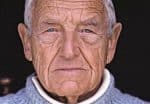
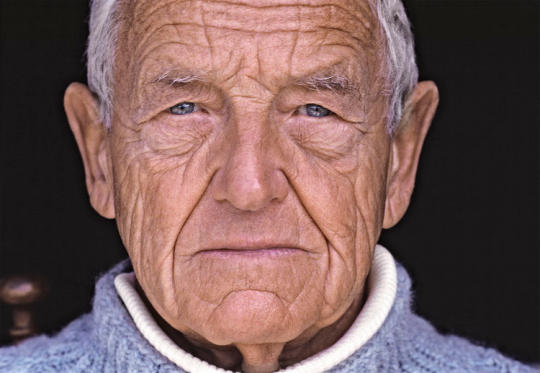
Andrew Wyeth © Peter Ralston

PBS documentary WYETH: the life of Andrew Wyeth in bold strokes airs Friday, September 7, at 10 p.m. The film opens with a close up of Andrew Wyeth’s craggy, weather worn face. As the narrator begins to speak, the camera slowly moves in until we are looking at just Andy’s eyes—crystal blue and piercing—eyes that seem to look into the world, seeing what others do not. His Superman vision sees what is hiding and waiting beneath the surface.

The documentary is the third in a four-part PBS American Masters Artists series exploring the lives of four iconic American visual artists. The Wyeth segment, which took three years to complete, moves seamlessly through Andrew Wyeth’s life, lifting up memorable moments—both tragic and triumphant. It airs on Friday, September 7 at 10 p.m. across the country and will be available to stream the following day. There are two versions of the documentary—a ninety-minute theatrical version and the sixty-minute broadcast version.
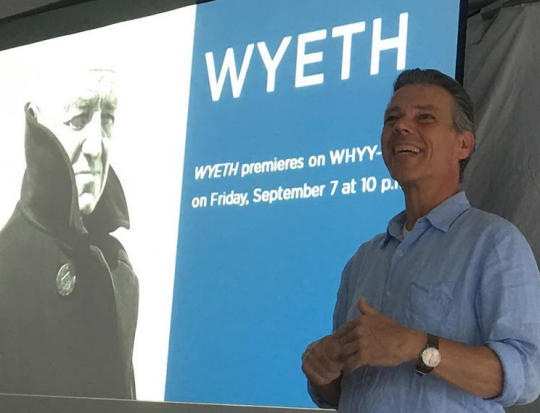
Director Glenn Holsten introduces WYETH viewing at Chaddsford Winery

WHYY members recently enjoyed a special viewing of the documentary at Chaddsford Winery with the filmmaker, Glenn Holsten, and the producer Chayne Gregg, in attendance. During a question and answer session following the film, Holsten and Gregg shared behind the scenes stories and attendees shared their special memories of our special and beloved neighbor.

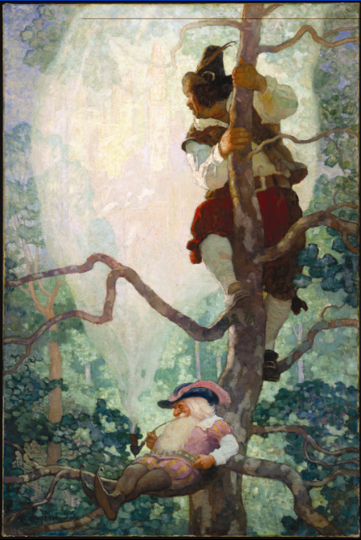
WYETH tells the story of Chadds Ford’s most celebrated resident and offers a peek into his thoughts about life and painting. The film explores contradictions and comparisons throughout the artist’s life. For example, Andrew adored his father, the famed illustrator N.C. Wyeth, but did not approach painting in the same way. N.C. painted in bold colors that made his images jump off the pages of the adventure books he illustrated for Scribner’s. Andrew, meanwhile, painted his action scenes in a palette of subtle greys and browns. Subject matter differed, as well. While N.C. painted historic and literary battles full of action, Andy, according to son Jamie, “was always painting a dead crow or something that was equally intriguing.” Andrew Wyeth felt he could only paint what he knew intimately. He walked and walked around his beloved Chadds Ford studying its strong, stone buildings and around Cushing, Maine taking in its rough landscapes and seascapes. He noticed everything. For him, the world was always changing. Andy observed that the river flows constantly, yet it is never the same.

An art critic once described Wyeth as being the most overrated–and the most underrated—artist in the world. He made money while he was still alive, which was unheard of. His first exhibition at age 20 was a sellout. He was as popular as a rock star and his exhibitions routinely broke attendance records at prestigious art museums across the country. Ironically, because his work was so popular, some critics concluded that it could not be very good.

New York’s Museum of Modern Art acquired Christina’s World in 1948 amidst great controversy within the museum itself and in the art world beyond. The controversy pitted those who thought the painting was a masterpiece against those who thought it awful. People are still drawn to Christina’s World. One does not need to know the story behind Christina Olsen’s disability to understand and relate to the isolated feeling it conveys. Wyeth was not discouraged by cruel comments. His reaction to negative interpretations of his art was to keep painting, which drove his critics mad. Now, with the advantage of time, art critics, scholars of American art, and historians are reevaluating and praising his body of work.

In the documentary, the audience learns much from interviews with art professionals, family, and friends—including Helga–who discuss Wyeth and his work. The home movies and photographs of the Wyeth family provide added dimension to the famed Wyeth family. Sons Jamie and Nicholas Wyeth talk candidly about their father. The narrator explains that Betsy always encouraged her husband, even after learning early in their marriage that she would always be number 2 in his life after painting. When Andy introduced the “Helga Paintings” to her and the rest of the world in 1986, she maintained her sanity in the midst of the media storm by organizing and cataloging the huge body of studies and paintings created over fifteen years.

Andrew Wyeth painted or thought about painting all the time. Mary Landa, Andrew Wyeth collections manager reflected that, “on his deathbed, asleep with his eyes closed, Andy’s hand was moving, as if he were painting.”

WYETH: The life of Andrew Wyeth in bold strokes will be available after the broadcast through WHYY or the Brandywine River Museum of Art.

‘The life of Andrew Wyeth in bold strokes’ Read More »
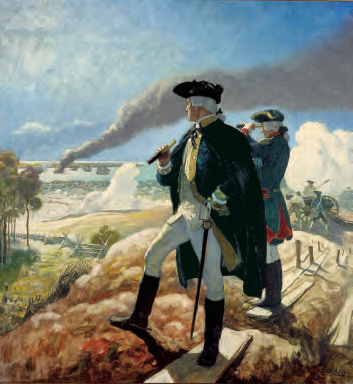
Pyle, Maxfield Parrish, Norman Rockwell and N.C. Wyeth Featured in New Exhibit

Pyle, Maxfield Parrish, Norman Rockwell and N.C. Wyeth Featured in New Exhibit

A Date with Art:

The Business of Illustrated Calendars

January 25 – May 18, 2014 at the Brandywine River Museum

Howard Pyle, Maxfield Parrish, Norman Rockwell and N.C. Wyeth–foremost illustrators in the first half of the 20th century–created some of their best-known images for advertising calendars. These hung in millions of homes, shops and offices, providing artists with an opportunity to disseminate their work to a much broader audience than that for books or magazines.

This exhibition introduces visitors to the once-thriving, lucrative business of illustrated calendars.  From Parrish’s haunting work for General Electric’s Edison Mazda brand to Norman Rockwell’s iconic images for the Boy Scouts of America, calendar images contributed greatly to an artist’s popular reputation. Yet as these four artists reaped financial benefit and fame by creating art for calendars, the connection to commercial ventures at times undermined their critical reputations as artists. This exhibition, featuring work from public and private collections, will reveal the various ways in which these artists integrated calendar work into their careers, adapting to shifting views of contemporary art, illustration and business.

N.C. Wyeth’s America in the Making

January 25 – May 18, 2014

Images of inspirational and patriotic events in American history, from Coronado’s 16th-century expedition through the Southwest to Abraham Lincoln’s second inaugural address in 1865, will be on view in this exhibition.
The exhibition features 12 dramatic paintings created by the artist in the late 1930s for a popular advertising calendar, and shows Wyeth’s renowned mastery of stirring action and authentic detail. Props from the artist’s Chadds Ford studio, such as a life mask of Abraham Lincoln, a coonskin cap and a Kentucky rifle, will provide fascinating insight into how Wyeth created these paintings. Visitors will be encouraged to record a calendar image of their own that depicts an important event from American history.


The America in the Making paintings are on loan from the collection of the Brunnier Art Museum of Iowa State University in Ames. An illustrated catalogue from the Brunnier Art Museum will be available.

Pyle, Maxfield Parrish, Norman Rockwell and N.C. Wyeth Featured in New Exhibit Read More »

Artwork collection chronicles change

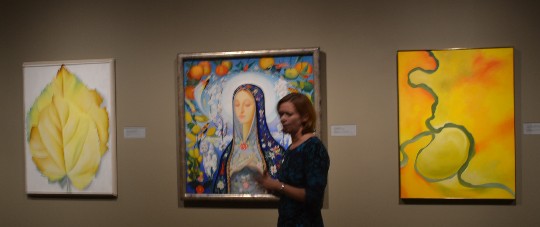
A collection of art which depicts the drama of a changing America in the early 20th century is now on exhibit at the Delaware Art Museum.  American Moderns, 1910–1960: From O’Keeffe to Rockwell opened Oct. 12.

The exhibit brings together different styles from so-called primitive to cubist art. The works are as varied as the styles.  Some are charming, some alarming and others filled with humor and whimsy.

Heather Coyle, the Curator of American Art, describes one of the most interesting  decisions she made while laying out the exhibit. Since some people don’t like abstract art, the layout tempts the viewer with a Wheelock wooden sculpture with abstract paintings on the side.  On the far wall is a familiar and popular Georgia O’Keeffe painting of a black pansy to draw the viewer in.

The 57 piece exhibit is divided into six series beginning with the Cubist Experiment followed by Still Life Revisited, Nature Essentialized, Modern Structures, Engaging Characters and Americana.

Synchromy


The cubist’s style itself can be described as fracturing of objects and placing the pieces on canvas.  Coyle noted that society itself was being fractured during the early to mid 20th century by war and social change.

The exhibit flows from the upheaval represented by cubists paintings to the serenity of artists rediscovering still life flowers and fruit.  The second series is a retreat to more classical form as if to say did we go too far with cubism?

Continuing on with nature, the third series shows man’s relationship to nature. This section contains Down to the Sea by Rockwell Kent. Kent’s work on Monhegan Island, Maine, is currently on exhibit at the Brandywine River Museum in Chadds Ford, Pennsylvania.

There are two artists named Rockwell in the exhibit.  Rockwell Kent was an illustrator and activist whose political views brought him up before the Joseph McCarthy hearings.  Norman is the other Rockwell in this exhibit whose illustrations were once in living rooms across America on the cover of the Saturday Evening Post.

The Sand Cart by George Wesley Bellows is looking forward and back. It looks back to manual labor, using a cart to collect sand, a basic material.  It looks ahead to the cement and glass that will be made with the sand.

The Sand Cart by George Wesley Bellows

The series called Modern Structures shows buildings and cities becoming industrialized. Text is part of the artwork as billboards are shown.

bluepeter


The Blue Peter shows onlookers to steamer.  The work conveys intensity and anxiety of the new world with a smoke stack and barriers to entry. The theme of observing change is repeated in the Vision of New York by N.C. Wyeth.  In this work, woodland creatures view New York City as if in a dream.

New York

Any one of the last four paintings in the Americana series is worth the trip to the museum. Morris Hirshfield’s Girl With Dog is a whimsical portrayal of an elegant woman walking an elegant critter.

Although painted in 1951, Anna Mary Robertson “Grandma” Moses’ Early Skating is conveys the innocence of a time before all of the changes depicted in the other works in the exhibit.  Both Hirshfield and Moses are considered primitive artists in because they were not formally trained in art.

Although you may have seen a reproduction The Tattoo Artist by Norman Rockwell, seeing the original in full size is a treat. A sailor is once again availing himself of the tattoo artist. The sailor’s arm is a chronicler of his own change, change of girlfriends from Sadie, Rosietta, Ming Fee, Mimi, Olga, Sing Lee to Betty.

“American Moderns” is a traveling exhibit organized by the Brooklyn Museum of Art. It will be on display in Wilmington until January 5, 2014.


Upcoming Events about the exhibit

American Moderns Gallery Talks Saturdays, October 12, November 9 and December 7 | 11:30 a.m.

American Moderns Lecture: What Modern Means Saturday, October 19 | 1:30 p.m.Terry Carbone, the Andrew W. Mellon Curator of American Art at the Brooklyn Museum

American Moderns Saturday Symposium Saturday, October 19 | 10:30 a.m. – 3:00 p.m. Heather Campbell Coyle, Curator of American Art

Family Exploration Day: American Moderns Sunday, November 10 | noon – 3:30 p.m. Kids and their families will learn about popular American artists featured in American Moderns


For more information go to http://www.delart.org or call 302-571-959


Artwork collection chronicles change Read More »

Scroll to Top