
Hillendale Elementary School

Education and community merge at Hillendale tree planting
Education and community merge at Hillendale tree planting

Scores of volunteers, mostly family units, converged at Hillendale Elementary School to plant trees as part of a stormwater management project that brought together Pennsbury Township, the school district and elementary school curriculum and others.

The Oct. 12 reforestation was part of a project to prevent runoff from the school that caused excessive silting of Craig’s Mill Run and damaged properties downstream.

For Pennsbury resident Andy Riggs — who brought his kids Olivia and Indiana — the planting is environmentally personal. He lives downhill from the school and heavy rains cause a problem for him. Runoff from the school runs

The Riggs family, dad andy with daughter Olivia and son Indiana, get into the spirit. Stormwater from the school runs off into their back yard.

into his back yard.

“This is great,” he said. “It really helps the community.”

Other residents, such as Ann DelCollo and Brian Wilson agreed, even though they haven’t been personally affected by the runoff.

DelCollo, who brought her two sons Drew and Zach, said they wanted to help their neighbors’ properties and work with the school. She said it’s a matter of being part of a community.

Wilson, who lives in Chadds Ford Knoll, said he wanted to help the school and the community.

“It’s a matter of building a sense of community, of having a common goal.”

For Wilson’s 6-year-old son Tyler, it was a matter of fun.

“I like planting trees. I like digging holes,” Tyler said.

In addition to the township and the school district, Pennsbjury Land Trust, Willowdale Chapel, the Brandywine Valley Association and the Brandywine Conservancy were also
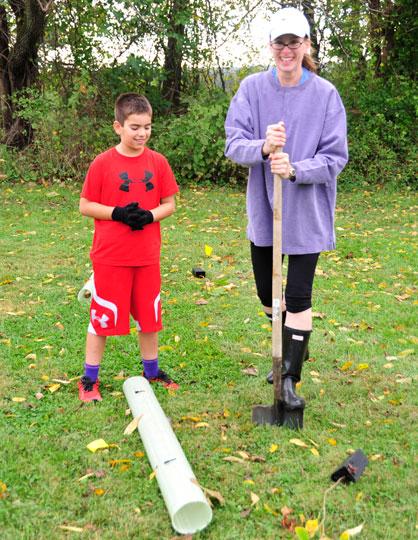
Ann and Drew DelCollo plant trees to help build a sense off community in Pennsbury Township.

involved.

Township Supervisor Aaron McIntyre said the coming together of the school board, township and environmental groups was significant.

“It was a great opportunity for us to reach out and bring those people into projects that relate directly to us…For Pennsbury Township to get active with [those environmental groups] and participate with them on something that’s meaningful to our residents is productive and I’m appreciative of having an opportunity to work with them,” McIntyre.

In all, 600 trees are being planted at the school. Not all were planted Saturday. Some trees were held out so fourth-grade students could get involved. According to Hillendale Principal Steve Dissinger, the project is being incorporated into the science curriculum unit pertaining to managing land and water.

The overall project, which began last school year, involved slowing down the runoff. That meant installing rain gardens, building two small retention basins and one large one. Eroded ditches were also filled in, Dissinger said, as well as the reforestation so that trees can soak up water and stabilize the ground.

For Dissinger, the educational aspect of the project was crucial.

“Last year’s fourth-graders took pictures of the erosion and the different effects the water has had on our property and neighboring properties. We’ve had them brainstorm ideas as to how they can be corrected…The current fourth-graders see the finished project. They see the interventions we put in place to stop the erosion and they’ll begin the next phase of the curriculum, and that is to educate the community on this project.”

Students will put signs with QR codes at key locations along the site. With a Smart phone or tablet, people can scan the code and get to a Web site where they can see or hear students explaining the importance of what was done at that specific location and how that impacted the entire project.

Hillendale Elementary School Principal Stewve Dissinger, left, and Ken Batchelor, assistant to the superintendent of the Unionville-Chadds Ford School District, lend a hand.

Fourth-grade students completed the tree planting during the week of Oct. 14.

Wes Horner, a senior advisor for water resources with the conservancy, said the trees being planted are magnolias, red buds, maples and oaks.

Horner said the water quality project was essential because stormwater drains into Craig’s Mill Run, which has been rated by the state as “Impaired.”

He said that impaired status means the stream has “failed to achieve state designated stream standard [caused by] developments that haven’t had adequate stormwater management. It has been hit hard over the years and is suffering from a water quality perspective.”

He said the school district has used best management practices to make the school grounds at Hillendale “more of a sponge” to retain more stormwater.

It will take time for the trees to nature, Horner said, that it will take two years for them to grow out of the protective tubing, five years before they begin to develop a canopy, but that in 10 years it will look like a grove of trees.

The conservancy is involved in planting 2,800 trees in various projects this fall. These plantings are part of a five-year, 28,000 tree reforestation program. There will be 4,000 trees remaining after this fall’s plantings.

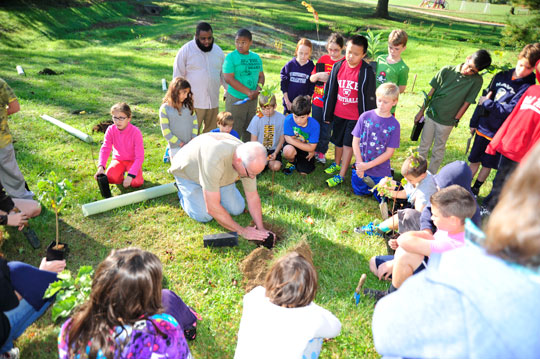
Lead photo: Teacher George Claypoole shows Hillendale fourth-graders how to plant trees. Claypoole also instructed students on the importance of rain gardens, retention basins and trees as means of slowing stormwater discharge and soil erosion.

Education and community merge at Hillendale tree planting Read More »
Hillendale Elementary School ranked number one in state

A national Web site, schooldigger.com, has ranked Hillendale Elementary School the number one elementary school in the state of Pennsylvania. Hillendale ranked number one among more than 1,600 other elementary schools in the state.

The site is designed for prospective homebuyers who want to know about the schools and school districts in areas where they might buy homes. It makes its state based assessment on several factors. It uses the results of standardized testing in math and reading, along with student to teacher ratio, said Hillendale Principal Steve Dissinger.

Schooldigger.com looks at each level, elementary, middle and high school and makes it’s assessment for each level, choosing the best in each state.

While it’s not an academic award, Dissinger is pleased with the designation. It means he, the faculty and the school district as a whole are doing something right. Two other schools, Chadds Ford and Pocopson elementary, have been named Blue Ribbon Schools in recent years.

“It’s about meeting the kids where they are and providing what they need,” he said. “What this says about Hillendale is that what we’re doing is helping kids grow. They are growing and they are achieving. It makes us feel really good about getting this recognition.”

“Everybody cares about every kid in the district,” he added. “In all of our schools, we have a very diverse group of kids, kids that have a variety of learning disabilities and maybe some other special needs, and we have kids that are working well above their grade level.”

He said it’s not just the teaching professionals who are involved, but the parents as well. As he said, “They keep us accountable to make sure that their kids are getting the absolute best education that they possibly can.”

Because of the nature of the assessment, Dissinger said there’s nothing special the school had to do to prepare.

“We’re not about rankings. We focus on achievement, that’s what our goal is. That’s what we do, that’s what we do well, that’s what we focus all of our energy on,” he said.

Dissinger said he and the faculty at Hillendale look at a lot of different data on the students — such as basic testing, monthly assessments and diagnostic tests — and make adjustments to better educate and meet the students’ needs.

“We look at a whole variety of data. We look at it constantly…We analyze it. We use that data to determine where our relative areas of weakness are, and where our strengths are, and then we develop action plans to address those areas,” Dissinger said.

The designation was announced publicly during the Oct. 22 Unionville-Chadds Ford School Board meeting, but Dissinger said he found out earlier in the month. He wasn’t notified by the site. Rather he learned about it from his wife, a teacher in Lancaster County, who learned about it from a coworker who lives in Avondale.

The recognition was not lost on the higher ups in the district.

“We are thrilled,” said Unionville-Chadds Ford School Superintendent John Sanville.  He sees the ranking of Hillendale as continued good work by everyone in the district, from student to parent to teacher to bus driver.

“Sustained excellence is a matter of the hard work of lots of people, starting with the students. We could not be more thrilled with the success of our students…It’s really a reflection of our community.”

Hillendale Elementary School ranked number one in state Read More »

Creative problem solving at Hillendale ES

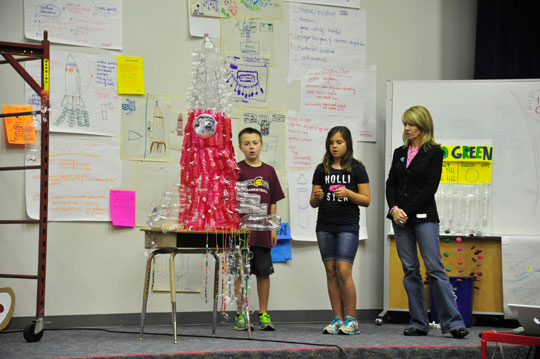
Hillendale Elementary School fifth-graders Sam Schriver and Taylor Godek, with artist Kathryn McEntee, explain aspects of their rocket ship project.

A two-week artist in residence program became more than a matter of up-cycling old plastic water bottles.


By Rich Schwartzman


On the surface, it was a simple project, make something out of old plastic water bottles. But, an artist in residence program turned into lessons on creative problem solving for Hillendale Elementary School fifth-graders, according to artist Kathryn McEntee.

McEntee, a sculptor, was this year’s artist in residence at Hillendale. She said of the program, “It was about the creative process that they had to go through and problem solve along the way.”

Her project, she said, was to inspire creativity using nothing but water bottles. Specific projects — chosen by the individual classes — included building a rocket ship, a chandelier and a marble maze.

“We were incorporating the idea of recycling, which is the theme at Hillendale this year for the entire school,” said McEntee.

She added that the fifth-graders were charged with the idea of how water bottles could be used to inspire creativity.

“Everything was completely driven by the kids making choices and doing a lot of creative mind-mapping,” she said, “and pushing themselves to think, ‘Yes, we’d like to do something huge, but what can we actually do?’”

McEntee said the kids rose to the occasion, brainstorming about what water bottles could be turned into, and how it would be inspirational to the younger kids.” She called the project a legacy to the school and younger students.

The students had many discussions to make, based on what money was available to work on a project, how many bottles they had to work with and then dealing with time constraints.

More than 330 plastic bottles were used for the projects. They were cleaned, cut and colored by the students. The total project time was two weeks, but the actual construction time was four days, working one hour per day. Students also had to decide how to divvy up the work among the class members, McEntee said.

“In understanding all those pieces of the puzzle,” McEntee said, “is how they made choices, sometime hard choices because they weren’t what they initially wanted to do. Some of the things they had to learn was there were always more than one right answer and one way to do things and in order to succeed you’re probably going to make a number of mistakes. We were all about trying every idea no matter how crazy it was.”

She said the entire two-week period was about tapping into the creative mind. “What we now know is that 80 percent of creativity is learned.”

McEntee said creativity is a muscle that needs to be exercised like any other muscle. “Every day we did creative muscle-building exercises that would focus them closer to their goals.”

She said the exercises, asking themselves how they would be affected by the project, then asking how other students would be affected, then how it might affect the community.

School Principal Steve Dissinger said the project tied in very well with the theme of recycling, but also connected to upcycling, converting waste materials into new materials or products of better quality or a higher environmental value. He was also impressed with the creative problem solving aspect.

“Everything they used to create their projects were things that we would normally throw into the trash, so there’s the whole upcycling kind of concept behind everything that they’ve done. That’s the recycling piece of it. The other part of it, that is impressive to me, is that it’s not so much the final project that they come out with, but it’s the thought process that they go through…It’s the whole idea of taking something that looks like junk and let’s create a useful product.”

Dissinger said he also liked the idea that while working in small groups, the kids learned to work together even while having different ideas.

There were other lessons learned, according to McEntee. The students learned that it’s not just artists and poets who need to be creative, but athletes and teachers need creativity as well. So do moms and scientists.

Creative problem solving at Hillendale ES Read More »

Scroll to Top