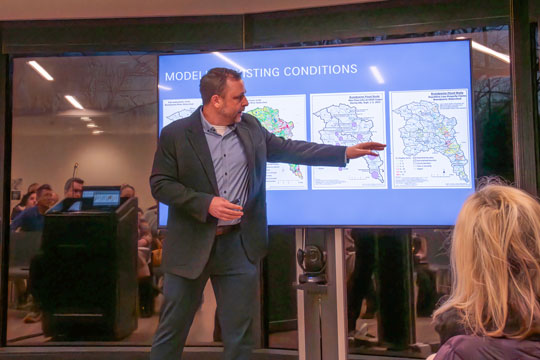


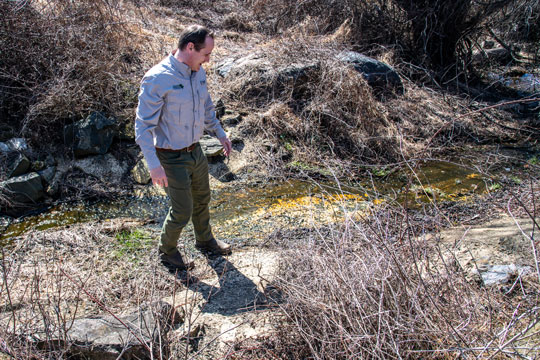
A lot is going on with NALT, the North American Land Trust. As previously reported, there’s a stream restoration project planned for the Brinton Run Preserve, and NALT is also looking at ways to preserve the Davis Tract, the former Camp property on Route 1 near the Barn Shoppes where N.C. worked and lived. There’s also a trail project planned.
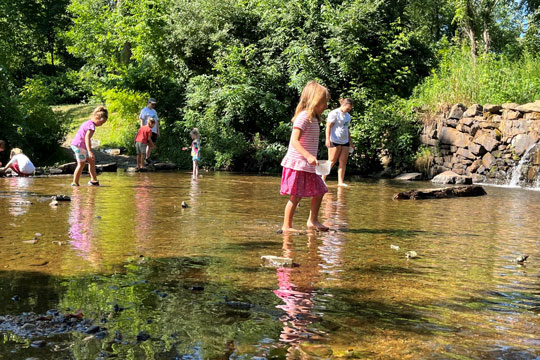
Now there’s a pollinator initiative NALT hopes will bring a renewal of pollinators — bees and butterflies primarily — to the area. And it started in Chadds Ford Township after NALT bought the 72-acre property now known as the Brinton Run Preserve along Oakland Road in 2022.
NALT received a $276,000 grant from the Pennsylvania Department of Conservation and Natural Resources in support of NALT’s Pollinator Meadow Initiative in Southeastern Pennsylvania.
Steve Carter, NALT’s president, said 20 acres at Brinton Run have already been converted to a pollinator meadow and more are likely to be converted, but the focus now is on getting such meadows in other community and municipal areas, as well as homeowner associations and individual private properties. One such pollinator project was for 12 acres at Bush Hill Farm in Concord Township, plus two other projects in Delaware County.
Carter admits to not being an expert biologist himself but said bees and butterflies are the primary pollinators for NALT’s initiative and one species of butterfly is important, the monarch.
“The monarch population is down by 80 percent based on some of the studies we’re reading, so we really want to provide the appropriate habitat to help out the monarch butterfly, which is such an important species for North America. And the bees as well,” he said.
For the last several decades there have been reports of bee populations dwindling, which is a problem since they help maintain plants used for food. Carter said pollinator meadows could be a major step in bringing back a healthy bee population.
“That’s what we’re hoping for,” he said. “That’s what we’re seeing and that’s what the data is showing, at least tangentially on other projects, that the bees will rebound and come back. Over one-third of our food supply comes from pollinators, including bees so it’s important that we keep those species going strong.”
Carter said pollinator habitats are beneficial not just for the pollinators, but for people, communities and the environment.
“They create a better eco-system and a better environmental experience for the property [but] for the community, it creates engagement opportunities. Folks are interested in this kind of work, and why we’re doing it, and what’s involved in doing it. We can explain why it’s important to create pollinator habitats and, maybe even more importantly, how they can take some of these strategies back home and create their own pollinator habitat.”
Without going into specifics, Carter said building the habitat is a matter of bringing in the right plant species for a given pollinator or pollinator group. And those species should be local, not invasive to the area, the ones “that are supposed to be here. If the right plants grow, the right species [of pollinator] come back to use them.”
Carter stressed that one thing he wants to get across is that creating a habitat is something that people can do on their own properties.
“What we want to do is create a blueprint to show people how they can take some of these concepts and some of these things on a smaller scale.”
There’s also another advantage to creating a pollinator habitat. Carter said it cuts back on landscaping costs because the pollinator habitat areas don’t require mowing.
Anyone interested in learning how to set up a habitat of their own should contact NALT at 610-388-3670.

About Rich Schwartzman
Rich Schwartzman has been reporting on events in the greater Chadds Ford area since September 2001 when he became the founding editor of The Chadds Ford Post. In April 2009 he became managing editor of ChaddsFordLive. He is also an award-winning photographer.