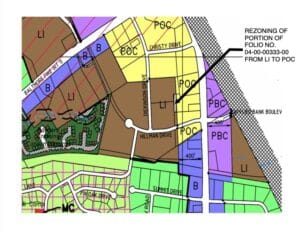

It will be another couple of months before the Chadds Ford Zoning Township Hearing Board renders its decision on a Calvary Chapel appeal. Calvary appealed the September decision of Zoning Officer Fran McCardle, in which he said a proposed permanent performance area at the chapel is not permitted in the POC Zoning District.
Calvary has been interested in building an extension to its current building with a terrace with an overhang that would also include sound equipment, TV screens, and lighting equipment at the chapel. But McCardle deemed that to be an amphitheater, which is not permitted. However, he did say after the hearing closed that such a structure would be allowed with conditional use approval on the other side — the south side — of Brandywine Drive. The chapel is located at 500 Brandywine, on the north side.
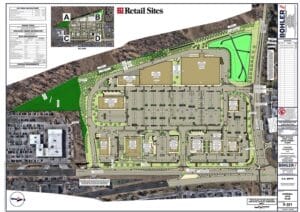
That 500 Brandywine Dive property is considered Lot 2 for calvary, and an area across Brandywine is considered Lot 4.
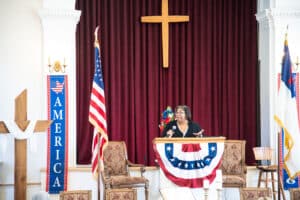
The site Calvary wants to use as a permanent area has been used for several years as a temporary performance area for special events, such as its “Sizzlin’ Summer” events, but the equipment has been removed and stored elsewhere in the building when not in use.
Chadds Ford Township opposed the appeal and retained Andrew Bellwar to represent it because solicitor Mike Maddren had a conflict.
Bellwoar questioned McCardle on his September decision. McCardle agreed that there are three steps in making such a decision: acquiring information, reviewing the zoning ordinances, and then making the decision.
He then showed McCardle several photos, one showing how the location has been used, to which McCardle acknowledged that the space was used for religious purposes, and then another showing a marketing brochure Calvary has been using to show what it wants to do.
McCardle, said the second photo showed a stage with a roof and projecting lights. It also showed a band with musical instruments, he said. He added that he originally understood that the church wanted to use the expansion as a covered terrace. But that changed when he saw the brochure photos.
Bellwoar asked him if he then analyzed what was proposed against the township zoning ordinances.
“I did,” McCardle said.
Bellwoar then read a part of McCardle’s letter from September:
“The proposed project identifies an addition and outdoor terrace; however, the inclusion of a removable glass wall system, exterior speakers, and light bars indicates the extension will function as an outdoor performance venue.”
McCardle said that was his conclusion, and that after looking at the plans, the pictures, and the zoning ordinance, he reached a determination as to where the proposed extension fits within the zoning ordinance.
“This structure fits in the CC District [Cultural Campus], but not the POC District [Planned Office campus],” McCardle said. [The CC District is on the other side of Brandywine Drive.]
Under further questioning from Bellwoar, McCardle said he used the words amphitheater and concert venue to describe the proposed use. He also said those uses are not listed as permitted uses in the township zoning code.
They then reviewed a Board of Supervisors resolution from 2005, which deals with lots 2 and 4 on Brandywine Drive. Bellwoar said the resolution granted conditional use to Calvary with 14 conditions. McCardle agreed.
Condition 12, Bellwoar said, deals with an amphitheater. He read:
“The applicant previously withdrew the proposed amphitheater as part of the conditional application…Applicant nonetheless agrees that it may only file an application for an amphitheater on that portion of the property lying to the east of the center line on Brandywine Drive.”
Again, McCardle agrees.
Bellwoar read further in which the resolution reads “Applicant agrees it shall not now or in the future apply for or construct an amphitheater west of said center line extension. Nothing herein shall act or be deemed to limit or restrict the rights of the applicant to apply for and/or construct an amphitheater on the applicant’s property shown on the applicant’s plan as Lot 4.”
In short, he and McCardle conclude that the amphitheater could be constructed on Lot 4 with conditional use approval, but not on Lot 2, the site of the chapel where the extension is shown on the application.
Bellwoar then brought up a 2015 agreement, which deals in part with outdoor events.
“Any structures or equipment not shown on the as-built plan dated Nov. 22, 2011, and utilized for the aforementioned events, outdoor events, shall not be permanent, and shall only be placed on the property after May 1 of any year, and removed by Aug. 31 of any year.”
Calvary’s “Sizzlin’ Summer” events fall into that temporary condition, and the chapel must get approval for those special events from the township.
Dennis Dunn was the attorney representing Calvary Chapel. He did not challenge McCardle on the decision concerning permanence or on whether the extension can be only on Lot 4. Rather, he wanted to know what documents, plans, and resolutions he used to make his determination.
Dunn did, however, call one witness, Al Pinero, Calvary’s senior director of operations.
Pinero testified that Calvary Chapel holds worship services on site, offers counseling, holds biblical study programs, and does baptisms.
Dunn brought up the volume of music from worship services that have caused concerns from neighbors in the past.
Pinero agreed but said the music lasts only 15 to 20 minutes. He added that they have made efforts to quiet the volume to work with those neighbors, most of whom live on Harvey Lane, which is adjacent to the chapel’s site.
He went on to say there is preaching, prayer, and baptisms during those worship services. Dunn’s questions and Pinero’s responses all centered around what Calvary deems a worship service. None of that testimony dealt with the permanent nature of the proposed expansion or whether it could be on lot 2 or 4.
Pinero did acknowledge that the proposed site of the expansion is where the chapel currently holds its “Sizzlin’ Sunner” and one or two special services, which require a special event permit. He added, however, that they filed for the permits under protest.
“Our letter to the township actually says that we do protest having to apply for a special protest,” Pinero said. “We believe it’s religious services that the property can accommodate, and during my time here, we’ve never been denied.”
After the testimony, public comment was allowed. One resident of Harvey Lane said it’s the zoning laws that are at issue and that they should be enforced by the township equally to all, adding that noise and light pollution from Calvary have been detrimental to the neighbors for years, and that continues to this day.
Tom Bradley, who is a member of the township Planning Commission, said Calvary is “a victim of its own success.” He said events at the church started small, but they grew larger as the congregation grew.
He said he monitored an event one day this past July when there were close to 2,500 people in attendance, and that the space is too small for such a large number of people. He added Calvary should have filed for a zoning variance, which they didn’t do.
Eric Gartner, also a Harvey Lane resident, commented that Calvary has “a history of non-compliance with conditional use requirements and zoning, and deceptive practices to include outright lying, in the course of their expansion plans.”
He questioned how they could raise more than $4 million from congregants for the project when it’s not allowed in the zoning district.
“Regardless, the only thing I see as more outrageous is the claim that they, as a Christian entity, can enter a township under false sworn testimony, do things that create the very problems that they swore they would not do, and then claim that they are being persecuted for wanting to further the very problems they are creating that were disallowed in the first place. As a Christian, I find this utterly offensive and, from a legal and biblical perspective, a position without any principled foundation whatsoever.”
The session closed with Zoning Hearing Board Chairman Bob Reardon saying the attorneys would have 21 days after getting the official transcript to file their findings of fact and conclusions of law, after which the board would review the information and make a ruling.
About Rich Schwartzman
Rich Schwartzman has been reporting on events in the greater Chadds Ford area since September 2001 when he became the founding editor of The Chadds Ford Post. In April 2009 he became managing editor of ChaddsFordLive. He is also an award-winning photographer.