
October 13, 2024

New Esherick exhibit at BRM
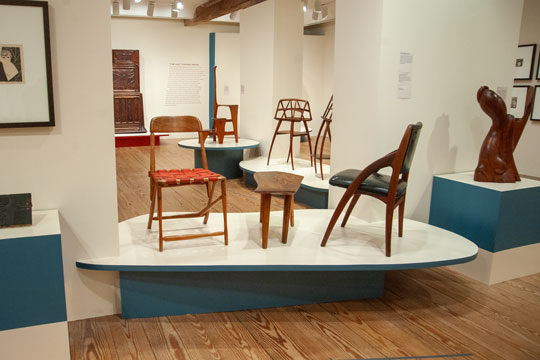
The Crafted World of Wharton Esherick is open now and runs through Jan. 19.

The new Wharton Esherick exhibit is different than most exhibits at the Brandywine River Museum of Art. There are still some hang-on-the-wall types of paintings and wood blocks, but there are also functional furniture and sculptures

“It’s so much different than people expect…We were interested in highlighting some of the other artists working in suburban Philadelphia, rural Pennsylvania at the same time as the Wyeths,” BRM Senior Curator Amanda Burdan said.
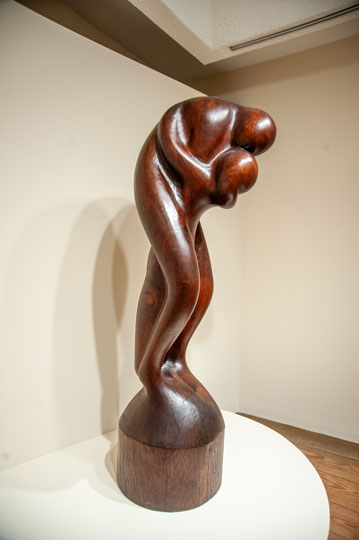
Oblivion, by Wharton Esherick, 1934. Walnut. The piece was inspired by an embrace of two actors in the play The Son of Perdition by Lynn Riggs.

Wharton Esherick, considered the father of the Studio Furniture Movement, lived from 1887 to 1970. He was born in Philadelphia and later moved to Malvern where there is now a Wharton Esherick Museum, which co-organized the exhibit at BRM.

“We’re so happy to bring these works out of the studio — of course, they belong there, and you should always experience them there —arranged in a way that gives a curatorial thesis, themes to follow through in a way to see things that you would never see together in a studio.”

The exhibit, The Crafted World of Wharton Esherick, includes more than 70 works and is the first to draw exclusively from the Wharton Esherick Museum’s collection of more than 3,000 pieces.

Burdan expressed how impressed she is with not only Esherick’s work but the times in which he was working, the times shared with another famous artist.

“He starts as a painter and is an artist who totally embraces and holistically takes over this aesthetic through printmaking and sculpture and furniture. And I just love what was happening simultaneously with N.C. Wyeth’s career,” she said. “It shows us this very artistic landscape of American art…We’re expanding, not just showing not just American art in general, but finding American art that has connections with our collection, with our mission, with our region.”
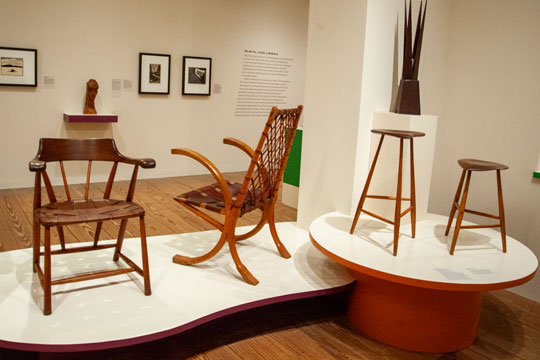
Esherick is considered the “father of the Studio Furniture Movement.

Emily Zilber, the director of Curatorial Affairs & Strategic partnerships of the Wharton Esherick Museum, said some of the items on display at the Brandywine had never left the WEM before. Others have not left in more than 50 years.

“These objects either had a life with Esherick for the duration of their existence, or they were out in the world but have not had a chance to make their second debut.,” Zilber said.

She went on to say that guests at the WEM get only one vision, how the objects but, “What you have here at the Brandywine will allow [visitors] to see those objects more similar to how Esherick would have staged them in his retrospective in the 1950s, but also in the context of a bigger art museum where you can see from different vantage points, where you can really engage with the objects on their own terms.”

The Crafted World of Wharton Esherick is open now and runs through Jan. 19.

New Esherick exhibit at BRM Read More »

George Robert Feathers of Unionville

George Robert “Bob” Feathers, 77, of Unionville died Friday, Oct. 4 from a sudden illness.

The beloved husband of Linda McRee Feathers, Bob was the son of the late George and Katherine Scholler Feathers.

George Robert “Bob” Feathers

He is survived by daughter Michelle Feathers, Reading, son and daughter-in-law Ben and Sarah Feathers, Downingtown, grandchildren Chelsey Breedy, Jessie Cinelli (Dan), Devon Breedy (Tara), Izabella Feathers, Dahlia Feathers and Edie Feathers and great-grandchildren Shane Breedy, Amelia, Eliza and Teddy Cinelli and Kai and Van Breedy.

Survivors also include brothers Stephen Feathers (Patricia) and Lance Feathers (Dorothy Ann), sisters Carolyn Miles (Murray) and Kathleen Fells, and many nieces and nephews.

Bob was one-of-a-kind. His genuine spirit, sense of humor, fierce love of his family and friends and ability to make anyone he met feel special will not be forgotten.

He will be greatly missed by his family and all who knew him.

A celebration of his life will be held later.

To view his online tribute and to share a memory with his family, please visit www.kuzoandfoulkfh.com.

Arrangements by the Kuzo Funeral Home, Kennett Square.

George Robert Feathers of Unionville Read More »

Rabbinic Reflections: Reclamation Proclamation

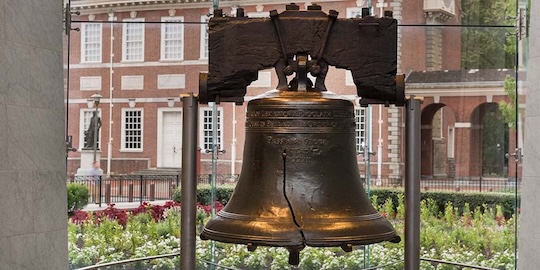
Image from https://www.nps.gov/inde/planyourvisit/libertybellcenter.htm

How do we go on? As a new Jewish year moves from the introspection and accounting of the High Holy Days into the coming harvest festival, how do we find hope when so much of last year’s hopes were broken?

 War and global conflict are inescapable news. Devastation from natural disasters hits harder and comes again faster. Politics and media are full of bitter division. On a lighter and also devastating note, Philadelphia sports fans are subject to a pile of playoff losses. In this context, it is instinctive to ask, like the Psalmist (121:1), “from where will my help come?”

Help may come from the divine, but Jewishly that really means God empowers us. What can we do to help ourselves and others to go on, to hope? The High Holy Day liturgy offers three possibilities that I will consider here: one, by referencing and reinforcing past traumas, we might see that “this too shall pass;” two, by ritualizing and resetting our relationships to each other and to God, we might start over; and three, perhaps a more obscure reference, by acknowledging and proclaiming liberty, we might reclaim common ground.

If resilience is like building muscle, the martyrology service of Yom Kippur is a choice workout. From ancient persecutions by the Romans to the Crusades and to the Holocaust, Jews’ worst experiences are highlighted as times of deep pain, loss, and lasting trauma. Knowing how antisemitism and other forms of hatred have turned against Jews has been key to the call “never again.” Part of the challenge of the past year is how many resonances there have been to painful moments in Jewish history. Some have even argued that seeing those resonances has limited Jews’ ability to see more broadly.

Regardless, the liturgy asks us to look back, to dwell on pain, to remember, and then to move forward from death (enacted through fasting and other abstinences of the day) to life (when atonement is achieved).

The ritualizing of atonement in processes of forgiveness and in prayers culminated in a re-enactment of the High Priest entering the Holy of Holies on Yom Kippur to seek atonement. To achieve atonement for the Jewish people, the High Priest first needs to seek it for himself, then for his family, and then for the people.

In many synagogues folks will fully prostrate to bring this ancient ritual back to life. Upon arising, the transition to atonement takes place and the tone of the day shifts. In theory, we emerge from Yom Kippur with a clean slate. From there, it is easy to move on, even if we know not everything will go right. We can, at least, try.

This year, though, I am struck by the final shofar blast at the end of Yom Kippur. It comes from Leviticus 25:8-10 as a command to sound the shofar to proclaim the jubilee year on Yom Kippur. Here is the catch, though, we do not know which year is the jubilee anymore; we have not known for millennia. There is something about “proclaim[ing] liberty throughout the land to all the inhabitants thereof” every year in case it is the right one that strikes me as a great path to hope.

By reclaiming a doubt and turning it into a gift, we take the cracks in our world and in our lives (like the crack in the Liberty Bell) and make them a cause for repair. This act is not a commitment to an ideological vision, it is a humble cry to patch things up as best we can. That is how I have hope, a call to reclaim our fragility, our human limitations, and to proclaim freedom for all.

Rabbinic Reflections: Reclamation Proclamation Read More »

Scroll to Top