
July 31, 2023

A Frenchman as an American hero

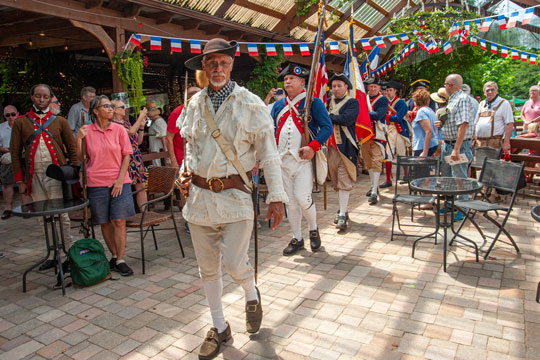
Bringing in the colors.

It’s said that when American soldiers arrived in France in 1917 to fight in WWI, the catchphrase from them was “Lafayette, we are here.”

Whether apocryphal or not, the phrase was used to connote a debt owed by and respect from the United States to France in general, and to the Marquis de Lafayette specifically. Lafayette came to the American colonies to help fight for their independence from Britain, which helped pave the way for France to ultimately join in the effort against the British.

Lafayette, Gen. George Washington’s aide, was wounded at what is now Sandy Hollow in Birmingham Township during the Battle of Brandywine. His efforts were remembered and honored Saturday at Thornbury Farm for Lafayette Day. Part of the 1777 battle took place on Thornbury Farm.
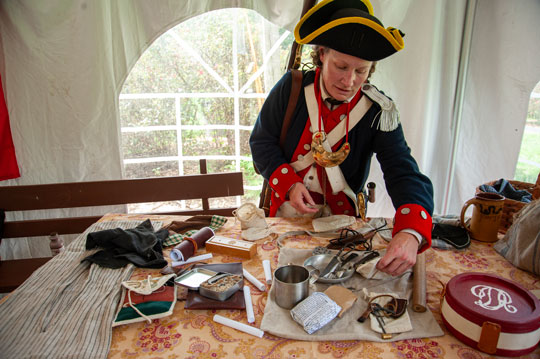
Reenactor Sheri Gidick displays items the average colonial infantryman would have in his kit.

“This is one of his first battles and where he and Washington formed a close father/son relationship,” said Randell Spackman, owner of Thornbury Farm and the president of the Chadds Ford Historical Society. He said Washington’s respect for Lafayette grew because of the young Frenchman’s conduct during the battle.

“When the ranks were starting to fall apart the marquis…went out and tried to reform the troops, realign them and actually pursue Gen. Howe’s army. And because he heroically went out into battle, fighting for [the American’ cause], the respect for him became incredible,” Spackman said. “Washington was so impressed that he had his own personal surgeon care for the marquis to help make sure he lived through his wound here at Brandywine.”

One of the guest speakers was to have been Chester County Commissioner Michelle Kichline, but she had an auto mishap on her way to the event so author and historian Bruce Mowday read the proclamation from County Council.

The proclamation reads in part, “…Lafayette fought for American freedom on the fields of Brandywine on Sept. 11, 1777, where he was wounded in his left leg spilling his blood on Chester County soil and marking the beginning of his ascent to becoming an American hero and trusted confidant to Gen. George Washington during the American Revolution.”

The resolution also acknowledged Lafayette’s efforts to get the French government to enter the war on behalf of the Americans, which helped Washington’s forces defeat the British at Yorktown and bring an end to the war.

In 1824, Lafayette returned to America for what was supposed to be a brief visit to the states along the eastern seaboard. However, he was in such demand that he stayed for 13 months going as far west and south as St. Louis, Mo., and New Orleans, La.

A Frenchman as an American hero Read More »
Brandywine Art Guide: Unseen Wyeth works on display

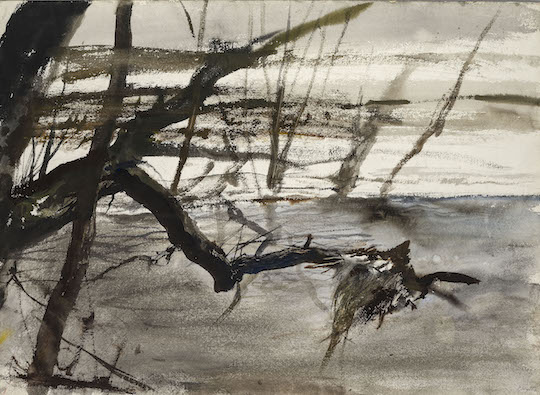
Andrew-Wyeth-Untitled-1948-watercolor-on-paper.-Collection-of-the-Wyeth-Foundation-for-American-Art-B0198.-2023-Wyeth-Foundation-for-American-Art-Artists-Rights-Society-ARS-New-York (digital file by Peter Philbin 3/23)

For those that think they know everything about Andrew Wyeth, the Brandywine Museum of Art has a message for you: You ain’t seen nothin’ yet.

Drawing from the nearly 7,000-object Andrew and Betsy Wyeth Collection of the Wyeth Foundation for American Art, Abstract Flash: Unseen Andrew Wyeth, the new exhibition that opened July 29, puts 37 never-before-seen abstract watercolors by the artist on view for the first time. Featuring scenes both familiar and inconclusive, it is an entirely fresh perspective on an artist that many may perceive as entirely, even overly, familiar.

“Untitleds are not unimportant simply because they are untitled,” said Karen Baumgartner, curator of the exhibition and Associate Collection Manager in the Wyeth Study Center at the Brandywine Museum of Art. Having worked with the artworks of Wyeth for decades, first for the Wyeths themselves and more recently at the Museum, she has a deep understanding of the vastness and variety of his full omnibus.

The collection has a new space within the museum as well, the Wyeth Gallery, a renovated area open to the public for the first time with this exhibition. The gallery will continue to show more works from the Wyeth collection as the rest of the collection is catalogued, studied, and analyzed, as well as other shows and exhibitions.

Andrew-Wyeth-Untitled-1953-watercolor-on-paper.-Collection-of-the-Wyeth-Foundation-for-American-Art-B0223.-2023-Wyeth-Foundation-for-American-Art-Artists-Rights-Society-ARS-New-York(digital file by Peter Philbin 3/23)

The watercolors are a novel presentation of Wyeth’s work. “This show reminds us that Wyeth is a radical painter,” said William L. Coleman, curator of the Brandywine’s Wyeth Foundation Center and director of the Wyeth Study Center. It presents “an unexpected side of the artist’s personality,” he added, with “an unexpected dialogue emerging” amongst the watercolors in the gallery and the rest of Wyeth’s body of work. The gallery opens onto a room of Wyeth paintings that are more familiar, large-scale realistic tempera works that depict landscapes and country scenery. It is a juxtaposition that highlights both the similarities and the differences of the artworks.

Take Untitled (1948), reference number B0198, by the system Betsy Wyeth used to label every piece of art created by Andrew before deciding whether they would be displayed, sold, shelved, or otherwise placed. Watercolor on paper, from far away it is not all that different from other Wyeths, the familiar scenery and colors and, well, the Brandywine itself. But up close the abstraction takes over, the pools of color and the scraped highlights and natural flow of watercolor versus the precise control of tempera.

It is interesting to set this piece in the world of Wyeth, and in the wider world of art. In 1948, Wyeth released Christina’s World, one of his best-known pieces. Also in 1948, Jackson Pollock created No. 5, 1948, one of his most famous works which was sold in 2006 for $140 million. “It was the last high watermark of realism as modernism,” said Coleman. From then on, the modernist movement as it is commonly recognized took over. Rather than Wyeth and Hopper and their realist contemporaries, it was Pollock and Duchamp and O’Keefe and Kahlo and Koons and Mondrian and Rothko.

Andrew-Wyeth-Untitled-1951-watercolor-on-paper.-Collection-of-the-Wyeth-Foundation-for-American-Art-B0265.-2023-Wyeth-Foundation-for-American-Art-Artists-Rights-Society-ARS-New-York

Wyeth’s abstract watercolors provide another perspective on his place in this movement. “For the makers, the painters that are inspired by Wyeth, this will be a treasure trove,” said Coleman.

“He is always thinking about what he is saying and what to show,” said Baumgartner, discussing both Wyeth’s abstract and realistic paintings. The artist is “controlling the light and the scene,” but in the abstract works, the why of the painting fades away, allowing the viewer to focus on the composition itself.

The catalog for this show is forthcoming early in the fall, and will set this collection in the vast abundance of Wyeth’s work. It includes essays by Coleman and Baumgartner, as well as Eric Aho, a contemporary artist. This quote from Aho seems to get to the heart of this show, and Wyeth as a whole: “Painting is about the accumulation of experience.” Part of the future of the Wyeth Collection includes the creation of the Wyeth Study Center at Brandywine, which will be open to scholars, artists, and others for research. It will be interesting to follow along and see what these experiences will uncover.

Abstract Flash: Unseen Andrew Wyeth is on view at the Brandywine Museum of Art from July 29, 2023, through February 18, 2024. It will then travel to the Farnsworth Art Museum in Rockland, Maine, where it will focus on the abstract works of Wyeth set in the Maine landscape. The Brandywine Museum of Art is located at 1 Hoffman’s Mill Road, Chadds Ford, PA. More information can be found online at Brandywine.org/Museum.

Brandywine Art Guide: Unseen Wyeth works on display Read More »

Scroll to Top