

June 18, 2023

Watershed race a success

Watershed race a success

They came to save the watershed and they left knowing their efforts are helping make that happen.

Concord Township and Newlin Grist Mill held a 5k and duck races Saturday, to fundraise for water quality monitoring equipment at the grist mill.

Steve Jacobs, Concord Township’s Parks and Recreation director, said that the event exceeded the number of 5k participants anticipated, with close to 130 runners. Jacobs added that several community members put lots of time and effort into planning the event and it was nice to see such ‘phenomenal’ results.
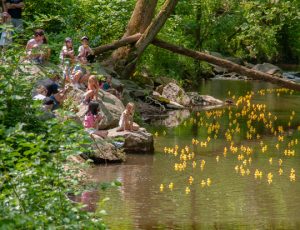
The ducks have an audience as they head into the final turn.

“It’s the first time we are doing this event, so it’s exciting to be partnering with the grist mill on this and bring communities together,” Jacobs said. “We’ve worked on this since the winter of 2022, so a lot of preparation and outreach went into the races,” he said.

Jacobs’s sister, Amanda Jacobs was one of the 5k race’s participants. She said she felt inspired to run in support of her brother, Concord Township, and her childhood at the Newlin Grist Mill.

“I grew up in Garnet Valley. The grist mill is always such a wonderful place to walk around and explore nature.” Amanda Jacobs said.

While the runners paid a $35 entry fee to take part in the 5k, people sponsored 353 rubber ducks at $20 per duck — or $50 for three ducks —to support the watershed effort. The rubber ducks were dumped out of buckets into the creek, where the current carried them downstream. Volunteers fished the ducks out of the water with nets.

Linda Reigel placed first in the duck race, with duck number 34, winning a prize of $1,000, while Tony Rock won the 5k race, finishing in 20 minutes and 24 seconds. Rock then ran back to his wife, who was walking the race with their baby in a stroller, finishing the 5k twice. Rock said he loves running 5k trails, noting that the grist mill trail was a great run.

Newlin Grist Mill Director Tony Shahan said that Concord Township and the grist mill have been working together on a watershed protection task force and that the money raised will go towards a hand-held water-quality monitor made by YSI.

Shahan, in his 15th year managing the 160-acre property, said he continually tries to hold community events, like the 5k, to bring the community together and remind Concord’s residents of the township’s unique historic and geographic landscape.

“[The goal of the Newlin Grist Mill] is to preserve and present the site, both the natural side and the historic side for the enjoyment and the pleasure of the public,” Shahan said. “We take very seriously serving our community and being an active part of it, not a drain.”

Shahan said he was proud of the event and the impact it will have on the grist mill.

“It was wonderful, absolutely wonderful. We met our fundraising goal of $10,000,” Shahan said. “It will be used to buy monitoring equipment so we can do a better job of monitoring our water quality in our community as part of a broader effort to protect our watershed.”

All ages were welcome to take part.

(Photos by Rich Schwartzman)

About Ellie Vasko

Ellie Vasko is a 2022 graduate of Unionville High School and a rising sophomore at George Washington University. She has written for the GW Hatchet and Unionville Post. She is interning with Chadds Ford Live this summer.

Watershed race a success Read More »
For the love of hot air

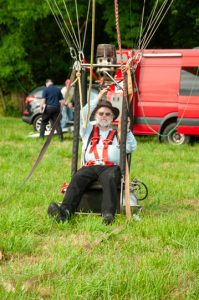
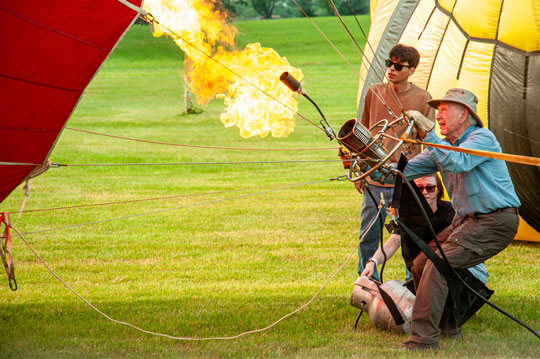
Bob Sparks, an 89-year-old balloonist, checks equipment for his balloon. He said later that the equipment wasn’t fitting properly and that he couldn’t fly because of that.

One man learned to fly balloons because his wife liked rabbits. Another man was a vaudeville-type entertainer who got bit by the balloon bug while performing in an open-air arena with Peggy Lee, and he’s still flying at 89 years of age.

They and more than a dozen other balloon pilots were taking part in the 2023 Chester County Balloon Festival. And there was a palpable buzz among the organizers of this year’s festival because it was in a new location. After years of being held at the New Garden Airfield, the 2023 festival was at Willowdale.

Keith Sproul sits in his single-seat chair under a balloon he made himself. He’s been flying for 21 years.

According to Rick Schimpf, the director of the Chester County Balloon Association, “We outgrew the airport,” saying the event had grown so much that the airport didn’t have enough room for all the vendors and that the tarmac would get too hot for comfort in late spring and into the summer.

But vendors aside, the event is about balloons and the people who fly them.

Keith Sproul was a Ham Radio operator and a computer programmer writing data collection programs for MacIntosh computers. He and his wife went to a balloon festival in New Jersey where they saw a balloon in the likeness of the Eveready Bunny and heard an announcement that the crew of that balloon was down a member and asked for volunteers.

“My wife likes rabbits, so I volunteered,” he said. Sproul then became a crew chief and later started flying himself. He eventually started making balloons. And he loves it. He’s been flying for 21 years and has reached an altitude of 10,000 feet.

“It’s neat, it’s fun, and I enjoy exposing people to ballooning who have never done it before. It’s fun to get up and it’s really a thrill to fly something you made yourself. I made this balloon,” Sproul said. “You have to have confidence in your abilities to do that. “I’m betting my life on this.”

Scorch, one of Keith Sproul’s homemade balloons. (Image from http://www.skychariot.com)

Some of the balloons Sproul made can be found here.

The most senior pilot at the festival was 89-year-old Bob Sparks, who started flying in 1966 and earned his pilot certificate by the decade’s end. He’s won 10 world records for ballooning, flew in 35 different countries, and taught ballooning in the former Soviet Union. He’s also flown across the Atlantic Ocean in a balloon, a gas balloon, not hot air. In 1975 he became the first person to fly a hot air balloon over all five of the Great Lakes.

To say he was bitten by the balloon bug is almost literal. Sparks said he got started after seeing a balloon while he was performing with Peggy Lee in a Midwest state fair.

“I was on stage next to [Peggy] and she looked up a couple of times. I looked up and thought it was a bug at first. And then I heard ‘Hello, Earthing.’ I looked up again and there was the damn balloon…I fell in love [with ballooning], still in love.”

Some people go aloft tethered to the ground.

He said he was invited to go to the Soviet Union while flying across Australia.

“The [Soviet] government had me come over there to teach. They had nobody who had a pilot’s certificate. They had no rules. A guy walked up to me and said, ‘Would you come to the Soviet Union if I arrange it?’ I said yeah and he arranged it.”

Sparks also made two attempts to cross the Atlantic in a balloon. The first ended with him going down in a thunderstorm off the coast of Newfoundland. Fortunately, the gondola he was using could convert to a boat and he was eventually rescued by the Canadian Coast Guard. His second attempt in a gas balloon was successful.

Age hasn’t slowed him down or dampened his enthusiasm. His love for ballooning hasn’t abated.

“When I’m in the air a mile above the ground, I know I’m where I belong.” And he added, “Every family should have a balloon.”

The National Balloon Museum has a page dedicated to Sparks.

About Rich Schwartzman

Rich Schwartzman has been reporting on events in the greater Chadds Ford area since September 2001 when he became the founding editor of The Chadds Ford Post. In April 2009 he became managing editor of ChaddsFordLive. He is also an award-winning photographer.

For the love of hot air Read More »

Brandywine Art Guide – Joseph Stella: Visionary Nature at the Brandywine Museum of Art

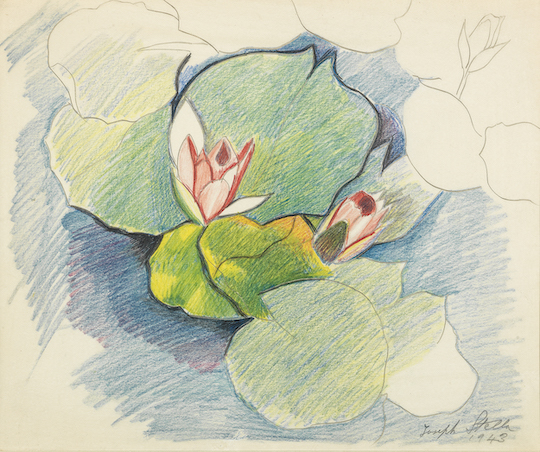
Joseph Stella, Two Pink Water Lilies, 1943, silverpoint and crayon on paper, 11 x 12 1/2 in. Collection of B. Dirr. Digital image courtesy of the Brandywine Museum of Art

Joseph Stella is an artist that defies categorization. His most recognizable artworks are modernist large-scale tributes to the marvels of the industrial age, Futurist, vivid, and linear depictions of the Brooklyn Bridge and Coney Island that capture the Gothic architecture within. However, the majority of his works took inspiration from the organic, the perfect imperfections of the natural world.

“I think he felt transformed by nature,” said Audrey Lewis, associate curator at the Brandywine Museum of Art and co-curator of the exhibition. The works shown in the exhibition are wonderfully varied in terms of style, subject, medium, and scale. From tiny watercolors to grandiose oils, exquisite botanical silverpoints to fantastical pastels, a casual observer would almost think they were seeing an exhibition of botanical artworks from dozens of artists rather than only one.

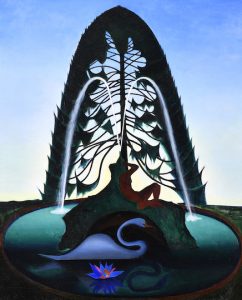
Joseph Stella, Fountain, 1929, oil on canvas, 49 x 40 in. Collection of Michelle Rabin and Sandy Bushberg. Photo by Dale M. Peterson, courtesy of Portland Art Museum, Portland, Oregon.

Stella worked as an illustrator early in the twentieth century, a contemporary of N. C. Wyeth, depicting realist images of the lives of immigrants in America. Himself an immigrant from Italy, Stella took inspiration from the scenes he encountered in New York, experimenting with style, form, and medium. His works from this time range from traditional oils to collages made with found materials to commercial works.

He returned to Europe, spending time in his home country and then Paris, where he found a thriving art scene and was exposed to Futurism, Cubism, Dadaism, and other modern influences among the members of Gertrude Stein’s famous salon. Stella returned to New York just in time for the infamous 1913 Armory Show, where he exhibited two paintings alongside Matisse, Cassatt, Monet, Renoir, Picasso, and other pillars of modern art.

Tree of My Life, Stella’s huge and intricately detailed oil, is reproduced on the wall at the Brandywine for a simple reason: the original painting won’t fit through the gallery doors. Both it and Brooklyn Bridge are seven feet tall, giant paintings that force the viewer’s eye to dance around the image to take it all in.

In Tree of My Life, “He is laying out his thematic program of what will recur in this work throughout his career,” said Stephanie Heydt, the Margaret and Terry Stent Curator of American Art at the High Museum of Art in Atlanta, Georgia. It provides an epic bridge for his work—literally and figuratively. An organic bridge stretches in from the left side of the painting, arching toward the twisted tree trunk that centers the scene.

In a time when there was significant anti-Italian and anti-Catholic sentiment, Stella was both. In his series of Madonnas, Stella was “flouting his identity and his past,” said Heydt. Purissima, another large vivid painting on view in the exhibition, recalls religious paintings, symmetrical upon first glance but revealing the many varieties of the natural world upon closer inspection. There are elements that reveal the passage of time, “memento mori”—a palm tightly furled and in full bloom, animals on full view and hidden behind greenery, Mount Vesuvius active in the background.

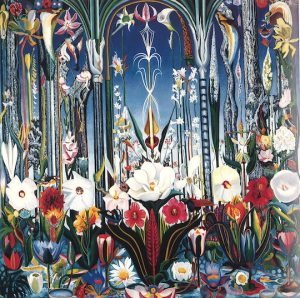
Joseph Stella, Flowers, Italy, ca. 1930, oil on canvas, 74 3/4 x 74 3/4 in. Phoenix Art Museum, Arizona, gift of Mr. and Mrs. Jonathan Marshall, 1964.20. Digital image © Phoenix Art Museum. All rights reserved. Photo by Ken Howie.

Throughout Stella’s works, including his botanicals, you can find a recurring “reference to Gothic architecture,” said Heydt, especially in works such as Flowers, Italy. While many of the birds and flowers in his works are recognizable, such as birds of paradise and sparrows, others are fantastical composites. Many pieces use “distinct layering techniques to achieve different textural effects,” Heydt noted.

The exhibition invites viewers to move not just in a direct line through the gallery, but to circle back and around again, new aspects of already seen paintings revealed by seeing what has come before and after. The silverpoints, comparatively simple, let the eye rest and see the organic lines of one flower that on other larger works are combined with hundreds of others. Stella enjoyed the challenge of working with silverpoint, an unforgiving medium where “once you make a wrong turn with the pen, there is no going back,” Heydt explained.

This is the first major exhibition of Stella’s work in decades, and his impact on modern art has mainly been overshadowed by his contemporaries and those that have come after. He is a sidenote in the outrageous stories of other, more flamboyant artists—for example, he accompanied Marcel Duchamp when he bought the object that, when signed, became the famous sculpture, Fountain. With this show, Stella is back in the spotlight, his grandiose works showcasing the range of American modernity.

Joseph Stella: Visionary Nature is on view at the Brandywine Museum of Art from June 17 through September 24. The exhibition is co-organized with the High Museum of Art, Atlanta, Ga., and this is its final stop. The Brandywine Museum of Art is located at 1 Hoffman’s Mill Road, Chadds Ford, PA. More information can be found online at Brandywine.org/Museum.

About Victoria Rose

Victoria Rose (she/her) is an editor, writer, avid reader, self-described geek, and fan of all things creative. Her passion for words has led to her current career as a freelance editor, and she is the owner of Flickering Words, an editing service. When not wielding a red pen (or cursor), she loves reading books of all genres, playing video, board, and word games, baking ridiculous creations to show off on the internet, or enjoying the gorgeous outdoors. She is a board member of the West Chester Film Festival and part of the Thirsty Monsters, a team of streamers from around the world who fundraise for various charities supporting LGBTQIA+ and accessibility rights. She can be found online @WordsFlickering or the Brandywine Art Guide @BrandywineArtGuide.

Brandywine Art Guide – Joseph Stella: Visionary Nature at the Brandywine Museum of Art Read More »

Preserving Hope: God isn’t an object

There’s a fascinating story in 1 Samuel 4 about the defeat of Israel at the hands of the Philistines nearly 3,000 years ago. Israel met in battle with the Philistines in a location called Aphek, which is considered to be eight miles east of the modern-day city of Tel Aviv. Tragically, Israel was defeated and lost nearly four thousand people. For perspective, that’s more than America lost on 911.

But instead of seeking the Lord in repentance, Israel regroups and tries again. This time, however, they bring the ark of the covenant with them. Perhaps you only know the Ark of the Covenant from Indiana Jones. But this was a special box constructed at the time of Moses, as Israel came out of bondage in Egypt. It contained the Ten Commandments, a bit of manna, and the staff of Aaron that had butted. It was called the “mercy seat” because it was the symbolic seat of Israel’s invisible God.

But Israel made a very unwise decision. They thought that God could be objectified. If they brought the ark of the covenant, God would never allow these holy objects to fall into the hands of his enemies. He would be forced to deliver the people. It’s a form of what one commentary calls “rabbit foot theology.” We view God as an object that can be manipulated rather than a loving, holy, personal God who must be treated as an active agent in the world.

Sadly, we can be a lot like Israel. We look to superstitious forms of worship, thinking that we can control God through our generous tithes or our feeble religious ceremonies. But God is the Holy, Righteous Creator of the universe. He is the One who put the stars in the sky. He is the One who orders everything according to the counsel of his holy will. He can’t be manipulated for our shallow purposes.

But as we return to 1 Samuel 4, we see that Israel was defeated by the Philistines a second time; this time, over 30,000 men lost their lives on the Israelite side. It was a massive defeat. The death toll rivaled many Civil War battles that were fought with guns and cannons. But the narrative teaches us a vital lesson: God is more concerned about our holiness than our outward success as the people of God.

Therefore, when Christians face political defeat in the culture or hardship in the church, our call isn’t to pull ourselves up by our bootstraps and to keep going. Our call is to turn to the Lord in repentance, humility, and faith. We are to seek him first and foremost as the personal God who loved us so much that he gave his only Son, Jesus Christ, to live the perfect life that we could never live and to die a sacrificial death in our place on the cross so that anyone who puts their trust in him can have eternal life and joy with God forever.

About Will Stern

Originally from Colorado, Will Stern is the pastor of Hope Presbyterian Church in Garnet Valley. He majored in violin performance for his undergrad and taught violin for a number of years before being called into ministry. He studied theology at Duke University and Westminster Theological Seminary.

Preserving Hope: God isn’t an object Read More »

Scroll to Top