

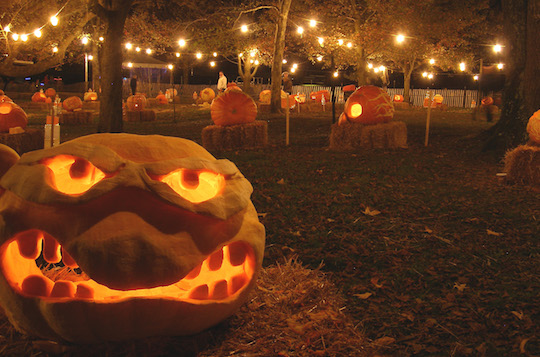
Pumpkins and sand at CFHS
The Great Pumpkin Carve could have a sequel, or maybe it’s a little brother or sister. Sand sculpting might be coming to the Chadds Ford Historical Society next year and the possibility will be previewed at this year’s Carve.
Chuck Feld, of Birmingham Township, is considered by some to be one of the top 100 sand sculptors in the country, according to Sandi Johnson, the operations director at the Chadds Ford Historical Society. She said recently that Feld will be doing a demonstration of sand sculpting during this year’s Carve.
She has no idea what he’s going to sculpt but estimates seven to ten tons of sand will be trucked in for Feld to do his thing on Thursday, Oct. 20, the first night of the Carve. If it’s successful and there’s enough community interest, Johnson said, sand sculpting could become an annual separate event for CFHS beginning next spring.
“That would be a perfect opportunity to do something different before the summer months,” Johnson said.
Jen Manderscheid, the perennial chairman for the Carve is eager to see what happens because it could lead to more support for the CFHS.
Manderscheid said QVC is supposed to be onsite that first night to live stream the sand sculpting. The word is, QVC will also replay the sculpting to generate a larger audience and that, Manderscheid said, could benefit the Historical Society.
“If QVC sees there’s a buzz about it, then they’re going to sponsor the event next spring.”
And if the sand sculpting is a success, Feld could carve himself a place in the folklore of The Great Pumpkin Carve. He’s already known as the man who throws pumpkin seeds and fiber into the air and shouts “Pumpkin guts.”
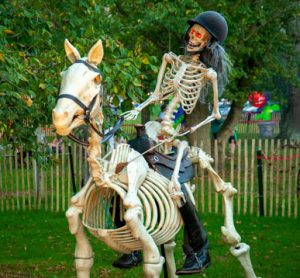
That folklore also includes a reason why the Carve moved from its original location at the porch of the old Chadds Ford Inn, now Brandywine Prime. It went from there, to Hank’s Place, and to the parking lot of the Brandywine River Museum of Art before finding its longtime home at the Historical Society.
As the story goes, it had to be moved from the inn because the pumpkins got in the way of the drunks. According to another tale, a carver stepped back into Route 1 to get a better look at his handy work and almost got hit by a car. And legend says that carver was Jamie Wyeth.
Those stories are not to be taken as gospel. They are merely part of the lore of the Carve, an event that has been the biggest fundraiser for the Historical Society, and one that is nothing but fun.
Jen Manderscheid, the perennial chairman for the event, has been at the helm for the past 13 years. In her words, “It’s a time to escape into having fun.”
And while the Carve has its lore, it also has reach.
She said that while most carvers are from the tri-state area, some have come from as far as California to be part of a carving team. Other-of-towners, she added, will plan to visit family and friends in this area so they take go to the Carve.
Manderscheid said she loves the fact that people come from all over, either to carve or just watch.
“It’s awesome. I think it’s great. I always think of it [just] here, but it affects other people and affects them enough in a positive way that they want to come to this.”
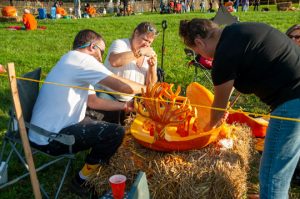
Up to 70 carvers can take part this year, that’s how many pumpkins there will be. Fifty people had already signed up by late last week and 20 more pumpkins are still waiting for a carver or two to slice, gut, and turn them into whatever the creative mind of the carver wants to make.
This year’s Carve is 4-9 p.m. Thursday and Friday, Oct. 20 and 21, and 3-9 p.m. on Saturday, Oct. 22. Each night, kids and adults can enjoy the carving, as well as a Haunted Trail, raffle prizes and live music from Kenny & Friends. Admission is $15 for adults, $5 for kids 7-17, and free for kids younger than 7 and CFHS members. Go here for more information.
About Rich Schwartzman
Rich Schwartzman has been reporting on events in the greater Chadds Ford area since September 2001 when he became the founding editor of The Chadds Ford Post. In April 2009 he became managing editor of ChaddsFordLive. He is also an award-winning photographer.
Pumpkins and sand at CFHS Read More »