
March 29, 2022

Parade returns to Kennett Square
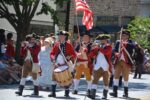
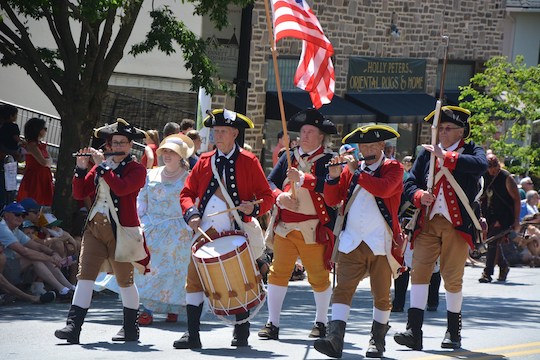
The Kennett Square Memorial Day Parade returns on May 30.

Kennett Square loves a parade, and the 2022 Kennett Square Memorial Day Parade promises to be a fun, family-friendly event with something for everyone, according to a press release. More than a dozen marching bands and musical groups will participate, including the Mummers and the Philadelphia Eagles Pep Band as well as bagpipers, fife and drum corps,  drum and bugle corps, high-school bands, and more. In addition to honoring over 100 veterans marching in the parade, spectators will enjoy seeing dancers, classic cars, colorful floats created by various community organizations, historic re-enactors, vintage military equipment, fire trucks, a Viking ship, and much more.

New to the parade this year will be the six-time world champion Bushwackers Drum and Bugle Corps from Princeton, N.J. The 50–75 members of the Bushwackers will be practicing at the Kennett High School football field on Sunday, May 29, during daytime hours (8 a.m.–4 p.m.). This practice will be open to the public.

“The parade is something for the whole family to enjoy,” said local realtor and parade committee member Luis Tovar. From the popular Aztec dancers to charros on horseback, Chinese folk dancers, and more, this year’s parade will include a great variety of culturally diverse participants.

The Grand Marshalls for the 2022 Memorial Day Parade are Alfred “Ray” Coe Jr. and Edward B. Fourney. Coe was commander of a Sheridan tank in Vietnam and earned a Bronze Star and a Purple Heart. Fourney, who served in Korea as a master mechanic in the Army Truck Fleet Service from 1952 to 1954, is a recipient of the National Defense Service Medal.

It’s his passion for remembering those who fought for our freedom that has motivated Bill Taylor to organize the Memorial Day Parade every year since 2005. “It’s important for young people to learn the history of this day and have an appreciation for our veterans who fought to protect our freedom,” Taylor says.

Taylor is retiring this year and passing the baton to a new Memorial Day Parade Development Committee comprised of 20 community members. While it may take a few dozen people to fill Taylor’s shoes, the committee is enthusiastic and grateful to Taylor, his family, and employees who have worked so hard and given so much to put on the parade for so many years.

“We are looking forward to creating a marvelous parade for us all to honor our US military personnel who have served, and continue to serve, with devotion, loyalty, and commitment in the United States Armed Forces to keep the freedom we all enjoy,” said committee chair Dave Haradon.

The parade route will remain the same as in past years, and the Kennett Square Police Department encourages parade-goers to park in the East Linden Street Parking Garage. The parade begins at 10 a.m. at Kennett High School and follows South Union Street to East Cypress Street, up the 100 block of South Broad Street, then west on State Street to North Union Street and on to Union Hill Cemetery, where a memorial service with a 21-gun salute and a wreath-laying ceremony will be held.

Parade updates and details will be posted on the new Memorial Day Parade website. Anyone who would like to march in the parade should contact David Francis at KennettMemorialDayParade@gmail.com. Organizations or businesses who would like to join this list of generous, community-minded parade sponsors can find more information on sponsorship opportunities here.

Parade returns to Kennett Square Read More »
Gate-crashing at BRM

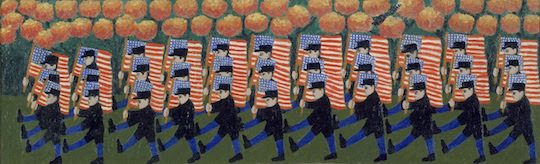
William Doriani (American, born Ukraine, 1891–1958), Flag Day, 1935, oil on canvas, The Museum of Modern Art, New York, The Sidney and Harriet Janis Collection. Digital Image © The Museum of Modern Art/Licensed by SCALA/Art Resource, New York.

Coming to the Brandywine River Museum of Art this May, Gatecrashers: The Rise of the Self-Taught Artist in America will celebrate two dozen early-20th century painters who fundamentally changed the art world. These artists, all without formal training, diversified the field across lines of race, ethnicity, class, gender, and ability. Featuring more than 60 works, this exhibition examines how self-taught artists “crashed the gates” of the elite art world after World War I and the remarkable ways in which they reshaped the notion of who could be called an artist in the United States.

Gatecrashers is organized by the High Museum of Art and curated by Katherine Jentleson, the High’s Curator of Folk and Self-Taught Art. The exhibition includes works by renowned painters such as Horace Pippin, Anna Mary Robertson “Grandma” Moses, and John Kane, as well as by artists who are lesser-known now but were recognized in their day, including Morris Hirshfield, Josephine Joy, Lawrence Lebduska, Patrick Sullivan and 17 others.

Horace Pippin (American, 1888–1946), Saying Prayers, 1943, oil on canvas, Brandywine River Art Museum, The Betsy James Wyeth Fund, 1980.

“This exhibition offers a fascinating new perspective on how self-taught artists were perceived and elevated in the years between WWI and II,” said Thomas Padon, the James H. Duff director of the Brandywine River Museum of Art. “During this period, the work of self-taught artists was thought to embody a more direct experience of American life. The exhibition reveals how this group brought a heretofore unknown degree of diversity to the inner sanctums of museums and galleries in this country.” Padon added, “The exhibition provides such a fascinating context to the Brandywine’s own holdings of self-taught artists.”

Expanding upon Jentleson’s book of the same title, Gatecrashers is organized into several thematic sections that explore the rise of self-taught artists in the era between the wars. The exhibition section entitled “American Mythologies” focuses on how these artists were eagerly embraced under the belief that—by virtue of being self-taught—they were examples of creative excellence that was “uniquely American,” free from the traditions and innovations that had made European artists dominant for centuries. These breakthrough American artists—such as John Kane and Patsy Santo—often rose from humble or marginalized beginnings and were praised for their originality and national character.

During the Great Depression, the idea of the practical, multitasking American gained particular resonance. In the “Workers First” section, the exhibition examines the role that self-taught artists’ jobs outside the art world played in advancing their reputations. Whether it was Morris Hirshfield’s rise through the ranks of Brooklyn’s textile factories, or Israel Litwak’s trade as a cabinetmaker, critics noted how these artists’ occupational histories influenced their subject matter and helped shape their artistic development. Many self-taught artists, such as Josephine Joy, were also at some point employed by the Federal Art Project, a Depression-era assistance program for artists that underscored the association of art with labor and the importance of government work-relief programs.

Morris Hirshfield (American, 1879–1946), Girl in a Mirror, 1940, oil on canvas, The Museum of Modern Art, New York, purchase. © 2021 Estate of Morris Hirshfield/Licensed by VAGA at Artists Rights Society (ARS), New York. Digital image © The Museum of Modern Art/Licensed by SCALA/Art Resource, New York.

A number of self-taught artists were recent immigrants who painted memories and customs from their homelands, as well as the places, symbols, and history of the United States. “Negotiating National Identity” outlines the ways in which self-taught artists often employed distinctly American subjects to establish national identity in their work. The Ukraine-born William Doriani, for example, paid tribute to his new home with a panoramic view of a patriotic procession he saw on the day he returned to the United States after a 13-year absence. In a 1938 exhibition, The Museum of Modern Art featured several of the artists represented in Gatecrashers, presenting them as “artists of the people” and showing how immigrants from Southern and Eastern Europe were increasingly considered American patriots. This was a significant shift given that, just a decade earlier, immigrants from these areas had been the targets of prejudice and restrictive immigration policies.

“Related Trends in American Painting” points out the ways in which work by self-taught artists in this period to the art of the American Modernists. Alignments in style and subject matter led to exhibitions that integrated these artists’ work with that of their trained peers, foreshadowing how many museums today display self-taught artists within their American and contemporary art collections. In Gatecrashers, the work of self-taught artists Horace Pippin and Cleo Crawford appear alongside formally trained modernists Jacob Lawrence and Hale Woodruff. All four were Black artists who achieved recognition in the pluralistic atmosphere of the period.

Gatecrashers’ — both the book and the exhibition — establish an origin story for how self-taught artists first succeeded within the mainstream art world,” said Jentleson. “Kane, Moses, Pippin, and the other artists in the exhibition deserve to be reconsidered not only because of how their work intertwined with major cultural and social change of their day but also because of how their gatecrashing set the stage for the vital role that self-taught artists still play in the 21st century, greatly diversifying our cultural canons across race, gender, class, ability and other important markers of identity that are all too often underrepresented.”

The Brandywine River Museum of Art is the second stop for this traveling exhibition and will be on view from May 28 through September 5, 2022. The exhibition previously debuted at the High Museum of Art in Atlanta, GA, and the tour will conclude at the Westmoreland Museum of American Art in Greensburg, PA. This project is supported in part by an award from the National Endowment for the Arts and The Dorothea and Leo Rabkin Foundation.


About CFLive Staff

See Contributors Page https://chaddsfordlive.com/writers/

Gate-crashing at BRM Read More »

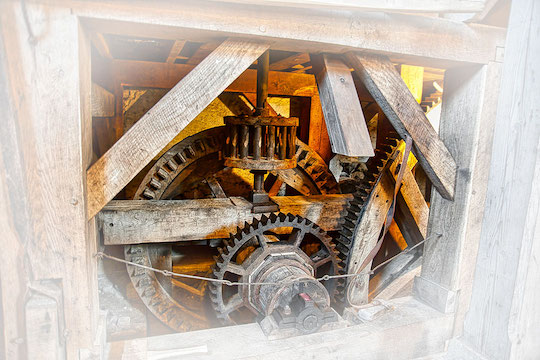
Photo of the Week: Gear Works

Gear Works

Part of the internal mechanism at the Newlin Grist Mill that turned the wheels that ground the grain.

About Rich Schwartzman

Rich Schwartzman has been reporting on events in the greater Chadds Ford area since September 2001 when he became the founding editor of The Chadds Ford Post. In April 2009 he became managing editor of ChaddsFordLive. He is also an award-winning photographer.

Photo of the Week: Gear Works Read More »

Scroll to Top