
February 1, 2020

Museum exhibits the fight for rights
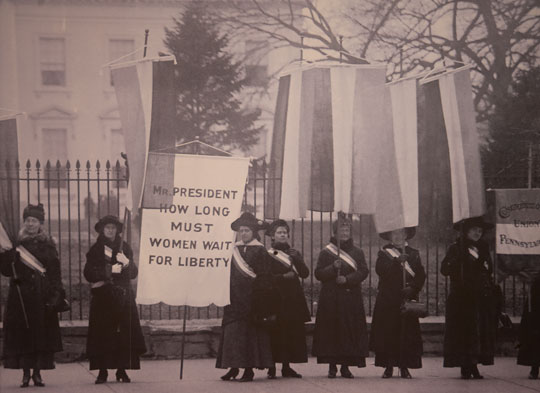
Women’s Suffrage Procession in Washington D.C., March 3, 1913. George Grantham Bain Collection, Library of Congress

Fighting for rights and equality under the law is never easy and can be life-threatening. Two new exhibits at the Brandywine River Museum of Art focus on two such struggles.
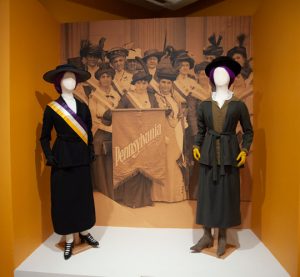
Pennsylvania suffragettes

Votes for Women: A Visual History, runs through June 7 and Witness to History: The Selma Photography of Stephen Somerstein runs through June 14.

Amanda Burdan, who curated Votes for Women, is clear on what she hopes visitors will take away after seeing the exhibits.

“How women, how anyone who feels invisible, makes their case, make their cause visible in a way that’s respectful, nonviolent, but also really makes an impact, a visual impact, has visualization of these movements happened,” she said.

Votes for Women includes photographs, movie footage, posters and period clothing from the suffragist movement in the 1910s leading up to the passage of the 19th Amendment in 1920. It’s a commemoration of the 100th anniversary of women getting the right to vote on the federal level. Some states, such as Wyoming, Colorado, Utah and Idaho granted suffrage during the 1800s. But it took a constitutional amendment for suffrage throughout the United States.

The movement for suffrage was omnipresent, Burdan explained, and that the visual went well beyond traditional visual arts such as painting.

Images, banners and pins from the movement.

“There was a Charlie Chaplin film about suffrage and another feature film [a clip of which is in the exhibit] called “80 Million People Want What?” And they have key aspects of suffrage in their plotline. So, you could go to the movies and see suffrage. You could walk down the street and see suffrage. You could walk by a woman who was wearing a pin that said, ‘Votes for Women’ and you’re seeing suffrage,” Burdan said.
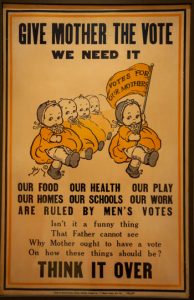
Invoking motherhood.

Also included are clothing worn by the suffragists of the day as they marched. Burdan thinks one of the more impressive visuals was when women moved out into the streets to march and protest, and “dressed to express thoughts and feelings.”

There are old pins, hatbands and dresses of the era, and also some of the old capes worn during the various marches, including a march in Washington during the inaugural weekend of 1913 following the election of Woodrow Wilson.

Also included in the exhibit is the recognition of the women of color who were involved in the suffrage movement. The Brandywine commissioned a group of women artists to create a mural illustrating the portraits of those women. The Hidden Figures of the Suffrage Movement include Ethel Cuff Black who founded Delta Sigma Theta, an African American sorority that marched in the 1913 parade in Washington.

Burdan will hold two lectures on her research into the suffragist movement on Wednesday, Feb. 19, at 11 a.m. and 6 p.m. The cost is $15 for members, $20 for others. To register, go here.

There will also be a tea and tour on Feb. 27.
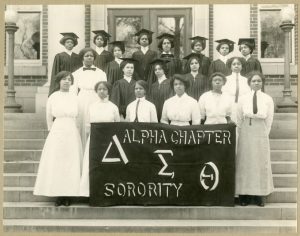
Delta Sigma Theta Sorority, 1913. Courtesy of the Moorland-Spingarn Research Center, Howard University Archives. Howard University, Washington, D.C.
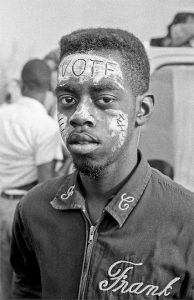
Bobby Simmons – African-American young man with “VOTE” on forehead painted with zinc oxide sun tan lotion – 1965 Selma to Montgomery, Alabama Civil Rights March. (Photo by Stephen F. Somerstein/Getty Images)

A second exhibit

The concurrent exhibit, Witness to History features the photography of a then 24-year-old student from the Community College of New York, Stephen Somerstein who traveled to Alabama to photograph Dr. Martin Luther King Jr.-led march from Selma to Montgomery in 1965.

Among the 55 images in the exhibit are those of King, Rosa Parks, Joan Baez Bayard Rustin and the multitude of the not so famous who took part in the third of three marches for civil and voting rights following 26-year-old Jimmy Lee Jackson, a church deacon earlier that year.

Somerstein will speak at the museum on Wednesday, April 1 from 6 to 8 p.m. To register for that discussion, go here.
About Rich Schwartzman

Rich Schwartzman has been reporting on events in the greater Chadds Ford area since September 2001 when he became the founding editor of The Chadds Ford Post. In April 2009 he became managing editor of ChaddsFordLive. He is also an award-winning photographer.

Museum exhibits the fight for rights Read More »
Mind Matters: Grief revisited

I sit at a college in Massachusetts, staring out the window at a stand of lodgepole pines. Students, staff, tread the paved walkways cleared of snow. I am here because a young woman athlete named Grace died in a car crash. Some of her rowing crewmates are still in a Florida hospital, hopefully healing from their injuries.

The local Boston papers have reported sudden deaths of other young people in the past few weeks—a young man shot in the city just a year after another family member was killed; another young college student died in a car crash in Costa Rica; another student died in a fight. In all these untimely deaths, there are friends and family left behind who are deeply grieving.

With Grace’s death, however, there seems to be public mourning. She was a champion at crew; she broke the record for indoor rowing; she was active in so many things and touched many lives. A lot of people’s various assumptive worlds caved in with her death.

Maybe that’s why I wanted to be on campus to make a difference — because I remember when my assumptive world came tumbling down in 1959 when my cousin died. I was 14, he was 13. It was Thanksgiving Day and he was riding his bike, delivering newspapers in a chilling rain when a drunk driver in a pickup truck careened into him.

He must have had severe brain damage as he lay in the hospital. Child that I was, I thought certainly a miracle would happen. I remember that the rain had stopped that evening, and the night became clear for stars to shine. We, my mother and I (my father went to work the night shift at the Philadelphia Inquirer), walked to my grandparents’ house. Was she as certain as I was that he would be all right? Probably not. We prayed anyway.

When we came back home and lay in bed, the finality of the news came. Roger had died. I remember sobbing in disbelief. This could not be. He’s younger than I—in that moment, I believe I not only faced his fragile mortality but my own as well. The stability of my assumptive world was shattered. Everything — topsy-turvy.

Sadly, I don’t think any of us really got to grieve or recognize how our worlds were shattered. The funeral was immense — all my high school nuns were there, their black robes befitting the occasion. I said some stupid thing to my aunt about Roger being an angel now. Aunt Margaret was so numb, she may not have heard what I said.

Days later, we were all back in school. His brother, my classmate, carried on as usual. He didn’t talk about Roger — no words, no tears. How terrible for them — his parents and siblings — how awful too for all of us. We were (and are now, even in old age) a band of cousins. We lived close to each other, we played together, ate together, slept over in each other’s houses.

Now that I look back, I am only now realizing how much no one really acknowledged our various griefs — our loss of a stable world we could trust.

It would have been so much better if back then there had been someone to talk to who would understand, or some group of grievers to offer support. Instead, Roger’s immediate and extended families both just slogged on, eventually creating a new normal out of the fractured pieces of our former assumptive worlds. How much better it would have been if we had had permission to mourn — to talk about Roger, to cry, to scream, to come to terms with the fragility of life and how our assumptive worlds were shattered, and then to make new meaning out of living.

See:

  • Robert A. Neimeyer, Lessons of Loss: A Guide to Coping, 2nd Ed., Taylor & Francis (January 30, 2012).
    ·         Therese A. Rando, How To Go On Living When Someone You Love Dies, Bantam, (July 18, 1991).
    ·         C. S. Lewis, A Grief Observed, HarperOne (February 6, 2001).

About Kayta Gajdos

Dr. Kathleen Curzie Gajdos ("Kayta") is a licensed psychologist (Pennsylvania and Delaware) who has worked with individuals, couples, and families with a spectrum of problems. She has experience and training in the fields of alcohol and drug addictions, hypnosis, family therapy, Jungian theory, Gestalt therapy, EMDR, and bereavement. Dr. Gajdos developed a private practice in the Pittsburgh area, and was affiliated with the Family Therapy Institute of Western Psychiatric Institute and Clinic, having written numerous articles for the Family Therapy Newsletter there. She has published in the American Psychological Association Bulletin, the Family Psychologist, and in the Swedenborgian publications, Chrysalis and The Messenger. Dr. Gajdos has taught at the college level, most recently for West Chester University and Wilmington College, and has served as field faculty for Vermont College of Norwich University the Union Institute's Center for Distance Learning, Cincinnati, Ohio. She has also served as consulting psychologist to the Irene Stacy Community MH/MR Center in Western Pennsylvania where she supervised psychologists in training. Currently active in disaster relief, Dr. Gajdos serves with the American Red Cross and participated in Hurricane Katrina relief efforts as a member of teams from the Department of Health and Human Services' Substance Abuse and Mental Health Services Administration.Now living in Chadds Ford, in the Brandywine Valley of eastern Pennsylvania, Dr. Gajdos combines her private practice working with individuals, couples and families, with leading workshops on such topics as grief and healing, the impact of multigenerational grief and trauma shame, the shadow and self, Women Who Run with the Wolves, motherless daughters, and mediation and relaxation. Each year at Temenos Retreat Center in West Chester, PA she leads a griefs of birthing ritual for those who have suffered losses of procreation (abortions, miscarriages, infertility, etc.); she also holds yearly A Day of Re-Collection at Temenos.Dr. Gajdos holds Master's degrees in both philosophy and clinical psychology and received her Ph.D. in counseling at the University of Pittsburgh. Among her professional affiliations, she includes having been a founding member and board member of the C.G. Jung Educational Center of Pittsburgh, as well as being listed in Who's Who of American Women. Currently, she is a member of the American Psychological Association, The Pennsylvania Psychological Association, the Delaware Psychological Association, the American Family Therapy Academy, The Association for Death Education and Counseling, and the Delaware County Mental Health and Mental Retardation Board. Woven into her professional career are Dr. Gajdos' pursuits of dancing, singing, and writing poetry.

Mind Matters: Grief revisited Read More »

Scroll to Top