
December 17, 2018

Overlapping painting and photography

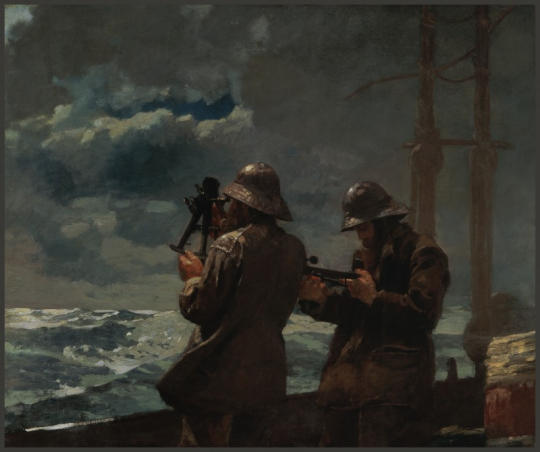
Winslow Homer (1836–1910), Eight Bells, 1886, oil on canvas, Credit: Addison Gallery of American Art, Phillips Academy, Andover, MA / Art Resource, N.Y.

While painting and photography are different arts, they can and do overlap at times. Paintings can look like photographs and photos can be processed to look like paintings. And classic paintings by the old masters are often used to teach photographers, as well as new painters, how to compose an image and even how to light a scene.

There are also times when painters will use a photograph to help complete a painting when they get back to their studio. And then there are painters who use photos to help develop their own art.

Consider some of the work of Winslow Homer now on display at the Brandywine River Museum of Art in Winslow Homer: Photography and the Art of Painting.

Homer began his artistic career as an illustrator in the 1800s and one of his illustrations — that of the inauguration of Abraham Lincoln — is hanging next to a photograph of the inauguration, a photo taken by noted Civil War photographer Alexander Gardner. Another side by side imagery shows two portraits of Lincoln, one being a drawing by Homer and another being a Matthew Brady photograph. Both of Homer’s illustrations were for Harper’s Weekly.
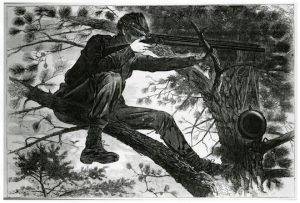
Winslow Homer (1836–1910), The Army of the Potomac — Sharpshooter on Picket Duty, wood engraving on paper, published in Harper’s Weekly, Nov.15, 1862

But as Christine Podmaniczky, a curator at the museum noted, the technology of the times that Homer included went beyond photography. He was not a photographer himself and he didn’t own a camera until the 1880s. But he included other types of viewing technology —telescopes and sextants — within his paintings and drawings.

His painting Eight Bells (see featured image) is an example of that point. The image shows two sailors at sea, one using a sextant and the other looking down at what might be a chart. Podmaniczky raised the possibility of the sailor looking at the chart might represent Homer the artist while the one using the sextant being Homer the observer who uses technology to get the observation accurate.

She also noted that the Civil War photography of Garner and Brady brought about “a new way of thinking about war [about how it’s portrayed]. It’s no longer the heroic general on a horse, but bodies.”

That new way of looking was also about the individual soldier and his life in uniform and in combat. Homer captured that concept with his The Army of the Potomac — Sharpshooter on Picket Duty, Skirmish in the Wilderness and Trooper Meditating Beside a Grave.

Podmaniczky was insistent that some of her comments come directly from Frank Goodyear and Dana Byrd, the actual curators of the exhibit from Bowdoin College in Maine. The exhibit is on loan to the BRM.

“It’s all about ‘getting it right,’” for Homer, she explained. “I’m fascinated that he was such an observer of nature. He spent hours and hours just observing. He was all about getting it right through observation.”

But Homer was also a businessman who realized a drawing or a painting could only be sold once, Podmaniczky said. So, during the last 30 years of his life, he had lithographs and photos made of his work so he could sell more copies of the same image.

But there were creative reasons as well, reasons that point to the idea of him getting things right through observation. According to press notes: “His use of various media came from his interest in probing the way things look and the challenge of portraying them realistically. Homer borrowed certain elements — the cropping, the blur of the background and the flatness of the composition — from photographic convention, yet his painting, based on unique optical experience, as an artistic creation reflective of myriad decisions. To Homer, paintings had the potential to make a subject more clearly understood; photography added to that conversation about how to portray the world around him.”

Winslow Homer: Photography and the Art of Painting, on loan from the Bowdoin College Museum of Art, runs through Feb. 17.
About Rich Schwartzman

Rich Schwartzman has been reporting on events in the greater Chadds Ford area since September 2001 when he became the founding editor of The Chadds Ford Post. In April 2009 he became managing editor of ChaddsFordLive. He is also an award-winning photographer.

Overlapping painting and photography Read More »
Robert C Jackson

Can you keep a secret?

Robert C Jackson
Can you keep a secret?

Bob Jackson is probably working in his 204 State Street studio even though the lights are out and it looks like no one is in there. Jackson chose this prime location, not to draw passersby inside but because of the room’s high ceilings and natural northern light—manna to painters who work on large canvases.

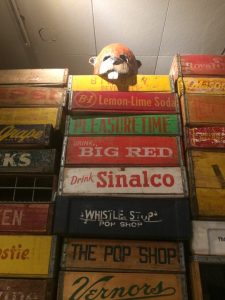
Signature soda crates in Jackson’s studio

The studio is neat and tidy with his signature soda crates visible where they are stacked floor to ceiling in the back room. Children’s toys that serve as props fill a glass display case in the corner. Because Jackson works on large canvases, he needs a studio with high ceilings—these ceilings are a perfect ten feet—and the room is large enough to accommodate the canvas, leaving Jackson enough room to roll around on his chair. He moves forward and backwards and from side to side inspecting and painting the current canvas on the easel.

Jackson jokes that his style betrays “a split personality.” “I paint in a traditional still-life manner but with a sense of humor,” he says with the ever-present twinkle in his eye. Jackson loves posing and reposing objects in his compositions. “I feel like a sculptor,” he says. “I like moving things around to get the right look,” he continues. His paintings are full of American nostalgia, to a slower time in life when there was time to enjoy and appreciate silly things that made us smile. His southern childhood (thanks to dad’s transfers all over the south during Jackson’s formative years) put a stamp on him as indelible as the stamp he now puts on his creations. His southern charm shines through in person and in his paintings

Props galore in the studio

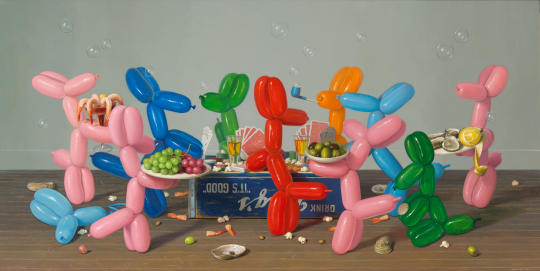
Jackson has incorporated dogs, apples, and balloon animals as points of interest in his compositions. His latest inspiration has his hand prints all over the formal arrangement of soda crates. If gives him great pleasure to know that people smile when they see his paintings. “A patron told me that I changed his way of collecting. He said people who came to his house never commented on any of the artwork hanging on the walls. But since he brought home Jackson paintings, visitors go right over to it and start talking about it,” he shared. “That’s what I want people to talk about the art. So now I look for other provocative paintings that will encourage discussion.”

Jackson wasn’t always a painter. He doodled in class (more than he should have, he admits) as a student studying electrical engineering at the University of Delaware. His now wife Suzanne gave him his first set of oil paints for Christmas his senior year. He had no idea what to do with them. His first composition was a still life of his paintbrush, one of the new tubes of oil paint, and a bottle of mineral spirits. In the spring semester, he took an Art 101 class. His professor, Bob Straight, recognized Jackson’s talent and asked him, “If you follow a career path in painting, what are your plans to make money?” “Most art majors end up teaching or working as a barista. You’ve got to have a plan,” he counseled. This early advice has kept Jackson focused on always developing his talent while making wise decisions that will assure his efforts are profitable. He is proactive and is always thinking about the next business move he should make.

During his stint with Motorola just after college, Jackson took art classes at the local community center. After four years, he responded to a magnetic pull that competed with his art and became associate pastor at his huge contemporary church. After four years, the family returned to Delaware. When they needed more room because another child was on the way, they moved to a house in Kennett Square, which also had space for a studio. Those arrangements worked for a while until the number of visitors to the house who also dropped in to Bob’s studio while he was working became problematic. Solution: a studio downtown.

“High Stakes” by Robert C. Jackson. Photo Courtesy of the artist.

Jackson’s paintings are part of collections in museums in Delaware, Pennsylvania, Connecticut, Michigan, Indiana, and South Dakota, and he participates in group or solo exhibitions all over the country annually. When asked, Jackson answers that there has been no “big moment” in his career that he can recall. He says, “It’s the little moments that keep me plugging away. I love bringing a smile to someone’s face.” Jackson enjoys being downtown and participating in the Kennett Borough’s various programs like the monthly First Friday Art Stroll. So, drop in then and say “hello.” He’ll be glad to see you and will probably even have the light on.


About Lora B. Englehart

Lora has a passion for art, gardening, yoga, music and dancing. She continues to research the life of locally born abolitionist and 1998 National Women's Hall of Fame inductee Mary Ann Shadd Cary. She is a dedicated community volunteer, working with the American Association of University Women, Wilmington, DE branch (programs chair), Chadds Ford Historical Society (former board member) and Brandywine Conservancy & Museum of Art. Lora lives in Birmingham Township with her husband Bill and son Brad. Daughter Erika lives in Pittsburgh with husband Bob and baby Wilhelmina. She is a former French, Spanish and ESL teacher, bilingual life insurance underwriter and public relations coordinator for Delaware Art Museum and Brandywine Conservancy & Museum of Art.

Can you keep a secret? Read More »

Adopt-a-Pet Dec. 17

Adopt-a-Pet Dec. 17

The following animals are ready to be adopted from the Brandywine Valley SPCA in West Chester.

Coco

Coco

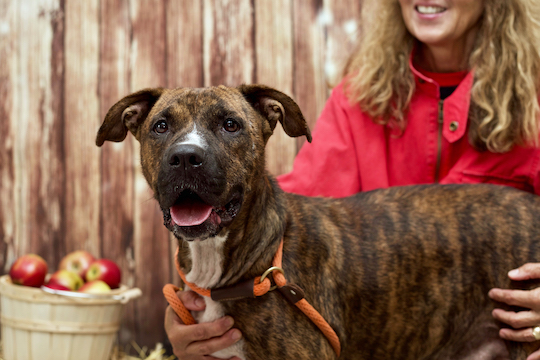
Coco and her pups lived in squalor until they were rescued by officers at a partner shelter. She and the eight other adult dogs on the property were chained to trees or cinder blocks with no edible food and fetid water. Her babies were living in a grocery cart with a plastic lid on top. The babies all found families, so now it’s Coco’s time to shine. (She’s about 3 years old and has done great with other dogs in playgroups here. She’ll need to be guided through treatment for heartworms at our clinic, the cost of which is covered in her adoption. Coco’s adoption fee is sponsored through Dec. 30, along with all large adult dogs, as part of our Gabriel’s Gift promotion.

Phyllis

Phyllis

Phyllis is as sweet as she is adorable. This petite 1-year-old is the perfect combination of what makes cats so lovable; she’s affectionate, playful, funny, and cute. Phyllis would make for a great family pet and she’s open to living with other cats. She can be adopted at a fee you name through Sunday, December 23.

For more information, go to www.bvspca.org or phone 484-302-0865.

About CFLive Staff

See Contributors Page https://chaddsfordlive.com/writers/

Adopt-a-Pet Dec. 17 Read More »

Scroll to Top