

September 11, 2018

Battlefield site preserved

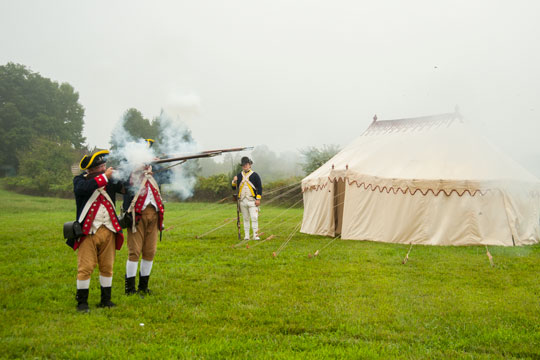
Re-enactors fire a musket volley near a replica of gen. George Washington's tent to begin the ceremony marking the preservation of the Odell property in Birmingham Township.

After almost 20 years of effort, the Brandywine Conservancy has purchased and now preserved all of the 113 acres of the Odell property in Birmingham Township. The property, along the Meetinghouse and Wylie Road corridor known as Birmingham Hill, saw the brunt of the fighting  during 1777 Battle of Brandywine.

During a brief ceremony to celebrate the acquisition of the final 13 acres, on Sept 11, the 241st anniversary of the battle, Ellen Ferretti, the director of the Brandywine Conservancy, praised the efforts of those involved in the prolonged effort, citing Roberta Odell and her family, as well as David Shields, the conservancy’s associate director for land conservation. She said conserving the land was a way of paying homage to the legacy of those who fought.

“Today, we mark the acquisition of the final piece of a decades-long puzzle. It is with profound excitement for the future of this land that we will soon undertake a master planning process to really explore how we can best activate and interpret this site. We look forward to working with all levels of government, with the community, our neighbors and area experts to create a plan that will pay homage to the significant events that took place here and engage future generations in its preservation,” Ferretti said.

Ellen Ferretti, the director of the Brandywine Conservancy, tells the audience that it took almost two decades to preserve the Meetinghouse Road corridor.

She said the efforts to preserve battlefield lands began in 1989. In 1993, the conservancy and other groups formed the Brandywine Battlefield Task Force to provide education and interpretation of the battle and to preserve lands within the national historic landmark.

At that time, Ferretti said, land prices in the area were escalating from about $5,000 per acre to upwards of $50,000 per acre and many property owners were unwilling to donate their land for conservation. So, the conservancy focused its efforts on the Odell property and four others, the Brigham, Spackman, Worth and Wylie tracts representing 450 contiguous acres.

“Here we gather, almost 20 years and $20 million later to celebrate the acquisition of the final piece of a decades-long quest to preserve and honor the historic integrity of this hallowed ground,” she said.

Ferretti added that the conservancy would be launching a planning process to figure out the best way to best activate and interpret the site.

Also speaking during the ceremony was Scott Stevenson, vice president of the Museum of the American Revolution who gave a brief history of the battle.

He said British Gen. Wm. Howe divided his force at about 5 a.m. the morning of Sept 11. A small force engaged colonial forces under Gen. George Washington at Chadds Ford, but the main body under the command of Gen. Charles Cornwallis, marched 17 miles north to attack the Americans on their right flank. It took those men until 2 p.m. to reach Osborne Hill. At about 4 p.m. the attack began.

Those forces, Stephenson said, represented the elite of Howe’s army, battalion companies, grenadiers and light infantry. They would lead the attack against the Americans, led by Gen John Sullivan, on the hill along what is now Meetinghouse Road.

A colonial soldier from New Jersey saw the British coming and noted, according to Stephenson, “The enemy came on with fury.”

A total of 30,000 men engaged in battle. Stephenson said a local member of the Birmingham Meeting, Joseph Townsend observed the fighting from Osborne Hill said it was as if “the whole face of the country was covered in soldiers.

The roar of cannon fire was so great, Stephenson added, that it was heard in Philadelphia.

While the battle was a military defeat for the American forces, it turned into a strategic victory. As several historians have noted, the battle took enough out of the British that they stayed in the field for five days, giving the Continental Congress time to flee Philadelphia before the British took the city. Also significant was the fact that Howe was supposed to have been in Saratoga. His absence there led to the American victory in that New York town, which convinced the French to enter the war against Britain.

Also speaking briefly were state Sen. Tom Killion and state Rep. Carolyn Comitta.

“Birmingham Hill is an incredibly significant Revolutionary War site for our country,” said Killion. “The Brandywine Conservancy has worked for decades to save hundreds of acres of the Brandywine Battlefield. We are immensely grateful for their efforts in protecting our land and preserving America’s history.”

Comitta said she has long admired the work of the conservancy adding, “I believe this purchase will allow for the permanent preservation of a vital part of our collective history and an important national treasure.”

The Odell property is one of two parcels significant to the Battle of Brandywine in the Birmingham and Westtown township area recently preserved. Last week the Natural Lands Trust announced that it has preserved the 88-acre Osborne Hill, from where British forces launched a devastating attack on colonial forces.
About Rich Schwartzman

Rich Schwartzman has been reporting on events in the greater Chadds Ford area since September 2001 when he became the founding editor of The Chadds Ford Post. In April 2009 he became managing editor of ChaddsFordLive. He is also an award-winning photographer.

Battlefield site preserved Read More »

Longwood ‘From the Top’ on NPR

Longwood Gardens hosted a live recording of National Public Radio’s “From The Top” on Sunday night.

It can be heard the week of Nov. 5 on FM station WRTI (90.1).

The appearance by the “From The Top” show was part of Longwood’s summer concert series and was moved inside to the ballroom because of rainy weather. The sold-out ballroom, built in 1929 and renovated more than 12 years ago, provided the kind of acoustics that perfectly highlighted the young musicians performing on “From The Top.”

Guest hosting the show was “From The Top” alumnus and pianist Peter Dugan, who not only performed with several of the show’s highlighted musicians but also performed an original piece he wrote specifically for the appearance at Longwood Gardens. The piece paid homage not only to the Philadelphia area – the “Rocky” theme featured prominently – but also to the late Aretha Franklin, herself a pianist.

At the beginning of the night, the audience received various instructions about what would happen during the recording, often delivered with humor.

“You’ve heard my voice. We’re friends,” said Tom Voegeli, the senior radio producer for “From The Top,” as he told the audience not to “leap out of your skin” if they hear his voice during the broadcast.

The main features were the performances from Angeline Ma, Jack Boettcher, Faustina Housner, Ria Modak, Andrew Chang, and Akili Farrow. Audience members listened to their performances and also learned a little more about the young musicians.

The 17-year-old cellist Boettcher and Dugan, on piano, performed Alberto Ginastera’s “Pampeana No. 2, Op. 21 for Cello and Piano” to open the show. Boettcher, of Illinois, described the piece as depicting a day on the Argentinian savannah.

The audience laughed when Boettcher told of winning a Chicago Bulls talent search with a cello piece set to Queen’s “Another One Bites the Dust.” He renamed it “LeBron James Bites the Dust” and performed it in front of about 20,000 people during half-time of the Bulls’ game.

Fifteen-year-old pianist Angeline Ma performed next on “From The Top,” with two waltzes by Chopin. Ma described the one piece, Chopin’s “Waltz in A flat Major, Opus 42” as a loving and tender piece. When she plays, Ma told the audience, she associates the pieces with certain colors. She said she saw Opus 42 as the color red. Ma’s associations of the music with colors continued when she talked about playing pieces in her favorite key of E Major, describing E Major as “a golden sunshine or sunny afternoon kind of key.”

Ma, a Berwyn, Pa. native who helps edit her high school’s literary magazine, also read the audience a poem she wrote.

A teenage duo performed an Astor Piazzolla piece titled “Histoire du Tango: Café 1930.” Ria Modak’s guitar set the scene while Faustina Housner’s violin told a story.

“You took us all back in time,” Dugan told the duo, describing the Piazzolla style as a combination of classical and jazz.

Housner, 17, of Cherry Hill, NJ, first met Modak, 18, of New York through the National YoungArts program.

“One of the first things we did was to play ‘Café 1930’ together without rehearsing in front of (other) musicians,” said Modak.

Housner appeared on “From The Top” as a 2019 recipient of the Jack Kent Cooke Young Artist Award.

Philadelphia violinist Akili Farrow joined with Dugan in playing Brahms’ “Sonatensatz in C minor,” a piece Dugan described as “tense and dramatic.”

After her performance, Dugan asked the 18-year-old – who was leaving in five days to study violin at the Royal College of Music in London – how she brought the Brahms’ piece to life. Farrow explained how her violin teacher brought in an actress during their second lesson to help Farrow discover her inner actor.

“That helped me bring out the actor in the piece,” she said.

Farrow thanked all the programs she had been involved in over the years – such as Play On, Philly!, Musicopia, and the Philadelphia Youth Orchestra – that helped her hone her musical skills.

Dugan played a recording of Farrow’s mother talking about how she would miss the sound of her daughter playing the violin, once Akili leaves for London.

“The thing I will miss the most about Akili is hearing the violin,” her mother said. “Akili not being here will make the house lonely.”

The fifth young musician to perform also collaborated with Dugan on piano. Andrew Chang, a 17-year-old clarinetist from California, played Robert Muczynski’s “’Time Pieces’ for Clarinet and Piano, Opus 43.”

“You managed to create this beautiful line,” Dugan told him. Chang responded that his music teacher told him to “sing through the notes.”

“The audience here in Kennett Square definitely loved that performance,” Dugan said. “Bravo.”

About Monica Fragale

Monica Thompson Fragale is a freelance reporter who spent her life dreaming of being in the newspaper business. That dream came true after college when she started working at The Kennett Paper and, years later The Reporter newspaper in Lansdale and other dailies. She turned to non-profit work after her first daughter was born and spent the next 13 years in that field. But while you can take the girl out of journalism, you can’t take journalism out of the girl. Offers to freelance sparked the writing bug again started her fingers happily tapping away on the keyboard. Monica lives with her husband and two children in Kennett Square.

Longwood ‘From the Top’ on NPR Read More »

Photo of the Week: Floating Foursome

Floating Foursome

Ducks swim between sunlight and shadow looking for a tasty morsel or two.

About Rich Schwartzman

Rich Schwartzman has been reporting on events in the greater Chadds Ford area since September 2001 when he became the founding editor of The Chadds Ford Post. In April 2009 he became managing editor of ChaddsFordLive. He is also an award-winning photographer.

Photo of the Week: Floating Foursome Read More »

Birmingham in brief: 2 hires, updated ordinance

Birmingham Township supervisors last night made two new hires for the township and updated the solicitation code.

The first hire was a new police officer, Tyler Devoe. Supervisors’ Chairman Scott Boorse administered the oath of office during the Sept. 10 meeting. With Devoe’s training completed, his salary is $21 per hour. During training, he received $19 per hour.

The board also hired a new office assistant, Kimberly Schmeltzer with a pay rate of $22 per hour.

In other business, the board unanimously voted to update the township’s solicitation code, expanding the hours of allowable door-to-door solicitation to 9 a.m. to 9 p.m. The hours had been 8 a.m. to 6 p.m.

The idea to change the hours was brought up during the August meeting when Police Chief Tom Nelling said the change would bring Birmingham’s ordinance in line with other adjoining townships.

Solicitor Kristen Camp said a similar restriction in Kennett Township had been successfully challenged, and making the change could prevent a challenge in Birmingham.

During a discussion, a resident asked how the ordinance applies to homeowner associations that have No Soliciting signs in their developments. Camp said the township can’t enforce those unless it’s in the township code.

Supervisor Michael Shiring suggested adding such text to the ordinance at a later date, and the rest of the supervisors agreed. That change couldn’t have been voted on Monday because only the hour change had been advertised.


About Rich Schwartzman

Rich Schwartzman has been reporting on events in the greater Chadds Ford area since September 2001 when he became the founding editor of The Chadds Ford Post. In April 2009 he became managing editor of ChaddsFordLive. He is also an award-winning photographer.

Birmingham in brief: 2 hires, updated ordinance Read More »

Scroll to Top