A Fiat 500L used by Pope Francis during his historic visit to Philadelphia last September was auctioned to the public on Friday, Jan. 29, at the Philadelphia Auto Show Black Tie Tailgate at the Pennsylvania Convention Center.
Provided by the Archdiocese of Philadelphia and the World Meeting of Families – Philadelphia 2015, the“Pope Francis’ Philly Fiat” was won by Michael and Kate Chapman of Chapman Auto Stores, a press release from the archdiocese said.
Michael Chapman, a former chairman of the Philadelphia Auto Show, and his wife secured the car with a winning bid of $82,000. Conducted by Max Spann Real Estate and Auction Co., the auction featured more than 19 bidders from across the country and lasted just 11 minutes.
“What a magnificent spirit of generosity we witnessed this evening,” Bishop John J. McIntyre, auxiliary bishop for the Archdiocese of Philadelphia, said in the release. “To be able to auction the Papal Fiat in such a spirited environment while knowing that this incredible outcome allows us to spread Pope Francis’ message of love and care in a concrete way by supporting the charitable works of the Archdiocese is most gratifying.”
A second Fiat 500L used by Pope Francis during his visit to Philadelphia remains on display to the general public for the duration of the Philadelphia Auto Show, which runs from Jan. 30 to Feb. 7.
“How wonderful is it that the return of ‘Pope Francis’ Philly Fiat’ has left such an indelible mark, both in our city and in our lives,” Donna Crilley Farrell, executive director of the World Meeting of Families – Philadelphia 2015, said in the release.
While the Black Tie Tailgate annually supports The Children’s Hospital of Philadelphia (CHOP) through the Auto Dealers CARing for Kids Foundation, the proceeds from the auction of “Pope Francis’ Philly Fiat” will benefit four missions of the Archdiocese of Philadelphia.
To purchase tickets to the Philadelphia Auto Show, visit phillyautoshow.com.
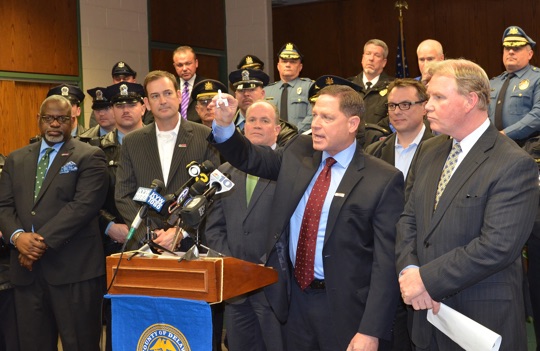
Delaware County Councilman David White demonstrates the NARCAN Nasal Spray at a press conference. Photo courtesy of the Delaware County District Attorney's Office
When seconds count during treatment for a drug overdose, a life-saving advancement debuted on Friday, Jan. 29 in Delaware County.
Joined by police chiefs and members of the Delaware County Heroin Task Force, Delaware County District Attorney Jack Whelan and Delaware County Councilman Dave White announced on Friday, Jan. 29, that police officers in Delaware County will be first in the world to carry and administer a newly developed nasal version of naloxone for emergency treatment of an opioid overdose.
Developed by Adapt Pharma, located in Radnor Township with its global headquarters in Dublin, Ireland, the NARCAN spray was purchased by Delaware County Council through federal grant funding. Each of the nearly 400 police vehicles in Delaware County will be equipped with two applicators at a cost of $37.50 per dose.
Authorities believe it has been crucial for police in Delaware County to have naloxone since they are often first on the scene. Experts say those early minutes can be the key to saving a life. It is believed that the new NARCAN spray could make a life-saving difference in those moments because it is easier to use and requires no assembly.
“We are fortunate to have outstanding police officers here in Delaware County, many who consider naloxone just another tool to perform the job they are sworn to do,” said Whelan in a press release. “However, to us, and the families of those experiencing an overdose, they are heroes. Every day, they are literally bringing people back to life, who will hopefully seek treatment to overcome their addiction.”
While not a substitute for emergency medical care, timely administration of naloxone can help rapidly reverse the life-threatening breathing difficulties that an opioid overdose may cause until emergency medical care can be administered.
“We know the first few minutes, and even seconds are crucial when responding to an overdose. NARCAN nasal spray takes just seconds to open and use,” Delaware County Councilman Dave White said in the release. “Our goal is to equip our police officers with the most effective tools we can in order to save as many lives as possible.”
Delaware County became the first in Pennsylvania to save a life with naloxone after David’s Law was passed in Nov. 29, 2014, and the District Attorney’s Office partnered with police chiefs to develop a countywide naloxone program, funded by Delaware County Council through grants. The program has since become a model for police departments across the state.
In just over one year since that law was passed, police in Delaware County saved 170 lives with the use of naloxone, officials said. Yet, despite those efforts, the number of heroin-related deaths in Delaware County continues to rise, and doubled with an estimated 101 deaths in 2015 as compared to 52 in 2014, according to the Delaware County medical examiner.
Anyone who uses prescription opioids to manage chronic pain, or who uses heroin, is potentially at risk of experiencing an accidental, life-threatening or fatal opioid overdose from the misuse of those products, officials said.
According to Adapt Pharma, NARCAN nasal spray will be available to consumers to be dispensed by a pharmacist without a prescription in the early spring from certain participating retail pharmacies. For more information and instructions on the use of NARCAN, visit www.narcannasalspray.com.
Currently, naloxone is available at various pharmacies throughout Delaware County. Family members and friends can access this medication by obtaining a prescription from their family doctor or by using a prescription written for the general public, issued by the Pennsylvania Physician General. The standing prescription is kept on file at many pharmacies, or can be downloaded from the Pennsylvania Department of Health website at www.health.pa.gov.
The FDA approved the NARCAN spray in November. Previously, naloxone was only approved in injectable form. Because a spray is easier to administer, some area first-responders had been putting the liquid into an atomizer, an extra step that is eliminated with the nasal spray.
Chester County officials said they are also considering a switch to the nasal spray. Good Fellowship Ambulance Club in West Chester, which leads Project Naloxone in Chester County, is in the process of researching the product, said Robert Kagel, director of the Chester County Department of Emergency Services.
Time is running out to help select an influential Delaware County woman for recognition.
In honor of Women’s History Month, the Delaware County Women’s Commission plans to honor women in public service and government who have had a significant positive impact on women and girls in the county.
Every year the National Women’s History Project – the organization that successfully lobbied Congress to create Women’s History Month – creates a theme to guide these honors. The 2016 theme, “Working to Form a More Perfect Union: Honoring Women in Public Service and Government,” will form the basis of celebrating Delaware County women who have demonstrated exemplary public service, civic engagement, and social responsibility.
The commission is seeking nominations from the community. For award criteria and to submit a nomination form, visit www.co.delaware.pa.us/womencom.
The deadline for nomination submissions is Sunday, Jan. 31. A breakfast celebration will be scheduled in May for the honorees.
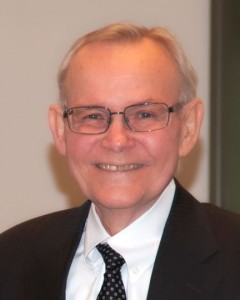
Former Chadds Ford Township Supervisor Keith Klaver died Wednesday, Jan. 27. He was 68. Klaver had been battling cancer for a number of years and he resigned from the Board of Supervisors in January 2015 for health reasons.
Chadds Ford Republican Party leader Mary Kot called the death a tragic loss.
“Keith was a tireless volunteer and always a gentleman. He was a great friend to me and to the Chadds Ford community. This is a tragic loss for us all. He will be sorely missed,” Kot said in an email.
Frank Murphy, the current supervisors’ chairman, said Klaver was a “great supporter of Chadds Ford, a gentleman who worked tirelessly for the township and its residents. He was a true leader from his days on the Sewer Authority, to his leadership on the Board of Supervisors. He’ll be missed by everyone who knew him.”
Former Supervisor Deborah Love was on the board when Klaver was elected in 2011.
“Having served with Keith on the Chadds Ford Board of Supervisors was an honor and privilege. Keith would do his own research on a topic prior to rendering an opinion or a vote, which always stood out as a characteristic of his personality as a public servant. We jointly served as members of the Concordville-Chadds Ford Rotary, where he followed the mission of service that Rotary espouses. The community will miss him,” Love said.
George Thorpe, another former supervisor who also served with Klaver, called him “an extremely nice person who was very accommodating to anybody and everybody. He did a wonderful job as both chairman of the Sewer Authority and as a supervisor and supervisors’ chairman. He really served the township.”
Current Supervisor Samantha Reiner said Klaver was highly respected and will be deeply missed.
An accountant and native of Iowa, Klaver worked at Pricewaterhouse Coopers from 1969 to 2007 and retired as a partner in the firm.
He is survived by his wife Jeanne, a son, daughter, and a grandson.
Jeanne Klaver said she thanks everyone in the Chadd Ford community who had been so caring during the years her husband was being treated for cancer.
“He really had a rough year…The whole community was so good too him and never failed to tell me how much they appreciated him and what he did, so I just want to thank them,” she said. “It’s a blessing to live in a community like Chadds Ford.”
She said there would be no memorial service, just a private family service at Westminster Presbyterian Church.
Jeanne Klaver later added that the family would appreciate a donation to the Kidney Cancer Association in place of flowers.
The township is lowering the flag to half staff in honor of the former supervisor.
Rich Schwartzman has been reporting on events in the greater Chadds Ford area since September 2001 when he became the founding editor of The Chadds Ford Post. In April 2009 he became managing editor of ChaddsFordLive. He is also an award-winning photographer.
PennDOT has announced the following road projects, which are weather-dependent and could affect residents in the greater Chadds Ford area during the week of Jan. 30 through Feb. 6. Motorists are urged to allow extra time if they are traveling through one of the construction zones.
Lane restrictions in both directions will be required on Route 202 in Birmingham, Thornbury, and Westtown townships between Routes 1 and 926. Crews are scheduled to work on patching from 9 a.m. to 3 p.m. from Monday, Feb. 1, through Thursday, Feb. 4.
Patching is also scheduled on the Route 322 Bypass in West Goshen and East Bradford townships between Routes 202 and 322. Lane restrictions will be in place from 9 a.m. to 3 p.m. on Friday, Feb. 5.
Drivers on Route 1 in Concord Township will continue to experience lane restrictions between Powell and Stoney Bank roads from 9 a.m. to 3 p.m. Crews will be working on turning-lane reconfigurations through Friday, Feb. 12.
Patching will necessitate lane closures on southbound I-476 in Concord, Bethel, and Upper Chichester townships between Baltimore Pike and I-95. on Thursday, Feb. 4. Crews are scheduled from 9 a.m. to 3 p.m.
A lane closure will be needed on Route 52 between Hillendale and Byron roads in Kennett Township for utility installation. Crews are scheduled to work from 9 a.m. to 3 p.m. through Thursday, Feb. 4.
Work is continuing on the project to widen Route 202, which is scheduled for completion in August 2016. Motorists should expect delays for traffic pattern shifts in Tredyffrin and East Whiteland townships.
Work will also continue on the Speakman Covered Bridge in East Fallowfield and West Marlborough townships. Frog Hollow Road between Concord Bridge and Strasburg roads will be closed and detoured until the estimated completion date of Sept. 20.
Burnt Mill Road in Kennett Township remains closed and detoured indefinitely between Norway and Spring Mill roads while advance work continues on repairs to the Burnt Mill Bridge, which was closed on April 24, 2014.
The Birmingham Road Bridge in Birmingham Township is also closed indefinitely to repair structural damage discovered in September. Posted detours will be in effect between Lambourne Road and Stoney Run Drive.
Utility installation on South High Street in West Goshen Township will require a lane closure from Thursday, Feb. 4, through Thursday, Feb. 11. Crews will be working between Yorktown and Lexington avenues from 9 a.m. to 3 p.m.
Bridge inspections will result in lane closures on I-95 in Philadelphia this week. The schedule involves the right northbound lane between Broad Street and I-676 on Tuesday, Feb. 2, from 9 a.m. to 3 p.m.; and the southbound right lane between I-676 and Broad Street on Wednesday, Feb. 3, from 9 a.m. to 3 p.m.
If you want to report potholes and other roadway maintenance concerns on state roads, call 610-566-0972 in Delaware County or 484-340-3200 in Chester County, or visit www.dot.state.pa.us and click on “submit feedback.”
More than 3,500 pounds of prescription medication avoided polluting waterways or causing overdoses in Chester County last year, said District Attorney Tom Hogan.
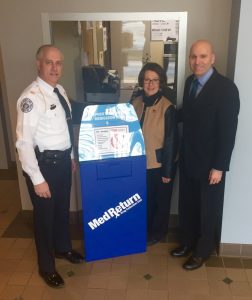
West Goshen Township Police Chief Joseph Gleason (from left), state Rep. Becky Corbin, and Chester County District Attorney Tom Hogan tout the benefits of the drug drop-box program.
Hogan issued a press release to announce that 3,747 pounds of prescription drugs were collected through the Chester County drug drop-box program in 2015. The program places secure boxes in police stations around Chester County so that citizens can safely dispose of prescription medications.
“The Chester County drug drop-box program has been a tremendous success,” Hogan said. “We have safely taken almost two tons of prescription drugs out of circulation. Those are drugs that will never cause a child to overdose or become addicted to opiates. Those are drugs that will never get into our ground water and drinking water. Chester County is proud of this program.”
The drug drop-box program originally was started through a grant from the Pennsylvania District Attorneys Association. More boxes were added later through funding from Pennsylvania American Water.
“Until this initiative was launched, many people didn’t know how to properly dispose of excess pain medications or that it was important to do so,” state Rep. Becky Corbin, R-155, a key early supporter of the program, said in the release. “I am glad the word is getting out and residents are responding. It is important that unused prescription painkillers not be stored in the home.”
The drug drop-boxes work as follows: Citizens can drop off prescription drugs or over-the-counter medications anonymously in the drug drop-boxes, secure receptacles located in police stations or other safe areas. The medication periodically is picked up by members of the Chester County Detectives and disposed of safely.
According to current statistics, approximately 70 percent of the U.S. population will take some type of prescription medication every year. The three most prescribed drugs in the U.S. in order of volume are antibiotics, antidepressants, and opiates, such as oxycodone, the release said.
In the Southeastern Pennsylvania region, the largest drug threat currently comes from prescription drugs and heroin, according to the Drug Enforcement Administration. This is the first time in the history of the region that prescription drugs have emerged as the largest threat.
Nationwide, more people are dying from prescription drug overdoses than from overdoses of any and all illegal drugs, including heroin, cocaine, and amphetamines. In Chester County, 57 overdose deaths occurred in 2015. Out of these deaths, prescription drugs were involved in 42 of them, the release said.
Opioids, such as oxycodone, now represent the most abused prescription drugs in the country. A few simple statistics show the explosive growth of this class of drugs. In 1998, 11.5 tons of oxycodone were produced worldwide. By 2010, 122.5 tons of oxycodone were produced, with more than 80 percent consumed in the U.S., the release said.
Vince Brown, executive director of Chester County’s Drug and Alcohol Services, stated in the release that the drop-box program has had a significant impact.
“There is a direct link between the availability of prescription medication and the heroin epidemic and overdose deaths we’re facing nationally, in Pennsylvania, and right here in Chester County,” Brown said in the release. “What experts know is that individuals with heroin addictions today are younger and more frequently getting hooked on drugs not on the street, but in the medicine cabinet.”
Hogan said when the program started, he expected to see a gradual decrease in the amount of drugs collected. “Instead, we have seen a steady supply of prescription drugs being collected every month, demonstrating the prevalence of prescription drugs in our society, particularly opioids,” he said in the release. “This program is part of Chester County’s multi-disciplinary approach to fighting the problems caused by drug abuse.”
West Goshen Police Chief Joseph Gleason, one of the participating police departments, agreed, calling the program “an invaluable tool for anyone to contribute to the betterment of society by removing the availability of prescription drugs being put into the wrong hands.”
The drug drop-box locations include the Kennett Square Borough Police Department, 115 N. Broad St., Kennett Square, Pa., 19348; the West Goshen Township Police Department, 1025 Paoli Pike, West Chester, Pa., 19382; the Westtown-East Goshen Regional Police Department, 1041 Wilmington Pike, West Chester, Pa., 19382; and the Sheriff’s Office, Chester County Justice Center, 201 W. Market St., West Chester, Pa., 19380.
A move to change Concord Township’s form of government is coming into the home stretch. A vote during the April 26 primary election will determine whether Concord remains a township of the second class or will operate under a home rule charter.
The Government Study Commission — which began its work in November of 2014 — unveiled its proposed home rule charter for Concord during a Jan. 28 hearing. If voters approve the charter in the April primary, the charter would become effective on Jan. 1, 2017.
Commission member Joshua Twersky said a transition team, made up of the township manager, two current supervisors, two GSC members and two members of the general public — would be established to review current ordinances and administrative code to make sure they’re in compliance with the charter, and if not, make recommendations on how to reconcile issues.
The proposal changes the five-member Board of Supervisors into a seven-member Township Council. Additionally, the terms of office would be for four years instead of six.
According to commission solicitor Michael Maddren, those changes would begin with the 2017 municipal election. Terms for two current supervisors — Dominic Pileggi and John Gillespie — would be up for election next year, and two other new members would also be elected.
Two of those four candidates would run for four-year terms, the other two would run for two-year terms. Maddren said the candidates would decide which ones would run for four years and which would run for two years.
As the terms cycle, all terms for council members would then be for four years by 2019.
Currently, supervisors may also be township employees, but that would not be the case for council members under the charter.
Council members may not be township employees, nor may they hold any other elective office during their terms on the council. Also, they are prohibited from being township employees for a full year after they leave office.
Other prohibitions include being employed by, or otherwise compensated by, any person or business serving as a contractor to the township or serving as a consultant during their term or for one year after they leave office.
Instead of a chairman and vice chairman, the council would have a president and vice president.
The proposed charter also limits increases in general fund taxes. Currently, the Second Class Township Code limits general fund taxes to no more than 14 mills. (Concord’s current millage rate is 0.944 mills.)
Under the charter, tax increases would be limited to 5 percent of the previous year’s revenue. However, an increase of more than 5 percent would be permissible by a supermajority (5-2) vote of the council.
The Township Council, as the Board of Supervisors does now, would exercise legislative power. Unlike what happens in the U.S. Congress, ordinances proposed are to be limited to one subject that is clearly expressed in the title.
Also, “No member of Council shall possess or exercise any power of Council unless such power is specifically delegated by this Charter or by a resolution adopted by the affirmative vote of at least a majority of council,” the draft reads.
In addition, no ordinance may be proposed and enacted on the same night. There must be at least a 10-day period before council may vote on a proposed ordinance.
Commission member Diane Bohr said that none of the changes are sweeping, but that they came about from listening to township residents.
The commission has until late February to finalize the draft and write a final report. During that time, residents are encouraged to contact the commission through the township website and offer suggestions.
Rich Schwartzman has been reporting on events in the greater Chadds Ford area since September 2001 when he became the founding editor of The Chadds Ford Post. In April 2009 he became managing editor of ChaddsFordLive. He is also an award-winning photographer.