The Pennsylvania Supreme Court on July 20 overturned lower court decisions that kept a referendum off last November’s ballot in Concord Township.
That referendum would have asked Concord voters whether or not they wanted the township to change from township of the second class to township of the first class.
Citizens group Concord First held a petition drive last summer to get the necessary signatures for the question to be put on the ballot. The petition needed 582 signatures — 5 percent of the 11,640 registered voters — and petitioners gathered 994 signatures.
The group filed the petition with the Delaware County Court of Common Pleas on July 28, 2014, but township Supervisors’ Chairman Dominic Pileggi and others, including the Delaware County Board of Elections, challenged the petition on Aug. 6.
On Aug. 14, a Common Pleas Court judge ruled in favor of the challenge and denied the petition for the referendum. Concord First’s Colette Brown appealed that decision to Commonwealth Court, which on Sept. 26, upheld the lower court decision.
Brown then appealed to the state Supreme Court.
At issue has been the interpretation of a section of state code. That section, 53 P.S. § 55207 reads:
“At the first general or municipal election occurring, at least ninety days after the ascertainment, by special enrollment or from the last preceding United States census, that any township of the second class has a population of at least three hundred inhabitants to the square mile, and after a petition signed by at least five per centum of the registered voters of the township has been filed in the quarter sessions court, the question of whether such township of the second class shall become a township of the first class shall be submitted to the voters of the township. . .”
The question before the court was whether that section means the referendum would go on the ballot at the first election after only the census or at an election after both the census and the petition.
Common Pleas and Commonwealth court opinions interpreted the code to mean the question could go on the ballot only at the first election 90 days after the census.
However, the Supreme Court agreed with Brown.
In an opinion written by Justice Correale F. Stevens, with Justices J. Michael Eakin and Max Baer joining, the court said: “…[W]e hold that pursuant to 53 P.S. § 55207, second- to first-class township referendum questions shall be submitted to voters at the first general or municipal election occurring at least ninety days after fulfilling both the population density ascertainment and petition signature filing requirements as set forth in the statute. Accordingly, we reverse the order of the Commonwealth Court and remand to the trial court for further proceedings consistent with this opinion.”
Dissenting were Chief Justice Thomas G. Saylor and Justice Debra McCloskey Todd.
Saylor wrote in his dissent that he agrees with the Commonwealth and Common Pleas court decisions. He said the section in question “is most readily read as conveying an intention to require that a referendum proceed within a time period which is reasonably contemporaneous with ascertainment. Thus, I would hold submission of a ballot question under the statute is appropriate only at the first general or municipal election occurring at least ninety days after a specified form of ascertainment demonstrates that the population of a second-class township meets the statutory threshold.”
Rich Schwartzman has been reporting on events in the greater Chadds Ford area since September 2001 when he became the founding editor of The Chadds Ford Post. In April 2009 he became managing editor of ChaddsFordLive. He is also an award-winning photographer.
A convent that had been sitting vacant will get new life as the resource center for Family Promise of Southern Chester County, a multi-denominational initiative to assist homeless families.
Two winters ago, a spate of punishing snowstorms took a toll on families who were already teetering on the brink of solvency – from losing hundreds of dollars of groceries during power outages to having fallen trees decimate uninsured residences.
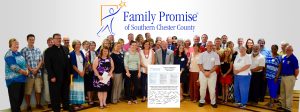
Representatives of more than 20 churches in southern Chester County assemble to sign up for Family Promise, a program that will use existing facilities to help families rebound from economic setbacks.
Despite the region’s affluence, the many families left homeless strained area service agencies and overloaded shelters, prompting an emergency meeting organized by United Way of Southern Chester County. Dave Haradon, a member of Longwood Rotary, recalled that United Way CEO Carrie Freeman posed the question: What can we do to fix this unacceptable situation?
The answer to alleviating the problem came a step closer to fruition last week. On Wednesday, July 15, representatives from more than 20 congregations gathered to sign a one-year commitment with Family Promise of Southern Chester County (FPSCC), a newly-formed, multi-denominational collaboration that will offer needy families a lifeline.
The celebratory signing by volunteers followed thousands of conversations and hundreds of meetings – spearheaded by United Way and Kennett Area Community Service (KACS). “The number of people hours has been incredible,” Haradon said, adding that the decision to duplicate the Family Promise program represented the easy part of the process. “They were already doing what we wanted to accomplish.”
In addition, Haradon said the New Jersey-based nonprofit had distinguished itself as a model for transitioning struggling families from despair to hope. It was also willing to assist the fledgling operation, Haradon said. The more challenging accomplishments were persuading churches to get involved and raising funds, he said.
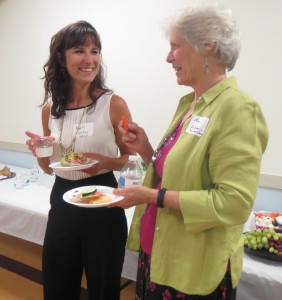
Kate Uhler, the emergency assistance case manager for Kennett Area Community Service, discusses Family Promise with Mary Boeni, a member of the FPSCC Church Recruitment Committee, during a reception following the signing ceremony.
The Family Promise program, which has nearly 200 affiliates nationwide, will operate with at least 13 host churches and some support congregations, which will provide supplemental food and volunteers as needed. Twelve host churches signed the FPSCC agreement last week, and another is expected to join shortly, Haradon said.
Under the program’s format, each host church agrees to house a maximum of 14 people in families with children who find themselves homeless. The host church will sign up for one week four times per year.
Using existing facilities, the congregations agree to provide overnight accommodations, breakfast, a take-out lunch, and dinner to the families, who have been screened for eligibility. During the day, families will be taken by van to a computer-equipped resource center, where they can shower, care for their preschool children, and get information on government programs and job assistance. School-aged children will attend their regular classes.
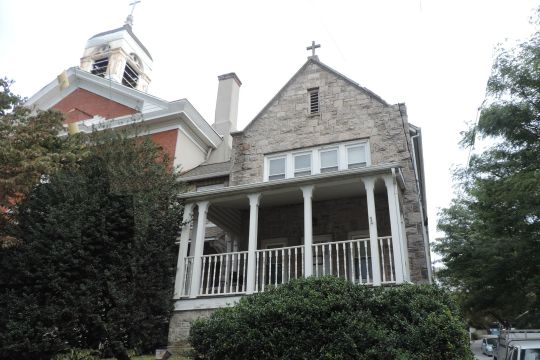
The resource center, which will serve residents in the Oxford, Avon Grove, Kennett, and Unionville-Chadds Ford school districts, is being transformed from a vacant convent that the Assumption of the Blessed Virgin Mary (ABVM) Church in West Grove is renting to Family Promise for $1 a month. “It’s a wonderful thing that we’re able to do,” Pastor Scott D. Brockson said.
Bill Carl, FPSCC’s treasurer, estimated the annual budget at $165,000 and first-year capital costs at $70,000. About $20,000 of in-kind capital donations for a new furnace and some plumbing are being collected, he said.
To date, $126,000 has been raised, not counting the in-kind donations, he said. He added that the group is currently seeking funds or a donation of a 15-passenger van, which will be used to transport the families.
“We’re clearly on our way to getting this running,” said Carl.
Pat Bokovitz, director of the county’s Department of Community Development, applauded the local Family Promise initiative. He said the effort is consistent with the county’s Decade to Doorways, a plan to end homelessness in the county within 10 years.
A poster features the names of the inaugural signers of the Family Promise of Southern Chester County agreement.
“They’ve done a great job in local fundraising,” Bokovitz said of the Family Promise team. “They’ve identified a need and have made real progress in addressing it.”
The county has been in communication with Family Promise organizers, he said. “We will continue to be involved,” Bokovitz said, adding that a fiscal partnership may be possible at some point.
One of the many Decade to Doorways initiatives is ConnectPoints, a toll-free hotline for anyone seeking emergency shelter or housing services in the county. The system cuts through bureaucracy by giving callers information about all available services and shelters, data that previously required myriad phone calls. Once it’s operational, Family Promise of Southern Chester County will be included among the ConnectPoints resources, Haradon said.
Underscoring the need for Family Promise, the four southernmost school districts in Chester County identified nearly 500 schoolchildren as homeless during the 2013-2014 school year, according to county data. In addition, no shelters for individuals or families exist in southern Chester County, and of the 235 shelter beds available countywide, only 34 accept families.
Haradon said FPSCC’s search for an executive director has been narrowed to several candidates. He said he expected that person to be hired soon so that the program can begin welcoming families sometime in the fall.
“I’m excited for Family Promise; this is so much more than a place to sleep,” Haradon said.
He said a core of trained, community volunteers who have passed background checks would be assisting the families. Given the size of the network of volunteers, he said he expected many would have leads on jobs and housing.
During the signing meeting, Kate Uhler, the emergency assistance case manager for KACS, reinforced the need for the program’s launch. She told the group of volunteers that six area families with children are presently living in motels because no shelter space was available. “It puts urgency on this [initiative],” she said.
Haradon said the number of people who have worked so hard to make Family Promise happen repeatedly impressed him. “It has really brought people together,” he said, citing differences in backgrounds, culture, and religion. “It’s been amazing to watch.”
He said Family Promise of Southern Chester County is continuing to seek congregations as well as donations. If more than 13 host churches participate, the number of weeks per year could end up being fewer than four. For more information, visit https://www.facebook.com/familypromisescc or http://www.familypromisescc.org.
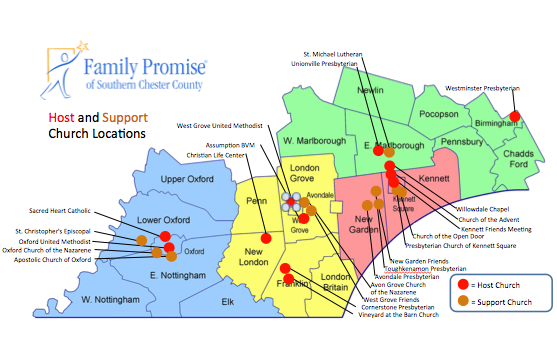
The host churches signed up so far are Unionville Presbyterian, Kennett Friends Meeting, Westminster Presbyterian, Willowdale Chapel, Cornerstone Presbyterian, Christian Life Center, Episcopal Church of the Advent, Assumption BVM, Oxford United Methodist, West Grove United Methodist, Sacred Heart Parish, and Vineyard at the Barn Church.
The support churches are St. Michael’s Lutheran Church, Avon Grove Church of the Nazarene, West Grove Friends, Presbyterian Church of Kennett Square, Church of the Open Door, Oxford Church of the Nazarene, Toughkenamon Presbyterian, St. Christopher’s Episcopal, Apostolic Church of Oxford, New Garden Friends, and Avondale Presbyterian.
A chart shows the participating congregations who have signed up for Family Promise of Southern Chester County.