
October 9, 2013

Super Bowl MVP in town to protect kids

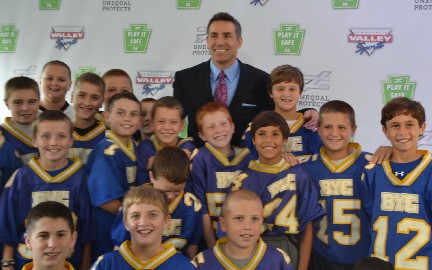
SuperBowll MVP Kurt Warner poses with athletes from Brandywine Youth Club at opening of world headquarters of Unequal Technologies

Kurt Warner took some hits on the way to becoming Super Bowl MVP. Now the most valuable player has become most valuable promoter for a new product that protects players from sports injury. Warner participated in the ribbon cutting for the world headquarters of Unequal Technologies in Glen Mills Oct. 8.

Warner sought out the company and its product while looking for the best way to keep his own children safe while playing football. His 9- and 15-year-old sons now use Unequal gear to protect themselves while playing.

Unequal Technologies’ founder and CEO Rob Vito is passionate about his product. His confidence in the protection it provides was demonstrated by video of himself getting hit in the chest with a baseball bat.

Vito said he got a call from Tom Cruz to help protect him and his stunt crew during a filming of Mission Impossible in London. Another call came from the Eagles to get a chest protector for Michael Vick after an injury. While these high profile customers are a great reference for the products, both Vito and Warner are driven to help kids play safely.

“When Kurt offered to fly to Chicago to share his and his kids’ experience using Unequal with the entire Pop Warner board, we knew we had discovered a natural ambassador for the brand” said Vito.

Warner signed a multiyear contract to be public spokesperson the day of the ribbon cutting.

Present at the event were many youth football players and coaches from the Brandywine Youth Club.  Each autumn, the BYC program fields more than 240 youth football players from 5 to 12 years of age.

BYC football commissioner and board member Steve Theisen stressed the importance of proper equipment and coaching to prevent concussions.  He noted that all of the BYC football coaches are required to get certification in the “Heads Up” program as well as becoming certified by the CDC in concussion prevention.   Furthermore, he said that approximately 40 percent of the initial coaching at BYC deals with proper techniques to avoid concussions.

Assistant football coach and BYC board member Kevin McGarrey stated that his son Kevin who plays quarterback in the BYC’s 100-pound team was the first member of the program to get the Kevlar insert.  McGarrey, a lawyer, researched the device and supports its wider introduction into youth sports.

Dr. Gerard Margiotti, a Bucks County pediatrician, spoke of the importance of protection from head injuries, which he sees in his five offices. He donated Unequal head protection for the entire North Hampton Indian football team.

The core product is a “patented fusion of a military-grade composite fortified with Kevlar®, Accelleron™, and an optional ImpacShield™” The thinness allows for easy custom fitting and concealed protection.

Unequal promotes the use of its technology as part of its “Play it Safe” strategy. The three Ts are Training, Technique and Technology.

 

Unequal Technologies CEO Rob Vito and Kurt Warner cut ribbon on new site.

Pennsylvania State Representative Steven Barrar expressed appreciation of the 200-300 jobs that Unequal Technology will bring to the 160th legislative district. Commercial realtor Justin Soss said the building is over 62,000 square feet on 6.5 acres of land. “There is room to grow.”

Harry Roosevelt added content to this story.

Super Bowl MVP in town to protect kids Read More »
Jamie Wyeth: on art and island

Jamie Wyeth: on art and island

“There is a weirdness of the island, no electricity and primeval sunsets,” Wyeth told the audience at a sold out event at the Brandywine River Museum on Oct. 4.

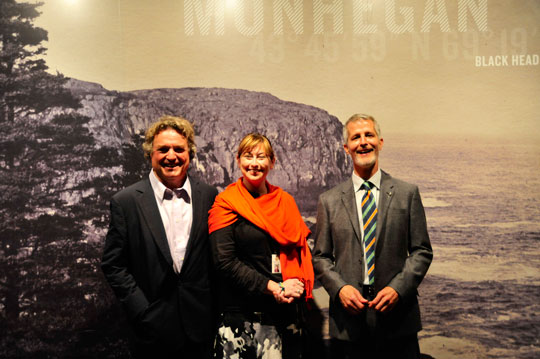
The event was part of the “Jamie Wyeth, Rockwell Kent and Monhegan” exhibit that opened June 15. Museum Executive Director Thomas Padon moderated a dialog with exhibit curator Amanda C. Burdan and Jamie Wyeth about his work.

Wyeth described his work as a solitary endeavor. He contrasts his life to that of his grandfather, N.C. Wyeth. The elder Wyeth was known to entertain with grand dinner parties with such famous people as Douglas Fairbanks Jr., and Scott and Zelda Fitzgerald.

Wyeth’s father Andrew led a quieter life more similar to his own. The contrast between the two artists is seen when visiting their two studios. N.C. Wyeth’s studio is big and bold with lots of props. Andrew Wyeth’s studio is understated with relatively plain walls.

Wyeth remembers painting in the next room to his father while the record player was blaring. The player was on his side so Andrew would come in to change records.

Now that both studios are open to the public, Wyeth was asked how he feels visiting them. Visiting Andrew Wyeth’s studio brings with it lots of emotion because that is where he grew up. Wyeth is glad for the public to have an opportunity to see the space with the hope that it might light a spark for a future artist.

Wyeth likes to paint from live subjects not from photographs. Portraiture presents a challenge to his desire to work alone. He made some sculptures of his subjects to help him extend the work beyond actual sittings. Some of these sculptures, including one of Andy Warhol, will be in the upcoming retrospective exhibit at the Museum of Fine Arts Boston.

Wyeth traced “going his own way” back to his home schooling that began around aged 12. Often alone, he roamed the farm and fields.  When asked if he liked to travel, “I hate it. I want to paint trees that I know or that person’s nostril.”

Wyeth described his father’s paintings of Keurner’s Farm as a having a deep and mysterious quality. That depth came from “having walked those hills thousands of times.  Legions of copyists miss that.”

Was Andrew Wyeth a good teacher? “Yes, by example.” We worked all day.

Was Carolyn Wyeth a good teacher? She was “flamboyant, visceral, down to earth.” Wyeth chose oil as his preferred medium because of seeing his aunt squeeze the tube of paint with gusto.

Unlike many artists who paint near the sea, many of Wyeth’s paintings in the current exhibit are with the artist’s back to the sea. Wyeth sees the houses as the embodiment of the people who build their lives on the rock of Monhegan.

In Wyeth’s paintings from his dreams, the artist does face the sea. He said the dreams came after his father’s death.

Burdan will be giving a talk entitled “Jamie Wyeth: Back to the Sea” about Wyeth’s choice of subjects on Nov. 13 at 2 p.m. at the museum.  The museum is also showing a documentary film about Rockwell Kent on Oct. 12 at 1 p.m.

Although Wyeth and Kent never met, they share Monhegan Island Maine as inspiration for many of their works. On a personal connection, Wyeth lives and works the house that Kent built on the island during the months he spends in Maine.

A retrospective of Jamie Wyeth’s work has been in preparation for the last four years.  The exhibit will open at the Museum of Fine Arts Boston in 2014 and in Chadds Ford January of 2015.

When asked if he could think of another family dynasty in the arts, Wyeth suggested Flying Wallendas. The evening offered several occasions to chuckle while offering an inside view into the creativity of the Wyeth family

Jamie Wyeth: on art and island Read More »

Around Town Oct. 10

Around Town Oct. 10

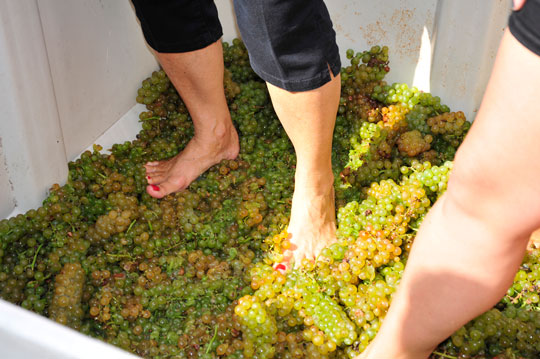
• Things got a little squishy for some visitors to the Chaddsford Winery on Oct. 5. For a minimum donation of $5 to the Delaware County Breast Awareness Coalition, folks had the opportunity to learn what it’s like to press grapes old school — with their feet. Several dozen people took part. As one person said, “It’s slippery.” (See photo)

• The Chadds Ford Civic Association is hosting a Meet the Candidates night 7 p.m., Thursday, Oct. 17 at the Chadds Ford Township municipal building. Scheduled to attend are Democrat Rhona Klein and Republican Frank Murphy who are running for township supervisor.

Longwood Fire Co. has kicked off its annual fundraising appeal to help meet the expenses of running a 24-hours-a-day operation and will hold an open house on Sunday, Oct. 20, to show families how the company operates. In a press release, Chief A. J. McCarthy said the company responded to 512 calls for help in 2012. “Longwood Fire Company heavily relies on donations from the community to meet our budget. Training our volunteers, maintaining our emergency vehicles and all of the other costs of running a fire company is very expensive. We’re asking the public to donate what they can. We understand these are tough financial times. Each dollar we receive is valued and will be put to good use,” he said.

allhallows[1]• The Young Friends of the Brandywine Conservancy host their 21st All Hallows Eve Costume Ball at 9 p.m. on Oct. 26 at the Brandywine River Museum. “Enter if you dare for an evening to die for,” a press release said. “Your fairgrounds pass includes games, cocktails, concession food, music and costume contest. Those not in costume will suffer an unspeakable fate.” Guests must be 21 to attend. For more information or to request an invitation, please visit www.youngfriends.org, send an e-mail to youngfriends@brandywine.org or call 610-388-8315.

Around Town Oct. 10 Read More »

Living History: The return of an annual tradition

Living History: The return of an annual tradition

Who would ever think that an orange, strange-looking squash would generate both an unofficial holiday and a multi-billion dollar industry? Over many decades, the ritual of Halloween with carved pumpkins, masks and spooky outfits has become one of the most celebrated events on our fall calendar. The common pumpkin — Cucurbita pepo — is native to North America, the oldest evidence from seeds dating back to around 7,000 B.C. The word pumpkin originates from the Greek pepon, meaning “large melon.” Adapted by the French to pompon, the English to pumpion and later by colonists to its present spelling, this ancient vegetable is now the symbol for a season of giving thanks, retrospection and, yes, a night of fun which we all know today.

Halloween is big business; it accounts for roughly $2.6 billion in annual sales in the United States alone. One of the most popular crops in the U.S., approximately 1.5 billion pounds of pumpkins are produced domestically each year. The largest pumpkin-generating states are Illinois, Indiana, Ohio, Pennsylvania and California. Aside from the ever-growing numbers of adult and child celebrants for Halloween, there are now pumpkin-growing contests where proud farmers boast stunning results, the world record pumpkin tilting in at 2,009 pounds in 2012.

Millions of parents around America visit rustic orchards and farm produce stands in the rural countryside to purchase what will become a source of fun and excitement in the days leading up to October 31st. Pumpkin carving originated in the 1600’s in England, where the term “Jack-‘O- Lantern” came into use to describe light flickering over peat bogs, a phenomenon sometimes called “Will- ‘O- the Wisp” in British folklore. In the 19th century, revelers in Ireland and Scotland often carved strange faces and figures on turnips and other vegetables to represent spirits coming to life around the time of the Autumn harvest. The term Jack- O- Lantern came to be used in America in the 1830’s. Noted poet John Greenleaf Whittier even wrote a poem titled “The Pumpkin”:

“…When wild, ugly faces we carved in its skin…
Glaring out through the dark with a candle within!”

Why the scary faces and flickering lights? An old Irish folk tale mentions a farmer named Jack who had a terrifying encounter with the devil, Jack later wandering the Earth searching for a place to rest as he carried a hollowed-out turnip holding a glowing ember. Superstitious people over the centuries tried to protect their homes and families with Jack- ‘O- Lanterns as a way to ward off evil spirits and, yes, even vampires. The more grotesque the images, the better they served to scare away loathsome entities. Thus began a trend which has lasted up to the present day, with children and parents enjoying this fanciful pursuit that brings more joy than almost any other day of the year.

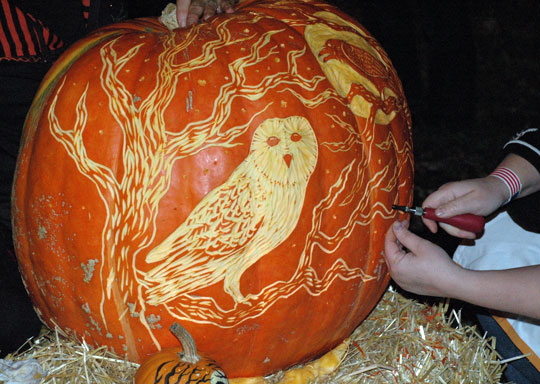
Pumpkin carving events around the Chadds Ford area started to attract attention when Andrew Wyeth began displaying them in the 1970’s around the Chadds Ford Inn. His creations became so popular, the event eventually moved to the grounds of the nearby Chadds Ford Historical Society (CFHS), where it has been thrilling people of all ages for more than two decades.

The 2013 Great Pumpkin Carve will take place at the Chadds Ford Historical Society behind the Barn Visitor Center, 1736 Creek Road in Chadds Ford, on Thursday, Oct. 24 through Saturday, Oct. 26 from 5 to 9 p.m. each night. More than 60 carvers will delight viewers with their wildly-sculpted creations. There will be hayrides and live music, as well as food and beverages sponsored by the Concordville-Chadds Ford Rotary. This year will showcase a new event — the “Haunted Trail” — where kids of all ages can wander through a spooky path featuring ghosts, goblins and flying creatures known to inhabit the nether world around All Hallows’ Eve.

In addition, there will also be “A Not So Scary Halloween”- a reading of stories at the historic John Chads House (circa 1725) just across the street from the Society on Sunday, Oct. 27 at 4 p.m. All are encouraged to come in costume and parade around the grounds to ward off any spooky “uninvited” guests. So this year, the public will get two opportunities to make Halloween a fun event for the entire family- The Great Pumpkin Carve and the readings at the John Chads House. For more information, contact the Historical Society at 610-388-7376 or visit their website at www.chaddsfordhistory.org.

• Gene Pisasale is an author and lecturer based in Kennett Square. His six books focus and lecture series on local history. Gene’s latest work is “The Forgotten Star”, which delves into the War of 1812 and true life mysteries surrounding an American icon- The Star-Spangled Banner. Gene will be conducting his lecture on the War of 1812 on Tuesday October 15th at the Swarthmore Public Library and one on the Civil War on Saturday October 19th at the Bayard Taylor Library in downtown Kennett Square. Both events are free and open to the public. Gene can be contacted at Gene@GenePisasale.com. Visit his website at www.GenePisasale.com.


Living History: The return of an annual tradition Read More »

Adopt-a-Pet: Oscar and Ruby

Adopt-a-Pet: Oscar and Ruby

Oscar and Ruby are two 2-year-old poodle mixes that were surrendered to CCSPCA when their owner could not provide enough socialization for the dogs. This poor pair is nervous and initially untrusting of people and new surroundings, but warm up to be loving and playful with quiet time spent with them.  As they are quite bonded and are much more comfortable with one another, Oscar and Ruby will need to be adopted as a pair. Oscar and Ruby will need a home without children and with an owner who understands their needs. With time and TLC, Oscar and Ruby will be wonderful companions for the lucky person who opens their home to them. If you are able to provide Oscar and Ruby or any of our other animals here at the shelter a home, visit the Chester County SPCA at 1212 Phoenixville Pike in West Goshen or call 610-692-6113. Oscar and Ruby’s registration number is 96817031 and 96817032.  To meet some of our other adoptable animals, visit the shelter or log onto www.ccspca.org. Not quite ready to adopt? Consider becoming a CCSPCA foster parent. Kitten season is still in full swing and CCSPCA needs fosters for kittens and mother cats. Additional information and applications are available online or at the shelter.

Adopt-a-Pet: Oscar and Ruby Read More »

Build resiliency by eating the elephant

Gary Keil appreciates the old joke: “How do you eat an elephant?” “One bite at a time.”

Keil, who co-owns the Beautiful Mind, Strong Body yoga studio on Route 52 near the Mendenhall Inn, is working with that “one bite at a time” concept in both his personal and professional lives.

He recently took part in the Pine Creek Challenge, a 100-mile run that participants have to complete in 30 hours. He finished the run in 22 hours.

Keil laughed when asked why he would even attempt such a thing.

“Many people ask me that,” he said, “but my reason was just to see if I could and to see if I could enjoy something that traumatic.”

He said many runners approach such activity with the thought that the first 50 miles are run by the body and the second 50 are run with the mind, but Keil did something different. What he did to finish the run and to create enjoyment for himself was to break the run up into little bits, viewing the run as five 20-mile runs.

It was a course in positive psychology — and a book “Being Happy” by Tal Ben-Shahar, the lead instructor in that course — that brought him to that type of thinking.

The basic idea is that no matter how big or daunting a task is, it should be broken down it down into those bite-size bits.

Continuing the elephant analogy, Keil said, “If you look at it as something big, you’re paralyzed. You can’t do anything. If you look at it in much more manageable sized bites, you start to look at this as manageable and [learn that] those bites are actually a lot different. When you’re eating the trunk it’s a lot different than eating the ear.”

Each part requires a different approach, a little different seasoning.

What he developed for the run — and what he is now bringing to his teaching table — is something he’s called the “fifth’s approach.”

“You can get through life using a fifth,” he said while miming that he was drinking from a liquor bottle, “or by looking at something as if it were five completely different stages.”

Those five phases are warm-up, cruising, appreciation, meditating to maintain and going deeper.

Every athlete knows they have to warm up before beginning their activity. Muscles need to be warm while joints need to be relaxed and flexible.

Once the warm up is over and you’re actively engaged, let yourself cruise.

“Once you’re warmed up, you feel great, you might even be feeling indestructible. But in reality, you’re not even halfway there yet. So, don’t get cocky,” he said.

That’s the time to be smart, don’t rest on your laurels, he added.

Being smart in that cruise portion leads to the next phase, that of appreciating where you are.

“You’ve now done, gotten through or endured, however you want to think of it, half of your event, so appreciate where you are. In a 100-mile run, you’ve done 50 miles, something most people never do. And yet, there’s still 50 more to go,”Keil said. “Appreciate you’ve gotten there, but appreciate there’s still more to do.”

According to Keil, the next phase is critical because you’re between 60-80 percent through. He calls this phase “meditate to maintain.”

Meditation is more active than most people think, he said. They view it as just sitting there, but it’s much more than that. It’s a matter of focusing, but focusing on the positive, not the negative.

“That’s the key point where people think they can’t make it, or that they should quit and be happy. Either way, you’re not finishing what you set off to finish,” he said.

The meditating phase is realizing you’re into the mental aspect of your activity, “and that you can capitalize on the positive, not succumb to the negatives.”

Keil calls the last phase a twist on something most people have heard for years. For Keil it’s “go deep,” not “dig deep.”

The subtle shift to “go deep to get there” is more than just semantic.

“Digging is an active process that requires a lot of physical energy…When you’re at the 80 percent mark, there’s hardly anything left, you have to go deep. I like the analogy that the freshest water is deep in the well. That’s where you have your energy, but it’s still the mental part. You know the end is in sight. You’re not going to be screaming like a little kid, happy to hit that finish line, but you can get there,” Keil said.

He said the phases are not strictly linear with one following immediately after the former is finished. They start and stop, loop back and repeat, and that people should not see that seeming reversal as a negative. It’s part of the process that builds resiliency.

The ability to be resilient is built in, he said, but it’s trauma that brings it out. The idea is to use non-threatening trauma to develop that innate ability.

Training and practice represent those non-threatening elements of trauma for the athlete, even the weekend warrior. But those concepts can, and should be extended to other aspects of life, whether they pertain to business or academic pursuits.

Keil advises people to be non-judgmental of themselves as they go through the process and that non-judgmental attitude is the first step to mindfulness and happiness. And that happiness comes before success.

“Give yourself permission to be human,” he said. “The prize is in the process, not in the end.”

Build resiliency by eating the elephant Read More »

Birmingham replaces emergency coordinator

Birmingham Township supervisors named Mike Hochhous to replace Lloyd Roach as the township’s emergency management coordinator. Roach resigned the position because he is moving.

Hochhous has served as deputy coordinator for Roach and has lived in the township for 10 years. He is a project manager for JP Morgan Chase & Co.

The board only recommends the coordinator. The appointment must be approved by PEMA, the Pennsylvania Emergency Management Agency.

In accepting Roach’s resignation, Supervisors’ Chairman John Conklin thanked Roach for years of service to Birmingham.

“Many people don’t volunteer, but he did. We owe him our thanks,” Conklin said.

Fellow supervisor Bill Kirkpatrick said Roach has held as many as six volunteer positions in the township over the years.

Birmingham replaces EMC

Birmingham Township supervisors named Mike Hochhous to replace Lloyd Roach as the township’s emergency management coordinator. Roach resigned the position because he is moving.

Hochhous has served as deputy coordinator for Roach and has lived in the township for 10 years. He is a project manager for JP Morgan Chase & Co.

The board only recommends the coordinator. The appointment must be approved by PEMA, the Pennsylvania Emergency Management Agency.

In accepting Roach’s resignation, Supervisors’ Chairman John Conklin thanked Roach for years of service to Birmingham.

“Many people don’t volunteer, but he did. We owe him our thanks,” Conklin said.

Fellow supervisor Bill Kirkpatrick said Roach has held as many as six volunteer positions in the township over the years.

Birmingham replaces emergency coordinator Read More »

Police log Oct. 10: Theft at Brandywine River Hotel, DUIs

PSP Logo• State police are investigating the theft of a necklace at the Brandywine River Hotel on Route 1 near Creek Road in Chadds Ford Township. A press release said the suspect is a 26-year-old hotel employee from Aston Township. According to the report, a male guest returned to the room to find the employee with his wife’s purse on the bed. The victim later said a necklace was missing. The incident happened shortly before 9 a.m. on Sept. 30.

• State police said Edward Joseph Ward, 56, of New London, was DUI when he was stopped on Route 1 at Brandywine Drive for having an expired license plate. The report said he was taken into custody and processed. The incident happened at 3:05 a.m. on Oct. 6.

• Police took a 21-year-old Hockessin man into custody for DUI after they received a call that two drunk men were leaving a hotel with a weapon. A police report said troopers responded to a 2:43 a.m. call from the Hampton Inn on State Farm Drive in Concord Township. When police arrived, they found Anton Powell Wainwright, the operator of a 2002 Isuzu Trooper, was under the influence of alcohol and that he had a sidearm concealed in the vehicle.

• A state police trooper noticed a car weaving in traffic along Route 202 at Hillman Drive shortly before 1 a.m. on Oct. 9. The trooper stopped the vehicle and took the driver, Stephen Emery Kochel, 42, of Townsend, Del., into custody for DUI.

• A 32-year-old Delaware man was charged with DUI and other related traffic offenses following a single-vehicle accident on Kennett Pike in Pennsbury Township. State police from Troop J, Avondale barracks, said Hugo Lopez, of Wilmington, was not hurt when he lost control of his Jeep Grand Cherokee on Route 52 north of Hillspring Road at about 3:40 p.m. on Oct. 7. The jeep left the roadway and hit a fence and a boulder before coming to rest on top of the boulder.

• Someone stole two sets of golf clubs from a vehicle parked on Johnson Farm Lane in Concord Township on Oct. 2.

• State police are investigating the theft of a white golf bag and a dark ice hockey bag from a garage on Willits Way in Concord Township. Police said the perpetrator entered the garage through an open door sometime between 6 p.m. Oct. 1 and 6:17 p.m. Oct 2.

• A Connecticut woman was injured in a two-car accident in Concord Township. A police report said Jaymie D. Nickerson, 26, of Old Lyme, Conn., was hurt when she hit a car on Route 202 at McComb Avenue when the lead car slowed for traffic.

• A Glen Mills woman, Patricia G. Dodds, 59, was cited for failing to yield the right of way in connection with an Oct. 1 accident at the intersection of Concord and Mattson roads. Police said Dodds was making a left turn from eastbound Mattson Road onto northbound Concord Road while another vehicle was heading south on Concord.

•  Birmingham Township police responded to 858 incidents in September, eight of which resulted in criminal arrests, according to Police Chief Tom Nelling. He told supervisors that there were eight thefts from unlocked cars. He also said that two cases remain open.


Police log Oct. 10: Theft at Brandywine River Hotel, DUIs Read More »

Letter to the Editor: School board candidate disappointed

I am very disappointed that the League of Women Voters’ traditional Meet the Candidates Night for the Unionville-Chadds Ford School Board election will not be taking place this year. The League offered to host a forum for the discussion of issues in the contested race in Region C, however my opponent has declined to participate.

I believe that addressing the issues should be a vital component of any campaign for the School Board. An open and public forum where our residents can ask questions is crucial in helping voters to select a well-qualified candidate. It is a cornerstone of our democratic process to have such forums that are available to everyone and provide for a well-informed electorate.

It is unfortunate that this opportunity will not be offered to our residents to address some of the issues facing our district, including:

  • the budget and the question of exceptions to the Act 1 Index;
  • unfunded mandates from the state and federal governments;
  • future renovations of some of our school buildings;
  • the evaluation and adequate compensation of our educators; and
  • how we can keep pace with the ever-changing educational landscape and the increasing demands on our students.

Therefore, in lieu of a public discussion, I invite you to visit my website at www.leticia4schoolboard.com to learn more about some of these important issues, and to submit your questions. I also invite voters from Pennsbury and Chadds Ford on Oct. 22 to meet me at the Mushroom Cafe at 9 a.m. and the Starbucks in Glen Mills at 7 p.m., to discuss some of these important issues.

I believe that serving on the board is a privilege and a responsibility. Answering difficult questions is – and should be – part of that responsibility. I look forward to addressing your issues as school board director.

Leticia Flores DeWilde
Pennsbury Township
School Board Director
Unionville -Chadds Ford School District

[Editor’s note: Carolyn Daniels, Flores DeWilde’s opponent in the school board race, did not return phone calls by press time. However, Chadds Ford Live did confirm with the League of Women Voters that Daniels did decline to take part in their event.]

Letter to the Editor: School board candidate disappointed Read More »

Scroll to Top