
While macroinvertebrates are a tasty food source for crayfish, a new study revealed a surprising finding: When crayfish were placed in experimental enclosures in the stream, macroinvertebrate density was higher, not lower.
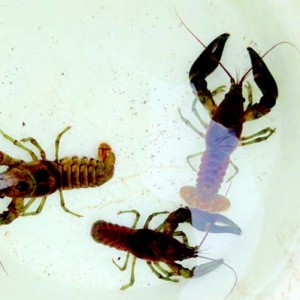
Stroud Water Research Center’s lead fluvial geomorphologist Melinda Daniels, and Lindsey Albertson, a postdoctoral researcher and ecology professor from Montana State University, conducted the study in Valley Creek, an urbanized and degraded tributary of the Schuylkill River, according to a Stroud press release.
The scientists placed wire-mesh enclosures, some with crayfish inside and some without, in the creek. At the conclusion of the two-week experiment, populations of macroinvertebrates such as caddisflies, which can indicate better water quality, were higher in the crayfish enclosures, despite being a food source for crayfish.
The crayfish enclosures also featured reduced settling of fine sediment pollution on the surface of the streambed. As the crayfish disturbed the rock and gravel bottom with their claws, they agitated and increased suspension of fine sediments, presumably allowing more sediments to flow downstream, the release said.
“We were surprised,” Albertson admitted in the release. “We thought the crayfish would eat the macroinvertebrates and reduce their populations, but we found the opposite. Macroinvertebrate density was higher in the crayfish enclosures. So even if the crayfish were eating some of the macroinvertebrates, we think that all of the fine sediment that had been suspended and washed away created a more macroinvertebrate-friendly habitat.”
Many macroinvertebrates don’t like to live in streams with high sediment loads. It’s a type of pollution that degrades freshwater streams and can be traced to land-use changes like agriculture and development.
“Crayfish show the potential to alleviate some of the problems seen in impaired streams,” Daniels said in the release. “Every organism has its part in an ecosystem, and we’re still learning what the individual roles are.”
The study, “Effects of Invasive Crayfish on Fine Sediment Accumulation, Gravel Movement, and Macroinvertebrate Communities,” was published “Freshwater Science” and can be accessed at http://www.journals.uchicago.edu/doi/abs/10.1086/685860. For more information on the Stroud Water Research Center in Avondale and its role in protecting drinking water, click here.