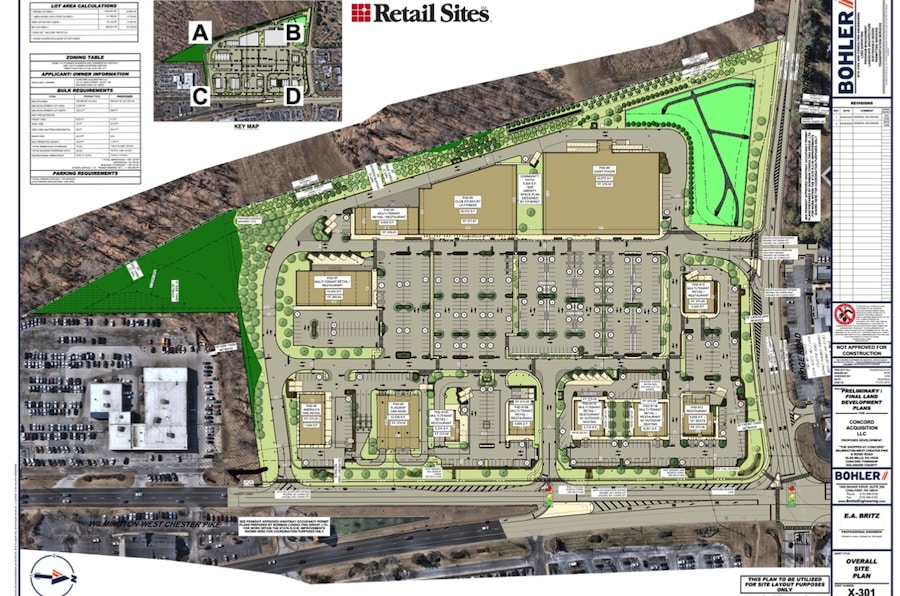


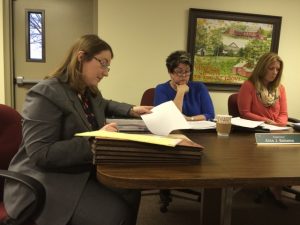
After nearly a half-hour of spirited discussion, the Pocopson Township Board of Supervisors voted unanimously at its meeting on Monday, April 25, to approve a preliminary land development plan for a daycare center in the Riverside at Chadds Ford subdivision.
At two previous meetings, the supervisors heard a host of concerns, mainly centered on parking and traffic, from residents of Riverside. The 10,000-square-foot center is planned to accommodate 128 children and 15 teachers and would be open five days a week from 7 a.m. to 6 p.m.
“Parking is a major issue,” said resident Anne Egger, echoing the comments of other residents. She also pointed out that traffic in the development is “already a nightmare” from 6:30 to 8:30 a.m.
Supervisor Alice Balsama said she wanted the residents to know that the decision to OK the plan was not taken lightly. Balsama said the supervisors went back to the township solicitor, engineer and planning commission. “We have taken their counsel,” she said. “We’ve spent considerable time on this.”
The supervisors imposed 19 conditions on the developer, the Riverside Daycare Partnership, which were read by township solicitor Amanda Sundquist. They included provisions such as adding a fence as a buffer for one neighbor, prohibiting parking on Riverside streets, adding a crosswalk at the proposed driveway, requiring a traffic circulation plan, and mandating off-site parking for special events.
Sean Rafferty, a longtime member of the Pocopson Township Planning Commission, suggested that the supervisors didn’t have much leeway. The daycare center was part of an agreement made by a previous board to settle a 2004 lawsuit.
Litigation is likely to resurface as plans for the Ducklings Early Learning Center on Winston Lane move forward. The Riverside Homeowners’ Association, through its attorneys, Adam G. Marcus and Robert Hoffman, have argued that the plan doesn’t meet the township’s zoning requirements and plan to challenge the legality of the approval.
The supervisors also heard concerns from residents that Denton Hollow Road would become a speedway again during the closure of the Route 926 bridge. A number of residents reported significant traffic woes when the Route 52 roundabout was under construction, and motorists used Denton Hollow as a detour. Resident Peggy Conaway asked whether a section of the road could be closed or made one-way during the construction.
At a recent meeting, PennDOT representatives said the Route 926 bridge project is scheduled to begin early in 2017, after at least 14 years of delays. If the project goes as planned, the construction will take a year, but detours will last only six months. Moreover, access to businesses in the area of the bridge, adjacent to Creek and Pocopson roads, will be kept open.
Supervisor Elaine DiMonte, the township’s PennDOT liaison, said she has learned that the township’s options are limited when it comes to redirecting traffic. She said she is reaching out to contiguous townships. “I think we have to have one voice [in communications with PennDOT],” she said, explaining that she fully understands residents’ fears.
“I want to do more research,” DiMonte said, promising to explore any remedy that is “within the law.” Rafferty and Conaway both offered to assist.
In his report, Public Works Director Mark Knightly said work was completed on the $50,000 project to stabilize the embankment on West Creek Road ahead of schedule. He also said the township sold a chipper for $16,000, which was twice the expected bid.
The supervisors said the Barnard House continues to be an ongoing topic of discussion. The historic building, once a stop on the Underground Railroad, was originally envisioned as the home of the Kennett Underground Railroad Center as well as the township’s offices; however, the building’s layout and renovation costs have derailed the municipal option for now.
The focus right now is on installing a security system – the last step needed to enable the KURC to occupy the building – and making a decision on replacing windows before a Keystone grant deadline expires.
Supervisor Alice Balsama said she studied the contract from the Protection Bureau and felt that although the overall price was attractive, some of the contract provisions were not favorable for the township. For example, if the township opted to terminate the five-year deal, it would need to pay 80 percent of the balance of the entire term. The supervisors agreed to have the township solicitor review the contract in hopes of renegotiating it.
Supervisors’ Chairman Ricki Stumpo, who had been researching cleaning services for the public bathroom in the Barnard House, said she learned that the township does not have that obligation. The contract with KURC states that it will maintain the shared public spaces.
Supervisor Elaine DiMonte said the board was waiting to hear back from the county solicitor and two members of the Chester County Planning Commission regarding options on the use of the Barnard House after a recent meeting with them. When the county sold the building to the township for $1 in 2008, it imposed a number of restrictions on its use.
DiMonte explained that the supervisors wanted information on the permitted uses before making a decision about the level of repair needed for the windows. “We’re up against the grant. We need to do something quickly,” she said. “I don’t want to throw that money away if we can use it for the windows.”
The supervisors agreed to contact the county, explain the urgency, and see if a decision could be expedited.
In other business, the supervisors all agreed to reinstate the Parks, Recreation and Trails Committee, recently disbanded due to apathy, because a group of residents expressed interest in serving on it. Tom Bierl will serve as chairman, and he will be joined by Flo Costello, Leah Zuo, Jesse Noa, Justin Colella and Matt Seindenberg.
Another unanimous vote involved the appointment of two representatives to serve on the Kennett Public Library Board of Trustees: Brad Peiper and Chris Larsen. The township has been without representation on the board for several years.